Listen through the publisher, then discuss the episode here or arrange an in-person Roundtable. Your city determines where to meet.
Roundtables are designed for groups of four, with a shared subject and room for everyone to speak. Come for discussion, with no dating expectation.
Merriam-Webster's Word of the Day for November 27, 2026 is: injunction • \in-JUNK-shun\ • noun An injunction is an order from a court of law that says something must be done or must not be done. // We requested an injunction with hopes of preserving the historic landmark. See the entry > (https://www.merriam-webster.com/dictionary/injunction) Examples: “… an Indiana Circuit Court judge in September granted him and a group of former college athletes a preliminary injunction that would allow an additional year of eligibility.” — Matt Murshel, The Orlando Sentinel, 19 Oct. 2026 Did you know? Injunction, injunction, what’s your function? When it first joined the English language in the 1400s, injunction referred to an authoritative command, and in the following century it developed a legal second sense applying specifically to a court order. Both of these meanings are still in use. Injunction ultimately comes from the Latin verb injungere (“to enjoin,” i.e., to issue an authoritative command or order), which in turn is based on jungere, meaning “to join”: it is joined as a jungere descendant by several words including junction (https://www.merriam-webster.com/dictionary/junction), conjunction (https://www.merriam-webster.com/dictionary/conjunction), enjoin (https://www.merriam-webster.com/dictionary/enjoin), and join (https://www.merriam-webster.com/dictionary/join).
Episode information is provided by the publisher. Listening takes place on the publisher’s service.
Three decisions from three appellate courts in the Court of Appeal edition of Thursday 26 November 2026, with the New South Wales, Victoria, Queensland and South Australia editions folded in. Personal material published online about a woman is reported as legal doctrine only. Pryor v Smallwood [2026] FCAFC 150 (https://jade.io/article/1308824) is covered in the Federal Courts brief. Criminal Law Desk (opening story). Gavin Brown (a pseudonym) v R [2026] NSWCCA 193 - an aggregate sentence requires an evaluation, even in very broad terms, of the objective criminality of each offence; the course of conduct goes to totality only; unexplained indicative sentences (ground 5, conceded); 'looms large' not an inflexible approach to general deterrence; material error test obiter; on re-sentence, moral culpability markedly reduced, special circumstances, a combined 50% discount (s 23(2) Crimes (Sentencing Procedure) Act 1999 (NSW)), parity. Leave granted; appeal allowed; re-sentenced (Ward P, Ham
Join NCI University today to master human behavior and influence: Uploaded 05-11-21 This is a dive to discover the possibilities, not the case itself. Sirhan Sirhan, in full Sirhan Bishara Sirhan, (born March 19, 1944, Jerusalem), Palestinian-born Jordanian citizen who was convicted (1969) of fatally shooting U.S. Sen. Robert F. Kennedy on June 5, 1968. He received the death penalty, but the sentence was later commuted to life. Sirhan, a Christian Palestinian, was born in Jerusalem. In 1948 Jordan took control of East Jerusalem and what is now the West Bank, and the following year it granted citizenship to people living in those areas. It is believed that this is how Sirhan became a Jordanian citizen. In the 1950s, he and his family moved to the United States and eventually settled in Pasadena, California. There he attended Pasadena City College and later held odd jobs, notably working at a horse stable and later at a health food store. During this time, Sirhan became vocal in his oppo
Twenty years. Multiple miscarriages. Seven rounds of IVF. A rare genetic disorder. A global pandemic. And then a miracle. In this deeply personal and moving conversation on The Unplanned Podcast, Sage and Tony Robbins open up about one of the most tender chapters of their life together, the long, humbling, and ultimately beautiful journey to becoming parents. Uploaded 08-04-26 Sage shares what it was like to carry the longing to be a mother across two decades, what changed when she finally surrendered that longing, and how, through an extraordinary act of love from a dear friend, their daughter arrived in the most unexpected and perfect way. Tony reflects on what it means to become a father again at 60+, why wisdom makes you a better parent, and the unique family they've built with three legal parents, all deeply devoted to their little girl. In this conversation: - Sage's 20-year journey through miscarriage, IVF, and a rare genetic disorder - How surrendering the dream opened the door
Walk into any industry today and you will see two groups of people. The first is busy building their brand. The second is busy building their skill. The first group is much more visible. The second is much more capable. And over time, only one of these groups builds a career that holds together. Uploaded 28-06-26 Here is the truth: the order matters. Skill comes first, brand comes second. Get the order wrong and you spend years building a reputation for things you cannot actually do — which collapses the first time someone examines what is behind the marketing. Get it right and the brand builds itself, slowly, from the actual capability that years of unglamorous work produced. Most ambitious adults are running the order backwards. They think the brand is the path to the opportunities, the opportunities are the path to the skill, and somehow it all works out. It does not. The opportunities, when they arrive, go to the people who can actually do the work — and the brand-first crowd is le
Imagine a friend telling you about something that has been bothering them. As you listen, you realize that if you were in their situation, with their experiences and circumstances, you might feel exactly the same way. Instead of telling them not to worry or trying to make them feel better immediately, you simply say: “You have every reason to feel the way you do.” Hello everyone, and welcome to Daily English. Today's expression is “have every reason to.” When we say someone has every reason to do or feel something, we mean that there are very good reasons for their feelings, beliefs, or actions. Given the circumstances, their response is completely understandable. Let's look at a few examples. Imagine a friend who has finally accomplished something after years of effort, setbacks, and moments of self-doubt. Yet they seem reluctant to celebrate their achievement. You could remind them: “You have every reason to be proud of yourself.” Or imagine someone who has been disappointed several
This is ANTARCTICA. And in 1985, it became the center of a global crisis… Directly over Antarctica, high up in the stratosphere was a massive hole. And if we hadn’t done anything about it, today, we’d be living in an alternate world. By now, a hole would be forming over the North Pole as well. By 2040, the “hole” would be over the entire planet. By 2065, skin cancer rates would be soaring. Kids wouldn’t play outside much anymore… But that’s NOT the world we’re living in! In fact, you’ve probably stopped hearing this story altogether. That wasn’t by accident. It was a choice. Two choices, both of which dramatically changed the course of human history for the better. So let me show you how that happened and what's about to happen next. Because it turns out, the little sliver at the bottom of the map is actually the center of everything/our whole planet. And you need to see this now, because scientists say we need to make the next big choice. Visit http://mercury.com (http://mercury.com/)
Merriam-Webster's Word of the Day for November 26, 2026 is: felicitous • \fih-LISS-uh-tus\ • adjective Felicitous is an adjective most often used in formal speech and writing to describe something that is very well expressed or suited for some purpose or situation. It can also be used as a synonym for pleasant or delightful. // She had not been asked ahead of time to speak at the event, but she managed some felicitous remarks nonetheless. // That the cousins happened to be on the same flight was a felicitous coincidence—they had no idea the other would even be traveling at that time. See the entry > (https://www.merriam-webster.com/dictionary/felicitous) Examples: “It’s a felicitous coincidence that the dance world pivots on the two seasons with action-verb monikers, fall and spring. The former is accompanied by swarms of students returning to classrooms and campuses, with the dance world snapping to attention in September.” — Andrew Gilbert, The East Bay (California) Times, 8 Sept. 20
Merriam-Webster's Word of the Day for November 25, 2026 is: arbiter • \AHR-buh-ter\ • noun An arbiter is a person with power to decide a dispute, or a person or agency whose judgment or opinion is considered authoritative. // The mayor will act as the final arbiter in any disputes between board members. // He is regarded as an arbiter of taste in the world of musical theater. See the entry > (https://www.merriam-webster.com/dictionary/arbiter) Examples: "Oscar documentary favorites are starting to emerge as critics and other arbiters begin to announce their nominees and shortlists, bringing some clarity to a wide-open awards race." — Matthew Carey, Deadline, 20 Oct. 2026 Did you know? There's no disputing the origins of arbiter: it traces back to a Latin noun, with the same spelling, referring to an eyewitness, onlooker, or person appointed to settle a dispute. Several English words having to do with judging or being a judge stem from the Latin arbiter, including arbitration (https://w
Merriam-Webster's Word of the Day for November 24, 2026 is: dubious • \DOO-bee-us\ • adjective Dubious describes a person who lacks a definite opinion or is doubtful about something; this sense of the word is usually used with about. Dubious can also describe something that causes doubt, uncertainty, or suspicion. In phrases like “dubious honor” and “dubious distinction” it functions ironically to describe something bad or undesirable as if it were an honor or achievement. // Despite having some late-season success, we were dubious about the likelihood of our team making the playoffs. // The miraculous revival of their company was achieved through dubious means. See the entry > (https://www.merriam-webster.com/dictionary/dubious) Examples: “In ‘The Music Man,’ ... River City, Iowa, comes alive in a whirl of brass, choreography, bright costumes and the bustling energy of a community discovering that maybe it has a little more music in it than anyone realized. ... At the center of it all
Individuals should control whether organizations share their personal information.
Share your view, then see how readers voted. No sign-in required. This poll is shared across stories.
Do you agree or disagree?
Common Quandary
A Common Quandary to discuss
Another conversation to explore, separate from this news story.
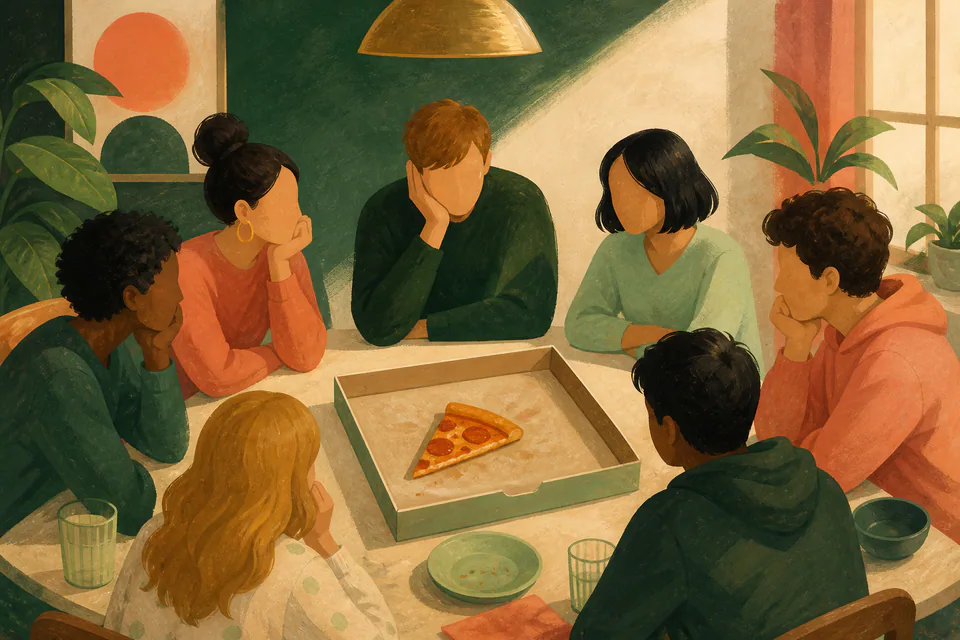
One slice of pizza remains and everyone is pretending not to want it. Can you take it?
Six friends have been circling the last slice of pizza for twenty minutes. Nobody claims it when you ask, yet two people keep glancing at the box. You are still hungry and paid the same share as everyone else.
Does politeness require leaving something that nobody will openly claim?