Listen through the publisher, then discuss the episode here or arrange an in-person Roundtable. Your city determines where to meet.
Roundtables are designed for groups of four, with a shared subject and room for everyone to speak. Come for discussion, with no dating expectation.
View full lesson: http://ed.ted.com/lessons/inside-the-minds-of-animals-bryan-b-rasmussen Uploaded 14-07-15 Do animals think? It’s a question that has intrigued scientists for thousands of years, inspiring them to come up with different methods and criteria to measure the intelligence of animals. Bryan B Rasmussen navigates through this controversial question, showing how determining intelligence often says more about how humans think than about anything else. Lesson by Bryan B Rasmussen, animation by Mike Schell.
Episode information is provided by the publisher. Listening takes place on the publisher’s service.
PBS Member Stations rely on viewers like you. To support your local station, go to: http://to.pbs.org/DonateSPACE ↓ More info below ↓ Uploaded 27-05-20 It’s been 120 years since Henry Cavendish measured the gravitational constant with a pair of lead balls suspended by a wire. The fundamental nature of gravity still eludes our best minds - but those secrets may be revealed by turning back to the Cavendish experiment. That steampunk contraption may even reveal the existence of extra dimensions of space. Sign Up on Patreon to get access to the Space Time Discord! Check out the Space Time Merch Store Sign up for the mailing list to get episode notifications and hear special announcements! Hosted by Matt O'Dowd Written by Katie McCormick and Matt O'Dowd Graphics by Leonardo Scholzer, Yago Ballarini, and Pedro Osinski Directed by: Andrew Kornhaber Camera Operator: Bahaar Gholipour Executive Producers: Eric Brown and Andrew Kornhaber End Credits Music by J.R.S. Schattenberg: https://www.youtu
We are living in a time of uncertainty – even a time of fear. But there is one thing that is never uncertain, one thing that can erase our fear once and for all: The RESILIENCE of humanity and our in-born power of FAITH. These are the beautiful, innate traits of being human. We are adaptable by our very nature. We find a way. And we always overcome. Uploaded 27-03-20 Life rarely gets easier. But uncertain times are a gift. They call us to become stronger and more resilient. They challenge us to quiet our minds and recognize the miracle of life within us. They encourage us to dig deeper. To examine our fears and draw on our faith to overcome them. This faith is not necessarily religious, although it can be. It is part of our true nature as humans. Faith allows us to drive in cars hurtling at 65 miles per hour and get on planes that fly through the sky even faster. It allows us to leave our homes each day believing that we will return. Faith is choosing to be certain in the face of uncer
Master the skills that change lives — enroll in your free human behavior course today: https://nci.university/learn Uploaded 14-03-26 During the first ninety seconds of any interaction, a window opens in the human brain that most people never notice. A specific sequence of neurological events unfolds — predictable, exploitable, and almost never taught outside of military and intelligence training. Very few people alive understand the full mechanics of what happens inside that window. Only operators, interrogators, and behavioral scientists with the right access have ever had this mapped out for them. Someone made sure it stayed that way. Every interaction you've ever had — every negotiation, every first impression, every moment you walked into a room — was governed by this sequence. You were either running it or it was being run on you. Most people spend their entire lives on the receiving end without ever knowing it. Language is the delivery system. But language isn't where it starts.
The Search for Glory | Jack Hopkins Full FightJack Hopkins guides you in reclaiming your masculinity in a feminine world and awakening the beast that lives inside you. Episodes created by entrepreneur and masculinity ace Jack Hopkins for his youtube channel, this podcast is dedicated to helping men rediscover their inner strength and confidence in a society that often promotes feminine values over masculine ones.Follow the podcast for valuable insights, inspiring stories, and practical advice on how to embrace your masculinity, build your confidence, and achieve your goals. Whether you're looking to improve your relationships, advance your entrepreneurial career, or simply feel more confident and capable, Jack has valuable insights that can help you achieve your goals.So, if you're ready to reclaim your masculinity and awaken the beast that lives inside you, follow the podcast & turn on notis Follow Jack Hopkins:Insta: @jackhopfitnessYT: @JackhopkinsCEODisclaimer: All content rights be
For all references and even deeper nuances, check out the StayCurious Metabolism letter: https://staycuriousmetabolism.substack.com/p/can-visceral-fat-cause-depression?r=40ekz2 Chapter *Call our service line at 815-STAY-CUR (815-782-9287) *Learn more about the data, here: https://staycuriousmetabolism.substack.com/p/life-or-death-in-the-fine-print-the?r=40ekz2 Visceral Fat Randomized Controlled Trial Video: https://youtu.be/lDeegZ1wtAI Description: Most people think of fat as extra weight—something cosmetic or something to “burn off.” But new science is showing something far more profound: visceral fat is an endocrine organ that sends biochemical messages across the entire body, including directly into the brain. And those messages can change mood, increase stress sensitivity, and even promote depression. In this video, we break down a brand-new study revealing how visceral fat releases tiny molecular packages called extracellular vesicles. Inside those vesicles is a specific microRNA—
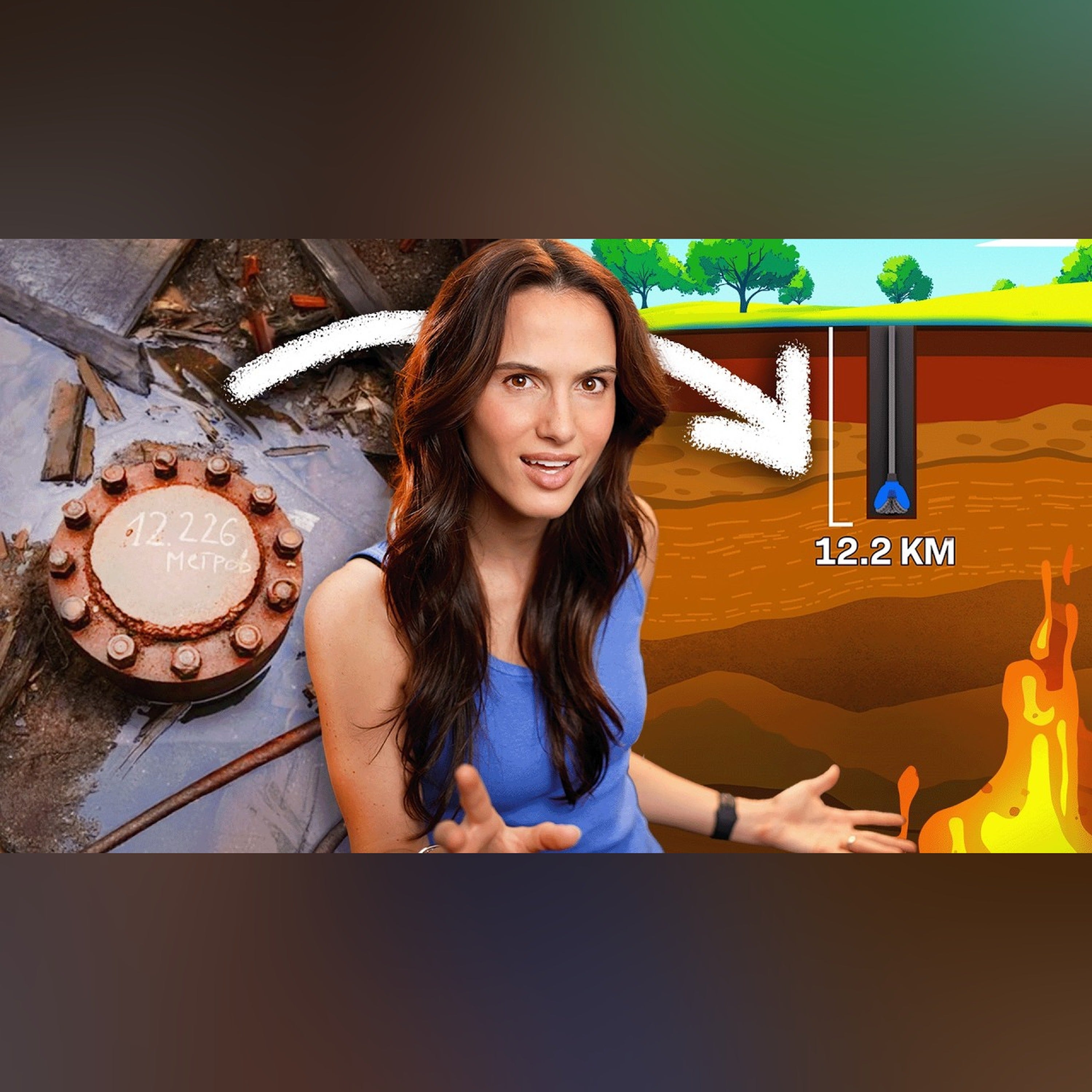
What's really down in the deep Earth? Have you ever thought, “what if I just dug a really really deep hole?” Well, the USSR actually did. The hole they dug is deeper than the deepest part of the ocean. It’s deeper than Mt. Everest is tall! They began digging it in the 1970s as part of a space race, but down. The United States only got to 600 ft before pulling funding. But the USSR kept going for 20 years. They made it about a third of the way through the Earth’s crust and then STOPPED. But what if… you just… kept... digging? If you dug a hole to the center of the Earth, what would you find? What would happen to you? And what does our newest tech tell us is REALLY down below your feet? In this video, we’re going on a journey to the center of the Earth… Chapters: 0:00 What if you dug a hole to Earth’s core? 1:05 What happens when I start digging? 1:36 What are the deepest made-made things? 2:25 What is the deepest hole humans ever dug? 3:03 What happens in the mantle? 3:45 Why is the Ear
Damon Horowitz reviews the enormous new powers that technology gives us: to know more -- and more about each other -- than ever before. Drawing the audience into a philosophical discussion, Horowitz invites us to pay new attention to the basic philosophy -- the ethical principles -- behind the burst of invention remaking our world. Where's the moral operating system that allows us to make sense of it? (Filmed at TEDxSiliconValley.) Uploaded 08-08-13 Talk by Damon Horowitz.
View full lesson: http://ed.ted.com/lessons/how-to-defeat-a-dragon-with-math-garth-sundem Having trouble remembering the order of operations? Let's raise the stakes a little bit. What if the future of your (theoretical) kingdom depended on it? Garth Sundem creates a world in which PEMDAS is the hero but only heroic when in the proper order. Lesson by Garth Sundem, animation by Mark Phillips.
View full lesson: http://ed.ted.com/lessons/the-secret-lives-of-baby-fish-amy-mcdermott Uploaded 11-08-14 Coral reef fish, like the yellow tang surgeonfish, begin life in a fascinating and weird way – as tiny floating larvae! These babies are capable of drifting thousands of miles on ocean currents, far from the reefs where they were born. Amy McDermott describes how these tiny trekkers travel across vast oceans, searching for the far-flung reefs they will one day call home. Lesson by Amy McDermott, animation by Reflective Films.
Essential community services should not depend mainly on unpaid volunteers.
Share your view, then see how readers voted. No sign-in required. This poll is shared across stories.
Do you agree or disagree?
Common Quandary
A Common Quandary to discuss
Another conversation to explore, separate from this news story.
The company allows an $80 dinner. Is ordering the lobster fair game?
During work travel, company policy permits an expensive dinner. A modest option is nearby, but colleagues choose the nicest restaurant because the company can easily afford it and everyone is within the stated limit.
Is following a rule enough when you are spending someone else's money?