Listen through the publisher, then discuss the episode here or arrange an in-person Roundtable. Your city determines where to meet.
Roundtables are designed for groups of four, with a shared subject and room for everyone to speak. Come for discussion, with no dating expectation.
When someone doubts our abilities, it can shake our confidence and make us question ourselves. But sometimes, being underestimated can motivate us to work harder and accomplish things others thought were impossible. Organizational scientist Samir Nurmohamed (https://mgmt.wharton.upenn.edu/profile/nurmo/) studies what he calls the "underdog effect." He explains why criticism and rejection can sometimes become powerful sources of motivation, and how we can harness this effect in our own lives. Then, on Your Questions Answered, social scientist Ben Rogers (https://www.bc.edu/bc-web/schools/carroll-school/faculty-research/faculty-directory/benjamin-rogers.html) returns to respond to listeners' comments about the stories we tell about our lives, and how these narratives shape our sense of meaning. How should we handle criticism that comes not from strangers and bosses, but from our own friends and family? And how can we offer feedback to friends and family in a way that motivates rather than demoralizes them? We explore these questions with Samir Nurmohamed in a conversation for Hidden Brain+ subscribers. That episode is titled “What Do They Know?” If you're not yet a subscriber, you can access that conversation with a free seven-day trial at support.hiddenbrain.org (https://www.patreon.com/HiddenBrain) or apple.co/hiddenbrain (https://podcasts.apple.com/us/podcast/hidden-brain/id1028908750?at=1010l3ab3&ct=hiddenbrain_podcasts&itscg=30200S&itsct=hiddenbrain_podcasts&ls=1). Hosted by Simplecast, an AdsWizz company.
Episode information is provided by the publisher. Listening takes place on the publisher’s service.
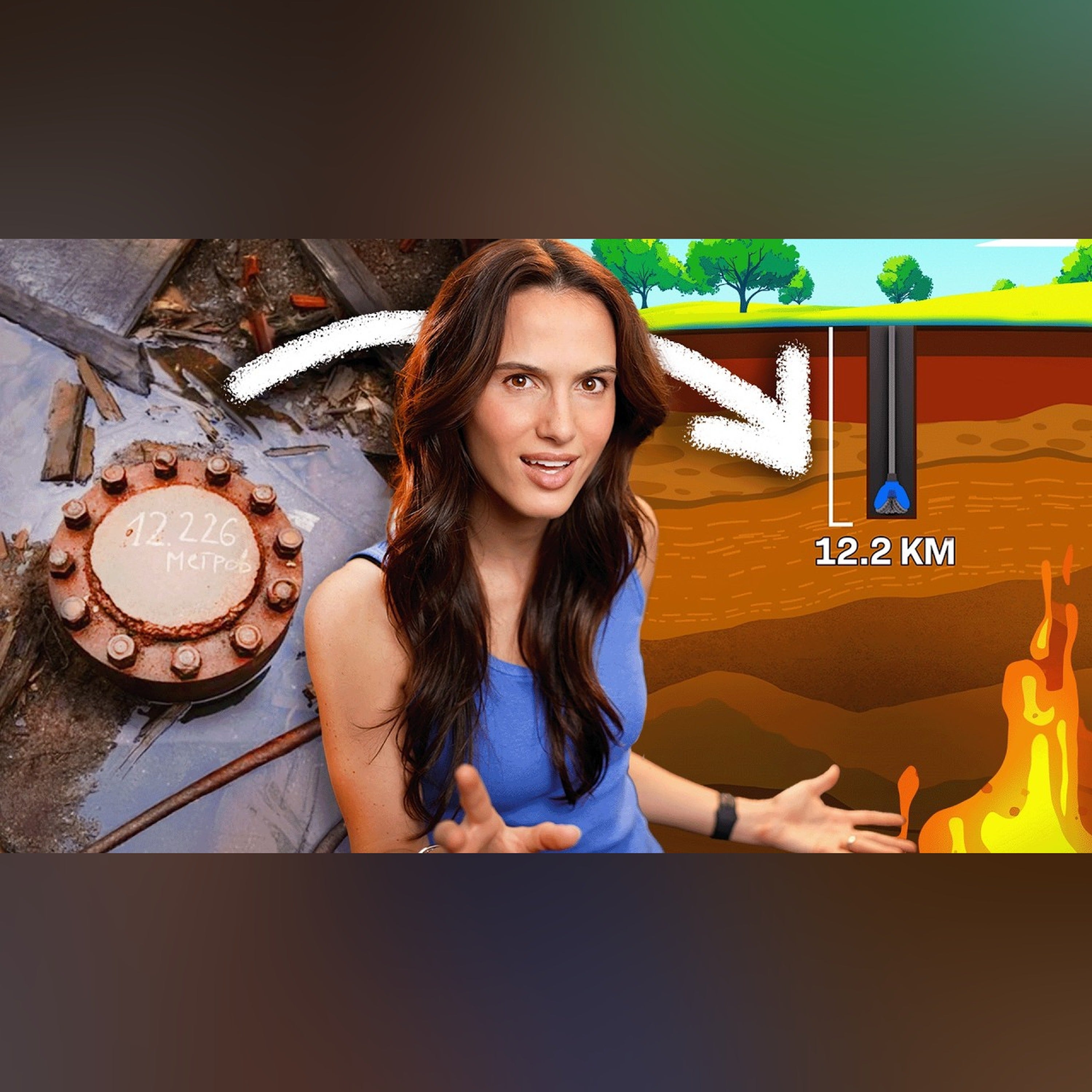
What's really down in the deep Earth? Have you ever thought, “what if I just dug a really really deep hole?” Well, the USSR actually did. The hole they dug is deeper than the deepest part of the ocean. It’s deeper than Mt. Everest is tall! They began digging it in the 1970s as part of a space race, but down. The United States only got to 600 ft before pulling funding. But the USSR kept going for 20 years. They made it about a third of the way through the Earth’s crust and then STOPPED. But what if… you just… kept... digging? If you dug a hole to the center of the Earth, what would you find? What would happen to you? And what does our newest tech tell us is REALLY down below your feet? In this video, we’re going on a journey to the center of the Earth… Chapters: 0:00 What if you dug a hole to Earth’s core? 1:05 What happens when I start digging? 1:36 What are the deepest made-made things? 2:25 What is the deepest hole humans ever dug? 3:03 What happens in the mantle? 3:45 Why is the Ear
Of all the things Nick Grime could have promised his ten-year-old son on Halloween, "your dreams will come true" might be the cruelest. Nick knows about the man in the castle. He knows Michael has spent hours in therapy trying to explain what happens there. He just never thought of those dreams when he tucked a handful of good fortunes into the barmbrack he was baking for his family. At 1:35 in the morning, Nick sits on the edge of Michael’s bed. His son is wide awake, staring at the ceiling. He knows something comes to the window at 1:36. He also knows that every time he dreams this part, he ends up looking, no matter how hard he tries to keep his eyes on the plaster. Nick puts an arm around him. For once, when the thing his son fears comes to the glass, his dad will be there. It hasn’t occurred to Nick to ask what happens to the parents in Michael’s dream. FEATURED STORY: "A Fine Barmbrack" by Seth Paul Performed by Otis Jiry Produced by Seth Paul Support Us and Listen Ad-Free (Becom
A kiss can be wonderful. It can create an instant connection, spark romance, or make you feel closer to someone. But a kiss can also have the opposite effect — and sometimes ruin everything. So what makes kissing so powerful, and why can one kiss make such a difference? There's some fascinating science behind it. https://www.scientificamerican.com/article/why-we-kiss/ We spend an enormous amount of time worrying about what's going to change. What's next? What's coming? How do we prepare? But what if we're paying attention to the wrong things? Some of the most important forces shaping our lives never change, and understanding them may be far more valuable than trying to predict the future — something humans are notoriously bad at. Morgan Housel, partner at The Collaborative Fund and author of Same as Ever: A Guide to What Never Changes (https://amzn.to/3SwWn6u) (https://amzn.to/3SwWn6u)), joins me to explain why the things that stay the same may be the most important things to understan
When a family moved into an apartment in New York, they had no idea just how much history the building held. Over the years, it had reportedly served several purposes, including a city hall and a jail. But they wouldn't learn those details until after some frightening experiences had already begun. On their very first night, the mother came running into her son's room, terrified by a man who had appeared in her bedroom. He hadn't simply frightened her. According to her account, he'd made it very clear that the family wasn't welcome. And things only became stranger from there. As the family settled in, they experienced unexplained sounds, unsettling physical encounters, and incidents that made them question what was actually moving around their home. Had something remained behind from the building's long history? And was it determined to make the new occupants leave? #RealGhostStoriesOnline #TrueGhostStories #HauntedApartments #HauntedJail #HistoricHauntings #NewYorkGhostStories #Parano
To learn to think like a scientist check out http://Brilliant.org/SpaceTime (http://brilliant.org/SpaceTime) Uploaded 20-12-18 PBS Member Stations rely on viewers like you. To support your local station, go to: http://to.pbs.org/DonateSPACE Check out the new Space Time Merch Store! Support Space Time on Patreon There’s this idea that beauty is a powerful guide to truth in the mathematics of physical theory. String theory is certainly beautiful in the eyes of many physicists. Beautiful enough to pursue even if it’s wrong? Tweet at us! @pbsspacetime Facebook: facebook.com/pbsspacetime Email us! pbsspacetime [at] gmail [dot] com Comment on Reddit: http://www.reddit.com/r/pbsspacetime Help translate our videos! Previous Episode: Quantum Physics in a Mirror Universe https://www.youtube.com/watch?v=UyTqgnKD3sw&t=5s (https://www.youtube.com/watch?t=5s&v=UyTqgnKD3sw) Hosted by Matt O'Dowd Written by Matt O'Dowd Graphics by Luke Maroldi Assistant Editing and Sound Design by Mike Petrow Made by
Fear has a way of quietly taking control of your life. It convinces you to stay where you are, avoid difficult conversations, delay decisions, tolerate situations you know aren’t good for you, and settle for a life that is far smaller than the one you are capable of living. In this episode of The Strong Life Project, we explore how fear impacts your thinking, your relationships, your career, your leadership, and ultimately your ability to live a meaningful life. Fear doesn’t always look like panic. Sometimes it looks like procrastination, overthinking, making excuses, people pleasing, avoiding conflict, or constantly waiting for the perfect moment. The problem is that every time you allow fear to make a decision for you, you reinforce the belief that you are incapable of handling what comes next. Over time, this creates a pattern of avoidance that undermines confidence, resilience, emotional strength, and personal growth. Learning to manage fear doesn’t mean becoming fearless. It means
Have you ever downplayed some aspect of your identity? Maybe you don’t hide it, but you don’t bring it up with certain people, either. It turns out that these subtle disguises can have powerful effects on how we view ourselves. This week, we bring you a favorite conversation with legal scholar Kenji Yoshino (https://its.law.nyu.edu/facultyprofiles/index.cfm?fuseaction=profile.overview&personid=22547). He introduces us to the concept of "covering," and talks about what happens when we soften or edit our true selves. Then, we revisit our "Your Questions Answered" segment in which Kenji answers listener questions and comments about his work. Another way that we hide who we are is by expressing views that we don't actually believe. In our latest YouTube video (https://www.youtube.com/watch?t=1s&v=iI3sfdYhGqY), we look at this phenomenon — known as preference falsification — and how it can affect our relationships. Check it out, and make sure to subscribe so you don't miss any of our future
Most of us have ideas about what we’re looking for in a romantic partner. But psychologist Paul Eastwick (https://psychology.ucdavis.edu/people/paul-eastwick) says these preferences are surprisingly poor guides for finding love. He explains why attraction is so difficult to predict, and what the research suggests is the best way to meet someone with whom you'll connect. Then, in a new installment of “Your Questions Answered,” psychologist Ed Lemay (https://psyc.umd.edu/facultyprofile/lemay/edward) responds to your questions about how we project our own thoughts and feelings onto other people, and how these projections shape our relationships. In our companion conversation for Hidden Brain+ subscribers, we talk with Paul Eastwick about online dating apps. He says apps can powerfully shape our experience of meeting potential romantic partners — often not for the better. If you're a subscriber, that episode is called “The Online Dating Trap.” If you're not yet a subscriber, you can listen
Access to effective legal representation should not depend mainly on personal wealth.
Share your view, then see how readers voted. No sign-in required. This poll is shared across stories.
Do you agree or disagree?
Common Quandary
A Common Quandary to discuss
Another conversation to explore, separate from this news story.
A coworker tells you their salary in confidence—and proves everyone else is underpaid. Do you share it?
A coworker privately tells you their salary and asks you not to repeat it. You later realize the figure is strong evidence that several equally experienced colleagues are being underpaid.
When does fairness outweigh a promise of confidentiality?