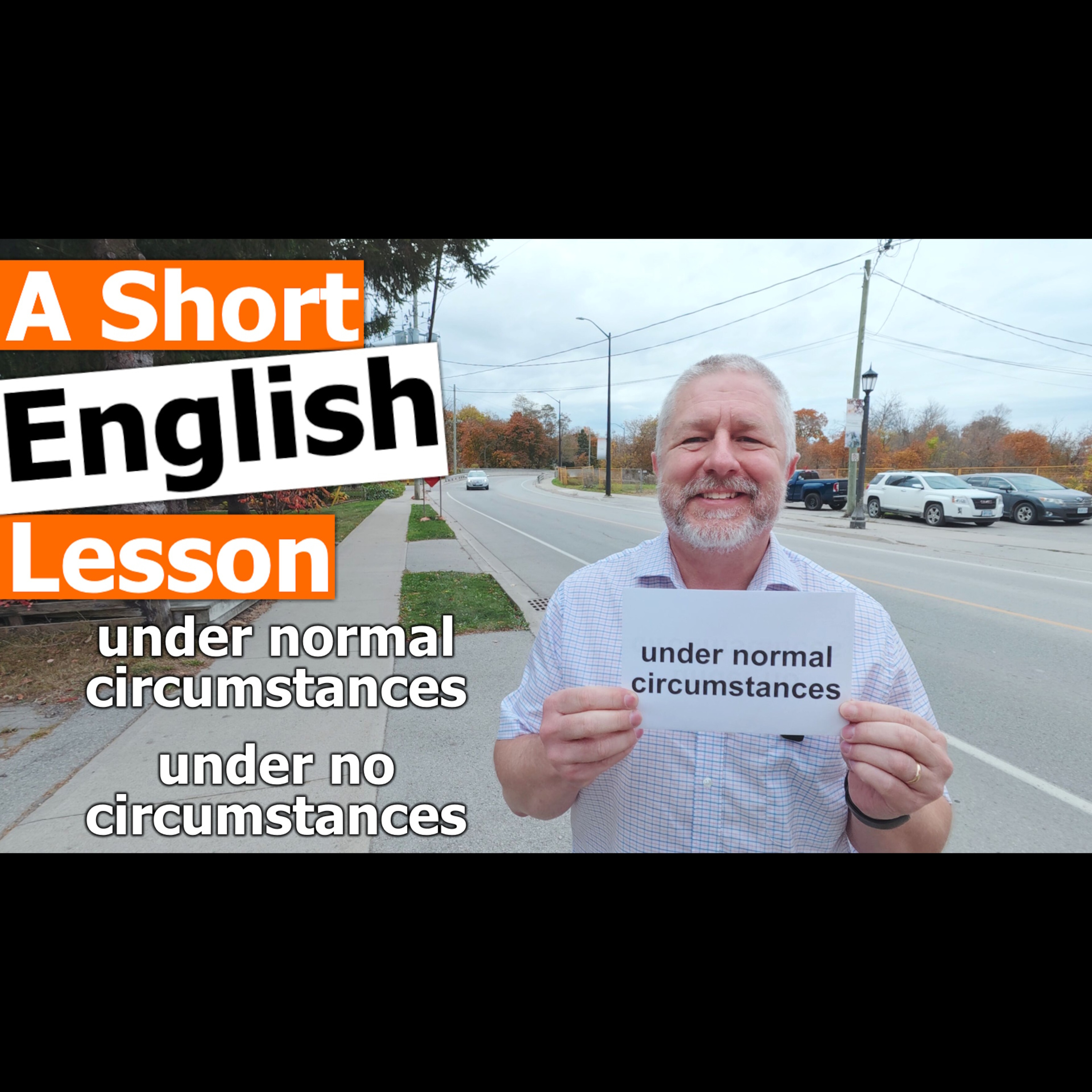
Learn the English Phrases "under normal circumstances" and "under no circumstances"
Listen through the publisher, then discuss the episode here or arrange an in-person Roundtable. Your city determines where to meet.
Roundtables are designed for groups of four, with a shared subject and room for everyone to speak. Come for discussion, with no dating expectation.
In this English lesson, I wanted to help you learn the English phrase "under normal circumstances." It's a pretty big word. We would call this a mouth a mouthful. Under normal circumstances. This simply means when things are normal, or when things are the way they normally are on that day. So here's a great example sentence: "Under normal circumstances, I'd be wearing a jacket today." In fact, under normal circumstances, on November 3rd. I would probably be wearing a winter coat. So under normal circumstances, the weather is much, much colder. I don't know what's happening here in Ontario, Canada. It has been super warm lately, and it just seems to keep on going. I'm appreciating it, but at the same time, I'm hoping that we don't have a sudden freeze. Like I hope we don't go from 20 degrees Celsius down to like minus 5 degrees Celsius within a day or two, but. Under normal circumstances, I would be wearing a jacket, maybe a winter coat, maybe even gloves. And then the other phrase I wanted to teach you today: "Under no circumstances." This simply means never. Under no circumstances, should students run in the hallway in a school. Under no circumstances, should someone drive 160 kilometers an hour in a 50 kilometer an hour zone. It simply means never, never. Under no circumstances means. There are no reasons to ever do those two things. So to review, under normal circumstances simply means when things are the way they normally are. I know I'm using normal to definea to define normal, but if things are normal, then you would say under normal circumstances. And under no circumstances simply means never. Under no circumstances should you should you skip watching this video. No, I mean that's a bad example, but hey. Let's look at a comment from a previous video. This comment is from Unsal. Thanks for another great lesson. Hearing you mention how gas prices are going through the roof made me won... made me wonder. In Canada, do salaries usually get adjusted to keep up with inflation? You're awesome. Have a great day. Bye. And my response: yes, salaries usually do, but hourly wage jobs don't always keep up. Having a job with a salary is usually a great benefit. So thanks, Unsal, for that comment. And let me explain the difference between salary and hourly wage. So I am a teacher, and so I am paid a salary. They tell me that I will get a certain amount of money to teach for a year. I don't get paid by the hour. I'm simply told your expectations are this: you need to be at work these days and these times, and we will pay you x amount of dollars. That's how we refer to an amount in English. We sometimes say x amount, x being the variable. But if you have an hourly wage job, you're paid $18 an hour or $27 an hour. I have a job where I'm paid a salary. Every year, they look at inflation and they usually give us a raise to match inflation or at least to get close to inflation. My son has a job where he has an hourly wage and he doesn't always have the same experience. So that's the difference between the two. What am I doing? I I'm I'm just shocked at how much green there is still. Everyone's lawns are still green and growing. We are having trees fall down. Oh, this is why I came this way to show you this. I think a year or two ago, maybe longer, there was a large feed mill there. There was a large building that was in the background and then it got torn down. And I just wanted to show you that nothing's happened there yet. It's just a vacant lot. I guess there's a couple faded Canadian flags over there. And I wonder what's happening. Maybe they're simply testing the soil for toxic waste or other things that shouldn't be there. And then eventually they'll build something there. Anyways, I'm Bob the Canadian. You probably know that already. Thanks for watching this little English lesson, and I'll see you next week with another one. Bye.
Episode information is provided by the publisher. Listening takes place on the publisher’s service.
Listen at the source ↗