Mixture of Experts: How Giant LLMs Get Smaller Without Being Smaller
33 min
Listen through the publisher, then discuss the episode here or arrange an in-person Roundtable. Your city determines where to meet.
Roundtables are designed for groups of four, with a shared subject and room for everyone to speak. Come for discussion, with no dating expectation.
Mixture of Experts is one of the cleverest tricks in modern inference, and it makes models smaller without actually making them smaller. This week we unpack how MoE models like DeepSeek V3 (671 billion parameters, only about 37 billion of them active for any given token) use a lightweight router to send each token to just a few "experts" in the feed-forward layers, why those experts often live on different machines, and how the idea traveled from a 1991 paper co-authored by Geoff Hinton, to a 2017 Google paper with Noam Shazeer and Jeff Dean, to standard practice today. Along the way: a delightful interpretability paper showing what feed-forward layers seem to "remember" from training.
Episode information is provided by the publisher. Listening takes place on the publisher’s service.
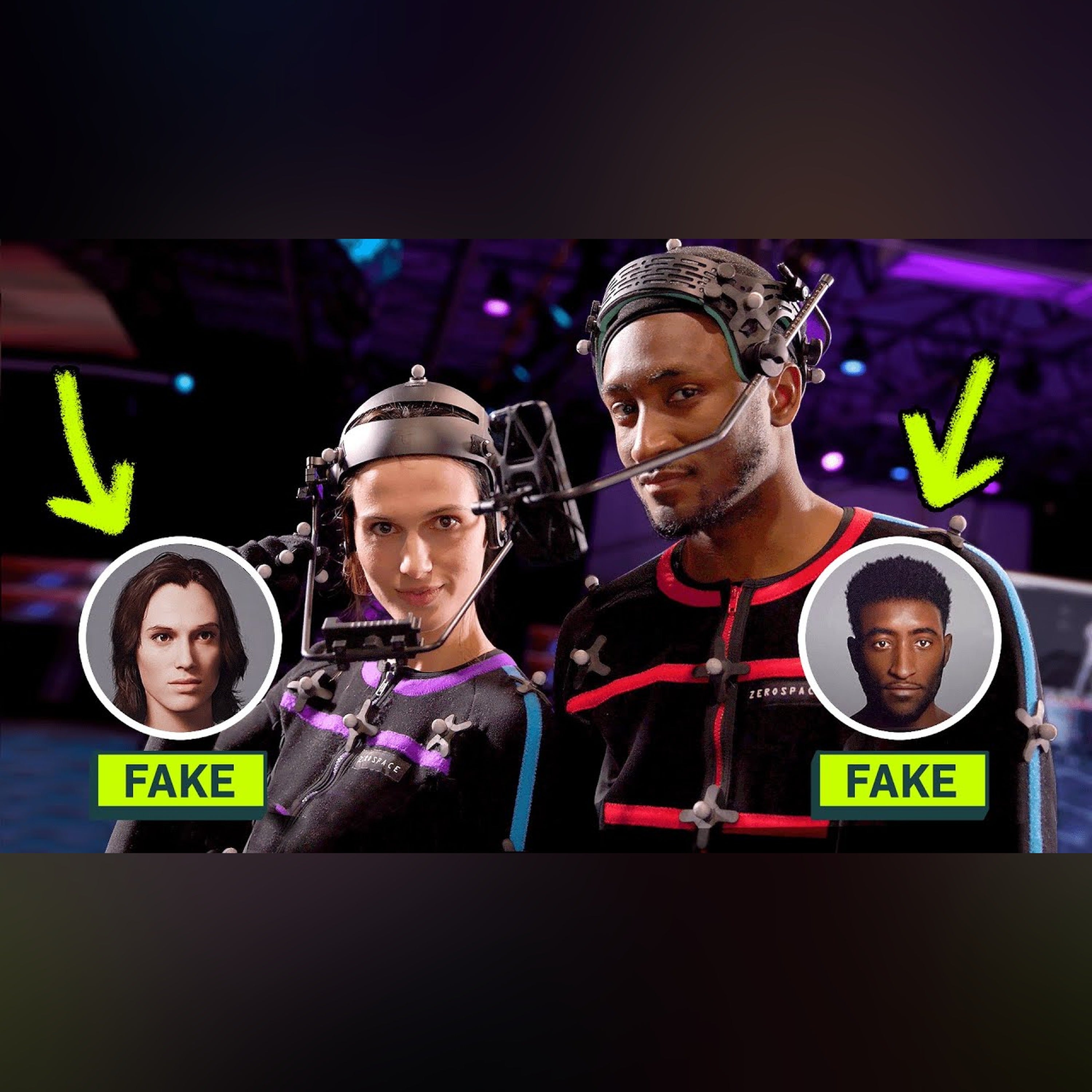
This new tech is changing how movies get made. So @mkbhd and I tested it out... Watch MKBHD's video: https://youtu.be/RM7SobH8ZO0 I’ve been obsessed with sci-fi movies since I was a kid. I love being transported to another world. But lately, I’ve been wondering: How do those worlds look so… REAL? The tech behind movies has exploded in complexity and realism, changing how stories come to life on screen. Luckily, at the same time, those tools are becoming more and more available to more people telling stories. It’s not just blockbusters like Avatar 2 or Avengers or Dune. It’s also smaller budget films like Everything Everywhere All at Once or even… YouTube creators? In this video, Marques Brownlee and I test out 3 movie-making tools that are changing how movies, shows, and maybe even YouTube videos (??) get made. We’re at ZeroSpace Studios in New York to show you how each of these crazy technologies work - and how you might be able to use them. Along the way, we hit big questions like: W
In This Episode: Annu Kapoor joins Shekhar Natarajan to share the life experiences, struggles and values that shaped his journey across Indian cinema, theatre, television and radio. 1. Annu Kapoor's early life and upbringing in a financially struggling family in Bhopal. 2. Growing up around his father's travelling folk theatre company and the challenges faced by performing artists. 3. Why his parents wanted their children to pursue more socially accepted professions. 4. His early struggles, including working at a tea stall, selling lottery tickets and running a firecracker shop. 5. The powerful lessons his parents taught him about honesty, passion and accepting life's uncertainties. 6. His family's history, cultural roots and the contrasting paths taken by different generations. 7. The influence of his mother in providing education and stability to the family. 8. Why he never resented his father's absence during his childhood and the respect he continues to have for his parents. 9. The
What if you could build an entire application over a weekend without writing a single line of code? It sounds like a software development breakthrough, but what happens when that application needs to scale, handle sensitive data, or support thousands of users? In this episode of techaily.ai, host David and resident expert Sofia explore the differences between vibe coding and agentic coding, examining how these two AI-assisted software development methodologies address fundamentally different engineering challenges. From natural language prompting and rapid prototyping to structured AI agent workflows, the conversation examines the risks of blindly accepting AI-generated code and the importance of maintaining architectural integrity, software security, and long-term maintainability. David and Sofia also discuss the limitations of large language models (LLMs), context windows, technical debt, and how specialized AI subagents can help manage complex enterprise codebases through task deleg
In this episode, I talked to Max Jaderberg, a former Google DeepMind research lead who helped develop AlphaFold 3 and is now president of Isomorphic Labs. He explains how his team uses AI to pick 20 or 50 molecules to test in the lab instead of screening hundreds of thousands, what it takes to turn a promising molecule into a medicine, and why so many drugs still fail in clinical trials even when the science looks right. He also walks me through a drug design agent that runs for days on its own, how to tell when an AI tool is actually ready for real work, and when AI-designed drugs could reach pharmacies. We talk about why Max hires AI engineers without a biology background, the interview question he uses to see how someone learns, and how he turns a big mission into goals his team can measure. He shares his personal AI stack, the part of his job he keeps human, and how to develop what he calls "research taste" so you can tell which problems are worth solving in the first place. Follow
Venice AI's Head of Strategy Jon and Head of Creative Lorenzo Frankel join David Hoffman for the November VVV community call to unpack Venice doubling its annualized revenue to $200M in just 99 days, the viral Nuremberg AI trailer, video generation driving 35%+ of revenue, the launch of Minds and two new VVV burn mechanisms, a record $458K discretionary burn, DIEM lending yields climbing from 2.5% to 9.1%, and the growing economy around tokenized AI inference. --- SPOTIFY PREMIUM RSS FEED | USE CODE: SPOTIFY24 TIMESTAMPS --- 0:00 Venice Hits $200M in Annualized Revenue 3:51 Nuremberg & the Rise of AI Filmmaking 11:56 Venice Minds & Creator Monetization 16:06 Discover & Viral AI Content 18:33 Two New VVV Burn Mechanisms 25:05 Record Monthly VVV Burn 33:14 The Rise of DIEM Inference Markets 37:59 DIEM Lending Yields & Growth Potential 42:40 DIEM Supply & VVV Staking Emissions 45:46 VVV as Collateral & Onchain Inference 52:00 What's Next for Venice? --- Not financial or tax advice. See ou
Hackaday Editors Elliot Williams and Al Williams met to review the week in Hackaday. It was a week for hands, in more ways than one, along with a voice assistant that ditches the cloud, a GPU for twenty cents, glasses that help the visually impaired see with LiDAR, and a virtual mechanical watch that shows you exactly how the real thing ticks. Beyond watch hands, you might like an eighteen-degrees-of-freedom robot hand for under $300 in parts. Or plant your own hands on a spinning wheel to make virtual honey feel sticky and virtual oil feel slippery in VR. For the Can't-Miss Articles, Elliot digs into the truth about hobbyist 3D scanning, photogrammetry versus structured light, and why the meshes you get are rarely the CAD models you wanted. Al, meanwhile, looks at how modern smartphones talk to satellites, bent pipes, flying cell towers, and all. Check out the links below to follow along, and as always, tell us what you think about this episode in the comments (https://hackaday.com/20
Staying relevant as a data scientist when AI is reshaping the field isn't just a career question — it's an existential one. Dr. Jon Krohn, neuroscientist-turned-data-science-educator, podcaster, and consultant, sits down to share how he thinks about navigating that challenge. From his unconventional path out of academia to the advice he gives practitioners trying to future-proof their careers, this conversation is packed with hard-won perspective. If you've ever wondered what it takes to keep growing in a field that won't stop moving, this one's for you. Links: Jon Krohn's website Y Carrot (Jon's AI consultancy) Katie on the Super Data Science Podcast, episode 1029 METR (source of the "task length doubles every seven months" charts Jon cited) Artificial Analysis (AI benchmarking site Jon cited) Serg Masís, "The Podcast Pipeline Nobody Sees: Behind the Scenes with AI Agents and AI gen" (Build Stuff) Search Engine podcast, "One man could slow down AI. He won't. Why?" --- Website: https:/
GPUs are the engines powering every AI conversation you've ever had — but what's actually happening inside those chips when an LLM generates a response? Understanding GPU fundamentals turns out to be surprisingly useful for making sense of why inference works the way it does, from the prefill stage that processes your entire prompt at once to the serial decode step that produces tokens one by one. If you want to understand the real constraints shaping modern AI systems, this is where to start.
The unsung hero of every LLM conversation you've ever had? A clever optimization called the KV cache. Self-attention is computationally brutal — every token attending to every other token means costs that scale as N², and that blowup gets worse with every turn of a conversation. The KV cache is what keeps that from becoming completely intractable at scale. Today's episode goes deep on how it works, why inference is a harder and more interesting problem than it gets credit for, and what's really happening under the hood when you chat with an LLM.
Extra learning support should avoid publicly labeling students as failures.
Share your view, then see how readers voted. No sign-in required. This poll is shared across stories.
Do you agree or disagree?
Common Quandary
A Common Quandary to discuss
Another conversation to explore, separate from this news story.
A pill can erase your most painful memory without changing anything else. Do you take it?
A safe new treatment can remove the emotional pain attached to one chosen memory while leaving the factual memory intact. Losing the pain might bring enormous relief, but the experience shaped your relationships, choices, and sense of who you are.
Are painful memories injuries to heal or parts of ourselves to keep?