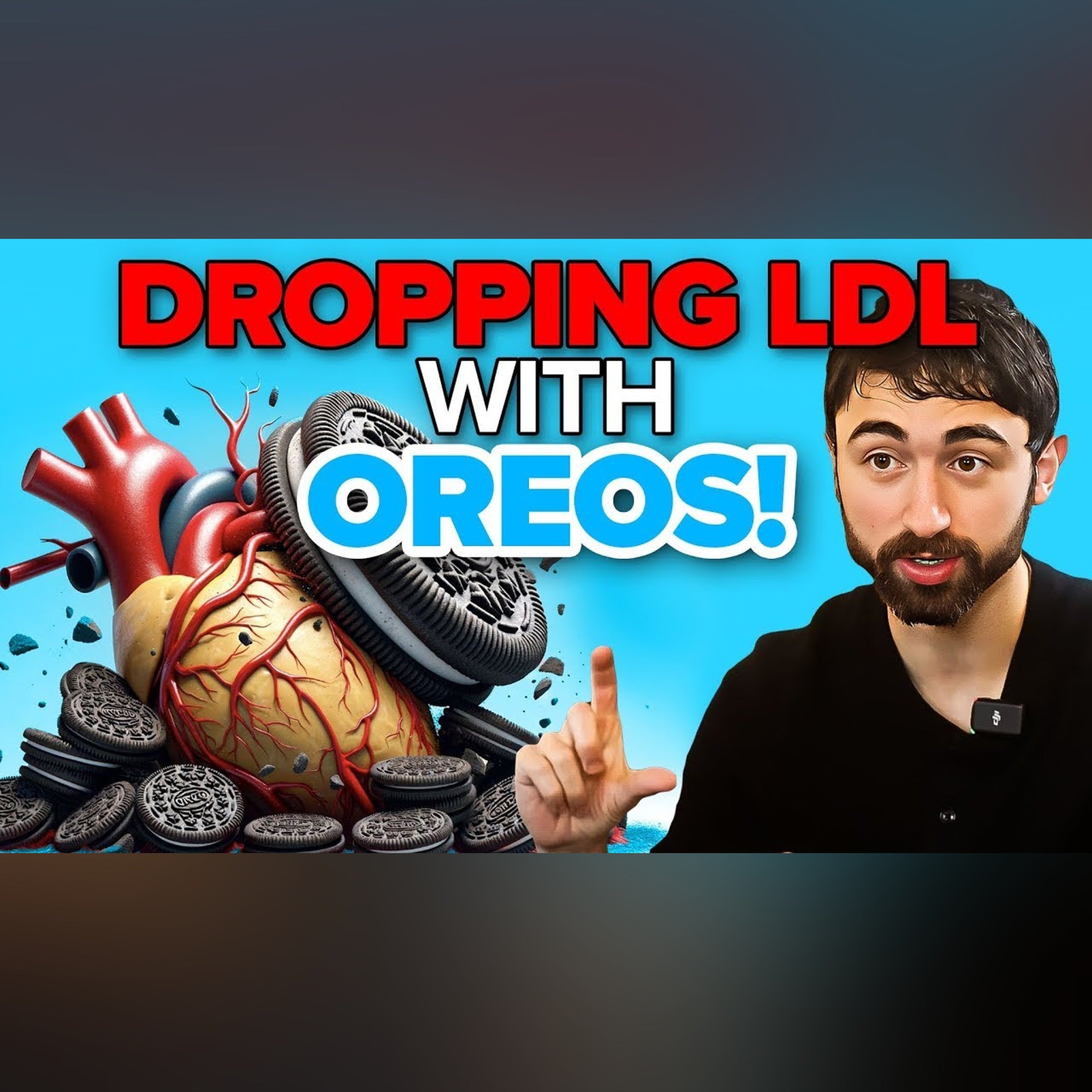
Oreos are the Most Potent Drug for LDL Cholesterol
Listen through the publisher, then discuss the episode here or arrange an in-person Roundtable. Your city determines where to meet.
Roundtables are designed for groups of four, with a shared subject and room for everyone to speak. Come for discussion, with no dating expectation.
Paper link: https://www.mdpi.com/2218-1989/14/1/73 Chapters 0:00 – Intro 0:28 – metabolic demonstration 0:43 – Part I, the idea 1:30 – LMHR triad 1:58 – Lipid Energy Model 3:06 – Part II, the experimental design 4:19 – Part III, results 6:00 – results summary 6:40 – Part IV, What’s Next? 7:37 – Thanks and Call to Action Aim: To tested the prediction -- consistent with the Lipid Energy Model (below) -- that adding carbohydrates (in the form of Oreo cookies) to an LMHR on a ketogenic diet would reduce LDL-C levels by a similar, or greater, magnitude than high-intensity statin therapy. Findings: Oreo supplementation (12 cookies/d) lowered LDL-C by 71% (273 mg/dl) in just 16 days. Rosuvastatin (20 mg/d) lowered LDL-C by 32.5% (137 mg/dl). Thus, Oreos were ~2X as potent as high-intensity statin therapy for LDL cholesterol lowering in this LMHR subject. The Why: The LMHR phenotype has much to teach us about human metabolism, and cardiovascular disease pathophysiology. It's a new frontier that deserves further study, for the sake of the patients with this phenotype and for pure scientific curiosity! This experiment will serve as 'productive provocation,' a form of 'legit-bait' that will hopefully help prompt discussions and larger-scale experiments that need to happen. 6 select Prior publications 1/ META of RCTs (new, 1/16/24) Sota-Mota A, Flores-Jurado Y, Norwitz NG, Feldman D, Pereira MA, Danaei G, Ludwig DS. Increased LDL cholesterol in adults with normal but not high body weight: a meta-analysis. Amer J of Clin Nutr. 2024; doi: 10.1016/j.ajcnut.2024.01.009 **LINK: https://www.sciencedirect.com/science/article/pii/S0002916524000091** VIDEO: https://youtu.be/FcUUqGJBXFM 2/ n = 10 lean healthy women Cooper ID, Sanchez-Pizarro C, Norwitz NG, Feldman D, Kyriakidou Y, Edwards Kurtis, Petagine L, Eliiot BT, Sota-Mota A. Thyroid markers and body composition predict LDL-cholesterol change in lean healthy women on a Ketogenic Diet: Experimental support for Lipid Energy Model. Frontiers in Endocrinology. 2023; doi: 10.3389/fendo.2023.1326768 LINK: https://www.frontiersin.org/articles/10.3389/fendo.2023.1326768/full VIDEO: https://youtu.be/OpOkeXVUotU?si=vHmfywr3CH27B2w5 3/ JCL editorial Norwitz NG, Mindrum M, Giral P, Kontush A, Soto-Mota A, Wood TR, D’Agostino DP, Manubolu VS, Budoff M, Krauss RM. Elevated LDL cholesterol among lean mass hyper-responders on low-carbohydrate diets deserve urgent clinical attention and further research. Journal of Clinical Lipidology. 2022; doi:10.1016/j.jacl.2022.10.010 Link: https://www.lipidjournal.com/article/S1933-2874(22)00295-1/fulltext 4/ Lipid Energy Model Norwitz NG, Soto-Mota A, Kaplan R, Ludwig DS, Budoff M, Kontush A, Feldman D. The Lipid Energy Model: reimagining lipoprotein function in the context of carbohydrate-restricted diets. Metabolites. 2022; doi: 10.3390/metabo12050460 Link: https://pubmed.ncbi.nlm.nih.gov/35629964/ Video: https://youtu.be/AkzxESsTJyM?si=A8lfhLXp_U1wPRdx 5/ LMHR, first paper Norwitz NG, Feldman D, Soto-Mota A, Kalayjian T, Ludwig DS. Elevated LDL-cholesterol with a carbohydrate-restricted diet: evidence for a “lean mass hyper-responder” phenotype. Current Developments in Nutrition. 2022; doi: 10.1093/cdn/nzab144 Link: https://cdn.nutrition.org/article/S2475-2991(22)00007-5/fulltext 6/ Low Sat Fat LMHR case report Norwitz NG, Soto-Mota A, Feldman D, Parpos S, Budoff M. Case report: hypercholesterolemia “lean mass hyper-responder” phenotype presents in the context of a low saturated fat carbohydrate restricted diet. Frontiers in Endocrinology. 2022; doi: 10.3389/fendo.2022.830325 Link: https://www.ncbi.nlm.nih.gov/pmc/articles/PMC9048595/ Video: https://youtu.be/JSEqIsYBZxU?si=lJ0_dnDYlDzvNyjt
Episode information is provided by the publisher. Listening takes place on the publisher’s service.
Listen at the source ↗