PAPod 624 - Engage Like a Pro: Improv Techniques to Transform Safety Culture
29 min
Listen through the publisher, then discuss the episode here or arrange an in-person Roundtable. Your city determines where to meet.
Roundtables are designed for groups of four, with a shared subject and room for everyone to speak. Come for discussion, with no dating expectation.
Todd interviews Matthew Sexton about practicing "engaged presence"—an improv-based approach that trains leaders to listen and connect using simple exercises (like a moving ball) to build cognitive, physical, and emotional engagement. The episode explains how engagement is a learnable skill, shows quick entry-level practices, and highlights why deliberate, repeated practice improves communication and safety at work.
Episode information is provided by the publisher. Listening takes place on the publisher’s service.
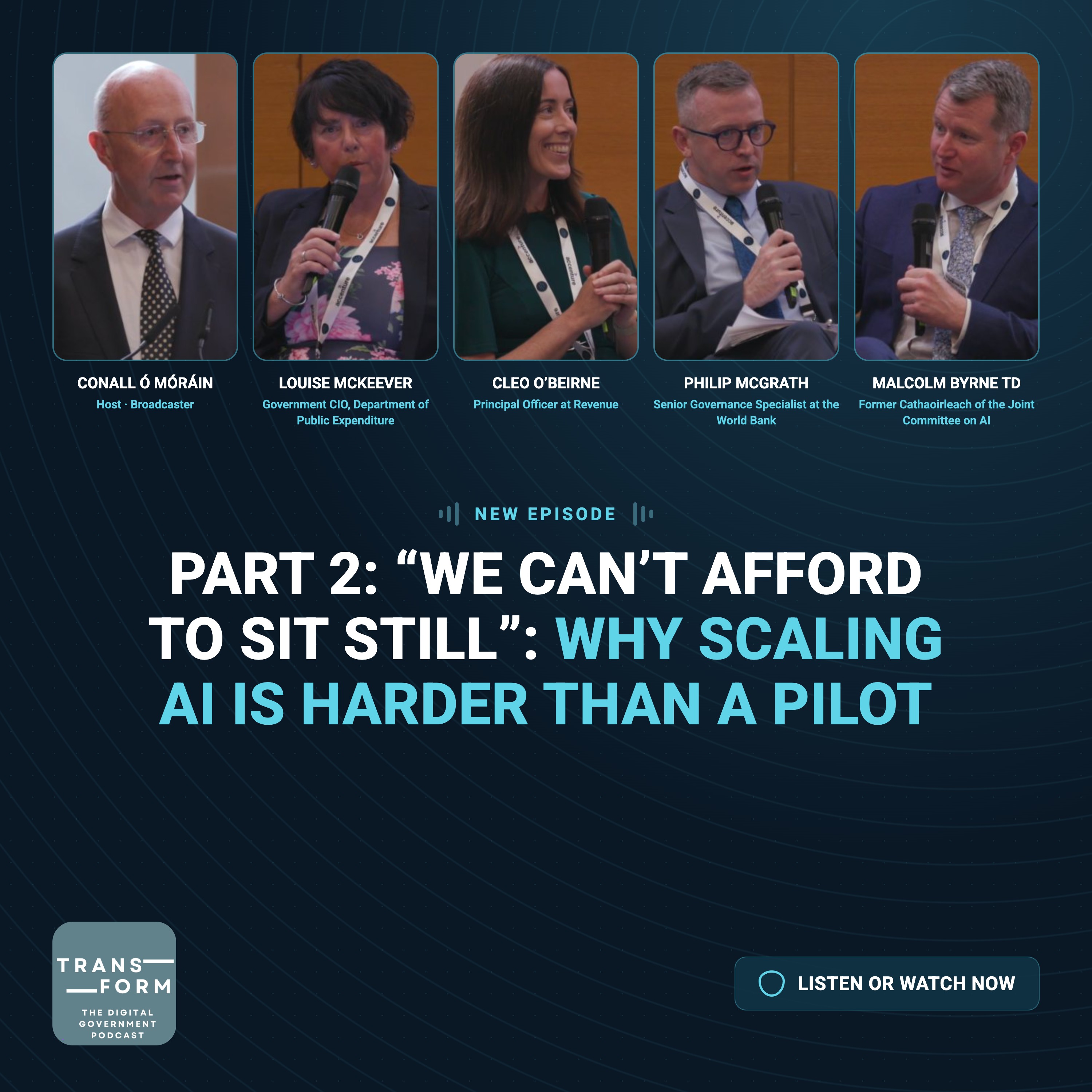
The pilot worked. Now what? In Part 2 of this panel discussion, four leaders explain how they're taking AI from pilot to scale, and what it takes to get data and governance right. This panel discussion took place at the Ireland eGovernment Awards and Leadership Summit 2026 on 24 September 2026 at UCD's O'Reilly Hall. We bring together Louise McKeever, Government CIO; Cleo O'Beirne, Principal Officer at Revenue; Philip McGrath, Senior Governance Specialist at the World Bank; and Malcolm Byrne TD, former Cathaoirleach of the Joint Committee on AI. The panel is chaired by Conall Ó Móráin. If you're taking AI beyond the pilot, here's what to do: Start small, prove it, then scale. Revenue tested agentic AI on a small application first, stage by stage. Redesign the whole process, not one stage. Individual productivity gains only go so far. Plan for lost knowledge, and recovered knowledge. As AI scales, people may know less, but AI can also capture knowledge that has already been lost. Reuse
Training Wednesday is back, and Aaron, Trent, and Peaches spend the live answering Air Force Special Warfare candidate questions — but first, there is an update from the current SWAS class. According to the numbers discussed on the live, 78 candidates failed the initial IFT and 52 still failed the refire. The guys try to understand how that happens after months of development and preparation, discuss reports that some candidates struggled with the swim and high-volume masks, and once again return to the same message they keep giving candidates: you need to arrive ready. From there, the live turns into a full candidate-training clinic. The guys talk about periodizing strength and endurance work, building Zone 2 capacity, gradually increasing mileage, why running with a weighted vest is probably not solving the problem you think it is, preparing for A&S, training with the equipment you will actually use, and why the goal is not simply to pass a minimum standard. They also answer question
The District of Columbia Circuit hears a dispute over the planned transfer of transgender women from women's federal facilities to men's facilities. In January 2025, a new executive order directed that people the administration classifies as male not be housed in women's prisons. The Bureau of Prisons moved to apply that policy to transgender women it had previously placed in women's facilities. The plaintiffs say the transfers would expose them to serious violence and severe psychological harm. Their suit invokes the Eighth Amendment's ban on cruel and unusual punishment. A district judge blocked their transfers. An earlier appeal required the judge to examine each plaintiff's circumstances, and the judge then issued a new preliminary injunction. The temporary orders protect the named plaintiffs during litigation, rather than finally deciding the policy's lawfulness. The government will argue that a no-exceptions rule based on biological sex is constitutionally reasonable, and that se
RNIB Connect Radio’s Toby Davey is joined again by Vidar Hjardeng MBE, Inclusion and Diversity Consultant for ITV News across England, Wales, Northern Ireland and the Channel Islands for another audio described theatre review. This time we have the spectacular Regent’s Park Open Air Theatre production of Andrew Lloyd Webber’s multi award-winning musical ‘Cats’ as the UK and Ireland tour visited the Birmingham Hippodrome with description by Professional Audio Describer Jonathan Nash. About ‘Cats’ From Euston station to Victoria Grove, the strays and rebels of London gather under the Jellicle moon in the hope they’ll be the chosen one. And each of them asks, because each of them dares, who will it be? Based on T.S. Eliot’s Old Possum’s Book of Practical Cats, and with a legendary score which inspired generations featuring Old Deuteronomy, Macavity: The Mystery Cat, Jellicle Ball and the chart-topping hit Memory, this brand-new production of CATS, directed and choreographed by Drew McOnie
As we watch tyrants flex at APEC, it has become increasingly vital for PM Mark Carney to turn the Middle Powers strategy into a bold, proactive initiative. We cannot afford to be merely reactive in the face of the dangerous far-right movements surging across the globe. In Canada, this urgency is underscored by the Conservative Party's alarming shift too far to the right. With rumours swirling that Pierre Poilievre's tenure as leader may be coming to an end, it’s time to ask ourselves: who can step in and steer the party—and the country—toward a more inclusive, democratic vision? We need leaders who are committed to protecting global democracy, and we cannot wait until it’s too late. Join us for an insightful strategy session with former Winnipeg Mayor and Ontario Cabinet Minister Glen Murray, hosted by Laura Babcock. Together, we will explore effective strategies to counteract far-right extremism and ensure that global threats, like Putin’s aggression in Europe, are met with steadfast
How does a status-sensitive China approach international order—the hierarchical institutional and/or normative orders that can either elevate or demote its positions? Conventional wisdom often accredits rising powers’ strategies to their treatment by established powers, whose (mis)recognition can swing these status-seekers between cooperation or revisionism. However, this simple dynamic between destabilizing rising powers and their superior status-quo-defenders risks truncating a status hierarchy—the vertical ordering of super- and subordination. This project thus theorizes the dynamic of multiple-audience status-seeking to comprehensively capture the diverse sources and consequences of China’s status (dis)satisfaction. Navigating recognitiongranting great powers and deference-paying smaller powers, China chooses its international order strategy according to four status scenarios with distinct socio-psychological and social forces: (1) cooperation vis-à-vis status satisfaction (high re
Todd Conklin hosts a candid conversation about mental health, substance abuse, and suicide in construction and mining, featuring peers who lead workplace support programs. They discuss startling statistics, the stigma that prevents help, and real peer-based solutions like the MATES and Brassfield-Gore programs. The episode highlights practical steps employers can take: empower peers, provide resources, normalize conversations, and treat these issues as a workplace responsibility to save lives and improve safety.
Companies should explain underlying business problems when reporting financial results.
Share your view, then see how readers voted. No sign-in required. This poll is shared across stories.
Do you agree or disagree?
Common Quandary
A Common Quandary to discuss
Another conversation to explore, separate from this news story.
The company allows an $80 dinner. Is ordering the lobster fair game?
During work travel, company policy permits an expensive dinner. A modest option is nearby, but colleagues choose the nicest restaurant because the company can easily afford it and everyone is within the stated limit.
Is following a rule enough when you are spending someone else's money?