Princeton Mathematician: Wormholes Can’t Survive Einstein’s Math
57 min
Listen through the publisher, then discuss the episode here or arrange an in-person Roundtable. Your city determines where to meet.
Roundtables are designed for groups of four, with a shared subject and room for everyone to speak. Come for discussion, with no dating expectation.
A Princeton mathematician says wormholes cannot survive Einstein's equations, and the AI apocalypse is absurd. A solution that vanishes under a small nudge is a ghost, not physics. Sergiu Klainerman is a mathematician at Princeton University. With Demetrios Christodoulou, he proved that empty spacetime is stable. We cover: What makes a solution of Einstein's equations physical, why slowly rotating black holes pass the stability test and wormholes fail it, why shocks form no matter how small the perturbation, whether AI can reproduce a landmark proof, and why he calls the AI singularity absurd. Mathematics is discovered, not invented. CHAPTERS 00:00 Are wormholes real? 08:38 What happens at an event horizon 12:06 God does not know about coordinates 17:32 What Maldacena would say about wormholes 21:48 Why extremal black holes matter 28:56 Einstein and the 1919 eclipse 33:52 Terry Tao and Fermat's Last Theorem 43:04 Can universities be reformed? 48:16 What to tell a 19-year-old 50:48 Kip Thorne and the movies Message: https://briankeating.com/yt Have a .edu email and live in the USA? Follow on Spotify: https://spoti.fi/3vpfXok Apple Podcasts: https://apple.co/39UaHlB Support Into the Impossible on Patreon: https://www.patreon.com/drbriankeating Join this channel for perks, monthly Office Hours and your name in the Member Roster: https://www.youtube.com/channel/UCmXH_moPhfkqCk6S3b9RWuw/join My three books: Losing the Nobel Prize http://amzn.to/2sa5UpA (http://amzn.to/2sa5UpA%C2%A0) Think Like a Nobel Prize Winner https://a.co/d/03ezQFu (https://a.co/d/03ezQFu%C2%A0) Focus Like a Nobel Prize Winner https://a.co/d/hi50U9U Amazon affiliate disclosure: links above marked to Amazon may earn a commission for the channel at no cost to you. As an Amazon Associate I earn from qualifying purchases. X: https://x.com/BrianKeating Blog: https://briankeating.com/blog Audio-only: https://briankeating.com/podcast #blackhole #generalrelativity #wormhole #Einstein #briankeating #intotheimpossible
Episode information is provided by the publisher. Listening takes place on the publisher’s service.
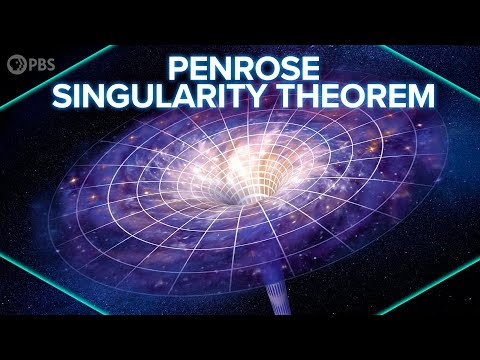
PBS Member Stations rely on viewers like you. To support your local station, go to: http://to.pbs.org/DonateSPACE ↓ More info below ↓ Uploaded 27-10-20 The Nobel prize in physics this year went to black holes. Generally speaking. Specifically, it was shared by the astronomers who revealed to us the Milky Way’s central black hole and by Roger Penrose, who proved that in general relativity, every black hole contains a place of infinite gravity - a singularity. But the true impact of Penrose’s singularity theorem would is much deeper - it leads us to the limits Einstein’s great theory and to the origin of the universe. Sign Up on Patreon to get access to the Space Time Discord! Check out the Space Time Merch Store Sign up for the mailing list to get episode notifications and hear special announcements! Hosted by Matt O'Dowd Written by Matt O'Dowd Graphics by Leonardo Scholzer, Yago Ballarini, and Pedro Osinski Directed by: Andrew Kornhaber Camera Operator: Setare Gholipour Executive Produ
Scientists are rethinking how particles behave when moving at extreme speeds through matter. New research into quark-gluon plasma, the exotic fluid that existed moments after the Big Bang, reveals unexpected patterns in particle motion that challenge traditional physical models. The findings could offer a powerful new way to investigate the properties of the universe’s earliest matter. This episode includes AI-generated content.
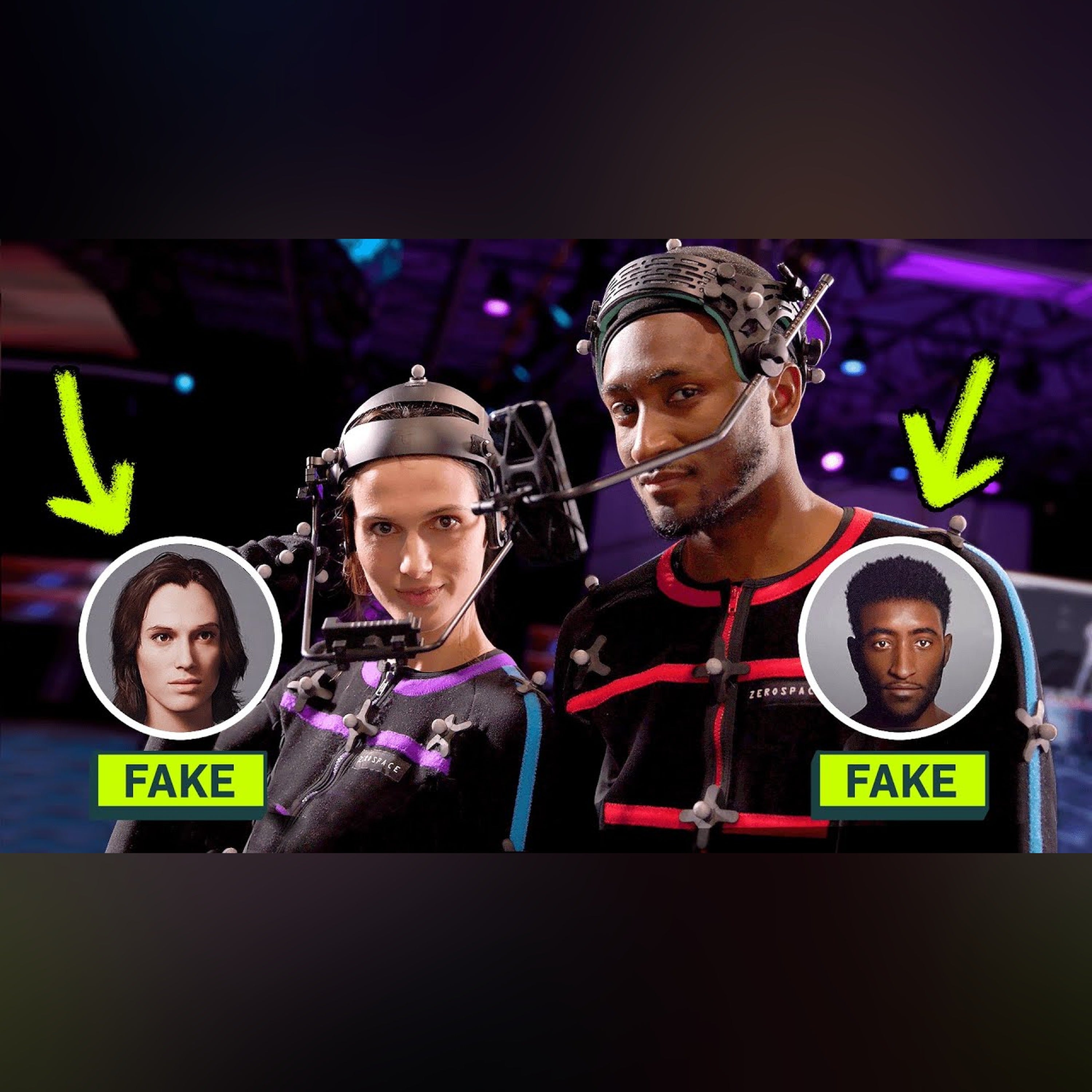
This new tech is changing how movies get made. So @mkbhd and I tested it out... Watch MKBHD's video: https://youtu.be/RM7SobH8ZO0 I’ve been obsessed with sci-fi movies since I was a kid. I love being transported to another world. But lately, I’ve been wondering: How do those worlds look so… REAL? The tech behind movies has exploded in complexity and realism, changing how stories come to life on screen. Luckily, at the same time, those tools are becoming more and more available to more people telling stories. It’s not just blockbusters like Avatar 2 or Avengers or Dune. It’s also smaller budget films like Everything Everywhere All at Once or even… YouTube creators? In this video, Marques Brownlee and I test out 3 movie-making tools that are changing how movies, shows, and maybe even YouTube videos (??) get made. We’re at ZeroSpace Studios in New York to show you how each of these crazy technologies work - and how you might be able to use them. Along the way, we hit big questions like: W
When he was ten years old, a boy made an unusual new friend. She was about his age, had a name, a personality, and stories about her family. For nearly a year, she would appear at his house to play, and during a particularly difficult time in his childhood, she seemed determined to protect him. But there was something different about this little girl. Nobody else appeared to see her, and there were strange limitations on where she could go. Eventually, she told him she had to leave, but promised she would always try to look out for him. As he grew older, he began questioning whether she'd ever existed outside his imagination. Then, more than a decade later, something extraordinary happened that made him reconsider everything he thought he knew about his childhood friend. Could a friendship continue beyond death? And if spirits really exist, do they remain forever the age they were when they died? #RealGhostStoriesOnline #TrueGhostStories #GhostlyFriend #ChildhoodGhosts #ImaginaryFriend
Are we in an AI stock bubble, or are investors betting on a genuinely bigger economy? Justin Wolfers examines AI stock valuations with Stacey Vanek Smith, separating what the technology could do for the economy from what investors might actually earn. A deliberately hypothetical valuation exercise shows why a trillion-dollar company isn't automatically absurd—but a breakthrough for society doesn't guarantee profits for shareholders. Competition can give you powerful tools at low prices while squeezing the companies selling them. The Thanksgiving turkey problem illustrates why a long run of good news can hide rare, severe risks. Justin connects that analogy to fat tails and the peso problem, then explains why spotting a bubble and successfully betting against it are different challenges. He also unpacks what the CAPE ratio can—and can't—tell you about whether stocks are overpriced. The stakes are your savings, not just Wall Street's scoreboard: Justin discusses an S&P 500 decline of 7.5
Dig into the monetary value of the Sun and how important it is as our energy source as Daedalus contemplates buying it. -- Daedalus hasn’t been the same since losing Icarus. Suddenly, he begins expressing interest in buying the Sun from Helios. Rumors say Daedalus is aspiring to destroy it to avenge Icarus — or channel its immense power towards other imprudent aims. He summons a divine accountant and asks: how much would it cost to buy the Sun? Cella Wright conducts a financial analysis of our star’s worth. Lesson by Cella Wright, directed by Igor Ćorić, Artrake Studio. This video made possible in collaboration with Speed & Scale Learn more about how TED-Ed partnerships work: https://bit.ly/TEDEdPartner A special thanks to Galen Barbose who provided information and insights for the development of this video. Support Our Non-Profit Mission ---------------------------------------------- Support us on Patreon: http://bit.ly/TEDEdPatreon Check out our merch: http://bit.ly/TEDEDShop -------
A Fields Medalist says AI can now do every basic PhD problem in hours or days. The question is no longer whether machines can prove theorems. It is who will still understand them. Alessio Figalli won the 2018 Fields Medal and is a professor at ETH Zurich. He is one of 25 Fields Medalists who signed the declaration on AI and mathematics. We cover: why Jim Simons got stuck in dimension 8, how a minimal-surface technique cracked the melting-ice problem, what happens when 10,000 AI agents race human mathematicians, and what OpenAI's Yang-Mills proof does and does not tell us. A proof nobody understands can be worse than no proof. Recorded in late October 2026, two days after OpenAI's Yang-Mills announcement. 00:00 Why 10,000 AI agents worry a Fields Medalist 00:57 Jim Simons asks for a $100,000 check 02:43 Why minimal surfaces break in dimension 8 08:42 Why not stop at dimension 3? 12:12 Counterexample people vs theorem people 13:15 How minimal surfaces cracked melting ice 20:23 Why meltin
Most UAP probably aren’t alien spacecraft. A physics professor says so himself, and in these slides one UFO photo turns out to be a seagull while a colleague’s analysis of crash debris found more Earth dirt than he expected. I sit down with Kevin Knuth, a physics professor at the University at Albany, who walks me through his slides on one question, how anomalous is anomalous when it comes to UAP. He answers it with energy and power, because some sightings leave enough data to work out how much power a UAP would need. I push back on whether every sensor is giving a true signal, not an artifact or a hallucination, and the debate carries over to my podcast conversation with Kevin. What you’ll hear: A radar return that is also visible puts a bound on the dielectric constants. Systematic error can’t be estimated without knowing the true value, so the acceleration comes out as a probability distribution. At 99.9% efficiency, a craft drawing 1,000 gigawatts would still shed about a gigawatt
Long-term public borrowing should account for the burden placed on future generations.
Share your view, then see how readers voted. No sign-in required. This poll is shared across stories.
Do you agree or disagree?
Common Quandary
A Common Quandary to discuss
Another conversation to explore, separate from this news story.
A private joke from years ago goes public. How long should it follow the person who wrote it?
Someone shares a screenshot of a tasteless joke made years ago in a private friends' chat. The person who wrote it says they were performing for a small audience, have changed, and never agreed to have the message made public.
How private should speech remain when it reveals something troubling?