Reconceiving AI: The World as an Apple or a Blue Orange with M. R. Hasan (CRC Press, 2026)
64 min
Listen through the publisher, then discuss the episode here or arrange an in-person Roundtable. Your city determines where to meet.
Roundtables are designed for groups of four, with a shared subject and room for everyone to speak. Come for discussion, with no dating expectation.
Reconceiving AI: The World as an Apple or a Blue Orange (https://bookshop.org/a/12343/9781041033417) (CRC Press, 2026) is Muhammed Hasan’s interdisciplinary exploration of Artificial Intelligence from philosophical, computational, linguistic and engineering perspectives. Using analogies and metaphors of Apple and Orange, the author conveys complex concepts about human perception and language limitations, as well as his perception of modern AI systems. He also holds that true visual intelligence would involve constructing a visual world similar to how humans do, rather than just analysing pixel-level information. Referencing Paul Cézanne’s philosophy, the author illustrates how language creates division between symbolic identity and personal experience, resulting in an inherent gap that leads to endless desire for new expression. The book discusses three dimensions of moral intelligence: temporal consciousness—an understanding causality and counterfactual reasoning; self-reflection—the recognition of oneself as the same person over time; and ethical intelligence— shared laws and frameworks for society. The author emphasises the need to question whether AI should mirror human intelligence or exist as a complementary form, suggesting a future where AI and humans might coexist in a more integrated way rather than as separate entities. Mariam Olugbodi is a university teacher and a writer, she is the author of the monograph titled: “Stylistic Features in the 2011 and 2012 Final Matches Commentaries in the UEFA Champions League”, published by Grin Verlag. Mariam’s greatest dream is seeing a world where knowledge is accessible to all. She does this through her volunteering roles on open knowledge platforms as a host and an editor. As part of her effort to maintain inclusion and diversity in knowledge transmission, she volunteers as a teacher in crises contexts. Learn more and connect with Mariam through her social links on Link (https://www.linkedin.com/in/olugbodi-mariam-801a52130/?originalSubdomain=ng)edIn (https://www.linkedin.com/in/olugbodi-mariam-801a52130/?originalSubdomain=ng) | ORCID (https://orcid.org/0000-0001-5027-6644) | Meta (https://meta.wikimedia.org/wiki/User:Margob28) Hosted by Simplecast, an AdsWizz company.
Episode information is provided by the publisher. Listening takes place on the publisher’s service.
What is the Apple Vision Pro actually for? THIS… Get better sleep with $200 off your Eight Sleep Pod Cover using my code CLEO: https://www.eightsleep.com/cleo/ If you want to feel more optimistic about the future, consider subscribing. You’ve seen the Apple Vision Pro. But this isn’t a product review. In this video, @mkbhd and I take a dive into what the future might actually look like with this category of tech - and why you should care. (With a cameo from @ryan !) Honestly, with all the jargon and hype (VR! AR! Spatial computing! Metaverse!), I’ve been tuning out the news about these devices for a while. But now, I think it’s time to turn the volume back up and pay attention. There is a deeply optimistic future that’s possible here. Not Ready Player One, but something else entirely. I’m going to try to show you what it might really look and feel like. If the Apple Macintosh helped unlock personal computing, and the iPhone unlocked computers in our pockets, what is this device suppose
My most dangerous ideaSpreading awareness about the works of some of the leading educators in the AI revolution."Helping humanity shepherd through this transition as we embrace the final invention of mankind: advanced artificial intelligence." David Shapiro aims to provide a pragmatic and optimistic view of the future.Core Ideas:Metamodernism: Narratives and emergence view of realityPostnihilism: The demand for meaning is false, there is only the Great MysteryHeuristic Imperatives: An ethical, moral, and decision framework.- Reduce suffering- Increase prosperity- Increase understandingPost-Labor Economics: Replace humans with machines (better, faster, cheaper, safer)mantra:EXPLORE: Delve into the unknown, driven by curiosity and a quest for discovery. Seek knowledge.ELUCIDATE: Make complex ideas clear, communicating them in an accessible and comprehensible manner.ENUMERATE: Ground insights in concrete data, providing measurable and quantitative evidence.ELABORATE: Add depth and detail
What actually works when it comes to detecting lies, and why are so many popular ideas about reading people and nonverbal behavior at odds with the scientific research? I talk with Aldert Vrij, one of the world's leading deception-detection researchers, who has spent almost four decades studying these topics. We discuss why what people say is far more revealing than their body language; why the perceived “sexiness” of reading nonverbal behavior has contributed to widespread myths and misconceptions; whether vocal behaviors like pitch, volume, and hesitation contain meaningful clues; and whether there's value in analyzing minor word choices and turns of phrase, as is done in so-called “statement analysis.” We discuss Paul Ekman's legacy as a source of faulty ideas about deception, micro-expression-based deception detection training, and the strategies that popular “body language experts” use to appear scientifically credible while simultaneously promoting ideas that conflict with the sc
In this in-depth conversation with Dr. Nic Verhoeven, PhD. creator of Physionic, we explore the controversial world of seed oils and their impact on health. Together, we – “the Nicks” –delves into the science behind seed oils, separating fat from fiction. Importantly, we try to approach this topic with the nuance and humility we both feel is deserves. This isn’t about what we know for certain as much as it is about what the biomedical and scientific community should admit we don’t know but need to study further. Get ready for a thought-provoking discussion on nutrition science, the impact of seed oils on metabolic health, and practical insights to make more informed dietary choices. To Learn More about Seed Oils see my prior video on topic, as well as a recent Newsletter covering a key paper that Nic and I briefly discuss in this interview. Hint: It’s all about “Perspective.” Prior Seed Oil video https://youtu.be/3rwbL5HrRUc Newsletter on Omega-6/3 Ratio and “Perspectives” https://open
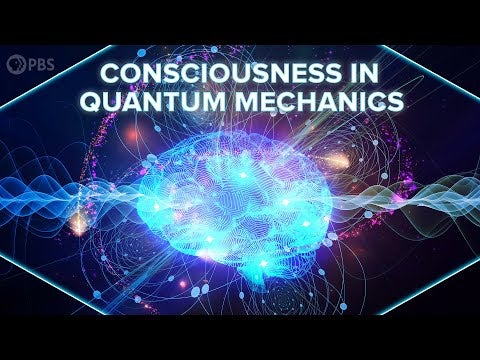
PBS Member Stations rely on viewers like you. To support your local station, go to: http://to.pbs.org/DonateSPACE ↓ More info below ↓ Uploaded 18-02-20 Sign Up on Patreon to get access to the Space Time Discord! Check out the Space Time Merch Store It’s not surprising that the profound weirdness of the quantum world has inspired some outlandish explanations - nor that these have strayed into the realm of what we might call mysticism. One particularly pervasive notion is the idea that consciousness can directly influence quantum systems - and so influence reality. Today we’re going to see where this idea comes from, and whether quantum theory really supports it. Hosted by Matt O'Dowd Written by Matt O'Dowd Graphics by Leonardo Scholzer and Adriano Leal Post Production: Yago Ballarini, Max Willians, Pedro Osinski Directed by: Eric Brown and Andrew Kornhaber Executive Producers: Eric Brown and Andrew Kornhaber End Credits Music by J.R.S. Schattenberg: https://www.youtube.com/channel/UCRl6
Puzzle through the ethical dilemma where two ships are in distress but you can only save one, and decide: which do you choose? Uploaded 21-12-21 -- You are the captain of an interstellar cargo transport headed to port when you receive two distress calls. The first is from a labor ship, whose passengers are running out of oxygen. The other from a luxury space cruiser which has lost a thruster, sending them careening into danger. With only enough time to save one ship, which should you choose? Doug Mackay explores this classic ethical dilemma. Lesson by Doug Mackay, directed by Avi Ofer. This video was produced in collaboration with the Parr Center for Ethics, housed within the renowned Philosophy Department at the University of North Carolina at Chapel Hill. The Parr Center is committed to integrating abstract work in ethical theory with the informed discussion of practical ethical issues, and prides itself on the development of innovative and inclusive approaches to moral and civic edu
In Britain at the end of the nineteenth century, the new sexual sciences—from anthropological accounts of religion as rooted in ancient fertility cults to psychoanalytic theories that explained religious experience in terms of psychosexual development—characterized religion as closely connected to the sexual. The outcome, as Joy Dixon argues in Sexual Heresies: Religion, Science, and Sexuality in Modern Britain (https://bookshop.org/a/12343/9781503646681), was a new sense that religion itself could be sexually suspect. One result was an increasing concern to police "sexual heresies" to produce a supposedly normal (healthy, monogamous, and heterosexual) religiosity. The overall effect was a narrowing of the sexual possibilities inside "orthodox" religion and the association of alternative forms of religion with dissident sexualities that continues to shape both religion and secularism today. Drawing on a wide range of materials from diverse elements of British society, this book emphasi
Historians of political thought interested in partisanship have long privileged the perspective of male canonical thinkers. Scholars have turned to Thucydides and Plato for insights on stasis, Aristotle on civic friendship, Niccolò Machiavelli on tumults, David Hume and Edmund Burke on political parties, and The Federalist on faction. Even political theorists who are primarily concerned with contemporary theories of partisanship often turn to these “usual suspects” to strengthen their otherwise largely non-historical arguments. Yet this narrow focus on canonical men has led scholars to neglect an important if counterintuitive perspective on partisanship which we find in the political thought of eighteenth-century women, for whom partisanship offered an unexpected but essential means to political inclusion. Partisan Virtue: The Politics of Inclusion in Eighteenth-Century Women’s Political Thought (https://bookshop.org/a/12343/9780198989349)(Oxford UP, 2026) by Dr. Geertje Bol focuses on
Inspired by the humanist and Catholic martyr Thomas More, David Albertson and Jason Blakely imagine a new politics of hope In Thomas More's Utopia, a traveler from the New World delivers a shocking message: on a lost island beyond the horizon, people live far better lives than in Europe. A leading intellectual of his day, More was murdered by Henry VIII in 1535 for refusing to sign a loyalty oath, but his utopian vision inspired some of the most consequential movements in the modern world. In their provocative manifesto Utopia for Our Century: A Manifesto of Hope (https://bookshop.org/a/12343/9780300278088) (Yale UP, 2026), David Albertson and Jason Blakely retrieve More's insights and apply them to our moment. Amid the decline of liberalism and the rise of authoritarianism, Albertson and Blakely resist the dystopian fears taking root in the twenty-first century. Utopian politics, they argue, can help us break free of today's entrenched polarities and recast what is possible. They retu
Food labels should explain environmental and ethical claims in verifiable terms.
Share your view, then see how readers voted. No sign-in required. This poll is shared across stories.
Do you agree or disagree?
Common Quandary
A Common Quandary to discuss
Another conversation to explore, separate from this news story.
The night before the wedding, your friend admits serious doubts. Do you tell their partner?
On the night before a wedding, your closest friend says they are unsure they should marry but insists it is ordinary panic. They make you promise secrecy and plan to proceed. Their partner asks you directly whether everything is okay.
When does loyalty require breaking a confidence before an irreversible choice?