Ronan Connolly/Gerry Quinn: “Assessing the Safety of the Modified mRNA Vaccine” #442
91 min
Listen through the publisher, then discuss the episode here or arrange an in-person Roundtable. Your city determines where to meet.
Roundtables are designed for groups of four, with a shared subject and room for everyone to speak. Come for discussion, with no dating expectation.
Ronan Connolly and Gerry Quinn discuss their new peer-reviewed Journal of Toxicology paper assessing safety concerns around modified mRNA COVID vaccines. They criticize shifting claims about vaccine efficacy, difficulties publishing dissenting views, and argue the technology differs from traditional vaccines because it delivers genetic instructions via lipid nanoparticles with broad body distribution. They discuss potential issues including dosing and duration of spike protein production, microvesicle transport, pseudouridine-related frame shifting and protein misfolding, manufacturing differences between trials and mass rollout, and possible DNA contamination. They also review clinical trial criticisms, seasonality findings, and argue observational claims of lives saved rely on models and confounding. 00:00 Guests and COVID Paper Recap 01:32 New mRNA Vaccine Focus 03:22 New Toxicology Paper and Caveats 08:50 Why Discussing Harms Was Taboo 10:28 Old Vaccines vs Gene Tech 15:27 Testing Gaps and Gene Therapy Roots 23:42 Where It Goes and How Long It Lasts 28:27 Manufacturing Differences and Contamination 36:13 Nobel Prize and Pseudouridine 41:15 How Modified Bases Can Misread 42:13 Frameshift Proteins Found 43:08 Codons Explained Simply 44:57 Reductionism Meets Epigenetics 47:30 Codon Optimization Changes Folding 51:37 Why Spike Protein Matters 56:14 Long COVID vs Long Vax 58:40 Trial Efficacy Math 01:02:02 Whistleblowers and Unblinding 01:07:26 Seasonality and Lockdowns 01:11:10 Lives Saved Model Critique 01:15:26 Observational Study Confounding 01:18:37 Adverse Events and Gatekeeping 01:23:26 Final Takeaways and Resources Ronan’s X: https://x.com/1RonanConnolly Gerry’s X: https://x.com/jercuinn “Scientists uncover major safety concerns over mRNA vaccine technology”: https://www.ceres-science.com/post/scientists-uncover-major-safety-concerns-over-mrna-vaccine-technology ========= My Linktree: https://linktr.ee/tomanelson1
Episode information is provided by the publisher. Listening takes place on the publisher’s service.
If you want early access to these sorts of breakdowns, all the references and extra nuances, join the Best-Selling StayCurious Metabolism Newsletter: https://staycuriousmetabolism.substack.com/p/nattokinase-the-heart-health-supplement?r=40ekz2 Can a fermented soybean enzyme actually reverse arterial plaque? In this video, we dive deep into the science behind nattokinase—one of the most misunderstood yet promising supplements in cardiovascular health. From its ancient samurai-era origins to modern clinical studies, we unpack whether this enzyme can truly lower your risk of heart disease. You'll learn how nattokinase works on a biochemical level—breaking down blood clots, lowering blood pressure, and reducing oxidative stress. We'll examine the latest research, including a 1,000-person study showing potential regression of atherosclerosis and improvements in cholesterol markers. And yes, we’ll talk dosing, safety, and how this fits into a broader heart health strategy. If you care about
Human DNA editing is finally here. Check out the new WHOOP here! https://join.whoop.com/cleo There is a microscopic technology that now gives us the power to edit our own genes while we’re alive. To cure certain diseases, possibly prevent others, or boost what our bodies can do… or maybe, one day give our kids abilities no one has ever had before… effectively putting evolution into our hands. This is not some sci-fi future! We’re already using this technology in real medical treatments in plants to grow new crops and in animals to create new species! Just yesterday, news broke that a baby’s life was saved using personalized gene editing that fixed one tiny error in its DNA. This is truly “huge if true.” Deciding how we use this new superpower may be the biggest challenge we have ever faced - and the biggest opportunity to reduce human suffering. This tool is called CRISPR. Dr. Jennifer Doudna won the Nobel Prize for discovering it. So, in this third episode of Huge Conversations, Dr. D
THE SEARCH FOR THE ULTIMATE RED LIGHT THERAPY IS OVER! After decades of exploring wellness technologies, Michael Jaco sits down with Rob Rene, founder of Exodus Strong, to explore the Red Light+ Total Body Reset system, the science behind red and near-infrared light, and why this technology has become such an important part of their wellness conversation. Rob's remarkable personal journey—including surviving five near-death experiences—inspired his mission to develop practical wellness tools that people can incorporate into their everyday lives. Discover the full-body Red Light+ Mat, designed for convenient 20-minute sessions, and the portable Red Light+ Wand, created for targeted use on areas such as the knees, shoulders, hands, and lower back. Michael and Rob discuss the technology, personal experiences, and how red light therapy may support a daily wellness routine. BLACK FRIDAY–CYBER MONDAY LISTENER EXCLUSIVE! This is your opportunity to explore Exodus Strong's special holiday offe
Puzzle through this classic ethical dilemma and decide: is community safety more important than individual privacy? -- Your government has introduced a plan to address record-breaking rates of traffic tickets and deadly hovercar accidents. They propose assigning “driver credit scores” to every citizen, but would need to install cameras and microphones in every vehicle. While it would make the roads safer, is this undeniable benefit worth the cost to drivers’ privacy? Michael Vazquez and Sarah Stroud investigate. Lesson by Michael Vazquez and Sarah Stroud, directed by Jeff Le Bars, JetPropulsion.space. This video made possible in collaboration with the Parr Center for Ethics Learn more about how TED-Ed partnerships work: https://bit.ly/TEDEdPartner Support Our Non-Profit Mission ---------------------------------------------- Support us on Patreon: http://bit.ly/TEDEdPatreon Check out our merch: http://bit.ly/TEDEDShop ---------------------------------------------- Connect With Us ------
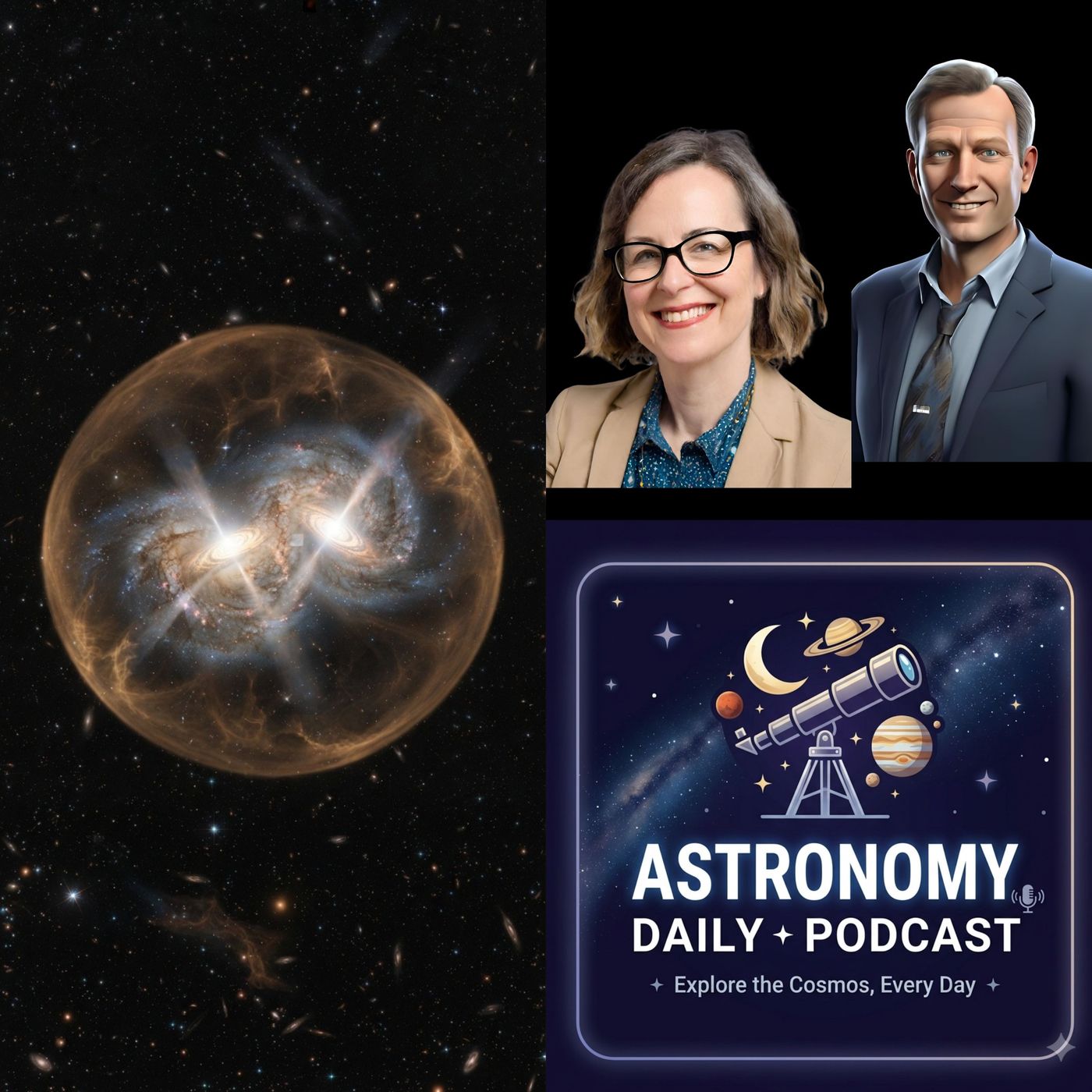
Eleven billion years ago two quasars blazed side by side, and this week astronomers weighed the invisible gas around them by the shadow it casts on the cosmic microwave background. There is 3.6 times more heat in it than gravity can explain. Plus a triple star 28 light-years away that 'should not exist', a pulsar found in ten hours with an algorithm borrowed from cryptography, The Week That Was, and the weekend sky from both hemispheres. In this episode Lead: Hot bubble around the dual quasar J1549+1245 at z = 2.37, measured with ALMA via the thermal Sunyaev–Zel'dovich effect (Hall, Zakamska et al., Nature Astronomy, 18 Nov 2026). Fresh item: Welopōʻai, the closest known triple with two white dwarfs, 28 light-years away (Artigau et al., A&A, 19 Nov 2026). Week That Was: Starship Flight 15 ship catch, CSIRO GenDIReCT and M87, SN 2026ahvu, failed supernovae in gravitational waves (E230); Voyager 1 one light-day, Beta Pictoris ices, heavy-oxygen water, Roman alignment (E231); Terra ends,
In the winter of 1944, as Nazi Germany was losing ground on every front, Hitler launched one final attempt to turn the war around. Through the dense forests of the Ardennes, German forces launched a massive surprise attack against the Allied armies, triggering one of the largest and most dramatic battles of World War II. Discover why the Allies were caught off guard, explore the harsh winter conditions that shaped the fighting, and follow the events surrounding the desperate defense of Bastogne. Learn about the German strategy, the Allied response, and the soldiers who endured weeks of uncertainty, snow, and exhaustion. Uncover how the Ardennes Offensive unfolded, why the German advance ultimately failed, and how this battle weakened Germany's ability to continue the war in Western Europe. Boring History for Sleep — Soft stories about forgotten battles, extraordinary events, and the people who shaped history.
Tom interviews Chris Morrison about his October-released book Implausible, which argues that mainstream climate, politics, and media narratives over the past 15 years relied heavily on the IPCC’s RCP8.5 “worst case” pathway, later deemed implausible, producing sensational claims such as Gulf Stream collapse and coral reef extinction. Morrison says the issue is political, tied to promoting net zero, and criticizes figures like David Attenborough and institutions like the BBC for amplifying fear without debate, citing Ofcom-related complaint pressures. He discusses organized activist funding, including groups like the Good Law Project and DeSmog, and warns about UK policy efforts to drastically cut hydrocarbons. Morrison also raises concerns about Met Office temperature measurement methods, renewable-grid instability, and potential winter blackouts, and invites public debate on the science and net zero. 00:00 Meet Chris Morrison 00:47 What Implausible Argues 02:10 RCP8.5 Implausibility D
Host Tom interviews Peter Ridd about the Great Barrier Reef, coral bleaching, global coral statistics, and ocean acidification. Ridd describes the reef’s size, protection, and natural variability from cyclones, starfish plagues, and sea-level change. Using Australian Institute of Marine Science data he compiles, he says coral cover hit lows around 2012 but reached record levels in 2022–2024 despite reported bleaching events; he argues scientists now call it “wrong” coral (Acropora) and cites a 2018 Nature letter predicting catastrophic, permanent change. He alleges global and Great Barrier Reef datasets were adjusted to look worse and calls for science audits. On acidification, he says corals use bicarbonate, which increases with CO2, and can regulate pH, making projected pH changes benign. 00:00 Reef Talk Preview 00:43 Where The Reef Is 01:38 Reef Scale And Protection 02:13 How Reefs Form 03:59 Coral Cover Trends 06:21 Bleaching Explained 09:03 Wrong Coral Claim 10:39 Doom Quotes Chal
Tom Kurz promotes his book Why There Is No Climate Crisis, and argues media and politicians wrongly claim warming increases weather catastrophes. He attributes major climate swings to the Atlantic Multidecadal Oscillation and cites satellite-era hurricane data showing fewer hurricanes since 1990, with ACE and PDI declining and no meaningful trend in Category 4–5 storms. He says strong (EF2–EF5) U.S. tornadoes have declined since 1954, while weaker tornado counts rose due to better detection. Paleoclimate evidence (ice cores, dune sands, historical records) is cited to link colder periods to worse storms and droughts. He argues Arctic amplification and upper-troposphere warming weaken storm drivers, claims heatwaves/wildfires track natural cycles, droughts decline, greening and crop yields rise, climate- and famine-deaths fall, and IPCC finds no clear global flood trend. 00:00 Intro and Guest 00:39 Media Fear Claims 02:33 AMO Climate Cycles 07:27 Hurricane Trends Data 11:24 Tornado Stre
Cities should actively seek views from residents who do not attend public meetings.
Share your view, then see how readers voted. No sign-in required. This poll is shared across stories.
Do you agree or disagree?
Common Quandary
A Common Quandary to discuss
Another conversation to explore, separate from this news story.
An old friend refuses to use someone's new name. Do you correct them at the reunion?
At a reunion, an old friend repeatedly uses the name a former classmate had years ago. They say shared history gives the old name affectionate meaning; the classmate has clearly introduced themselves with a different name.
When does preserving your shared past deny who someone is now?