Uncover the oil industry’s decades-long campaign to discredit climate change science regarding the danger of fossil fuels. -- Throughout the 1980s, oil industry reps discussed the dangers of burning fossil fuels, acknowledging the risk their product posed to the future of humanity. However, instead of warning the public or pivoting towards renewable energy sources, they doubled down on oil — and launched a decades-long campaign to discredit climate change science. Stephanie Honchell Smith digs into Big Oil's tactics. Lesson by Stephanie Honchell Smith, directed by Sofia Pashaei. This video made possible in collaboration with Speed & Scale Learn more about how TED-Ed partnerships work: https://bit.ly/TEDEdPartner Data and graph shown at 5:43 by Statista: https://www.statista.com/chart/11673/the-soaring-costs-of-climate-change Support Our Non-Profit Mission ---------------------------------------------- Support us on Patreon: http://bit.ly/TEDEdPatreon Check out our merch: http://bit.ly/
#Motivation, #JimRohn, #PersonalGrowth, #SelfImprovement, #Discipline, Are you chasing goals but still feeling stuck? Do you feel like you're working hard but not becoming the person capable of achieving your dreams? This powerful 35-minute motivational speech inspired by Jim Rohn’s timeless wisdom will completely transform the way you think about success, discipline, personal growth, mindset, consistency, habits, purpose, and your future. Uploaded 26-05-26 Most people spend years chasing money, success, confidence, and goals… but fail because they never invest in the most important thing — their own growth. In this deeply emotional, philosophical, and life-changing motivational speech, you’ll learn why personal development matters more than temporary success, how discipline creates destiny, why pain and regret shape your future, and how ordinary daily habits can completely transform your life. If you're tired of procrastinating, tired of staying stuck, tired of wasting your potential,
Ep 400: A birthday hike in Hawaii ends with a woman bloodied on a cliffside. She claimed her husband tried to kill her, but he had a very different story. This is the Arielle Konig story. A birthday hike on Oahu ends with a woman bloodied on a cliffside, screaming that her husband tried to kill her. He tells investigators something very different. This is the case of Arielle Konig, a Westinghouse nuclear engineer turned project manager at TerraPower, and her husband Dr. Gerhardt Konig, a University of Pittsburgh anesthesiologist who had moved the family to Maui for what he called their dream life. Megan and Amy trace the marriage from the outside-in: the careers, the two young sons, the emotional affair that unraveled things, and the monitoring and surveillance that followed. Then comes March 2025, the narrow ridges and sheer drops of the Pali Puka Trail near the Nuuanu Pali Lookout, two hikers who heard screaming, and an eight-hour search of the mountain. At the Honolulu trial for att
This is the craziest Olympic sport by far. Trust me. This episode is #sponsored by @NBCSports @YouTube #WinterOlympics Every four years, people lose their minds over one Olympic sport. They make fun of it! But the more I learned about it, the more obsessed I got… and I realized that all these people making fun? They’re getting this totally wrong. This is the coolest Olympic sport by far. The sport I’m talking about is… CURLING. From stones so unique they all have to come from one tiny island, to a tech doping scandal nobody wants to talk about. It’s a game with strategy so complicated it’s called “chess on ice”. And a physics mystery that’s gone unsolved for over a century that could one day help us design robots for space. And that’s just the start… Trust me, you don’t know enough about Curling…YET. So I’m going to take you onto the ice at the Olympic Trials… to show you what everyone’s missing and why Curling is the Olympic sport you should be watching. Chapters 00:00 What's the most
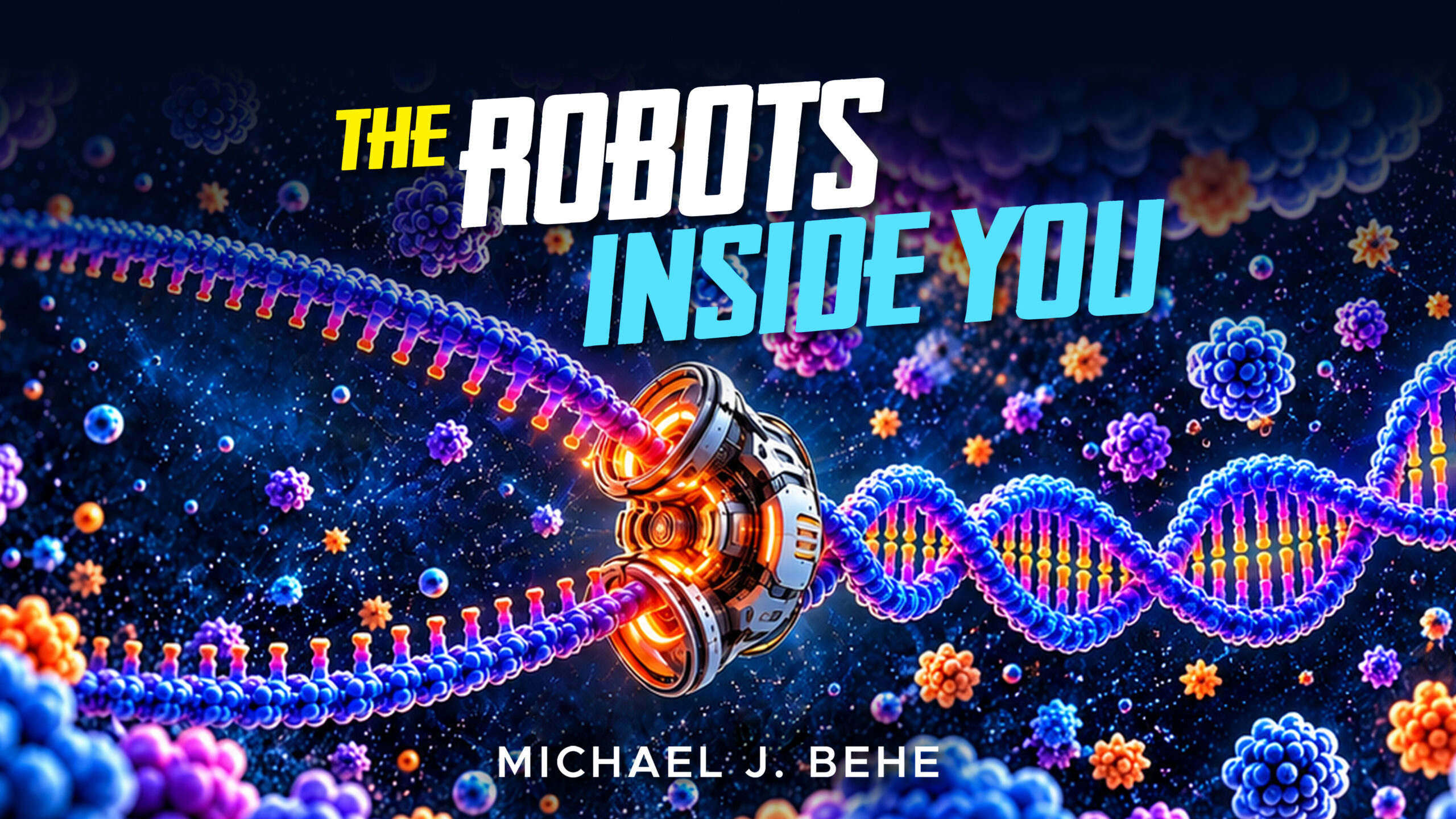
Did you know that right now, inside your body, tiny robots are hard at work keeping you alive? What are these miniature machines, and what can they teach us about the wonders of life? On this ID The Future, host Andrew McDiarmid speaks with biochemist Dr. Michael Behe about his new children’s book The Robots Inside You, now available from Discovery Institute Press. Source (https://idthefuture.com/2294/)
AI has dominated the headlines, but the bigger story might be happening in hardware. Bryce and Ren sat down in New York with Andrew Kang, CEO of RoboStrategy, who argues robot intelligence is now where AI was in 2022. With physical work making up roughly half the world's labour, they unpack why specialised robots will arrive before humanoids in your home, how the US and China really compare, and what it means to invest in a theme that is still mostly privately held. In this episode: 00:00:00 Are Robots The Next Trillion-Dollar Investment Opportunity? 00:02:48 Inside The Robotics Revolution At Figure AI 00:04:19 Why Robotics Is Where AI Was In 2022 00:07:51 How Big Could The Robotics Industry Become? 00:09:42 Where Robots Are Already Being Used Today 00:11:37 Why Specialised Robots Could Win First 00:14:22 Who Is Winning The Robotics Race: US Or China? 00:16:54 Why Robots Could Cost Just $2 An Hour 00:19:31 How Andrew Picks The Next Robotics Winners 00:24:33 The Company Powering America
PBS Member Stations rely on viewers like you. To support your local station, go to: http://to.pbs.org/DonateSPACE ↓ More info below ↓ Uploaded 15-06-20 Sign Up on Patreon to get access to the Space Time Discord! Check out the Space Time Merch Store Sign up for the mailing list to get episode notifications and hear special announcements! Conformal Cyclic Cosmology is a story of the origin and the end of our universe from great mathematical physicist Sir Roger Penrose. It’s goes like this: the infinitely far future, when the universe has expanded exponentially to to an unthinkably large size, and every black hole and particle has decayed into faint radiation .... that infinite stretch of space and time is identically the SAME THING as the infinitesimal and instantaneous big bang of a new universe, and our universe is just one in an endless chain. Hosted by Matt O'Dowd Written by Matt O'Dowd Graphics by Leonardo Scholzer, Yago Ballarini, and Pedro Osinski Directed by: Andrew Kornhaber Cam
Watch Space: The Longest Goodbye on Independent Lens: https://pbs.org/longestgoodbye In the far future we may have advanced propulsion technologies like matter-antimatter engines and compact fusion drives that allow humans to travel to other stars on timescales shorter than their own lives. But what if those technologies never materialize? Are we imprisoned by the vastness of space—doomed to remain in the solar system of our origin? Perhaps not. A possible path to a contemporary cosmic dream may just be to build a ship which can support human life for several generations; a so-called generation ship. Sign Up on Patreon to get access to the Space Time Discord! Check out the Space Time Merch Store Sign up for the mailing list to get episode notifications and hear special announcements! Search the Entire Space Time Library Here: https://search.pbsspacetime.com/ Senior Creative Producer (ITVS): Andrea Bloom Creative Director (ITVS): Carol Paik Executive Producers (ITVS): Carrie Lozano, Loi
PBS Member Stations rely on viewers like you. To support your local station, go to:http://to.pbs.org/DonateSPACE Sign Up on Patreon to get access to the Space Time Discord! Quantum mechanics is our best theory of the fundamental nature of reality, but it's usually only distinguishable from familiar classical mechanics on the smallest scales. However, there are some fringe cases where its distinct features manifest on scales we can observe—in things like superfluids, or the interiors of collapsed stars. But it’s also possible that our entire galaxy is filled with a reverberating quantum mechanical wave that literally holds the galaxy together—and in fact explains all the dark matter that we see across the universe. And this isn’t even a fringe theory. It’s axionic dark matter. Check out the Space Time Merch Store Sign up for the mailing list to get episode notifications and hear special announcements! Search the Entire Space Time Library Here: https://search.pbsspacetime.com/ Hosted by
Employers should help workers retrain when their jobs disappear.
Share your view, then see how readers voted. No sign-in required. This poll is shared across stories.
Do you agree or disagree?
Common Quandary
A Common Quandary to discuss
Another conversation to explore, separate from this news story.
You find a wallet full of cash. Can you take a finder’s fee before returning it?
You find a wallet containing identification and several hundred dollars. Returning it will require a detour and some effort. The owner would probably never know if a small amount were missing.
Can an unrequested good deed entitle someone to compensation?