English-language podcasts

PBS Space Time

Solving the Impossible in Quantum Field Theory
21 min

Listen through the publisher, then discuss the episode here or arrange an in-person Roundtable. Your city determines where to meet.

Roundtables are designed for groups of four, with a shared subject and room for everyone to speak. Come for discussion, with no dating expectation.

Viewers like you help make PBS (Thank you ) . Support your local PBS Member Station here: https://to.pbs.org/DonateSPACE Uploaded 12-07-17 How do you calculate infinite quantum outcomes? Feynman Diagrams. Get your first two months of Curiosity Stream for free by going https://curiositystream.com/spacetime and using the promo code “spacetime” at sign up. You can further support us on Patreon at https://www.patreon.com/pbsspacetime Get your own Space Time t­shirt at http://bit.ly/1QlzoBi Tweet at us! @pbsspacetime Facebook: facebook.com/pbsspacetime Email us! pbsspacetime [at] gmail [dot] com Comment on Reddit: http://www.reddit.com/r/pbsspacetime Help translate our videos! https://www.youtube.com/timedtext_cs_panel?tab=2&c=UC7_gcs09iThXybpVgjHZ_7g (https://www.youtube.com/timedtext_cs_panel?c=UC7_gcs09iThXybpVgjHZ_7g&tab=2) Previous Episode: Feynman’s Infinite Quantum Paths The equations of quantum field theory allow us to calculate the behaviour of subatomic particles by expressing them as vibrations in quantum fields. But even the most elegant and complete formulations of quantum physics – like the Dirac equation or Feynman’s path integral - become impossibly complicated when we try to use them on anything but the most simple systems. But physicists tend to interpret “that’s impossible” as “I dare you to try!” And try they did. First they expressed these impossible equations in approximate but solvable forms. Then they tackled the pesky infinities that kept appearing in these new, approximate equations. Finally, the entire mess was ordered into a system that mere humans could deal using the famous Feynman diagrams. Written and Hosted by Matt O’Dowd Produced by Rusty Ward Graphics by Kurt Ross Assistant Edit and Sound Design by Mike Petrow Made by Kornhaber Brown (www.kornhaberbrown.com) Comments answer by Matt: Christian Haas https://www.youtube.com/watch?v=vSFRN-ymfgE&lc=z132vnrhvkq1d3wbi04cdvewopzqjhtidn40k (https://www.youtube.com/watch?lc=z132vnrhvkq1d3wbi04cdvewopzqjhtidn40k&v=vSFRN-ymfgE) Psy Kosh https://www.youtube.com/watch?v=vSFRN-ymfgE&lc=z12evvsbtvahjprpx04cclc4nprifxdzwcc (https://www.youtube.com/watch?lc=z12evvsbtvahjprpx04cclc4nprifxdzwcc&v=vSFRN-ymfgE) lohphat https://www.youtube.com/watch?v=vSFRN-ymfgE&lc=z123gzmhdyezideg504chbuy2rnne1tjx5c (https://www.youtube.com/watch?lc=z123gzmhdyezideg504chbuy2rnne1tjx5c&v=vSFRN-ymfgE) Special thanks to our Patreon Big Bang, Quasar and Hypernova Supporters: Big Bang CoolAsCats Shane Robinson David Nicklas Eugene Lawson Joshua Davis Quasar Tambe Barsbay Max Levine Mayank M. Mehrota Mars Yentur Josh Mark Rosenthal Dean Fuqua Hypernova Chuck Zegar Jordan Young Ratfeast John Hofmann Joseph Salomone Martha Hunt Craig Peterson Prof. Dr. Kenneth Michael Beck Science Via Markets Thanks to our Patreon Gamma Ray Burst Supporters: Peter Durocher Michael Kers Chris Hicks Mark Vasile Patrick Murray Justin Lloyd Sultan Alkhulaifi Alex Seto Conor Dillon Jared Moore Michal-Peanut Karmi Bernardo Higuera Erik Stein Daniel Lyons Kevin Warne JJ Bagnell J Rejc Amy Jie Avi Goldfinger John Pettit Shannan Catalano Florian Stinglmayr Yubo Du Benoit Pagé-Guitard Nathan Leniz Jessica Fraley Loro Lukic Brandon Labonte David Crane Greg Weiss

Episode information is provided by the publisher. Listening takes place on the publisher’s service.

Listen at the source ↗

Featured places to meet in Palo Alto, CA

Explore these places and arrange a conversation through ThinkMatch.

City guide for Palo Alto, CA

More from PBS Space Time

PBS Space Time

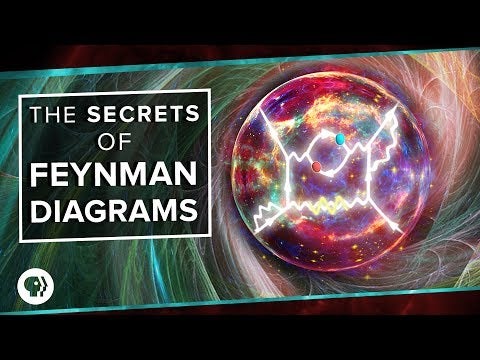
The Secrets of Feynman Diagrams

19 min

Viewers like you help make PBS (Thank you ) . Support your local PBS Member Station here: https://to.pbs.org/DonateSPACE Uploaded 26-07-17 Unlock the secrets of Feynman Diagrams. Part 5 in our Quantum Field Theory series. And if you're submitting an answer to our challenge question email your answer by August 2nd to pbsspacetime [AT] gmail.com with the subject line "Feynman Diagram Challenge." You can further support us on Patreon at https://www.patreon.com/pbsspacetime Get your own Space Time t­shirt at http://bit.ly/1QlzoBi Tweet at us! @pbsspacetime Facebook: facebook.com/pbsspacetime Email us! pbsspacetime [at] gmail [dot] com Comment on Reddit: http://www.reddit.com/r/pbsspacetime Help translate our videos! https://www.youtube.com/timedtext_cs_... Previous Episode: The Real Star Wars Feynman’s path integral shows us that, to properly calculate the probability of a particle traveling from point A to point B, we need to add up the contributions from all conceivable paths between tho

Discuss this episode

PBS Space Time

How Vacuum Decay Would Destroy The Universe

17 min

Sign Up on Patreon to get access to the Space Time Discord! Uploaded 18-08-21 The universe is going to end. But of all the possible ends of the universe vacuum decay would have to be the most thorough - because it could totally rewrite the laws of physics. Today I hope to help you understand exactly how terrified you should be. Check out the Space Time Merch Store Sign up for the mailing list to get episode notifications and hear special announcements! Hosted by Matt O'Dowd Written by Matt O'Dowd Graphics by Leonardo Scholzer, Yago Ballarini, Pedro Osinski, Adriano Leal and Stephanie Faria GFX Visualizations: Ajay Manuel Directed by Andrew Kornhaber Assistant Producer: Setare Gholipour Executive Producers: Eric Brown and Andrew Kornhaber End Credits Music by J.R.S. Schattenberg: https://www.youtube.com/user/MultiDroideka Special thanks to Our Patreon Sponsors Big Bang Supporters Ari Paul Kyle Bulloch Charlie Mrs. Tiffany Poindexter Leo Koguan Sandy Wu Matthew Miller Scott Gray Ahmad Jo

Discuss this episode

PBS Space Time

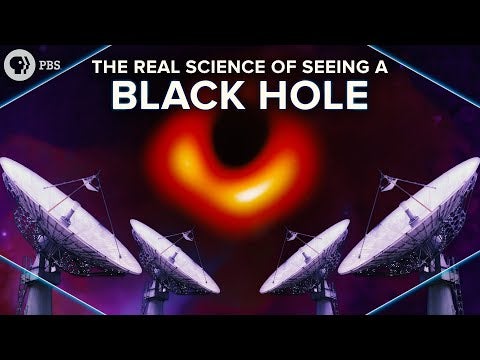
The Real Science of the EHT Black Hole

16 min

You can learn more about CuriosityStream at https://curiositystream.com/spacetime Uploaded 01-05-19 PBS Member Stations rely on viewers like you. To support your local station, go to: http://to.pbs.org/DonateSPACE How do you take a picture of a black hole and what can we learn from it? Our first ever actual bona fide photo of a black hole, made by the Event Horizon Telescope and revealed to the world in a press conference on April 10th. Since then it’s got plenty of coverage, because … I mean look at it. It’s a freaking black hole. It’s black, it’s holey, it’s everything we hoped it would be. Now that the giddiness has subsided and I personally have stopped spending hours on end staring at a black spot, we can take a breath and actually look at the real science here and discuss exactly how a picture like this could be taken and what we can learn from it. Check out the new Space Time Merch Store! Support Space Time on Patreon Need a Black Hole Refresher #Blackhole #astrophysics #spaceti

Discuss this episode

Community Poll

A workable temporary compromise is often better than delaying all action.

Share your view, then see how readers voted. No sign-in required. This poll is shared across stories.

Do you agree or disagree?

Choose one answer

Common Quandary

A Common Quandary to discuss

Another conversation to explore, separate from this news story.

A better public school is one borrowed address away. Would you use it?

Your child is struggling at the assigned school. A grandparent lives inside the boundary of a much stronger public school and offers to let you use their address. The desired school has limited places and verifies residency unevenly.

Can a parent's duty justify taking an opportunity allocated by an unfair boundary?

Explore this quandary