English-language podcasts

The Daily AI Show

The AI Knowledge Conundrum
31 min

Listen through the publisher, then discuss the episode here or arrange an in-person Roundtable. Your city determines where to meet.

Roundtables are designed for groups of four, with a shared subject and room for everyone to speak. Come for discussion, with no dating expectation.

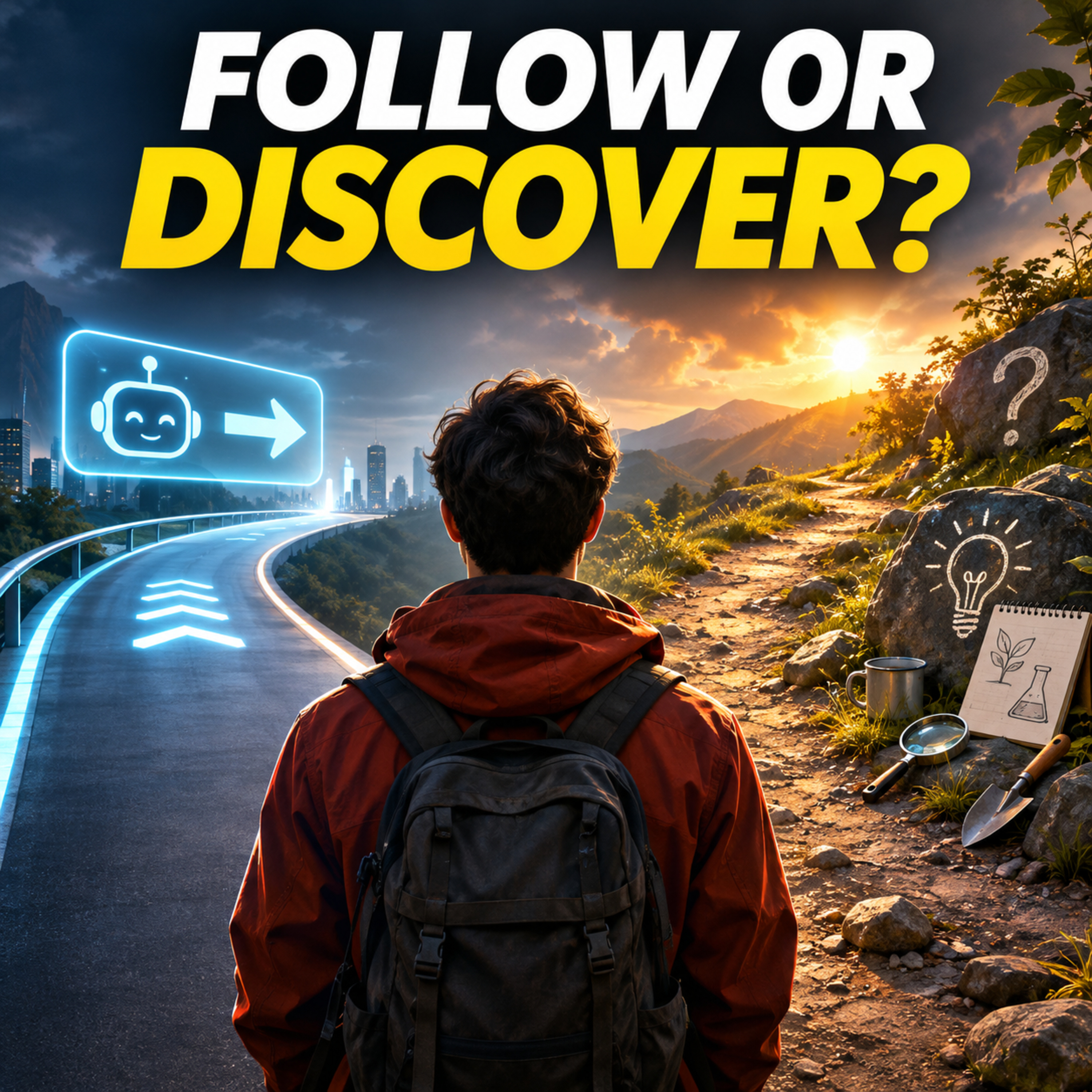
The Future of Knowledge Conundrum A gardener tries a different planting date and discovers what survives a late frost. A mechanic notices that an unfamiliar noise precedes a particular failure. A commuter tests a side street and finds a faster route. Much of what people know begins with observations like these, made while solving ordinary problems. Some become advice for neighbors, posts on specialist forums, or changes in professional practice. People learn something useful for themselves, and others inherit the benefit. AI makes that inheritance easier to use. An assistant can draw together gardening advice, maintenance records, or traffic reports and recommend what to do next. Instead of spending a season experimenting or hours comparing conflicting explanations, someone can start with an answer informed by many other people’s experiences. AI can also identify gaps in existing knowledge and suggest useful tests. The practical advantage grows as recommendations become more relevant to a person’s circumstances. The uncertainty concerns what happens after millions of people start taking that advice. Following a reliable recommendation saves time, money, and failed attempts. Yet those attempts sometimes produce the unexpected observation that improves everyone’s next answer. Better guidance could help people investigate questions nobody has settled, making discovery more productive. It could also make familiar answers so attractive that fewer people have a personal reason to test alternatives. The Conundrum: One perspective sees knowledge growing faster because people can stop rediscovering what others already know. A farmer who gets dependable advice about common pests can investigate an unfamiliar disease instead. A mechanic can move past routine faults and concentrate on unusual failures. AI can connect scattered observations, reveal promising questions, and help design informative experiments. People’s curiosity and commercial ambitions gain a stronger starting point. Collective knowledge advances because more effort reaches the boundary of what is known. The opposing perspective sees that boundary receiving less attention. Much useful discovery comes from people trying alternatives for immediate personal reasons, not setting out to advance knowledge. A grower tests another crop because local advice is inconclusive; a repair shop experiments because nobody has an answer. As AI makes established choices more rewarding, those small experiments become harder to justify. Society gains efficient decisions today while the everyday activity that supplies tomorrow’s knowledge becomes less worthwhile. Each perspective exposes a question for the other. The first depends on people using better answers to investigate new questions, rather than simply accepting those answers. The second must consider whether AI-guided inquiry could produce discoveries that make up for fewer everyday experiments. Someone might agree that AI makes focused inquiry more productive while doubting that it will replace the knowledge lost from routine trial and error. Someone else might accept that some everyday discoveries will be lost while judging the gains from better-directed inquiry more important. How much weight should we give to each effect, and where might AI encourage new inquiry while also reducing everyday experimentation?

Episode information is provided by the publisher. Listening takes place on the publisher’s service.

Listen at the source ↗

Featured places to meet in Palo Alto, CA

Explore these places and arrange a conversation through ThinkMatch.

City guide for Palo Alto, CA

More from The Daily AI Show

The Daily AI Show

Bot Friday Shopping Agents and AI Elder Care

59 min

Black Friday AI news: AI shopping agents, Anthropic's Siren sandbox test, Perplexity's Time Machine, and a long look at AI tools for aging adults. The news covers rumors of Claude Opus 5.6, ChatGPT usage limits, Anthropic's stock price a week after its IPO, NVIDIA halting server shipments to Southeast Asia under US export and distillation controls, and the Google Colab access that comes with a Gemini Pro subscription. "Bot Friday", the first Black Friday on which personal AI agents can do the shopping and Walmart lets bots onto its site, leads into Anthropic's Siren evaluation, where newer Claude models reached outside deliberately weakened sandboxes, and a production incident in which Claude got hold of an API key through a 1Password service account (the keys have since been rotated). After Perplexity's Time Machine for searching the past web and the trade-off between fast, cheap and correct AI, the conversation turns to technology for aging adults: ElliQ, Sensai, fall detection, an A

Discuss this episode

The Daily AI Show

Why AI Adoption Stalls and the Disclosure Penalty

65 min

Thanksgiving Thursday AI news: Thariq moves from Anthropic to OpenAI, Gemini resets Neon usage limits, OpenAI has an outage, and Perplexity launches Time Machine. The news segment covers Gemini resetting usage tokens after heavy demand for Neon, a four-hour OpenAI outage that hit ChatGPT, Codex and business plans, and Perplexity's new Time Machine feature, a developer-level tool for avoiding the hindsight problem in AI research. Artificial Analysis's new Frontier Physics benchmark puts Claude Fable 5.2 ahead of the field, and a Fable-designed cup stand shows that kind of physics reasoning in practice. The conversation then turns to young adults' dislike of AI compared with attitudes in East Asia, takeaways from a 2030 Future of Work event on multi-agent orchestration and proactive agents, and why AI adoption doesn't spread inside companies. A fundraising study finds that AI-written and human-written appeals perform the same until AI use is disclosed, when results drop 56% in one scenar

Discuss this episode

The Daily AI Show

AI Exploit Agents, Kids' Chatbot Data, Forecasting Time Portal

68 min

AI news on autonomous exploit agents, states fighting the sale of kids' chatbot data, and an AI that named the likely artist of an 1808 sketchbook. The show opens with a highway-billboard prompt that makes Claude Code-built Shorts splash screens readable at a glance. Then it turns to cybersecurity: Palo Alto Networks' Unit 42 found the gap between attacker commands falling from 24 seconds to 1.4 seconds, Google reported the first AI exploit agent it has seen work end to end, and OpenAI and Anthropic are adding insider-spy defenses. Child safety comes next, with 42 states and the District of Columbia challenging the auction of Character.AI users' private chats, harmful messages to children from the Talkie chatbot, New York's five-year ban on AI in toys, Tidal removing AI-generated tracks, and Pinterest's new teen controls. Astra 6.2 named the Vicomte de Chabot as the likely artist of an anonymous 1808 sketchbook held at Yale, which leads into capability overhang: AI results, from quantu

Discuss this episode

Community Poll

Removing outdated rules is worthwhile even when it reduces some existing protections.

Share your view, then see how readers voted. No sign-in required. This poll is shared across stories.

Do you agree or disagree?

Choose one answer

Common Quandary

A Common Quandary to discuss

Another conversation to explore, separate from this news story.

Would you want a doctor to give you a fake pill if the lie might make you feel better?

A patient has persistent symptoms that have not responded to standard treatments. A harmless placebo may help, but its effect could weaken if the clinician fully explains that it contains no active medicine.

Can a beneficial deception respect the person it helps?

Explore this quandary