The Blueprint: How Socialism Can Work in the Real World with Mike Beggs (Verso, 2026)
61 min
Listen through the publisher, then discuss the episode here or arrange an in-person Roundtable. Your city determines where to meet.
Roundtables are designed for groups of four, with a shared subject and room for everyone to speak. Come for discussion, with no dating expectation.
Neither capitalism nor central planning, this is the future for socialism. Capitalism isn’t working. But is there a plausible alternative? The Blueprint: How Socialism Can Work in the Real World (https://bookshop.org/a/12343/9781839768637)(Verso, 2026) lays one out: a system where workers control every lever of production, and competitive markets and state planning coexist side by side. Drawing on the history of socialist experiments and the economic debate over planning and markets, The Blueprint confronts the hardest questions about what went wrong in the past—and why it can go right in the future. The result is a socialism worthy of the twenty-first century. Mike Beggs is senior lecturer in political economy at the University of Sydney. His research focuses on the history of macroeconomic and monetary thinking and policy. Morteza Hajizadeh (https://www.youtube.com/user/a48266/videos) is a Ph.D. graduate in English from the University of Auckland in New Zealand. His research interests are Cultural Studies; Critical Theory; Environmental History; Medieval (Intellectual) History; Gothic Studies; 18th and 19th Century British Literature. YouTube channel (https://www.youtube.com/user/a48266/videos). Twitter (https://twitter.com/TalkArtCulture). Hosted by Simplecast, an AdsWizz company.
Episode information is provided by the publisher. Listening takes place on the publisher’s service.
In 1620, a small ship called the Mayflower crossed the Atlantic carrying English settlers in search of a new life. Their arrival in North America became one of the most familiar stories in American history, but the reality behind the legend was far more complicated than the traditional Thanksgiving tale suggests. Discover why the Pilgrims left England, what their dangerous voyage was really like, and how they survived their first winter in an unfamiliar land. Explore their encounters with the Wampanoag people, the role of Tisquantum, also known as Squanto, and the assistance that helped the struggling settlers establish their colony. Uncover what happened at the harvest gathering of 1621, who actually attended, what was served, and how this event became connected to the modern Thanksgiving holiday. Follow the history beyond the familiar celebration and discover the people, cultural encounters, and historical realities behind the Mayflower story. Boring History for Sleep — Soft stories
View pictures and support us on Patreon(https://www.patreon.com/user?u=73787379) This episode examines documented black bear encounters involving hikers, hunters, campers, homeowners, and backcountry workers. These incidents range from surprise encounters and defensive attacks to prolonged confrontations where bears returned repeatedly, testing human endurance, decision-making, and survival instincts.Black bears are often described as shy or non-aggressive, but these cases reveal how quickly circumstances can change when food sources, cubs, human behavior, or environmental pressure collide. Each story is carefully researched and presented to highlight what went wrong, what saved lives, and what these encounters reveal about black bear behavior in the wild.
Your body doesn't work like you think... Take your personal data back with Incogni. How and when people are having kids is changing, but our bodies aren't. As we get older, it can get harder to have kids when we want to. So smart people figured out it’s possible to remove eggs, freeze them, and unfreeze them to use later. They can even fertilize those eggs to make embryos and freeze those. Basically, humans invented cryosleep! … Just for tiny cells. It’s totally sci-fi - and you need to know about it. This is a level of control over our bodies no species has ever had before. It’s already changing people’s lives - and how our species can reproduce. But there are real concerns about whether it’s worth it. Because let me tell you, the process is not easy. I’ve been taking medication for two weeks. And at the same time, I’ve been doing research, talking to doctors, and learning as much as I can about the cutting edge of fertility tech. In this video, I'm going to take you behind the scenes
PBS Member Stations rely on viewers like you. To support your local station, go to: http://to.pbs.org/DonateSPACE ↓ More info below ↓ Uploaded 18-02-20 Sign Up on Patreon to get access to the Space Time Discord! Check out the Space Time Merch Store It’s not surprising that the profound weirdness of the quantum world has inspired some outlandish explanations - nor that these have strayed into the realm of what we might call mysticism. One particularly pervasive notion is the idea that consciousness can directly influence quantum systems - and so influence reality. Today we’re going to see where this idea comes from, and whether quantum theory really supports it. Hosted by Matt O'Dowd Written by Matt O'Dowd Graphics by Leonardo Scholzer and Adriano Leal Post Production: Yago Ballarini, Max Willians, Pedro Osinski Directed by: Eric Brown and Andrew Kornhaber Executive Producers: Eric Brown and Andrew Kornhaber End Credits Music by J.R.S. Schattenberg: https://www.youtube.com/channel/UCRl6
If you're interested in going deeper, check out our StayCurious Metabolism library on "Peptides and More" https://staycuriousmetabolism.substack.com/p/peptides Referenced Letters Russian Longevity Peptides: https://staycuriousmetabolism.substack.com/p/can-these-longevity-peptides-be-real?r=40ekz2 Pinealon and Sleep: https://staycuriousmetabolism.substack.com/p/why-im-trying-this-peptide-for-sleep?r=40ekz2 To Try Pinealon Thymic Health and Longevity: https://open.substack.com/pub/staycuriousmetabolism/p/the-most-overlooked-organ-in-aging?utm_campaign=post-expanded-share&utm_medium=web (https://open.substack.com/pub/staycuriousmetabolism/p/the-most-overlooked-organ-in-aging) Chapters 0:00 – Are These Russian Longevity Peptides Real?! 1:57 – Part 1, All Roads Lead Back to Russia 6:24 – Part 2, How These Peptides Work 10:20 – Part 3, My Personal Experience 14:28 – Part 4, Looking Towards the Future Can short peptides really influence aging, immunity, sleep, and even mortality? In this vide
In Florida, three counties have declared states of emergency due to rising cases of dengue (https://www.sciencefriday.com/segments/floridas-dengue-outbreak/)—a viral infection spread by mosquitos carrying the dengue virus. There have been around 1,000 cases (https://www.cdc.gov/dengue/data-research/facts-stats/current-data.html) in the state this year, making it the largest outbreak (https://apnews.com/article/dengue-virus-outbreak-florida-7f0bda2b0a1e7895e834010f38cedb1e) in the continental U.S. in decades. But this is part of a larger story. Over the last couple of decades, the number of dengue cases has surged globally, and dengue is becoming more common in places it hasn’t historically been. So what’s behind these shifts? And what public health measures should we be thinking about? Flora chats about this with epidemiologist Gabriela Paz-Bailey, chief of CDC’s dengue branch in San Juan, Puerto Rico. Guest: Dr. Gabriela Paz-Bailey is an epidemiologist and chief of the dengue branch i
In Britain at the end of the nineteenth century, the new sexual sciences—from anthropological accounts of religion as rooted in ancient fertility cults to psychoanalytic theories that explained religious experience in terms of psychosexual development—characterized religion as closely connected to the sexual. The outcome, as Joy Dixon argues in Sexual Heresies: Religion, Science, and Sexuality in Modern Britain (https://bookshop.org/a/12343/9781503646681), was a new sense that religion itself could be sexually suspect. One result was an increasing concern to police "sexual heresies" to produce a supposedly normal (healthy, monogamous, and heterosexual) religiosity. The overall effect was a narrowing of the sexual possibilities inside "orthodox" religion and the association of alternative forms of religion with dissident sexualities that continues to shape both religion and secularism today. Drawing on a wide range of materials from diverse elements of British society, this book emphasi
Historians of political thought interested in partisanship have long privileged the perspective of male canonical thinkers. Scholars have turned to Thucydides and Plato for insights on stasis, Aristotle on civic friendship, Niccolò Machiavelli on tumults, David Hume and Edmund Burke on political parties, and The Federalist on faction. Even political theorists who are primarily concerned with contemporary theories of partisanship often turn to these “usual suspects” to strengthen their otherwise largely non-historical arguments. Yet this narrow focus on canonical men has led scholars to neglect an important if counterintuitive perspective on partisanship which we find in the political thought of eighteenth-century women, for whom partisanship offered an unexpected but essential means to political inclusion. Partisan Virtue: The Politics of Inclusion in Eighteenth-Century Women’s Political Thought (https://bookshop.org/a/12343/9780198989349)(Oxford UP, 2026) by Dr. Geertje Bol focuses on
Inspired by the humanist and Catholic martyr Thomas More, David Albertson and Jason Blakely imagine a new politics of hope In Thomas More's Utopia, a traveler from the New World delivers a shocking message: on a lost island beyond the horizon, people live far better lives than in Europe. A leading intellectual of his day, More was murdered by Henry VIII in 1535 for refusing to sign a loyalty oath, but his utopian vision inspired some of the most consequential movements in the modern world. In their provocative manifesto Utopia for Our Century: A Manifesto of Hope (https://bookshop.org/a/12343/9780300278088) (Yale UP, 2026), David Albertson and Jason Blakely retrieve More's insights and apply them to our moment. Amid the decline of liberalism and the rise of authoritarianism, Albertson and Blakely resist the dystopian fears taking root in the twenty-first century. Utopian politics, they argue, can help us break free of today's entrenched polarities and recast what is possible. They retu
Scarce treatments should be allocated by medical need rather than ability to pay.
Share your view, then see how readers voted. No sign-in required. This poll is shared across stories.
Do you agree or disagree?
Common Quandary
A Common Quandary to discuss
Another conversation to explore, separate from this news story.
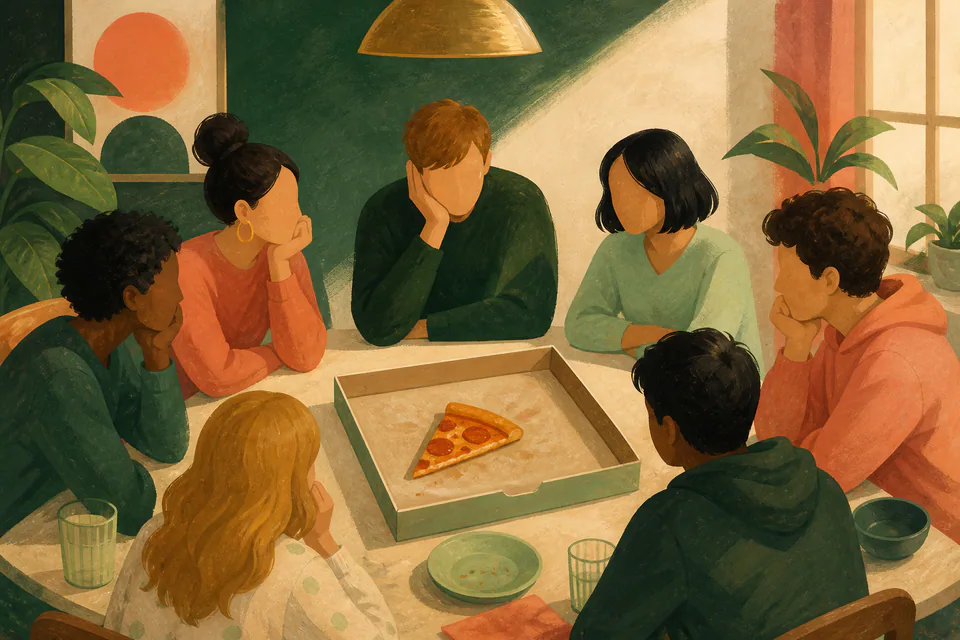
One slice of pizza remains and everyone is pretending not to want it. Can you take it?
Six friends have been circling the last slice of pizza for twenty minutes. Nobody claims it when you ask, yet two people keep glancing at the box. You are still hungry and paid the same share as everyone else.
Does politeness require leaving something that nobody will openly claim?