Listen through the publisher, then discuss the episode here or arrange an in-person Roundtable. Your city determines where to meet.
Roundtables are designed for groups of four, with a shared subject and room for everyone to speak. Come for discussion, with no dating expectation.
PBS Member Stations rely on viewers like you. To support your local station, go to: http://to.pbs.org/DonateSPACE ↓ More info below ↓ Uploaded 24-01-19 Check out the new Space Time Merch Store! Support Space Time on Patreon The search for a single number: the hubble constant, which is the rate of expansion of our universe, has consumed astronomers for generations. Finally, two powerful and independent methods have refined its measurement to unprecedented precision. The only problem is that they don’t agree. This calls into question some of our most basic assumptions about the universe. Tweet at us! @pbsspacetime Facebook: facebook.com/pbsspacetime Email us! pbsspacetime [at] gmail [dot] com Comment on Reddit: http://www.reddit.com/r/pbsspacetime Help translate our videos! Previous Episode: Why String Theory Is Wrong Hosted by Matt O'Dowd Written by Matt O'Dowd Graphics by Luke Maroldi Directing by Andrew Kornhaber In 1929, Edwin Hubble discovered the universe. He gave us our first incontrovertible proof that there are galaxies outside the Milky Way by measuring the distances to the spiral nebulae. They were many millions of light years from us –far outside the Milky Way and so must be galaxies in their own right. Combined with the Doppler-shift velocity measurements of Vesto Slipher, Hubble revealed that the galaxies are not only receding from us, but they are receding at a rate proportional to their distance. Special thanks to our Patreon Big Bang, Quasar and Hypernova Supporters: Big Bang Anton Lifshits CoolAsCats David Nicklas Fabrice Eap Juan Benet Justin Lloyd TIm Davis Quasar Dean Fuqua James Flowers Mark Rosenthal Tambe Barsbay Vinnie Falco Hypernova Chuck Zegar Danton Spivey Donal Botkin Edmund Fokschaner Jens Theisen John Hofmann Jordan Young Joseph Salomone Mark Heising Matthew O’Connor Thanks to our Patreon Gamma Ray Burst Supporters: Alexey Eromenko Antonio Ruiz Bradley Jenkins Brandon Labonte Buruk Aregawi Carlo Mogavero Daniel Lyons David Behtala David Crane David Schmidt Dustan Jones Geoffrey Short Greg Weiss Jack Frosch James Hughes James Quintero Jinal Doshi JJ Bagnell John Webber Jon Folks Jonah Joseph Emison Josh Thomas Kenneth F Leonard Kevin Warne Kyle Hofer Malte Ubl Mark Vasile Nathan Hitchings Nicholas Rose Nick Virtue Richard Broman Sammy J Scott Gossett Sigurd Ruud Frivik Tommy Mogensen سلطان الخليفي
Episode information is provided by the publisher. Listening takes place on the publisher’s service.
Why deep sea maps are SO BAD (and how to fix it)... Our maps of the ocean are surprisingly bad! On Google Maps it looks like we know so much… but we know less about the ocean floor than we do the surface of Mars. And that’s a big problem, because we are using the ocean all the time: We’re laying internet cables across it, we fight wars in it, we search it during a crisis - like the imploded OceanGate Titan submersible or the missing Malaysia Airlines Flight 370. 71% of the surface of the Earth is water! And yet we have a surprisingly limited view of what’s below it. But that’s also understandable. Because cartographically speaking, water sucks. For Mars or Earth’s surface, we can take pictures. But light doesn’t get to the ocean floor, so we need other ways to see it. The good news is, we’re developing that tech right now, and an international group called Seabed 2030 is working to piece together a better map. There is a terrifying, incredible, alien world on our own planet, and we’re
Discover how scientists developed atomic clocks, which use the vibrations of atoms to measure and maintain a globally consistent time. Uploaded 19-01-21 -- In 1967, researchers gathered to answer a long-running scientific question: just how long is a second? It might seem obvious at first. A second is the tick of a clock, the swing of a pendulum, the time it takes to count to one. But how precise are those measurements? And what is that length based on? John Kitching digs into how we scientifically define this fundamental unit of time. Lesson by John Kitching, directed by Tjoff Koong. Support Our Non-Profit Mission ---------------------------------------------- Support us on Patreon: http://bit.ly/TEDEdPatreon Check out our merch: http://bit.ly/TEDEDShop ---------------------------------------------- Connect With Us ---------------------------------------------- Sign up for our newsletter: http://bit.ly/TEDEdNewsletter Find us on Twitter: http://bit.ly/TEDEdTwitter Peep us on Instagram
Explore how the Hubble Space Telescope reveals the Universe, from iconic images to major discoveries, and how it complements the James Webb Space Telescope. "ASTROMAN: the Dark Sky Guardian" is a podcast channel that aims to explore popular science in multiple disciplines and research on interdisciplinary approaches, such as sustainability, dark-sky protection, astrophotography, space exploration, astronomy innovation, inclusive science communication, and STEAM Education by integrating science and arts. Exodus Chun-Long Sit, also known as the ASTROMAN, is a transmedia astronomy educator, popular science author, STEAM educator, and science communicator in Hong Kong. He is recently the National Astronomy Education Coordinator (Chair of Hong Kong, China) of the International Astronomical Union and President of Starrix. He was also an International Committee Member of the Dark Sky International, regularly organizing public lectures at the Hong Kong Space Museum and the Hong Kong Science Mu
#JimRohnMotivation #JimRohn #JimRohnSpeech In this Jim Rohn Motivation video, you’ll discover how failure, when understood and leveraged correctly, becomes one of the most powerful tools for growth, identity, resilience, and wisdom. Key Topics From This Motivational Video: How to reframe failure as feedback, not defeat Why your identity must be separated from your outcomes How to rebuild stronger systems after setbacks The importance of support and vulnerability after falling Why failure tests not just your plans, but your vision This powerful breakdown of failure will teach you how to stop spiraling when things go wrong and start building from what went right inside the breakdown. It's not just a motivational pep talk—it's a playbook for how to transform mistakes into momentum. When you stop fearing failure and start learning from it, your life begins to multiply in strength and direction. This Jim Rohn Motivational Video Is Perfect For: Leaders, entrepreneurs, and creatives who feel
In part 2 of this special edition episode, Tony – along with his friend Dr. Peter Diamandis, the Harvard Medical School trained M.D. and executive founder of Singularity University – explore the present and future of COVID-19. Uploaded 11-05-20 Tony and Peter speak with Mei Mei Hu and Lou Reese, Co-CEOs of United Biomedical, a company that is now offering an affordable and accurate diagnostic test for COVID-19 through its subsidiary, COVAXX Their antibody test is different from others, as it can detect not only if you currently have the virus, but also it signals if you’ve ever had the virus, which is crucial in determining the true rate of mortality associated with COVID-19 – and whether people are immune and therefore able to stop isolating, and go back to work. Lou and Mei Mei’s team at COVAXX is also working on a breakthrough alternative option to a traditional vaccine for coronavirus, which you’ll hear discussed in the last half of the episode. COVAXX: https://www.covaxx.com/ View
Until a little under two weeks ago, Silicon Valley Bank was the sixteenth largest bank in the United States, the favoured choice of tech startups due to the tailored services it provided. But by 10th March 2023, American authorities were taking control of SVB following its collapse. It had assets of over $200bn, making for the second biggest bank failure in US history. There were a number of factors behind the collapse, and it’s causing concern as it’s common for one bank collapse to be followed by another, due to what’s called financial contagion. Indeed, just a few days later it was the turn of New York-based Signature Bank to collapse. And over in Europe, Switzerland’s second largest bank Crédit Suisse had to take out a $54bn to stay afloat, before then being bought out by the country’s largest bank UBS, in a bid to halt the crisis. Why did Silicon Valley Bank collapse? How do stock market crashes happen? In under 3 minutes, we answer your questions! To listen to the last episodes,
Viewers like you help make PBS (Thank you ) . Support your local PBS Member Station here: https://to.pbs.org/DonateSPACE Uploaded 26-07-17 Unlock the secrets of Feynman Diagrams. Part 5 in our Quantum Field Theory series. And if you're submitting an answer to our challenge question email your answer by August 2nd to pbsspacetime [AT] gmail.com with the subject line "Feynman Diagram Challenge." You can further support us on Patreon at https://www.patreon.com/pbsspacetime Get your own Space Time tshirt at http://bit.ly/1QlzoBi Tweet at us! @pbsspacetime Facebook: facebook.com/pbsspacetime Email us! pbsspacetime [at] gmail [dot] com Comment on Reddit: http://www.reddit.com/r/pbsspacetime Help translate our videos! https://www.youtube.com/timedtext_cs_... Previous Episode: The Real Star Wars Feynman’s path integral shows us that, to properly calculate the probability of a particle traveling from point A to point B, we need to add up the contributions from all conceivable paths between tho
Sign Up on Patreon to get access to the Space Time Discord! Uploaded 18-08-21 The universe is going to end. But of all the possible ends of the universe vacuum decay would have to be the most thorough - because it could totally rewrite the laws of physics. Today I hope to help you understand exactly how terrified you should be. Check out the Space Time Merch Store Sign up for the mailing list to get episode notifications and hear special announcements! Hosted by Matt O'Dowd Written by Matt O'Dowd Graphics by Leonardo Scholzer, Yago Ballarini, Pedro Osinski, Adriano Leal and Stephanie Faria GFX Visualizations: Ajay Manuel Directed by Andrew Kornhaber Assistant Producer: Setare Gholipour Executive Producers: Eric Brown and Andrew Kornhaber End Credits Music by J.R.S. Schattenberg: https://www.youtube.com/user/MultiDroideka Special thanks to Our Patreon Sponsors Big Bang Supporters Ari Paul Kyle Bulloch Charlie Mrs. Tiffany Poindexter Leo Koguan Sandy Wu Matthew Miller Scott Gray Ahmad Jo
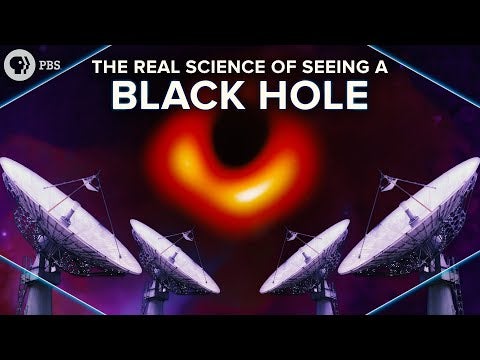
You can learn more about CuriosityStream at https://curiositystream.com/spacetime Uploaded 01-05-19 PBS Member Stations rely on viewers like you. To support your local station, go to: http://to.pbs.org/DonateSPACE How do you take a picture of a black hole and what can we learn from it? Our first ever actual bona fide photo of a black hole, made by the Event Horizon Telescope and revealed to the world in a press conference on April 10th. Since then it’s got plenty of coverage, because … I mean look at it. It’s a freaking black hole. It’s black, it’s holey, it’s everything we hoped it would be. Now that the giddiness has subsided and I personally have stopped spending hours on end staring at a black spot, we can take a breath and actually look at the real science here and discuss exactly how a picture like this could be taken and what we can learn from it. Check out the new Space Time Merch Store! Support Space Time on Patreon Need a Black Hole Refresher #Blackhole #astrophysics #spaceti
Residents should help decide which activities are allowed in shared public spaces.
Share your view, then see how readers voted. No sign-in required. This poll is shared across stories.
Do you agree or disagree?
Common Quandary
A Common Quandary to discuss
Another conversation to explore, separate from this news story.
A stranger rings up fancy apples as the cheap kind. Do you mind your own business?
At self-checkout, the shopper beside you labels expensive organic apples as the cheapest variety. An employee is distracted nearby. The difference is only a few dollars, the store is a huge chain, and the shopper notices that you noticed.
When does witnessing a small cheat make it any of your business?