Listen through the publisher, then discuss the episode here or arrange an in-person Roundtable. Your city determines where to meet.
Roundtables are designed for groups of four, with a shared subject and room for everyone to speak. Come for discussion, with no dating expectation.
PBS Member Stations rely on viewers like you. To support your local station, go to: http://to.pbs.org/DonateSPACE ↓ More info below ↓ Uploaded 09-12-19 Sign Up on Patreon to get access to the Space Time Discord! Sign up for the mailing list to get episode notifications and hear special announcements! Check out the Space Time Merch Store Since the dawn of humanity around 100 billion people have lived. How many will live in the future of our species? We might hope for a trillion times that if we colonize the galaxy. But a simple statistical argument tells us that the doom of our species is much, much closer. Hosted by Matt O'Dowd Written by Matt O'Dowd Graphics by Leonardo Scholzer and Adriano Leal Directed by: Andrew Kornhaber Executive Producers: Eric Brown and Andrew Kornhaber End Credits Music by J.R.S. Schattenberg: https://www.youtube.com/channel/UCRl6-nb4iOnsij-vnpAjp0Q In some recent episodes we’ve explored the anthropic principle and seen how it can be used to explain the fact that both our planet and our universe seem very finely tuned to allow the development of life. Our planet and/or universe can be rare and unlikely as long as there are enough other planets and/or universes to stack the odds in favour of our existence. We touched on both the potential power and potential misuse of this principle. Today we’re going to push our luck, and see how this controversial idea can be used to predict the physics of our universe, and also to predict the imminent demise of the human race. Special Thanks to Our Patreon Sponsors BIg Bang Andrew and Brenna Alexander Tamas Craig Stonaha David Barnholdt David Nicklas Fabrice Eap John S Juan Benet Morgan Hough Quasar Mark Heising Vinnie Falco Hypernova chuck zegar Danton Spivey Donal Botkin Edmund Fokschaner Hank S John Hofmann John Pollock John R. Slavik Jordan Young Joseph Salomone Julian Tyacke Justin Ash Mathew Matthew O'Connor Syed Ansar Gamma Ray Burst A G Adrian Hatch Adrien Molyneux AlecZero Andreas Nautsch Angela Prigge Bradley Jenkins Brandon labonte Dan Warren Daniel Lyons David Bethala DFaulk Eric Kiebler Frederic Simon Geoffrey Short Graydon Goss Greg Smith James Flowers Jamie Frederick John Funai John Griffith John Robinson Jonathan Nesfeder Joseph Dillman Josh Thomas Kevin Lee Kevin Warne Kyle Hofer Malte Ubl Michael Conroy Nick Virtue Nick Wright Paul Rose Robert Ilardi Scott Gossett Sean Warniaha Sipke Schoorstra Steve Bradshaw Tatiana Vorovchenko Tim Stephani Tonyface Yurii Konovaliuk
Episode information is provided by the publisher. Listening takes place on the publisher’s service.
Uploaded 11-12-17 View full lesson: https://ed.ted.com/lessons/why-is-herodotus-called-the-father-of-history-mark-robinson 2,500 years ago, the writing of history as we know it didn’t exist. The past was recorded as a list of events, with little explanation for their causes beyond accepting things as the will of the gods. Herodotus wanted a deeper understanding, so he took a new approach: looking at events from both sides to understand the reasons for them. Mark Robinson explains how “history” came into being. Lesson by Mark Robinson, directed by Remus and Kiki Thank you so much to our patrons for your support! Without you this video would not be possible! Daniel Day, Nick Johnson, Bruno Pinho, Javier Aldavaz, Rodrigo Carballo, Marc Veale, Boytsov Ilya, Bozhidar Karaargirov, Darren Toh, ilya bondarik, maxi kobi einy, Runarm , Misaki Sato, Peter Koebel, Levi Cook, Alex Kongkeo, Craig Sheldon, Andrew Bosco, Catherine Sverko, Nik Maier, Robert Sukosd, Mark Morris, Tamás Drávai, Adi V, Pet
DISCOVER NCI-1: https://nci.university/fe---sales-page-short-2-327352 Uploaded 13-06-26 Please note that the content provided in this broadcast is for informational and educational purposes only and should not be construed as legal, medical, financial, or professional advice. No material in this communication establishes any form of professional relationship that is privileged or confidential. The insights and opinions expressed herein solely reflect the personal views of the speaker based on his extensive expertise and academic background in his field of study. These are purely personal opinions and should not be taken as direct statements of fact about any individuals, whether stated explicitly or implied. Any opinion shared in this broadcast is drawn from referenced material specific to this publication only. Remember, what's discussed here are perspectives—not claims of fact. Copyright and all rights reserved.
This holiday season, inspire the next generation of thinkers with KiwiCo! In this week's episode, David is joined by Jacob Haqq-Misra (https://www.haqqmisra.net), Senior Research Investigator and Co-Founder of Blue Marble Space (https://www.bluemarblespace.org). Check out Jacob's UAP software at https://mcdonald.bluemarblespace.org (https://mcdonald.bluemarblespace.org/) To support this podcast and our research lab, head to https://coolworldslab.com/support REFERENCES - Haqq-Misra et al. (2022): “Detectability of Chlorofluorocarbons in the Atmospheres of Habitable M-dwarf Planets” - Kopparapu et al. (2021): “Nitrogen Dioxide Pollution as a Signature of Extraterrestrial Technology” - Haqq-Misra et al. (2022): “Disruption of a Planetary Nitrogen Cycle as Evidence of Extraterrestrial Agriculture” - Loeb & Turner (2012): “Detection Technique for Artificially-Illuminated Objects in the Outer Solar System and Beyond” - Crawford & Schulze-Makuch (2024): “Is the apparent absence of extraterres
We live in extraordinarily turbulent times. A lot of businesses haven’t made it, or won’t make it. Yet a lot of businesses have also innovated during this time. They’ve refocused their energy where it matters: on the customer. And they’ve come out even stronger. Uploaded 06-06-19 How can the average investor prosper and yet still protect themself? How do we navigate the financial landscape today to create long-term wealth? While you may get many different answers to these questions, one thing remains the same – you must understand the economic environment you are investing in and leverage it to your advantage. In this episode of the Tony Robbins Podcast, you will hear from Ashwin Vasan as he discusses how he built one of the most successful hedge funds during an economic winter. Ashwin is the Chief Investment Officer of macro hedge fund Trend Capital and a renowned economist with over 25 years of investment experience. He’ll share his expertise about the current global trends that may
#JimRohnMotivation #JimRohn #JimRohnSpeech Success is not about luck or one big breakthrough—it’s about the habits you build and the actions you take every single day. In this Jim Rohn Motivation video, discover the one habit that separates winners from everyone else. Learn how taking full control of your time and energy will unlock discipline, momentum, and results faster than you ever imagined.Key Topics From This Motivational Video: The power of small, consistent actions in shaping your future How distractions steal your focus and keep you stuck Why discipline beats motivation every single time The mindset shift that will help you take control of your life How to eliminate wasted time and accelerate your success Most people believe success comes from motivation, but the truth is that winners don’t rely on motivation—they rely on discipline. If you wait until you “feel like it,” you will never take action. But when you make execution a habit, everything changes. This video breaks dow
Nowadays, we will all have hundreds of apps on our phones, but we want to separate the wheat from the chaff when it comes to the software that can help us Parkies. This week, we're joined by the creator of the Parkinson’s UK Tech Guide, John Pettigrew, to help us make the most of what the app store has to offer. Find the PUK tech guide here (https://techguide.parkinsons.org.uk/). Produced and edited by Nick Hilton for Podot. Associate Producers: Ewan Cameron & Lulu Goad Music by Alex Stobbs Hosted on Acast.
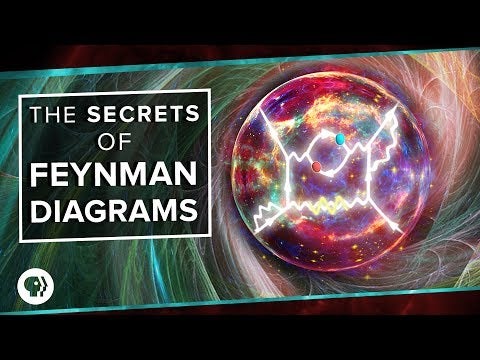
Viewers like you help make PBS (Thank you ) . Support your local PBS Member Station here: https://to.pbs.org/DonateSPACE Uploaded 26-07-17 Unlock the secrets of Feynman Diagrams. Part 5 in our Quantum Field Theory series. And if you're submitting an answer to our challenge question email your answer by August 2nd to pbsspacetime [AT] gmail.com with the subject line "Feynman Diagram Challenge." You can further support us on Patreon at https://www.patreon.com/pbsspacetime Get your own Space Time tshirt at http://bit.ly/1QlzoBi Tweet at us! @pbsspacetime Facebook: facebook.com/pbsspacetime Email us! pbsspacetime [at] gmail [dot] com Comment on Reddit: http://www.reddit.com/r/pbsspacetime Help translate our videos! https://www.youtube.com/timedtext_cs_... Previous Episode: The Real Star Wars Feynman’s path integral shows us that, to properly calculate the probability of a particle traveling from point A to point B, we need to add up the contributions from all conceivable paths between tho
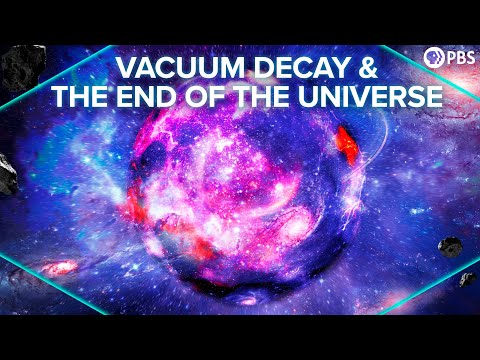
Sign Up on Patreon to get access to the Space Time Discord! Uploaded 18-08-21 The universe is going to end. But of all the possible ends of the universe vacuum decay would have to be the most thorough - because it could totally rewrite the laws of physics. Today I hope to help you understand exactly how terrified you should be. Check out the Space Time Merch Store Sign up for the mailing list to get episode notifications and hear special announcements! Hosted by Matt O'Dowd Written by Matt O'Dowd Graphics by Leonardo Scholzer, Yago Ballarini, Pedro Osinski, Adriano Leal and Stephanie Faria GFX Visualizations: Ajay Manuel Directed by Andrew Kornhaber Assistant Producer: Setare Gholipour Executive Producers: Eric Brown and Andrew Kornhaber End Credits Music by J.R.S. Schattenberg: https://www.youtube.com/user/MultiDroideka Special thanks to Our Patreon Sponsors Big Bang Supporters Ari Paul Kyle Bulloch Charlie Mrs. Tiffany Poindexter Leo Koguan Sandy Wu Matthew Miller Scott Gray Ahmad Jo
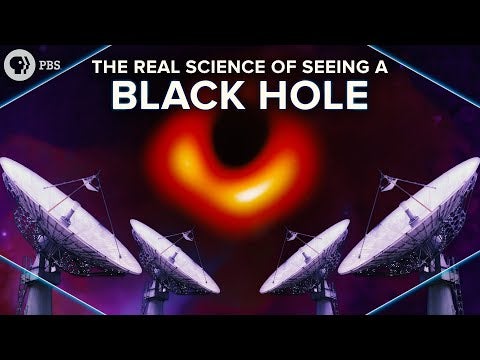
You can learn more about CuriosityStream at https://curiositystream.com/spacetime Uploaded 01-05-19 PBS Member Stations rely on viewers like you. To support your local station, go to: http://to.pbs.org/DonateSPACE How do you take a picture of a black hole and what can we learn from it? Our first ever actual bona fide photo of a black hole, made by the Event Horizon Telescope and revealed to the world in a press conference on April 10th. Since then it’s got plenty of coverage, because … I mean look at it. It’s a freaking black hole. It’s black, it’s holey, it’s everything we hoped it would be. Now that the giddiness has subsided and I personally have stopped spending hours on end staring at a black spot, we can take a breath and actually look at the real science here and discuss exactly how a picture like this could be taken and what we can learn from it. Check out the new Space Time Merch Store! Support Space Time on Patreon Need a Black Hole Refresher #Blackhole #astrophysics #spaceti
Employers should help workers retrain when their jobs disappear.
Share your view, then see how readers voted. No sign-in required. This poll is shared across stories.
Do you agree or disagree?
Common Quandary
A Common Quandary to discuss
Another conversation to explore, separate from this news story.
A coworker tells you their salary in confidence—and proves everyone else is underpaid. Do you share it?
A coworker privately tells you their salary and asks you not to repeat it. You later realize the figure is strong evidence that several equally experienced colleagues are being underpaid.
When does fairness outweigh a promise of confidentiality?