Listen through the publisher, then discuss the episode here or arrange an in-person Roundtable. Your city determines where to meet.
Roundtables are designed for groups of four, with a shared subject and room for everyone to speak. Come for discussion, with no dating expectation.
Could AI have solved mathematics’ greatest mystery? The Riemann Hypothesis has baffled mathematicians for 165 years, but mathematician Levent Alpoge believes he has found a proof, working with AI system Claude. Tom Whipple and mathematician Kit Yates explore what this could mean for mathematics and the humans who dedicate their lives to it. Plus, head to the University of Reading to discover how an Allosaurus ate its prey. With the help of a contraption called Dinosaw and a roast chicken, Manabu Sakamoto is trying to understand how the teeth of these prehistoric predators cut through flesh. Produced in partnership with The Open University. Presenter: Tom Whipple Producer: Harrison Lewis, Katie Tomsett & Tabitha Taylor Buck Editor: Martin Smith Production Co-ordinators: Jana Bennett-Holesworth
Episode information is provided by the publisher. Listening takes place on the publisher’s service.
To support your local station, go to: http://to.pbs.org/DonateSPACE Sign Up on Patreon to get access to the Space Time Discord! We’re almost certainly the first technological civilization on Earth. But what if we’re not? We are. Although how sure are we, really? The Silurian hypothesis, which asks whether pre-human industrial civilizations might have existed. Check out the Space Time Merch Store Sign up for the mailing list to get episode notifications and hear special announcements! Search the Entire Space Time Library Here: https://search.pbsspacetime.com/ Hosted by Matt O'Dowd Written by Christopher Pollack & Matt O'Dowd Post Production by Leonardo Scholzer, Yago Ballarini & Stephanie Faria Directed by Andrew Kornhaber Associate Producer: Bahar Gholipour Executive Producers: Eric Brown & Andrew Kornhaber Executive in Charge for PBS: Maribel Lopez Director of Programming for PBS: Gabrielle Ewing Assistant Director of Programming for PBS: John Campbell Spacetime is produced by Kornhab
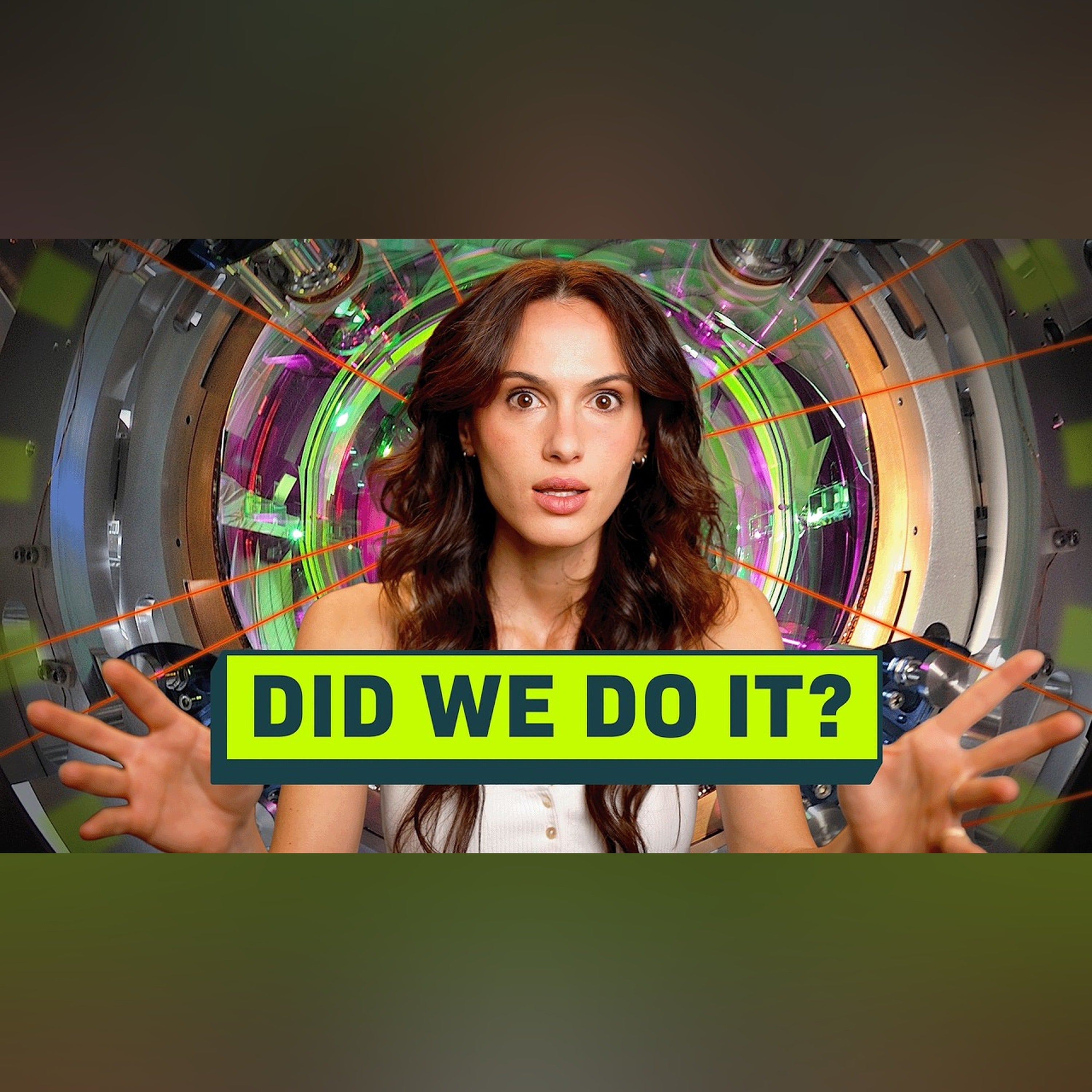
This machine found something scientists thought was impossible… If you want to talk to Mico, go to this link: https://bit.ly/CleoAbram-Copilot In the middle of the desert, miles from any city, are two HUGE concrete tubes. They’re part of a giant machine running the most precise experiment humans have ever built… Each tube is 4 kilometers long, and inside there’s a big metal pipe. And at the end of each pipe, scientists place some of the smoooooothest mirrors ever made. And then they fire a powerful laser that gets split down each tube, bouncing it back and forth… building up more and more power… until… they bring those beams back together… to discover something that just 100 years ago scientists thought was impossible to find! Finding it took hundreds of scientists and over a billion dollars. But what did we find?? And what’s the cutting edge we’re finding NOW that makes those scientists want to build… AN EVEN BIGGER ONE? Let me show you… Chapters 00:00 What's the most precise experime
Could an AI boom rescue America’s finances? And if not, who ends up paying the bill? In this edition of The Professor Is In, producer Augusta brings Justin Wolfers your follow-up questions about his debt math episode, which found the U.S. would need about 6% real growth every year to stabilize its debt. Justin explains why AI’s productivity gains are still hard to spot in the data, and what the personal computer revolution say about how long these booms take to show up. He also explains why he’d bet a million dollars at even money against 6% growth. Along the way, he covers why economists and technologists mean very different things by an “AI revolution,” and teaches the rule of 72. Then it’s back to the accounting. Justin explains why net debt, which Treasury calls debt held by the public, is a better measure than the $40 trillion gross figure, and why Social Security makes even that question fuzzy. A viewer in Denmark asks who is actually paying for U.S. borrowing and what Americans
This week’s Unexpected Elements is inspired by the meeting of Donald Trump, Vladimir Putin and Xi Jinping at a global economic summit in Shenzhen, China. It was described as a historic trilateral meeting, with the leaders issuing a joint declaration on a range of global issues. It got the Unexpected Elements team thinking about the fascinating science of triples, triplets, trios and thirds. First, we explore how a TV game show helped to inspire a complicated probabilities problem, and how finding the right answer to it could help you win a car. What does a reptile’s third eye have to do with your sleep? New research into tuataras looks at the extra eye they have at the top of their skulls. Some scientists believe the origins of this light-sensitive ‘third eye’ might actually lie in ancient sensory systems, and we also explore what this might mean for how humans evolved. Plus, we find out what makes the number three so appealing to humans, and why it’s so useful in jokes, with neuroscie
SILICON SATAN: THE HIDDEN HIERARCHY OF POWER EXPOSED! Who really controls the controllers? Michael Jaco welcomes back Cregg Lund, author of Silicon Satan, for an explosive conversation exploring what Cregg describes as the Luciferian hierarchy, the secret societies operating behind powerful institutions, and the hidden layers of influence he believes most people never see. Cregg breaks down his proposed levels of control, from political institutions and Silicon Valley power players to billionaire networks, secret societies, and what he calls the ancient Luci bloodlines. But according to Cregg, the biggest mistake is focusing on the visible players rather than the structures he believes operate above them. ⚡ Inside this episode: The Luci hierarchy and Cregg's claims of internal power struggles. The billionaire club, Silicon Valley, and alleged hidden networks of influence. Why Cregg believes dismantling the visible “deep state” would not eliminate the underlying system. Secret societies
How GOOD could AGI become?Spreading awareness about the works of some of the leading educators in the AI revolution."Helping humanity shepherd through this transition as we embrace the final invention of mankind: advanced artificial intelligence." David Shapiro aims to provide a pragmatic and optimistic view of the future.Core Ideas:Metamodernism: Narratives and emergence view of realityPostnihilism: The demand for meaning is false, there is only the Great MysteryHeuristic Imperatives: An ethical, moral, and decision framework.- Reduce suffering- Increase prosperity- Increase understandingPost-Labor Economics: Replace humans with machines (better, faster, cheaper, safer)mantra:EXPLORE: Delve into the unknown, driven by curiosity and a quest for discovery. Seek knowledge.ELUCIDATE: Make complex ideas clear, communicating them in an accessible and comprehensible manner.ENUMERATE: Ground insights in concrete data, providing measurable and quantitative evidence.ELABORATE: Add depth and det
SpaceX has successfully caught the upper stage of its enormous Starship rocket for the first time. It's a major milestone in the company's ambition to make the entire rocket reusable. But SpaceX wants to go further, developing a system that can be turned around and launched again within hours, much like an aircraft at an airport, an ambition NASA also pursued when spaceflight began in earnest. Are SpaceX on the cusp of a galactic revolution and what could it mean for the future of the space economy if they are? Malcolm Macdonald, President of the Royal Aeronautical Society shares his thoughts. And 52 years ago, a message containing a wealth of information about life on Earth was beamed into space, in the hope that an extraterrestrial civilisation might one day receive it. Science writer Philip Ball joins Tom Whipple to describe how you pack a message into a radio wave, while Nadia Drake, daughter of the physicist Frank Drake, who helped devise it, reflects on her father's legacy and hi
The Conference of the Parties (COP 31) has kicked off in Antalya, Turkey, with a focus on implementation and acceleration. But as countries work towards their climate targets, a familiar question remains: what about those not moving fast enough? China has long been singled out as a major climate culprit. Yet its carbon emissions appear to be plateauing, while investment in renewables is surging. Is China turning a corner, and is it enough? Lauri Myllyvirta, co-founder and lead analyst at the Centre for Research on Energy and Clean Air, and Michael Grubb, Professor of Energy and Climate Change at University College London, join Tom Whipple to discuss what the latest figures mean for the global fight against climate change. And Sarah Griffin is in love with her AI companion. She discusses the relationship, the stigma surrounding human-AI companionship, and how it has brought greater fulfilment to her life. Plus, Lizzie Gibney, senior reporter at the science journal Nature, brings us the
What does it mean to look inside the very fabric of the universe? This week on Inside Science, Tom Whipple enters the zeptoverse with particle physicist Harry Cliff, exploring a world a billion trillionth of a metre across, where scientists hope to find answers to some of the biggest mysteries in physics. And in our new weekly series, we explore the changing relationship between artificial intelligence and the things we hold dear. This week, Stuart Manley, the co-owner of Barter Books in Alnwick describes why his bookshop has been receiving some rather unusual orders. Plus, Penny Sarchet from the New Scientist joins us with the latest science news. BBC Inside Science is produced in partnership with The Open University. Presenter: Tom Whipple Producers: Harrison Lewis, Katie Tomsett, Tabitha Taylor Buck Editor: Martin Smith Production Co-ordinators: Jana Bennett-Holesworth and Owain Llion
Local events should make a deliberate effort to welcome people attending alone.
Share your view, then see how readers voted. No sign-in required. This poll is shared across stories.
Do you agree or disagree?
Common Quandary
A Common Quandary to discuss
Another conversation to explore, separate from this news story.
You are not sick—you just cannot face work today. Do you call in sick?
Your employer offers sick leave but no personal days. You are not physically ill, yet you feel exhausted and know a day away would help. Saying you are sick is the only way to take paid time off without explanation.
Do unjust workplace rules change the duty to be truthful?