The Most Relaxing Facts About the Planets of Our Solar System to Fall Asleep To
127 min
Listen through the publisher, then discuss the episode here or arrange an in-person Roundtable. Your city determines where to meet.
Roundtables are designed for groups of four, with a shared subject and room for everyone to speak. Come for discussion, with no dating expectation.
In this calm and sleepy facts episode, we set out on a slow and peaceful grand tour of our solar system, visiting each planet one by one as we drift outward from the Sun into the quiet dark. We begin with tiny Mercury, where a single day lasts longer than its entire year, and then glide past Venus, a world wrapped in thick golden clouds that spins so slowly backward the Sun rises in the west. From there we return to our own pale blue Earth before traveling on to Mars, home to a volcano nearly three times taller than Mount Everest and a canyon that could stretch across a continent. Along the way, we visit mighty Jupiter with its giant swirling storm and moons hiding oceans beneath their ice, pass gently by the glowing rings of Saturn, and meet Uranus, which rolls through space on its side, and deep blue Neptune, a world discovered through mathematics before anyone ever saw it. We end beyond Neptune with Pluto and the distant icy worlds of the Kuiper Belt, following the Voyager spacecraft as they carry humanity’s first close look at these planets out toward the stars. Let these 500 quiet facts about the planets carry you peacefully to sleep.
Episode information is provided by the publisher. Listening takes place on the publisher’s service.
PBS Member Stations rely on viewers like you. To support your local station, go to:http://to.pbs.org/DonateSPACE Sign Up on Patreon to get access to the Space Time Discord! I’m going to tell you about the craziest proposal for an astrophysics mission that has a good chance of actually happening. A train of spacecraft sailing the sun’s light to a magical point out there in space where the Sun’s own gravity turns it into a gigantic lens. What could such a solar-system-sized telescope do? Pretty much anything. But definitely map the surfaces of alien worlds. Check out the Space Time Merch Store Search the Entire Space Time Library Here: https://search.pbsspacetime.com/ Hosted by Matt O'Dowd Written by Matt Caplan & Matt O'Dowd Post Production by Leonardo Scholzer, Yago Ballarini, Pedro Osinski, Caique Oliveira, Adriano Leal & Stephanie Faria GFX Visualizations: Ajay Manuel Directed by Andrew Kornhaber Associate Producer: Bahar Gholipour Executive Producers: Eric Brown & Andrew Kornhaber E
This holiday season, inspire the next generation of thinkers with KiwiCo! In this week's episode, David is joined by Jacob Haqq-Misra (https://www.haqqmisra.net), Senior Research Investigator and Co-Founder of Blue Marble Space (https://www.bluemarblespace.org). Check out Jacob's UAP software at https://mcdonald.bluemarblespace.org (https://mcdonald.bluemarblespace.org/) To support this podcast and our research lab, head to https://coolworldslab.com/support REFERENCES - Haqq-Misra et al. (2022): “Detectability of Chlorofluorocarbons in the Atmospheres of Habitable M-dwarf Planets” - Kopparapu et al. (2021): “Nitrogen Dioxide Pollution as a Signature of Extraterrestrial Technology” - Haqq-Misra et al. (2022): “Disruption of a Planetary Nitrogen Cycle as Evidence of Extraterrestrial Agriculture” - Loeb & Turner (2012): “Detection Technique for Artificially-Illuminated Objects in the Outer Solar System and Beyond” - Crawford & Schulze-Makuch (2024): “Is the apparent absence of extraterres
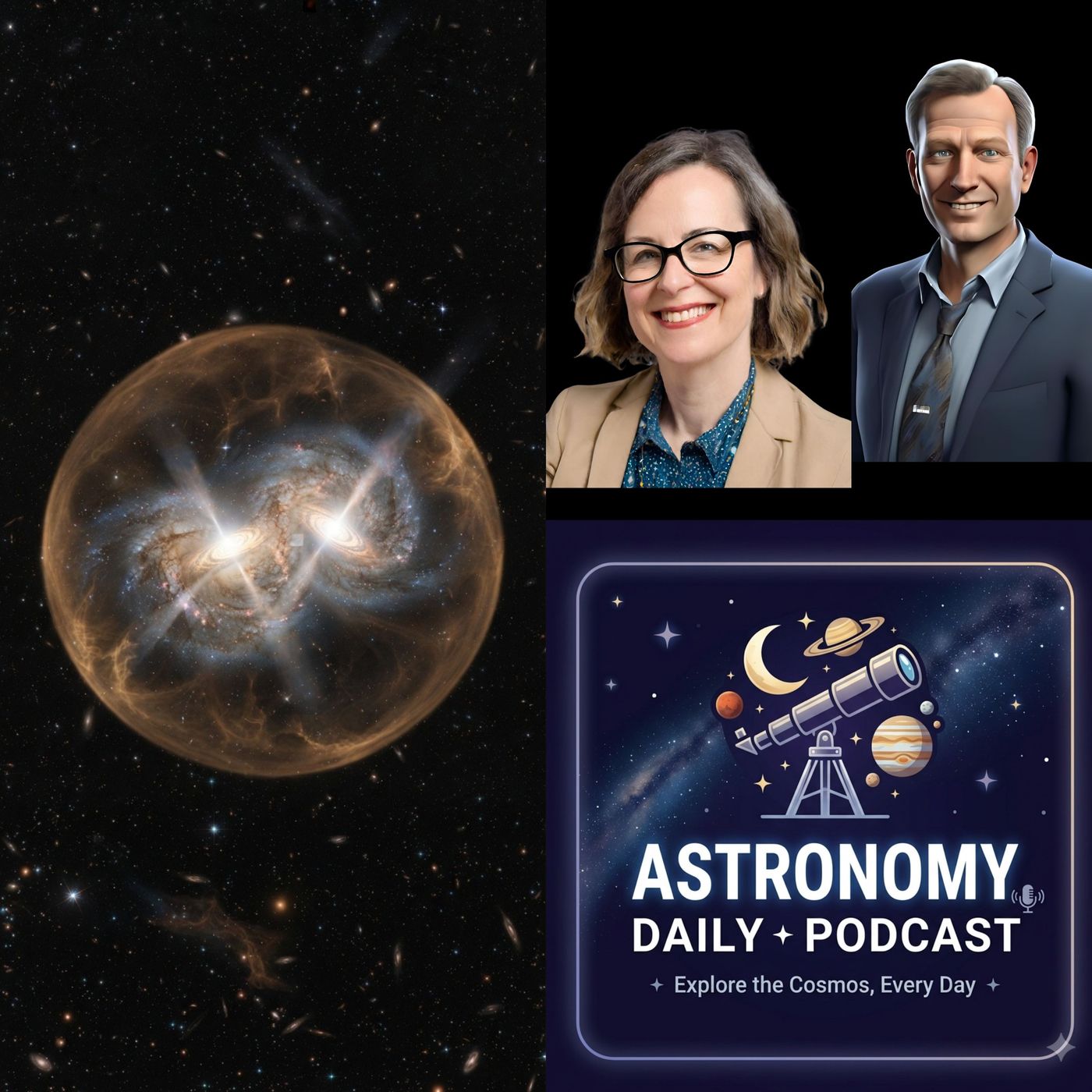
Eleven billion years ago two quasars blazed side by side, and this week astronomers weighed the invisible gas around them by the shadow it casts on the cosmic microwave background. There is 3.6 times more heat in it than gravity can explain. Plus a triple star 28 light-years away that 'should not exist', a pulsar found in ten hours with an algorithm borrowed from cryptography, The Week That Was, and the weekend sky from both hemispheres. In this episode Lead: Hot bubble around the dual quasar J1549+1245 at z = 2.37, measured with ALMA via the thermal Sunyaev–Zel'dovich effect (Hall, Zakamska et al., Nature Astronomy, 18 Nov 2026). Fresh item: Welopōʻai, the closest known triple with two white dwarfs, 28 light-years away (Artigau et al., A&A, 19 Nov 2026). Week That Was: Starship Flight 15 ship catch, CSIRO GenDIReCT and M87, SN 2026ahvu, failed supernovae in gravitational waves (E230); Voyager 1 one light-day, Beta Pictoris ices, heavy-oxygen water, Roman alignment (E231); Terra ends,
One evening, a mother was putting her three-year-old son to bed, just as she'd done countless times before. She read him a story, rubbed his back, and waited for him to fall asleep. But for no apparent reason, she suddenly became overwhelmed by sadness. The feeling was so intense that she began to cry. Later that night, she woke to the unmistakable sounds of someone playing with her son's favorite building blocks. When she went to investigate, she found him sound asleep and his toys put away. But something in the room wasn't quite as she'd left it. Over the following nights, that same unexplained sadness returned. It wasn't until she thought about the time of year, and a heartbreaking loss she'd experienced a decade earlier, that she began to wonder whether these strange occurrences might be connected. Could someone she'd lost have found a way to visit? #RealGhostStoriesOnline #TrueGhostStories #SpiritVisitations #AfterDeathCommunication #SignsFromBeyond #ChildSpirit #ParanormalEncount
Fall asleep to this quiet science story. A Boring Science For Sleep episode about How a Transistor Switches and Amplifies Signals. How a Transistor Switches and Amplifies Signals Settle in for a quiet exploration of How a Transistor Switches and Amplifies Signals. This episode follows Gold Points on Germanium; Crystals, Chemists and Surfaces; Inside the Base Region; Leakage, Heat and Stored Charge; Gates, Pairs and Quiet Logic. Listen closely or let the details drift past. Chapters 00:00:00 How a Transistor Switches and Amplifies Signals 01:38:47 Broom Making and the Binding of Broomcorn 04:09:45 Rubber Erasers and the Mixing of a Soft Compound If you enjoy this quiet science bedtime pace, you might also like Nature Documentary for Sleep (https://open.spotify.com/show/6Jcyoklmz2GdNGdCcNyQes) on Spotify — same quiet rhythm, different night.
This will be the next space suit on the moon. What can it do? Only 12 people have ever walked on the moon and they all did it within just 4 years of each other. Then, for the last 50 years, no one has gone back… but that’s about to change. Soon, astronauts will return to the moon to prepare for people to live there long-term and to get us ready to send the first humans to Mars. But to do it, they need to survive outside in space and work for hours in one of the most dangerous conditions a human will ever face. The problem is, our spacesuits for the Moon haven’t been updated in decades! But now, to make this next chapter in space possible, space suits are getting a major upgrade. These new suits will give astronauts the superpower to do more, for longer… and I’m one of the first civilians to put one on. In this video, we’re taking you behind the scenes to show how Axiom Space is designing, building, and testing NASA’s new space suits. I am going to put myself and this suit to the test,
In this calm and sleepy facts episode, we spend eight peaceful hours exploring some of the quietest wonders of the natural world. We begin beneath a gathering thunderstorm, following warm air as it rises into towering clouds and learning how a single flash of lightning can briefly heat the air to several times the temperature of the surface of the Sun. From there we settle into the hidden world of hibernation, where animals slow their breathing and their heartbeats to just a few beats a minute and wait out the long winter in stillness. Next, we wander among the trees, discovering how they lift water hundreds of feet into the air without a single moving part and quietly record each passing year in rings of wood. Finally, we cross the deserts, where the heat of the day gives way to cold, clear nights and some dunes hum softly as the sand slides down their slopes. Each story unfolds slowly and gently, with no sudden sounds, so the whole night can pass in calm and quiet wonder. Let these c
In this calm and sleepy facts episode, we journey far beyond our own solar system to explore the thousands of worlds orbiting distant stars, places we have only recently learned to find and are only just beginning to understand. We start with the basics of what an exoplanet is and how astronomers detect them, from the gentle dimming of a star as a planet passes in front of it to the tiny gravitational wobble a hidden world imprints on its sun. We visit the extraordinary harvest of the Kepler space telescope, which revealed that planets are not rare exceptions but the rule, scattered across nearly every star in the Milky Way. Along the way we encounter strange and extreme worlds, gas giants so close to their stars that they complete an orbit in mere days, tidally locked planets with one face locked in permanent daylight and the other in endless night, and rogue planets drifting alone through interstellar space with no star to call home. We explore the habitable zone, the narrow region a
In this calm and sleepy facts episode, we drift quietly into the deepest, most mysterious objects in the universe, places where gravity is so intense that not even light can escape. We begin with the basics of what a black hole actually is, not a cosmic vacuum cleaner but simply a region of space where matter has collapsed so completely that it warps the fabric of spacetime around it. We follow the life of a massive star as it burns through its fuel and collapses in on itself, crossing the threshold where nothing can stop gravity from winning. We explore the anatomy of a black hole, from the event horizon, the invisible boundary beyond which there is no return, to the singularity at the center where our understanding of physics breaks down entirely. From there we turn to the supermassive black holes sitting quietly at the centers of nearly every large galaxy, including Sagittarius A star at the heart of our own Milky Way, roughly four million times the mass of the Sun, and the enormous
Established legal precedents should change when strong reasons outweigh the value of consistency.
Share your view, then see how readers voted. No sign-in required. This poll is shared across stories.
Do you agree or disagree?
Common Quandary
A Common Quandary to discuss
Another conversation to explore, separate from this news story.
You ignore a friend's message all day while posting online. Do you owe them an explanation?
A friend sends a message that deserves a thoughtful answer. You lack the energy to respond, but spend the day posting jokes and photos. They can see that you are active and eventually ask whether something is wrong.
Does being visibly online create an obligation to be available?