Listen through the publisher, then discuss the episode here or arrange an in-person Roundtable. Your city determines where to meet.
Roundtables are designed for groups of four, with a shared subject and room for everyone to speak. Come for discussion, with no dating expectation.
In the rainforests of Madagascar, one species of lemur displays a striking resemblance to an opera singer. Like trained sopranos, these lemurs use special vocal techniques to make their calls carry across the forest. In this episode of Science Quickly, we dive into fascinating new research into how this one species, Indri indri, evolved to have such a striking musical ability and how scientists are tuning in with conservation in mind. Recommended Reading: “Dynamics of Jaw Kinematics and Fundamental Frequency Suggest Vocal Tract Tuning in the Indris’ song,” by Filippo Carugati et al, in PLOS Computational Biology. Published online September 21, 2026 (https://journals.plos.org/ploscompbiol/article?id=10.1371%2Fjournal.pcbi.1014781) “Passive Acoustic Monitoring for the Estimation of Density of the Singing Lemur (Indri indri),” by Valeria Ferrario et al, in Conservation Science and Practice. Published online October 9, 2026 (https://conbio.onlinelibrary.wiley.com/doi/10.1111/csp2.70428) Our theme music was composed by Dominic Smith.
Episode information is provided by the publisher. Listening takes place on the publisher’s service.
For some reason, it did not stop him.Now I just want to ask you something real quick to put you in the mind of a bear. If you found some of your favorite food just left out and you somehow, like me most of the time, just couldn’t resist the temptation. Bears live and eat by what is detected by their noses, so logically, after eating its fill, a proper expectation would be that the bear would go sleep off a large meal upwind of where its food was cached. The wind carries both scent and sound to the bear as it rests and acts as an alarm to it to defend its cache. The hide was still up in the birch, untouched. He dropped his packboard at the base of the tree and glanced up to see where he would need to climb. Movement in the brush, some three hundred feet away, caught his eye. Two bears, roughly thirty feet apart, moved through the brush. From their color and build, he identified them as grizzlies, also called coastal brown bears.Up to that day, every bear he had met in the wild had chose
For extra nuances and all the references, please see the newsletter: https://staycuriousmetabolism.substack.com/p/how-i-hacked-my-girlfriends-brainwith?r=40ekz2&utm_campaign=post&utm_medium=web&triedRedirect=true (https://staycuriousmetabolism.substack.com/p/how-i-hacked-my-girlfriends-brainwith?r=40ekz2&triedRedirect=true) Can light influence attraction, hormones, and even reproductive biology? In this video, we explore surprising research on light exposure, testosterone, estrogen, fertility signals, and behavioral changes observed in both animal models and human studies. From hormone cascades triggered through the skin to seasonal changes in reproductive biology, this is a fascinating look at how deeply light may shape human physiology. Along the way, I also test whether increasing my own sunlight exposure changes my testosterone levels and reveal how my girlfriend hacked my brain! For more nuance, mechanisms, protocols, and limitations behind these findings, check out the full deep
In today's brief: Lake Erie, 1957: a newly released Air Force report says two boys saw a humming, bell-shaped craft near the Enrico Fermi Atomic Plant. Skinwalker Ranch: owner Brandon Fugal calls the new files landmark and recalls a daylight saucer over the mesa. Warship footage: a 20-second 2020 infrared clip shows a light crossing a US Navy ship in the Middle East, with no Pentagon assessment. Martha's Vineyard, 1957: a spiked, nickel-coloured object that the Air Force put down to a radar-reflector balloon. Loch Ness: reported sightings jump to 15 this year, up from six in 2025. The Book of Miracles: a 16th-century manuscript of comets, blood rain and multiple suns heads to auction at Christie's. Quick hits: a 1952 file blames the saucer wave on temperature inversions; more Pentagon UFO files are on the way. Every story and source: https://believepod.com/ufo-paranormal-news-22-november-2026/ New episodes every morning. Keep your eyes on the sky. Sources: FOX 2 Detroit: https://www.fo
Explore what makes polio so dangerous, what is causing the 21st century resurgence of cases, and how we can eradicate the disease. -- In 1952, polio was everywhere: killing or paralyzing roughly half a million people annually. Yet just 10 years later, paralytic polio cases in the US dropped by 96% and we were on track to get rid of polio for good. But in recent years, the virus started striking back. So, what’s behind these recent spikes? Explore the dangers of poliovirus and the possibility of eradicating this deadly disease. Directed by Anton Bogaty. This video made possible in collaboration with Gates Ventures Learn more about how TED-Ed partnerships work: https://bit.ly/TEDEdPartner A special thanks to Ananda Bandyopadhyay, Amber Zeddies, and Kathleen O'Reilly who provided information and insights for the development of this video. Support Our Non-Profit Mission ---------------------------------------------- Support us on Patreon: http://bit.ly/TEDEdPatreon Check out our merch: htt
Brain chips don't read your mind. They do something weirder... This is Neuralink’s Next Gen R1 surgical robot. It’s one of several new ways scientists are now trying to combine the human brain with a computer, which sounds like science fiction because… it is! But not anymore. And you need to know about this right now, because human clinical trials are happening and this tech is moving fast. Some people want to use it to make you superhuman. But I think most people aren’t seeing what’s really huge if true here. This story isn’t about how to make us more like machines Instead, this might be one of the most cutting edge ways to keep us human. Visit http://mercury.com (http://mercury.com/) to join over 300 thousand entrepreneurs who love Mercury. Mercury is a financial technology company, not an FDIC-insured bank. Banking services provided through Choice Financial Group and Column N.A., Members FDIC. Chapters: 00:00 What if you put a chip in your brain? 01:02 What does a human brain feel l
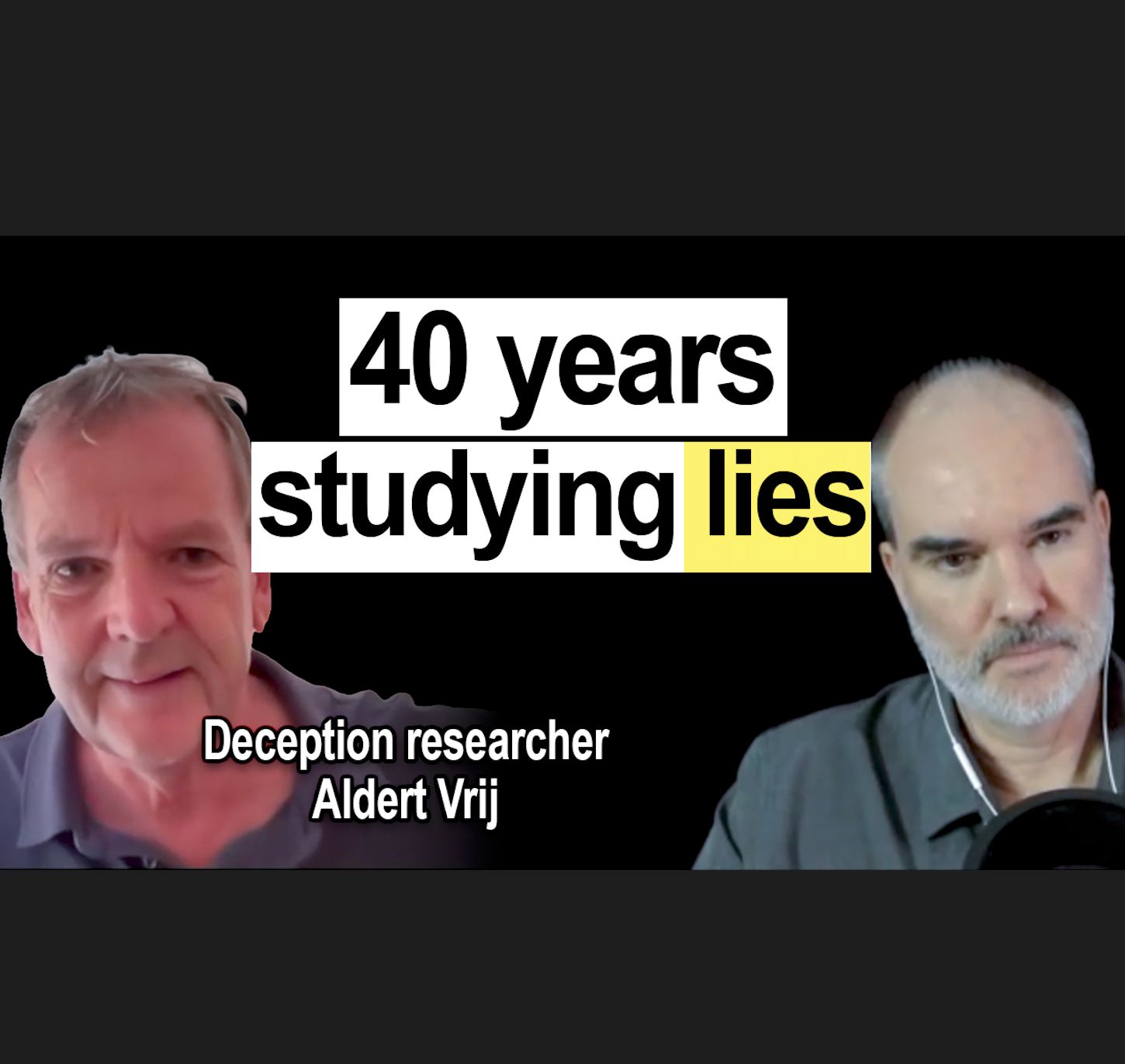
What actually works when it comes to detecting lies, and why are so many popular ideas about reading people and nonverbal behavior at odds with the scientific research? I talk with Aldert Vrij, one of the world's leading deception-detection researchers, who has spent almost four decades studying these topics. We discuss why what people say is far more revealing than their body language; why the perceived “sexiness” of reading nonverbal behavior has contributed to widespread myths and misconceptions; whether vocal behaviors like pitch, volume, and hesitation contain meaningful clues; and whether there's value in analyzing minor word choices and turns of phrase, as is done in so-called “statement analysis.” We discuss Paul Ekman's legacy as a source of faulty ideas about deception, micro-expression-based deception detection training, and the strategies that popular “body language experts” use to appear scientifically credible while simultaneously promoting ideas that conflict with the sc
In the debut episode of our new book club, we dive into Entangled Life, by Merlin Sheldrake, a fascinating exploration of the hidden world of fungi. Join us as we discuss mushroom intelligence, underground fungal networks that connect plants, fungi with more than 23,000 mating types and the surprising role a ”pretty golden mold” played in making penicillin widely available. Recommended Reading: Entangled Life. Merlin Sheldrake. Random House, 2020 (https://www.penguinrandomhouse.com/books/566795/entangled-life-by-merlin-sheldrake/) See the hidden fungal network so big it could stretch to Proxima Centauri and back (https://www.scientificamerican.com/article/see-the-hidden-fungal-network-so-big-it-could-stretch-to-proxima-centauri-and-back/) Out of Sight, ‘Dark Fungi’ Run the World from the Shadows (https://www.scientificamerican.com/article/mysterious-dark-fungi-are-lurking-everywhere/?search=fungus) Our theme music was composed by Dominic Smith.
What does it mean to do math in a world where artificial intelligence might do it better? That’s the question mathematicians are grappling with as AI systems advance. Could this technology be a boon to the field, or should mathematicians unite to fight against it? On this episode of Science Quickly, Scientific American senior reporter Joseph Howlett reads his December/January cover story, “The End of Math as We Know It.” In his piece, he speaks with leaders in the field who are embracing AI as an opportunity to solve age-old problems and others who see it as a hindrance to the true art of mathematics. Science Quickly is produced by Rachel Feltman, Fonda Mwangi, Allison Rodgers and Jeff DelViscio. This episode was edited by Allison Rodgers. The original article was fact-checked by Jennifer Hackett and copyedited by Angelique Rondeau and Aaron Shattuck.’
In this week’s Science Quickly news roundup, we’ll dig into SciAm’s vast archives with senior editor for Earth and environment Andrea Thompson to find out what the magazine was covering 50, 100 and 150 years ago. We’ll also break down some surprising news about fossil fuel emissions and its implications for our energy-hungry future. Plus, we’ll learn about the real culprits behind a Roman-era frog massacre. Recommended Reading: Oil prices are so high that CO2 emissions from fossil fuels are dropping (https://www.scientificamerican.com/article/oil-prices-are-so-high-that-co2-emissions-from-fossil-fuels-are-dropping/) Scientific American Issue Archive (https://www.scientificamerican.com/archive/issues/) Our theme music was composed by Dominic Smith.
Changing a public decision in response to new evidence is a sign of responsible leadership.
Share your view, then see how readers voted. No sign-in required. This poll is shared across stories.
Do you agree or disagree?
Common Quandary
A Common Quandary to discuss
Another conversation to explore, separate from this news story.
Your anonymous review could cost a coworker a promotion. Do you sign your name?
A company requests anonymous feedback about a colleague being considered for promotion. You have serious concerns based on direct experience, but anonymity prevents them from asking questions or understanding the context of your criticism.
Does honest criticism require accepting personal accountability for it?