Listen through the publisher, then discuss the episode here or arrange an in-person Roundtable. Your city determines where to meet.
Roundtables are designed for groups of four, with a shared subject and room for everyone to speak. Come for discussion, with no dating expectation.
What does it mean to do math in a world where artificial intelligence might do it better? That’s the question mathematicians are grappling with as AI systems advance. Could this technology be a boon to the field, or should mathematicians unite to fight against it? On this episode of Science Quickly, Scientific American senior reporter Joseph Howlett reads his December/January cover story, “The End of Math as We Know It.” In his piece, he speaks with leaders in the field who are embracing AI as an opportunity to solve age-old problems and others who see it as a hindrance to the true art of mathematics. Science Quickly is produced by Rachel Feltman, Fonda Mwangi, Allison Rodgers and Jeff DelViscio. This episode was edited by Allison Rodgers. The original article was fact-checked by Jennifer Hackett and copyedited by Angelique Rondeau and Aaron Shattuck.’
Episode information is provided by the publisher. Listening takes place on the publisher’s service.
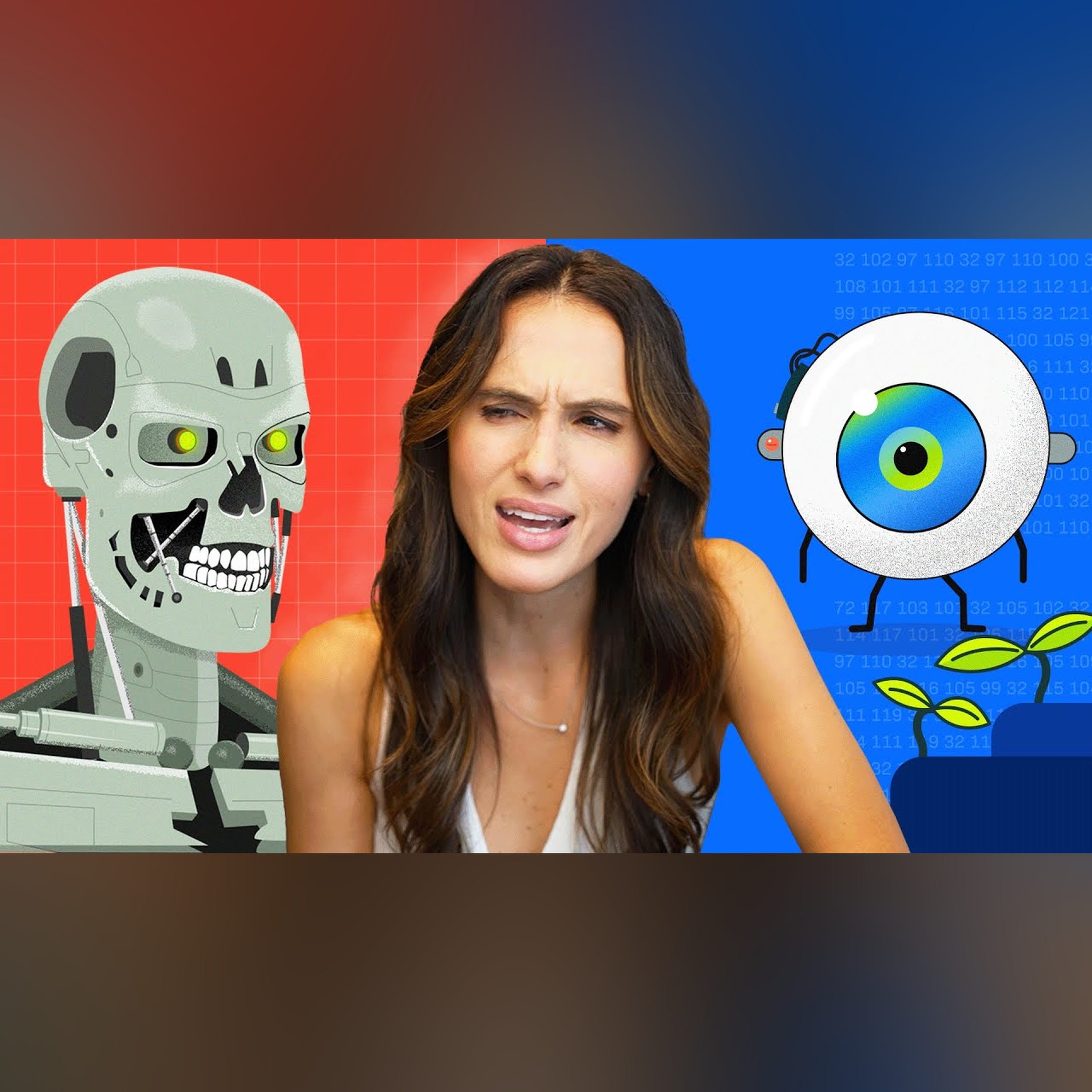
AI is here. Now what? Everyone’s talking about artificial intelligence and machine learning. There are lots of names thrown around - OpenAI’s ChatGPT and DALLE-2, Google’s Bard, Meta’s LLaMa 2, Midjourney, AlphaFold… Right now, we’re in this weird moment where lots of smart people agree we’re on the cusp of a truly world-changing technology. But some seem to be saying it's going to lead to human extinction while others are saying it’s “more profound than fire.” But it all feels so VAGUE. I want to know: How specifically would AI kill me? Or totally transform my life for the better? In this video, that’s what I’m going to try to learn. We dive into what the most extreme bad and good AI futures actually look like, so that you and I can get ready. And more importantly, so we can make sure that we get our real future RIGHT. Chapters: 00:00 Why is AI so confusing? 1:13 What is AI? 2:37 Why is everyone talking about AI now? 5:12 Why is AI dangerous? 6:22 How would AI kill me? 8:08 Should we
PBS Member Stations rely on viewers like you. To support your local station, go to: http://to.pbs.org/DonateSPACE ↓ More info below ↓ Uploaded 26-08-19 Check out the new Space Time Merch Store! Support Space Time on Patreon Do you want to major in Astrophysics? Are you thinking about becoming (or ever just wondered how one becomes) an Astrophysicists? Do you want to know Matt O’Dowd’s origin story? Then buckle up and enjoy the ride and try your astrophysics skill in calculating bubble universes to try to win some free Space Time Swag from the Merch Store. Hosted by Matt O'Dowd Written by Matt O'Dowd Graphics by Murilo Lopes Directed by: Eric Brown Produced By: Kornhaber Brown To Jump to Challenge Question: Email Challenge Answer to by 9/9/19: [email protected] Subject line: Eternal Inflation Challenge Want Even More Great Space Content? Check out the Exciting STELLAR Playlist https://www.youtube.com/playlist?list... (https://www.youtube.com/playlist?list...=) Big Bang Supporters:
How does ballet convey narrative, emotion, and character? Dive into “The Sleeping Beauty” to see how a ballet creates its essential elements. Uploaded 20-04-20 -- A baby cursed at birth. A fierce battle of good and evil. A true love awoken with a kiss. Since premiering in 1890, “The Sleeping Beauty” has become one of the most frequently staged ballets in history. So what makes this piece so beloved? And what exactly does ballet bring to this— or any other— story? Ming Luke shares what makes ballet the perfect medium for stories old and new. Lesson by Ming Luke, directed by Visorama. Animator's website: http://www.visorama.tv/ Sign up for our newsletter: http://bit.ly/TEDEdNewsletter Support us on Patreon: http://bit.ly/TEDEdPatreon Find us on Twitter: http://bit.ly/TEDEdTwitter Peep us on Instagram: http://bit.ly/TEDEdInstagram View full lesson: https://ed.ted.com/lessons/what-s-the-point-e-of-ballet-ming-luke Thank you so much to our patrons for your support! Without you this video wo
I Ate 1000 Sardines in a Month, Video: https://youtu.be/_Th54GWd8WY How Sardines Supercharged my Metabolism, Letter: https://staycuriousmetabolism.substack.com/p/the-weird-anti-insulin-hormone-that?r=40ekz2 Omega-6/3 Ratio Can Be Misleading, Letter: https://staycuriousmetabolism.substack.com/p/how-we-got-omega-fat-wrong-this-will?r=40ekz2 Best Omega-3 for the Brain, Letter: https://staycuriousmetabolism.substack.com/p/why-omega-3-supplements-dont-work?r=40ekz2 If you want to get your Omega-3 via Omega Quant, click on this link: https://omegaquant.com/ref/864 Fatty Acid Research Institute: https://www.faresinst.org (https://www.faresinst.org/) Description: In this conversation, I sit down with Professor William Harris, one of the world’s leading experts on omega-3 and omega-6 fatty acids, to cut through confusion around fish oil, seed oils, cardiovascular health, and brain health. We break down what omega-3 and omega-6 fats actually are, why their chemistry matters, and how they’re conv
THE SEARCH FOR THE ULTIMATE RED LIGHT THERAPY IS OVER! After decades of exploring wellness technologies, Michael Jaco sits down with Rob Rene, founder of Exodus Strong, to explore the Red Light+ Total Body Reset system, the science behind red and near-infrared light, and why this technology has become such an important part of their wellness conversation. Rob's remarkable personal journey—including surviving five near-death experiences—inspired his mission to develop practical wellness tools that people can incorporate into their everyday lives. Discover the full-body Red Light+ Mat, designed for convenient 20-minute sessions, and the portable Red Light+ Wand, created for targeted use on areas such as the knees, shoulders, hands, and lower back. Michael and Rob discuss the technology, personal experiences, and how red light therapy may support a daily wellness routine. BLACK FRIDAY–CYBER MONDAY LISTENER EXCLUSIVE! This is your opportunity to explore Exodus Strong's special holiday offe
My special guest tonight is author and cryptozoologist Lyle Blackburn who's here to discuss an upright walking creature that resembles a lizard terrorizing a town in South Carolina. From the swamplands near Bishopville, South Carolina, come reports of a seven-foot-tall, scaly humanoid creature the locals call the "Lizard Man." Over the years, the creature has been seen by numerous witnesses, including a teenager who claimed it attacked him one night near a remote area called Scape Ore Swamp. The young man's testimony and physical evidence was so compelling, it not only launched a serious investigation by the local sheriff's office but an all-out monster hunt that drew hundreds of people to the small town. This real-life "creature from the black lagoon" has inspired major national news coverage, even a call from the famous CBS news anchor, Dan Rather, as he and the rest of the world clamored to know more about Bishopville's elusive monster. The case is often mentioned in books, websites
In the rainforests of Madagascar, one species of lemur displays a striking resemblance to an opera singer. Like trained sopranos, these lemurs use special vocal techniques to make their calls carry across the forest. In this episode of Science Quickly, we dive into fascinating new research into how this one species, Indri indri, evolved to have such a striking musical ability and how scientists are tuning in with conservation in mind. Recommended Reading: “Dynamics of Jaw Kinematics and Fundamental Frequency Suggest Vocal Tract Tuning in the Indris’ song,” by Filippo Carugati et al, in PLOS Computational Biology. Published online September 21, 2026 (https://journals.plos.org/ploscompbiol/article?id=10.1371%2Fjournal.pcbi.1014781) “Passive Acoustic Monitoring for the Estimation of Density of the Singing Lemur (Indri indri),” by Valeria Ferrario et al, in Conservation Science and Practice. Published online October 9, 2026 (https://conbio.onlinelibrary.wiley.com/doi/10.1111/csp2.70428) Ou
In the debut episode of our new book club, we dive into Entangled Life, by Merlin Sheldrake, a fascinating exploration of the hidden world of fungi. Join us as we discuss mushroom intelligence, underground fungal networks that connect plants, fungi with more than 23,000 mating types and the surprising role a ”pretty golden mold” played in making penicillin widely available. Recommended Reading: Entangled Life. Merlin Sheldrake. Random House, 2020 (https://www.penguinrandomhouse.com/books/566795/entangled-life-by-merlin-sheldrake/) See the hidden fungal network so big it could stretch to Proxima Centauri and back (https://www.scientificamerican.com/article/see-the-hidden-fungal-network-so-big-it-could-stretch-to-proxima-centauri-and-back/) Out of Sight, ‘Dark Fungi’ Run the World from the Shadows (https://www.scientificamerican.com/article/mysterious-dark-fungi-are-lurking-everywhere/?search=fungus) Our theme music was composed by Dominic Smith.
In this week’s Science Quickly news roundup, we’ll dig into SciAm’s vast archives with senior editor for Earth and environment Andrea Thompson to find out what the magazine was covering 50, 100 and 150 years ago. We’ll also break down some surprising news about fossil fuel emissions and its implications for our energy-hungry future. Plus, we’ll learn about the real culprits behind a Roman-era frog massacre. Recommended Reading: Oil prices are so high that CO2 emissions from fossil fuels are dropping (https://www.scientificamerican.com/article/oil-prices-are-so-high-that-co2-emissions-from-fossil-fuels-are-dropping/) Scientific American Issue Archive (https://www.scientificamerican.com/archive/issues/) Our theme music was composed by Dominic Smith.
Officials should publicly explain serious mistakes that affect a competition's outcome.
Share your view, then see how readers voted. No sign-in required. This poll is shared across stories.
Do you agree or disagree?
Common Quandary
A Common Quandary to discuss
Another conversation to explore, separate from this news story.
The restaurant gives free birthday cake. Is moving your birthday by a week close enough?
A restaurant offers a spectacular free dessert on birthdays. Your birthday was last week, but nobody took you out then. When the server asks whether anyone is celebrating, your friends point at you and wait for your answer.
How much flexibility can a harmless celebration tolerate before it becomes a lie?