Your body doesn't work like you think... Take your personal data back with Incogni. How and when people are having kids is changing, but our bodies aren't. As we get older, it can get harder to have kids when we want to. So smart people figured out it’s possible to remove eggs, freeze them, and unfreeze them to use later. They can even fertilize those eggs to make embryos and freeze those. Basically, humans invented cryosleep! … Just for tiny cells. It’s totally sci-fi - and you need to know about it. This is a level of control over our bodies no species has ever had before. It’s already changing people’s lives - and how our species can reproduce. But there are real concerns about whether it’s worth it. Because let me tell you, the process is not easy. I’ve been taking medication for two weeks. And at the same time, I’ve been doing research, talking to doctors, and learning as much as I can about the cutting edge of fertility tech. In this video, I'm going to take you behind the scenes
For a written breakdown, early access to content like this, and extra nuances, see the associated StayCurious Metabolism newsletter: https://staycuriousmetabolism.substack.com/p/why-you-need-to-track-your-heart?r=40ekz2 If you want to try the omega supplement I use, Accentrate Omega Max, here’s the link: https://www.fenixhealthscience.com/staycurious Heart rate variability (HRV) is more than just a number, it’s a real-time window into how well your brain, heart, and nervous system are working together. In this video, we break down what HRV actually measures, why it’s such a powerful predictor of mortality and heart attack risk, and how it reflects something deeper: your body’s ability to adapt, recover, and respond to stress. We walk through landmark studies showing that low HRV is associated with significantly higher risk of death and first cardiac events—even after controlling for traditional risk factors. But this isn’t just about risk. HRV is something you can measure today and act
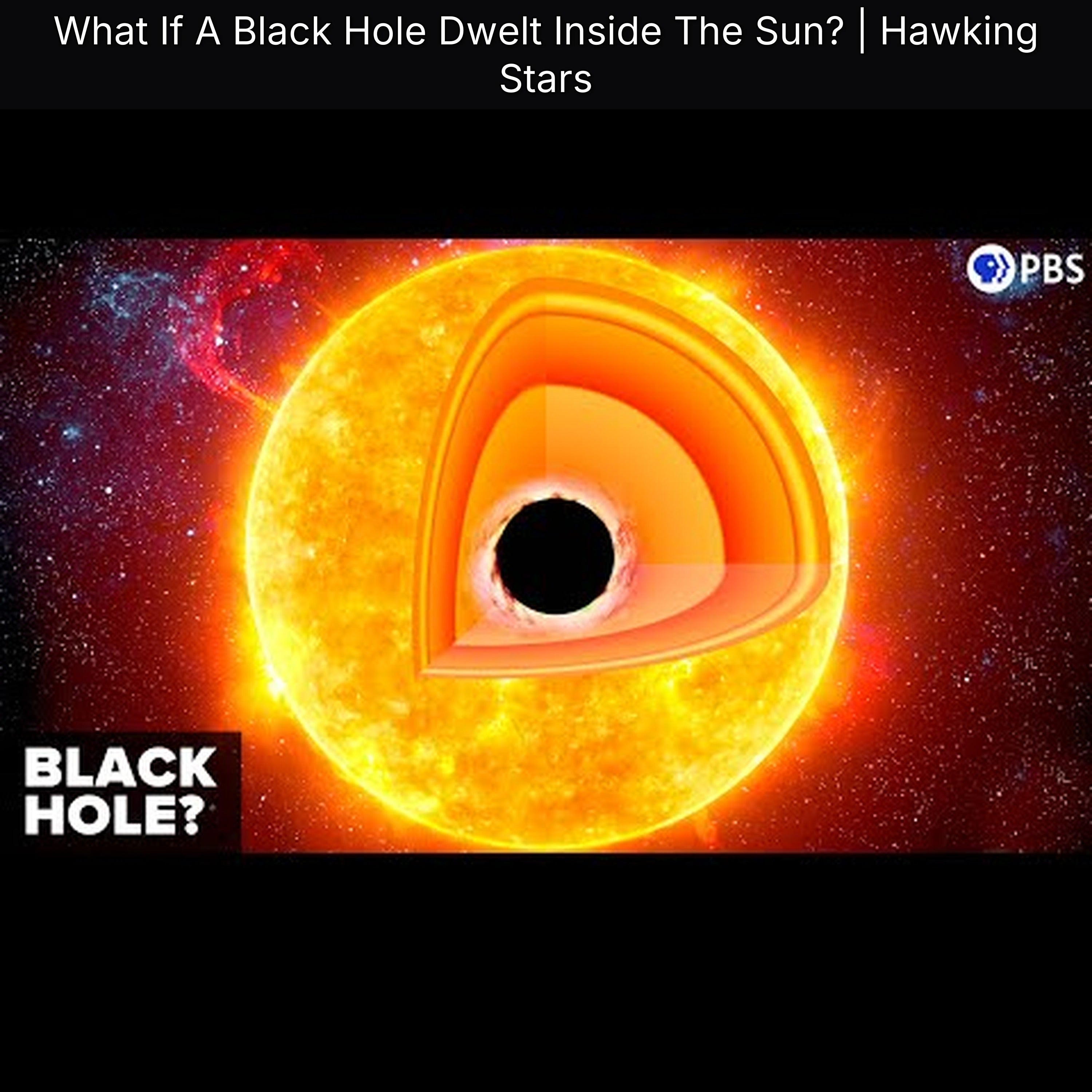
PBS Member Stations rely on viewers like you. To support your local station, go to:http://to.pbs.org/DonateSPACE Sign Up on Patreon to get access to the Space Time Discord! A fun nightmare sci-fi scenario is the sun being consumed by a black hole. Fortunately the chance of a black hole randomly wandering into our solar system is pretty tiny. That’s good news. But what if it’s already here, hiding in the core of the Sun and slowly eating it from the inside out? Hawking Stars Journal Papers: Search the Entire Space Time Library Here: https://search.pbsspacetime.com/ Hosted by Matt O'Dowd Written by Matt Caplan & Matt O'Dowd Post Production by Leonardo Scholzer, Yago Ballarini & Stephanie Faria Directed by Andrew Kornhaber Associate Producer: Bahar Gholipour Executive Producers: Eric Brown & Andrew Kornhaber Executive in Charge for PBS: Maribel Lopez Director of Programming for PBS: Gabrielle Ewing Assistant Director of Programming for PBS: John Campbell Spacetime is produced by Kornhaber
Over 20,000 Uighur refugees escaped repression in China by fleeing to Syria at the height of its brutal civil war. Originally from north western China, the Muslim minority fought fiercely against the Assad regime. But now that the war is over, they live in limbo, unable to return home or even contact loved ones while the Chinese state continues its campaign against their community. So will the new Syrian government honour their sacrifice? Or try to stay on good terms with the Chinese state? Our reporter has been to northern Syria to meet them. Guest: Anthony Loyd, special correspondent, The Times Host: Luke Jones Producer: Robyn Simon and Harry Stott We want to hear from you - email: [email protected] Read more: They fought for Syria’s freedom. Will they fight for their own? (https://www.thetimes.com/world/middle-east/article/uighur-fighters-syria-xinjiang-china-cfv5733d8) Further listening: SAS in Syria: the untold murder probe (https://pod.fo/e/6c8ea9) Clips: The New York Times,
We are back yet again with another round of TDA Debate Club. Our topic this time is: Should Australia move to a four day work week? On today’s episode Zara and Elliot are going head to head over what could be one of the biggest changes to working life in Australia, including where the idea came from and what the TDA audience has to say about it. Hosts: Elliot Lawry and Zara Seidler Executive Producer: Orla Maher Producer: Imogen Abbott Want to support The Daily Aus? That's so kind! We would be so grateful. We are completely independent. Want more from TDA? Have feedback for us? We’re always looking for new ways to improve what we do. If you’ve got feedback, we’re all ears. Tell us here (https://thedailyaus.typeform.com/to/D0EhJI4S). Shot on Fujifilm (https://www.fujifilm.com/au/en).
In this episode: 00:25 Voyager 1 goes farther than any human-made object has gone before Nature: Voyager 1 achieves a cosmic first: one ‘light day’ from Earth (https://www.nature.com/articles/d41586-026-03672-1) 04:37 Genomic analysis reveals how vampire bats stomach their gory diet Nature: Secrets of the vampires: genomes reveal how these bats live off blood alone (https://www.nature.com/articles/d41586-026-03706-8) Hosted on Acast.
Finding provides new insights into what happens within stellar mergers — plus, using quantum physics to securely pinpoint someone’s location. 00:46 What happens when a star engulfs its neighbour Research Article: Karambelkar et al. (https://www.nature.com/articles/s41586-026-11221-z) 10:15 Research Highlights Nature: Microplastics change the colour of the sea near the Great Pacific Garbage Patch (https://www.nature.com/articles/d41586-026-03637-4) Nature: Rattlesnakes have personalities too — to venomous effect (https://www.nature.com/articles/d41586-026-03536-8) 12:56 How quantum technology could help defeat fraud Research Article: Kavuri et al. (https://www.nature.com/articles/s41586-026-11247-3) Hosted on Acast.
More needs to be done to combat climate change, but what? We discuss some big ideas to rein in emissions. Projections of future climate change show a relatively cooler world thanks to the growth of renewable energy. And yet the world is still on track to reach around 2.6˚C of warming by the end of the century — far beyond what many climate scientists say we need to avoid the worst impacts of climate change. So, what are we going to do about it? In the second episode of Cooked? I talk to experts around the world about their big ideas of what we can do to tackle climate change. We talk about energy, food, economics and how the world needs to adapt to a warmer world. 00:00 How can we save the world? 04:27 The synergistic solutions to climate change and other big challenges 12:03 Can we end humanity’s addiction to meat? 21:49 How to make economics work to fight climate change 33:30 Why the world needs to adapt 43:40 Preview of next time Further reading: Not the End of the World (https://ww
Sports venues should actively welcome first-time visitors and people attending alone.
Share your view, then see how readers voted. No sign-in required. This poll is shared across stories.
Do you agree or disagree?
Common Quandary
A Common Quandary to discuss
Another conversation to explore, separate from this news story.
You lecture everyone about climate change—then get invited on a dream flight. Do you go?
A close friend living overseas invites you to an important celebration. Flying is affordable but carbon-intensive. Your individual decision will not determine whether the flight operates, yet it conflicts with commitments you publicly encourage others to make.
When is a small personal contribution to a large harm morally significant?