Unparliamentary: Tales from Canada's Colourful Parliamentary Past
54 min
Listen through the publisher, then discuss the episode here or arrange an in-person Roundtable. Your city determines where to meet.
Roundtables are designed for groups of four, with a shared subject and room for everyone to speak. Come for discussion, with no dating expectation.
Think Canadian politics has always been polite and predictable? Think again. In this episode, LAC curator Forrest Pass is joined by author Charlie Feldman, who refutes this commonly held opinion in his book Unparliamentary: Tales from Canada’s Colourful Parliamentary Past. Shining a light on records from the collections at LAC, this lively conversation explores the scandals, pranks, fiery debates, and larger-than-life personalities that prove Canada's political history is anything but dull.
Episode information is provided by the publisher. Listening takes place on the publisher’s service.
For America's first 100 years, Supreme Court justices were an integral part of political life. They ran for office from the bench, met with constituents, wrote newspaper op-eds about their work, and more. Today, of course, they do their work mostly in secret and rarely speak to the public aside from a few appearances each year. How did things get this way, and what would happen if the justices went back to having a closer relationship with the people? Our guest today answers those questions and sheds light on what life was like for justices in the 19th century. Rachel A. Shelden is an associate professor of history and director of the George and Ann Richards Civil War Era Center at Penn State. She is the author of The Political Supreme Court: A Forgotten History (https://uncpress.org/9781469697130/the-political-supreme-court/), which explores the court's role as an "unmistakably a political institution." The book also follows the shifts at the turn of the twentieth century, when member
Former Prime Minister Stephen Harper joins Hub Dialogues to discuss his political journey and new memoir, Here for Canada. Harper reflects on his unconventional path from Toronto to Alberta to Ottawa, his role in building the Conservative Party of Canada, and the tension between populism and conservatism. He examines the challenge of uniting Canada’s fractured conservative movement, emphasizing fiscal responsibility and economic management as core principles. Harper also discusses his approach to Quebec, the importance of building durable political institutions over personal ambition, and how successful conservative politics must balance philosophical grounding with responsiveness to ordinary Canadians’ concerns. This is part one of The Hub’s interview. Stay tuned for part two, coming Wednesday. The Hub is Canada’s fastest growing independent digital news outlet. https://tinyurl.com/3a7zpd7e (Apple) https://tinyurl.com/y8akmfn7 (Spotify) Watch a video version on YouTube: https://www.yo
Why has Pauline Hanson's moment finally come, almost 30 years after she first won a seat? How does One Nation turn nostalgia for an imagined past into political power? Could a party with no experience in government really end up running the country? In this live episode, recorded at ANU, Professor Mark Kenny talks with author John Birmingham about his new Quarterly Essay, Another Country: The Rise and Rise of One Nation. They discuss Hanson's lucky career from Ipswich to the Senate, the four demographic filters of race, place, age and education that predict One Nation support, and the March for Australia rallies. They also look at how the shift to three main political forces is unsettling the Liberals, how the neoliberal economic consensus helped create today's grievance politics, and what to expect from the Victorian election. Hosted on Acast.
The recent upheaval in the world economy, driven by unsettling news from the AI tech oligarchy Nvidia scandal, is a wake-up call for all of us. The urgent need to protest against dangerous data centres has never been more critical. In Alberta, we are witnessing a remarkable shift: traditional conservatives are distancing themselves from Premier Danielle Smith and her chaotic MAGA party, creating an unprecedented opportunity for the NDP. This shift highlights the public’s growing concern over unregulated AI and data centres — an issue that affects us all.While PM Mark Carney focuses on attracting investment to Canada’s energy sector, his strategy may be a bluff aimed at outmaneuvering Smith and messaging investors. This landscape is shifting rapidly, and we must stay informed. Join Max Fawcett, Lead Columnist for Canada's National Observer, as he delivers a thought-provoking assessment of Alberta’s state and the risks AI poses. This isn't just another political discussion; it's a rallyi
Canada has known for decades that the baby boom would reach its 80s. Now it has. By 2030, there will be about 200,000 more Canadians aged 85 and older than there were in 2025. In this episode, Donna Duncan sits down with Kevin Milligan, Professor of Economics at thehttps://economics.ubc.ca/Vancouver School of Economics (https://economics.ubc.ca/) at the University of British Columbia. Kevin has spent his career studying pensions, retirement and how our lives change as we grow older. When Donna asks if governments are ready, he doesn’t hedge. Their conversation looks at long-term care as more than a cost in a government health budget. It helps family caregivers stay in their jobs. It gives newcomers a place to build their lives in Canada. And as more of us live longer, healthier lives, more of us, not fewer, will need it near the end. It’s a reminder that the way we think about aging, and about care, may still be too narrow. Resources mentioned in this episode: The Economics of Long-Ter
Food rituals twine through our calendars and religious observances: what we eat, when we eat it, and when we go without. How does that repetition become ritual? How does food become sacred? And who gets to decide what belongs on the table—and who belongs around it? Complexified is joined by culinary historian and two-time James Beard Award–winning author Michael W. Twitty (https://michaelwtwitty.com/). In The Cooking Gene (https://thecookinggene.com/), he traces his ancestry through African American culinary history. In Koshersoul (https://koshersoulbook.com/), he explores food, faith, and Black and Jewish identity. Our conversation moves from his year of food traditions to the meals that make us feel at home—and the moments when they don’t. We talk about changing family recipes, welcoming someone’s food along with their full selves, and the difference between borrowing a tradition and respecting the people who carry it. And as we gather for eating season, Michael offers a reminder: ca
Advertised prices should include all unavoidable charges.
Share your view, then see how readers voted. No sign-in required. This poll is shared across stories.
Do you agree or disagree?
Common Quandary
A Common Quandary to discuss
Another conversation to explore, separate from this news story.
The restaurant gives free birthday cake. Is moving your birthday by a week close enough?
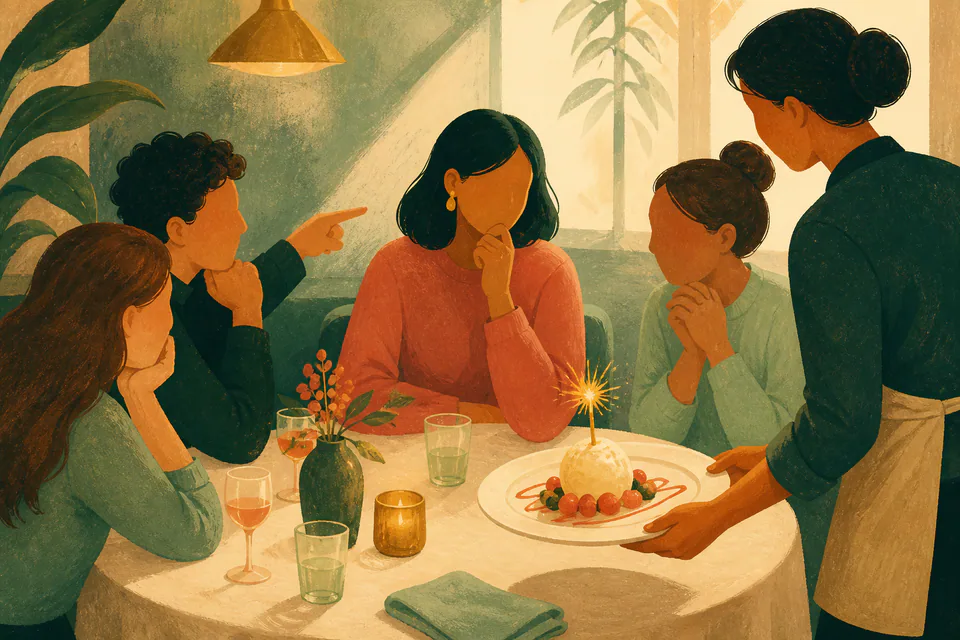
A restaurant offers a spectacular free dessert on birthdays. Your birthday was last week, but nobody took you out then. When the server asks whether anyone is celebrating, your friends point at you and wait for your answer.
How much flexibility can a harmless celebration tolerate before it becomes a lie?