English-language podcasts

CrashCourse

Venice and the Ottoman Empire: Crash Course World History #19

15 min

Listen through the publisher, then discuss the episode here or arrange an in-person Roundtable. Your city determines where to meet.

Roundtables are designed for groups of four, with a shared subject and room for everyone to speak. Come for discussion, with no dating expectation.

In which John Green discusses the strange and mutually beneficial relationship between a republic, the city-state of Venice, and an Empire, the Ottomans--and how studying history can help you to be a better boyfriend/girlfriend. Together, the Ottoman Empire and Venice grew wealthy by facilitating trade: The Venetians had ships and nautical expertise; the Ottomans had access to many of the most valuable goods in the world, especially pepper and grain. Working together across cultural and religious divides, they both become very rich, and the Ottomans became one of the most powerful political entities in the world. We also discuss how economic realities can overcome religious and political differences (in this case between Muslims and Christians), the doges of Venice, the sultans of the Ottoman empire, the janissaries, and the so-called slave aristocracy of the Ottoman Empire, and how money and knowledge from the Islamic world helped fuel and fund the European Renaissance. Also, there's a They Might Be Giants joke. Chapters: Introduction 00:00 Venice 1:02 Venetian Trade 1:26 Piazza San Marco 2:48 Venetian Imports, Exports, & Economy 3:45 Venetian Government 4:25 The Ottomans 4:46 Ottoman Sultans 5:21 An Open Letter to Ottoman Eunuchs 7:15 The Ottomans' and Venetians' Relationship 8:12 Credits 9:38 -- If you really want to read about Ottoman eunuchs (warning: it's explicit), here you go: http://en.wikipedia.org/wiki/Eunuch#Ottoman_Empire (http://en.wikipedia.org/wiki/Eunuch) -- Crash Course is on Patreon! Want to find Crash Course elsewhere on the internet? Facebook - http://www.facebook.com/YouTubeCrashCourse Twitter - http://www.twitter.com/TheCrashCourse Instagram - https://www.instagram.com/thecrashcourse/ CC Kids: http://www.youtube.com/crashcoursekids

Episode information is provided by the publisher. Listening takes place on the publisher’s service.

Listen at the source ↗

Featured places to meet in Palo Alto, CA

Explore these places and arrange a conversation through ThinkMatch.

City guide for Palo Alto, CA

More from CrashCourse

CrashCourse

Dark Energy, Cosmology part 2: Crash Course Astronomy #43

18 min

The majority of the universe is made up of a currently mysterious entity that pervades space: dark energy. We don’t know exactly what it is, but we do know that dark energy accelerates the expansion of space. We think this means the Universe will expand forever, even as our view of it shrinks while space expands faster all the time. Check out the Crash Course Astronomy solar system poster here: http://store.dftba.com/products/crashcourse-astronomy-poster If you want to learn more about the creation and death of the universe, watch Crash Course Big History here: https://youtube.com/playlist?list=PL8dPuuaLjXtMczXZUmjb3mZSU1Roxnrey -- Chapters: Introduction: The Expanding Universe 00:00 The Expansion of Space is Accelerating 2:17 What is Dark Energy? 4:19 Will the Universe Expand Forever? The Geometry of the Universe 5:20 The Cosmic Horizon of the Observable Universe 6:50 Review 10:20 -- GEOMETRY OF THE UNIVERSE RESOURCES Geometry: Expanding faster than light: General expansion: -- PBS Di

Discuss this episode

CrashCourse

Diazonium Salts and Nucleophilic Aromatic Substitution: Crash Course Organic Chemistry #47

20 min

Have you ever wondered where cured meats like salami or pepperoni get their bright red color? Of course its from organic chemistry! A chemical called nitric acid gives them that bright color, while also increasing their shelf. It's also involved in some other interesting reactions. In this episode of Crash Course Organic Chemistry we'll see how nitrous acid reacts with primary amines to form diazonium salts, we'll learn about alkyldiazonium salts and aryldiazonium salts, and see what conditions are necessary for nucleophilic aromatic substitutions. Series Sources: Brown, W. H., Iverson, B. L., Ansyln, E. V., Foote, C., Organic Chemistry; 8th ed.; Cengage Learning, Boston, 2018. Bruice, P. Y., Organic Chemistry, 7th ed.; Pearson Education, Inc., United States, 2014. Clayden, J., Greeves, N., Warren., S., Organic Chemistry, 2nd ed.; Oxford University Press, New York, 2012. Jones Jr., M.; Fleming, S. A., Organic Chemistry, 5th ed.; W. W. Norton & Company, New York, 2014. Klein., D., Organ

Discuss this episode

CrashCourse

Alkene Addition Reactions: Crash Course Organic Chemistry #16

19 min

Like a trendy dance, a fighting combo, or a secret handshake, organic reactions can be broken down into simpler steps. In this episode of Crash Course Organic Chemistry, we’ll specifically be looking at alkene addition reactions, and with each new reaction ask ourselves three questions to help us puzzle through the mechanism and understand what’s going on. Episode Sources: Le Couteur, P, Burreson, J. Napoleon’s Buttons: 17 molecules that changed history., Penguin, New York, 2004, Chapter 1. Whipps, H., “How the Spice Trade Changed the World,” https://www.livescience.com/7495-spice-trade-changed-world.html Last accessed, 3/28/2020. Henriques, Martha, “How spices changed the ancient world,” http://www.bbc.com/future/bespoke/made-on-earth/the-flavours-that-shaped-the-world/ Last accessed, 3/28/2020. Hashimoto, K., Yaoi, T., Koshiba, H., Yoshida, T., Maoka, T., Fujiwara, Y., Yaamoto, Y, Mori, K., “Photochemical Isomerization of Piperine, a Pungent Constituent of Pepper”, Food Sci. Technol.

Discuss this episode

Community Poll

Landscape restoration needs funding commitments that extend beyond normal political terms.

Share your view, then see how readers voted. No sign-in required. This poll is shared across stories.

Do you agree or disagree?

Choose one answer

Common Quandary

A Common Quandary to discuss

Another conversation to explore, separate from this news story.

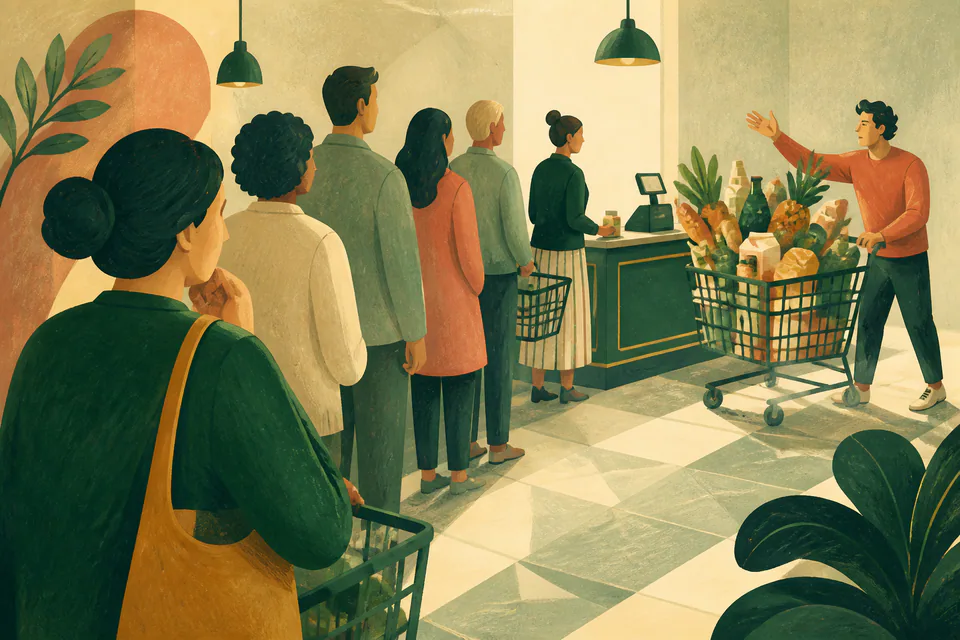
Someone holds a grocery line spot while their partner fills the cart. Is that cutting?

A shopper with one item stands ahead of you in a long checkout line. Just before reaching the register, their partner arrives with a cart packed to the top and joins them. They insist they were shopping together all along.

Can one person reserve a place in line for an unknown amount of work?

Explore this quandary