Listen through the publisher, then discuss the episode here or arrange an in-person Roundtable. Your city determines where to meet.
Roundtables are designed for groups of four, with a shared subject and room for everyone to speak. Come for discussion, with no dating expectation.
The planet Venus and the star Spica are standing side by side in the dawn sky. They’re well up in the southeast at the first blush of twilight. Venus is the brilliant “morning star” – the brightest object in the night sky other than the Moon. Spica is quite close to the right or lower right of Venus. It’s only about one-half of one percent as bright as Venus. Even so, it’s one of the brighter true stars in the night sky, so you won’t have any trouble picking it out. The two bodies look like they could practically reach out and touch each other. But that appearance is completely misleading. They’re actually far, far apart. Right now, Venus is closer to us than any other major object except the Moon – about 35 million miles away. That distance is equal to about 6,000 round-trips between New York and Los Angeles. At a trip length of 12 hours, that’s more than eight years in the air. Spica is 250 light-years away – roughly 42 million times farther than Venus. At the speed of an airliner, it would take about 300 million years to get there. Even at that great distance, Spica qualifies as a close neighbor. The most-distant objects we’ve seen are about 55 million times farther – 13-and-a-half billion light-years away – at the very edge of the observable universe. Tomorrow: a pair of giant stars for the bull. Script by Damond Benningfield
Episode information is provided by the publisher. Listening takes place on the publisher’s service.
What can this human-like robot really do? You might know Atlas, the famous robot that does parkour and throws heavy objects in Boston Dynamics’ popular YouTube videos. I visited Boston Dynamics to challenge Atlas to a little friendly competition, to see what this robot can REALLY do. I wanted to answer a question I’ve had since I was a kid: When are all the robots coming? Like C-3PO! The Iron Giant! Sonny from “I, Robot”! Human-like machines that can help people do more than we can by ourselves. For most of my life, humanoid robots have seemed pretty far away. But recently? Not so much. Tesla with Optimus, Boston Dynamics with Atlas, NASA with Valkyrie, startups like Figure and many more are all making huge leaps in this field. In this video, we take you to the cutting edge of humanoid robots, to show you what they can actually do right now… and what you can expect in the robot future that’s coming. Chapters: 00:00 What is a humanoid robot? 01:16 Is Boston Dynamics Atlas real? 02:31 Wh
Sign Up on Patreon to get access to the Space Time Discord! Uploaded 15-09-21 We’ve traveled to lots of weird places on this show - from the interiors of black holes to the time before the big bang. But today I want to take you on a journey to what has got to be the weirdest place in the modern universe - a place where matter exists in states I bet you’ve never heard of. Today we take a journey to the center of the neutron star. Check out the Space Time Merch Store Sign up for the mailing list to get episode notifications and hear special announcements! Hosted by Matt O'Dowd Written by Matt O'Dowd Graphics by Leonardo Scholzer, Yago Ballarini, Pedro Osinski, Adriano Leal and Stephanie Faria GFX Visualizations: Ajay Manuel Directed by Andrew Kornhaber Assistant Producer: Setare Gholipour Executive Producers: Eric Brown and Andrew Kornhaber End Credits Music by J.R.S. Schattenberg: https://www.youtube.com/user/MultiDroideka Special thanks to Our Patreon Sponsors Big Bang Sponsors David N
What if the life you've been dreaming about isn't a thousand changes away? What if it's separated by just one — one habit, one practice, one consistent action repeated every day until it becomes who you are? Uploaded 23-04-26 This seminar is about the foundational habit — the single, often invisible behavior that holds the entire pattern of your life in place. We break down why the habit that would actually change everything is almost never the one you'd guess, why the real leverage point is usually the thing you've been quietly avoiding, and how one kept promise to yourself can set off a chain reaction that reaches places you never expected it to touch. What You'll Learn: ️Why most people never begin — not because the project is too hard, but because they believe it requires changing everything at once. ️The foundational habit — the hidden architecture of your days, and why a small push in the right place produces more change than a decade of effort in the wrong places. ️Why the obvio
Struggling to make real changes in your life? You're not alone. In this video, Tony Robbins reveal the #1 reason most people fail at change — and how to finally fix it for good. He shares powerful insights on human behavior, motivation, and how to align your actions with your true needs. Uploaded 27-04-25 Watch more videos like this Tony Robbins Shares Shocking Story About His Past with Randall Kaplan: https://youtu.be/F6r0zvfJDF8 These 2 Daily Habits Can Increase Your Happiness Right Now: https://youtu.be/nf9GFhKO7Hs The ONLY 3 Paths to Mastery - Achieve ANYTHING You Want: https://youtu.be/9u7cU3X5HKU The #1 Secret to Getting ANYTHING YOU WANT in Life: https://youtu.be/30Y66uxJWTc Follow Tony Robbins: Facebook: https://www.facebook.com/TonyRobbins Instagram: https://instagram.com/tonyrobbins/ TikTok: https://www.tiktok.com/@UC-12kRMQjK1LiQKRrT2zXcQ Twitter: https://twitter.com/tonyrobbins LinkedIn: https://www.linkedin.com/in/officialtonyrobbins Website: https://www.tonyrobbins.com/ T
In 1982, a U.S. Forest Service biologist made plaster casts of reported Bigfoot tracks near Walla Walla. On page two of his report, he says he turned the casts and original photo negatives over to the Walla Walla Ranger District. Forty-four years later, I have a question for anyone who worked there. Do you remember what happened to them? I’m Jeremiah Byron, host of Bigfoot Society. I walk through all three Bigfoot/Sasquatch records the Forest Service posted on October 15, 2026. We start in the Mill Creek watershed, where Paul Freeman led investigators to two 15-inch tracks. I explain why the fine ridges in those impressions caught my attention and why the investigators came away skeptical. Then we head to Montana. At Petty Creek, hunters returned for a bull elk and found large tracks in the snow where they’d left it. Decades later, an eight-year-old visiting a neighbor near Plains spotted prints that two men followed about 100 yards into the woods. Read all three original files under “
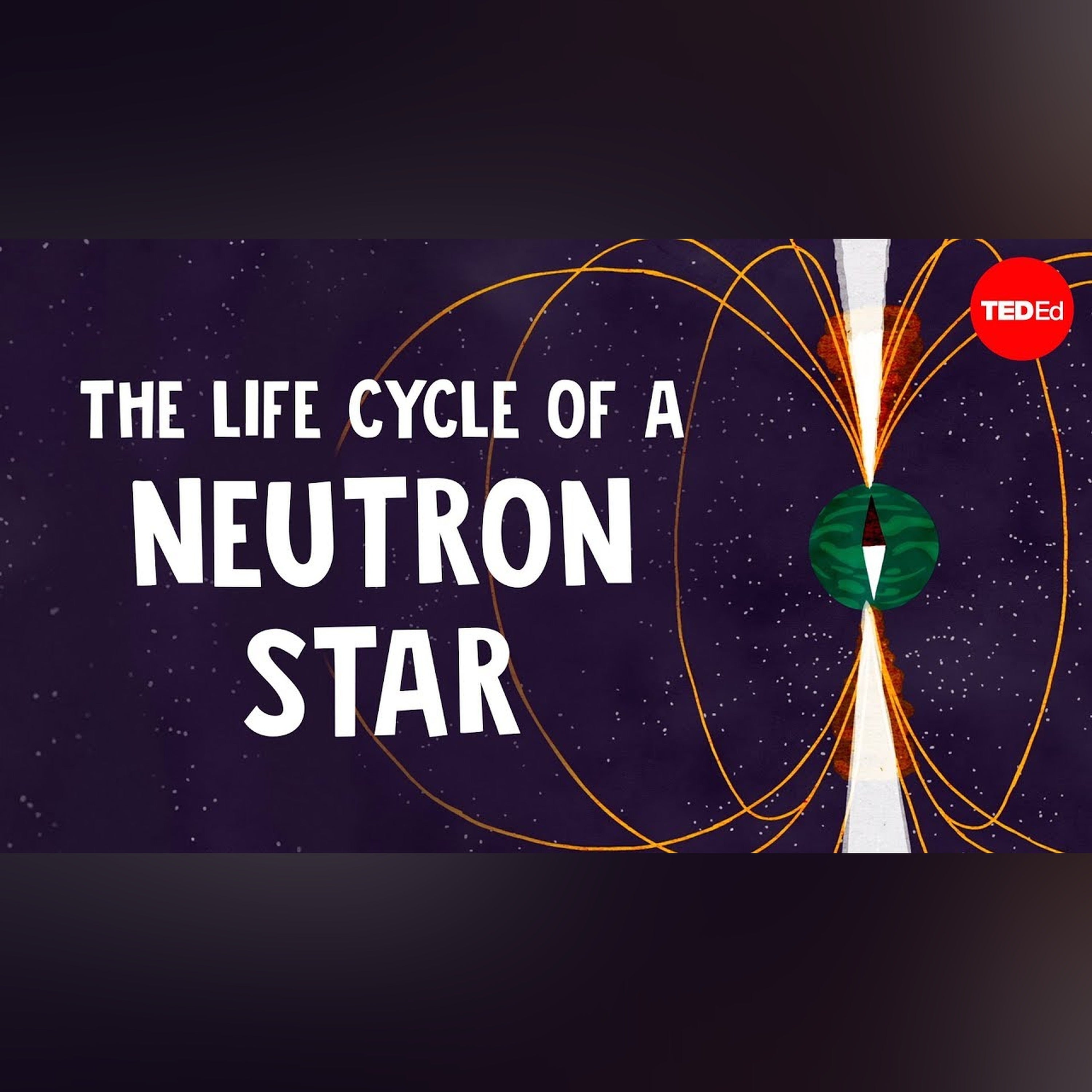
Uploaded 20-11-18 View full lesson: https://ed.ted.com/lessons/the-life-cycle-of-a-neutron-star-david-lunney About once every century, a massive star somewhere in our galaxy runs out of fuel. No longer able to produce sufficient energy to maintain its structure, it collapses under its own gravitational pressure and explodes in a supernova. The death of that star is the birth of a neutron star: one of the densest known objects in the universe. David Lunney explores what, exactly, a neutron star is. Lesson by David Lunney, directed by JodyPrody. Thank you so much to our patrons for your support! Without you this video would not be possible! Sandra Tersluisen, Ellen Spertus, Fabian Amels, sammie goh, Mattia Veltri, Quentin Le Menez, Yuh Saito, Heather Slater, Dr Luca Carpinelli, Christophe Dessalles, Arturo De Leon, Eduardo Briceño, Ricardo Paredes, David Douglass, Grant Albert, Jen , Megan Whiteleather, Mayank Kaul, Ryohky Araya, Tan YH, Ph.D., Brittiny Elman, Kostadin Mandulov, Yanuar A
Ophiuchus, the serpent bearer, must be a bit dizzy. His “head” – the star Rasalhague – spins at more than a half million miles per hour. That’s almost fast enough to tear the star apart. Rasalhague is about 50 light-years away. It’s actually a binary star – two stars that orbit one another every 8.6 years. But astronomers couldn’t get a good reading on the individual stars until fairly recently. The smaller star is a little less massive than the Sun, and only about a quarter as bright as the Sun. The larger star – the one we see – is more than twice the Sun’s mass. It’s also a good bit wider than the Sun, and about 30 times brighter. But perhaps the most interesting thing about it is how fast it spins – more than a hundred times faster than the Sun. Astronomers calculate that it’s at almost 90 percent of the speed needed to cause the star to break up. That dizzying speed pushes material at its equator outward. As a result, the star is about 20 percent fatter through its equator than th
660 million tons is a lot of anything. It takes about 16 months for American farmers to grow that much corn, more than two years for Americans to generate that much trash, or nine years for worldwide manufacturers to churn out that much aluminum. Yet it takes only one second for the Sun to burn through that much of its hydrogen fuel – a process that’s been going on for four-and-a-half billion years. Like all stars in the prime of life, the Sun is powered by nuclear fusion reactions in its core. Through a complicated series of steps, atoms of hydrogen – the lightest and simplest chemical element – “fuse” together to make helium, the second-lightest element. You can’t do this with a chemistry set on your kitchen table, though. It takes temperatures of tens of millions of degrees to make fusion work – temperatures that are found in the heart of a star. In the Sun, fusion converts about 660 million tons of hydrogen into 656 million tons of helium every second. The remaining mass doesn’t ju
Four of the five planets that are easily visible to the eye alone are in good view at dawn. Mercury is low in the south-southeast, and looks like a bright star. Venus, the “morning star,” is well to its upper right, near the bright star Spica. But the highlight is a close encounter between Mars and Jupiter, high in the south. The star Regulus is close by, creating a tight triangle. Jupiter is the brightest member of the trio. In all the night sky, it’s outshined by only Venus and the Moon. It’s so bright because it’s the largest planet in the solar system, and because it’s covered by reflective clouds. And it’ll get brighter over the next few months, because it’s getting closer. It will pass closest to Earth early next year, making it look almost twice as bright as it does now. Mars is close to the left of Jupiter. It’s only a few percent as bright as Jupiter, because it’s much smaller and its rocky surface doesn’t reflect as much sunlight. But it, too, is getting closer. It will pass
Major sporting rule changes should be tested before permanent adoption.
Share your view, then see how readers voted. No sign-in required. This poll is shared across stories.
Do you agree or disagree?
Common Quandary
A Common Quandary to discuss
Another conversation to explore, separate from this news story.
The mayor is excellent at the job—and secretly cheating on a spouse. Is that news?
A local official is effective, honest in office, and privately having an affair. A journalist can verify it but finds no misuse of public resources or direct connection to official duties.
Does private dishonesty reveal something citizens are entitled to judge?