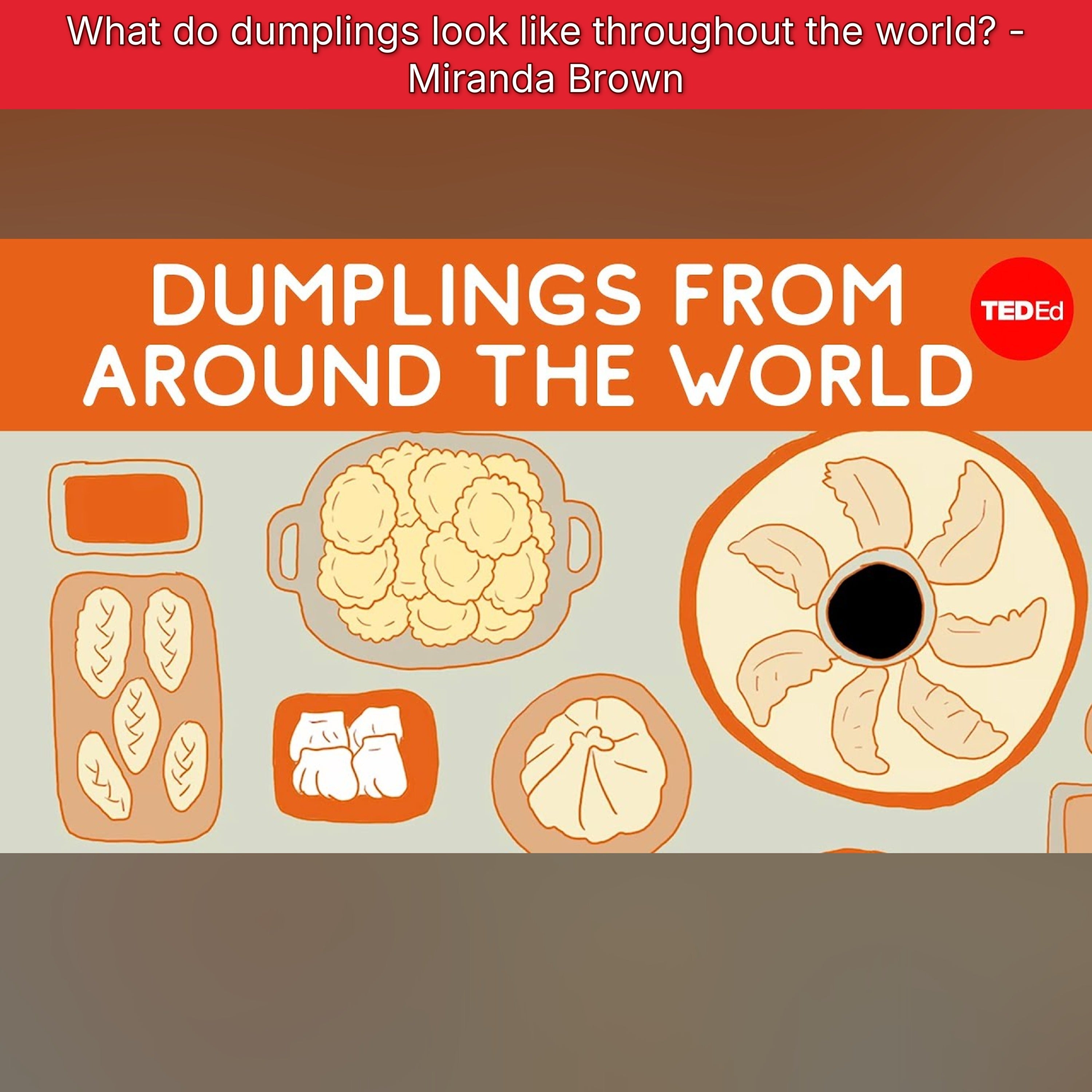
What do dumplings look like throughout the world? - Miranda Brown
Listen through the publisher, then discuss the episode here or arrange an in-person Roundtable. Your city determines where to meet.
Roundtables are designed for groups of four, with a shared subject and room for everyone to speak. Come for discussion, with no dating expectation.
Trace the diverse and delicious history of dumplings, from their first recorded origins to their spread across the Asian continent and beyond. -- As archaeologists pored over ancient tombs in western China, they discovered some surprisingly well-preserved and familiar relics. Though hardened over 1,000 years, there sat little crescent-shaped dumplings. So who invented these plump pockets of perfection, and how did they spread across the world? Miranda Brown traces the tangled, mysterious historical web of dumplings. Lesson by Miranda Brown, directed by Léon Moh-Cah, Andi Concha. This video made possible in collaboration with Marriott Hotels Learn more about how TED-Ed partnerships work: https://bit.ly/TEDEdPartners Support Our Non-Profit Mission ---------------------------------------------- Support us on Patreon: http://bit.ly/TEDEdPatreon Check out our merch: http://bit.ly/TEDEDShop ---------------------------------------------- Connect With Us ---------------------------------------------- Sign up for our newsletter: http://bit.ly/TEDEdNewsletter Find us on Twitter: http://bit.ly/TEDEdTwitter Peep us on Instagram: http://bit.ly/TEDEdInstagram ---------------------------------------------- Keep Learning ---------------------------------------------- View full lesson: https://ed.ted.com/lessons/a-brief-history-of-dumplings-miranda-brown Dig deeper with additional resources: https://ed.ted.com/lessons/a-brief-history-of-dumplings-miranda-brown#digdeeper (https://ed.ted.com/lessons/a-brief-history-of-dumplings-miranda-brown) Animator's website: https://nananastudio.com (https://nananastudio.com/) ---------------------------------------------- Thank you so much to our patrons for your support! Without you this video would not be possible! Javid Gozalov, Kyanta Yap, Rebecca Reineke, William Biersdorf, Patricia Alves Panagides, Yvette Mocete, Cyrus Garay, Samuel Barbas, LadyGeek, Curtis Light, Dianne Palomar, Marin Kovachev, Fahad Nasser Chowdhury, Penelope Misquitta, Hans Peng, Gaurav Mathur, Erik Biemans, Tony, Michelle, Katie and Josh Pedretti, Sunny Patel, Hoai Nam Tran, Stina Boberg, Kack-Kyun Kim, Michael Braun-Boghos, zjweele13, Jurjen Geleijn, Anna-Pitschna Kunz, Edla Paniguel, Thomas Mungavan, Jaron Blackburn, Venkat Venkatakrishnan, ReuniteKorea, Aaron Henson, Rohan Gupta, Begum Tutuncu, Mikhail Shkirev, Brian Richards, Cindy O., Jørgen Østerpart, Tyron Jung, Carolyn Corwin, Carsten Tobehn, Katie Dean, Ezgi Yersu, Gerald Onyango, alessandra tasso, Côme Vincent, Doreen Reynolds-Consolati, Manognya Chakrapani, Ayala Ron and Eunsun Kim.
Episode information is provided by the publisher. Listening takes place on the publisher’s service.
Listen at the source ↗