Listen through the publisher, then discuss the episode here or arrange an in-person Roundtable. Your city determines where to meet.
Roundtables are designed for groups of four, with a shared subject and room for everyone to speak. Come for discussion, with no dating expectation.
Did you know that the ocean’s ultimate apex predator isn't a whale at all? It’s actually the world's largest dolphin! Join Mira and Finn on this mind-blowing underwater adventure as we dive into the incredible world of the orca. Discover why eighteenth-century Spanish sailors originally named them "whale killers" and how that fierce name got flipped around over time! You will be amazed to learn that these giant, six-ton creatures are ruled by their grandmothers, who hold all the secret knowledge of the sea. Did you know that different families, called pods, even speak their very own secret languages? It's true! Learn about their genius hunting tricks, like how a team of orcas can swim perfectly in sync to create massive waves that wash sleepy seals right off Antarctic ice floes! Plus, find out how they manage to sleep with only half of their brain at a time so they never drown. Get ready for giant dolphins, epic ocean waves, and mind-bending marine biology facts. Press play and let's explore the deep blue sea!
Episode information is provided by the publisher. Listening takes place on the publisher’s service.
Immerse yourself in the serene and mesmerizing world of the ocean with the enchanting 'Ocean Melodies' of whale sounds. This captivating audio experience takes you on a journey beneath the waves, where the gentle and melodic songs of whales create a peaceful and soothing atmosphere. Let the harmonious sounds of these majestic creatures transport you to a place of deep relaxation and tranquility. As you listen to the enchanting whale sounds, you can envision yourself floating effortlessly in the vastness of the ocean, surrounded by the calming sounds of water and the gentle echoes of whale songs. These melodic and hauntingly beautiful sounds have a unique ability to induce a sense of calm and serenity, allowing you to let go of stress and worries and enter a state of deep relaxation. The deep, resonant tones of whale calls create a rhythmic and meditative ambiance that promotes a sense of peace and tranquility. These soothing sounds have been known to reduce anxiety, lower stress levels
Off the coast of Sicily, there’s a massive underwater machine. It looks like a forest of floating spheres… And on the surface, hidden in an abandoned winery, a computer watches them and waits. And in 2023, they saw something… Something WAY smaller than an electron tore through that forest, setting off a signal nearly 30x more powerful than anything like it we’ve seen before, which means something HUGE must have happened way out in space. This crazy experiment is not alone! Down in Antarctica, buried deep in the ice, are over 5000 more of these mysterious spheres. Together, these two machines – called KM3net and Ice Cube – are part of a massive global effort to give us a brand new way to find and look inside the biggest, most extreme, cosmic events in our universe. But to do it, they need to catch the most elusive particle in all of physics. And in this episode of HUGE* If True, we’re going to show you how… This episode was made possible by AT and T, the official connectivity partner of
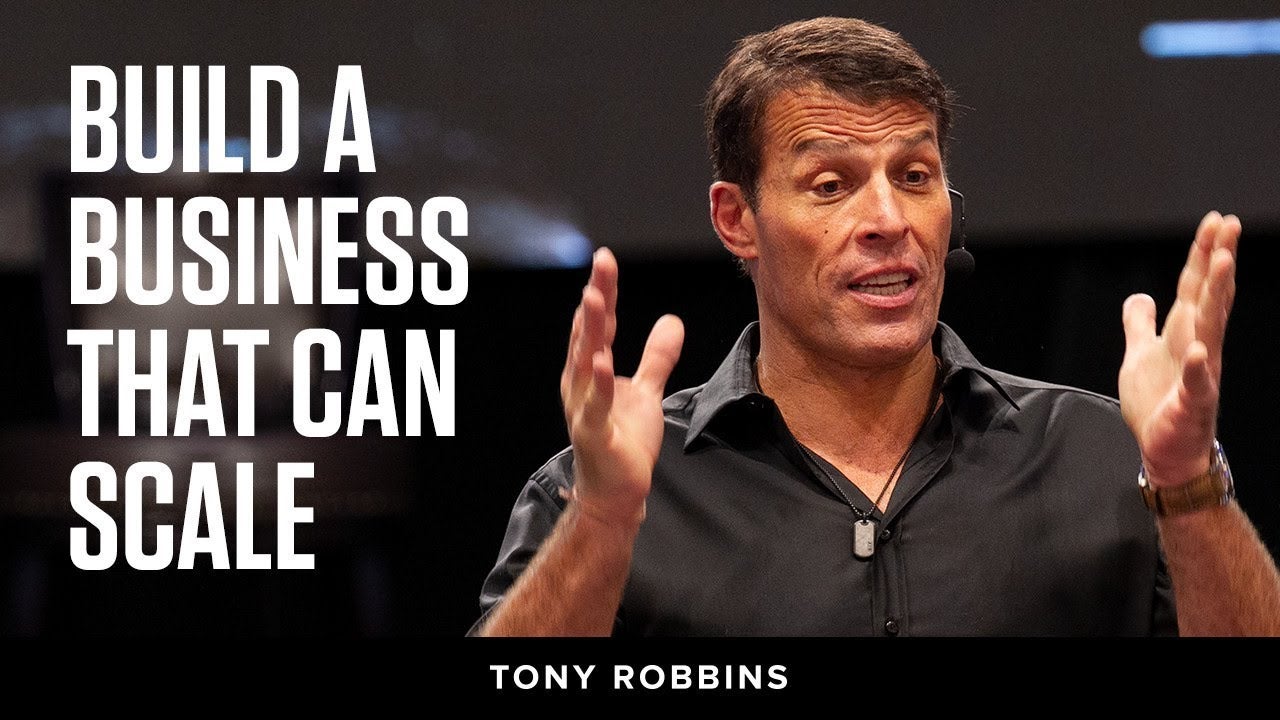
If you’re a business owner, then you know the power of developing and executing a world-class marketing strategy. But how do you go about creating the world-class marketing plan that will set you apart from your competition? How do you find and convey your unique selling proposition? Uploaded 08-10-19 Marketing isn’t just about doing something unique – it’s about adding more value than anyone else in the game. Doing more for your customer than anyone else. And in this episode, we’re taking you to Business Mastery, where you’ll hear Tony speak with Darcy: a woman who is struggling to find her niche, even despite an impressive resume of clients. Darcy runs a successful production company that works with some of the biggest companies around the world. But up to this point, Darcy has relied on word-of-mouth to propel her business’s growth. And while her referrals have gotten her up to a certain point, it’s not enough to create the massive impact that she longs for. She needs a world-class
PBS Member Stations rely on viewers like you. To support your local station, go to: http://to.pbs.org/DonateSPACE ↓ More info below ↓ Uploaded 07-02-19 You can check out Google's Science Journal app at http://g.co/ScienceJournal Check out the new Space Time Merch Store! Support Space Time on Patreon Email your answers to: [email protected] With the subject heading: Negative Mass Challenge Question Invisible to the naked eye, our night sky is scattered with the 100s of billions of galaxies the fill the known universe. Like the stars, these galaxies form constellations – hidden patterns that echo the reverberations of matter and light in an epoch long before galaxies ever formed. These are the baryon acoustic oscillations, and they may hold the key to understanding the nature of dark energy. Tweet at us! @pbsspacetime Facebook: facebook.com/pbsspacetime Email us! pbsspacetime [at] gmail [dot] com Comment on Reddit: http://www.reddit.com/r/pbsspacetime Help translate our videos! Prev
Can you rewire your brain to turn down chronic pain? Your pain is real, but your brain decides how loud that pain feels and new science shows that self-hypnosis may offer a new route to pain relief. One that goes beyond relying on pills alone. In today’s episode, Stanford psychiatrist Dr. David Spiegel, who has spent decades researching pain, explains how the brain controls pain. You’ll learn why chronic pain can be worsened by fear, anxiety and poor sleep. David explains how pain signals travel from your body to your brain, and why the brain can turn them up or down. He also shares how tools like hypnosis can help with pain management. By the end of the episode, you’ll have a simple 7-step self-hypnosis exercise for drug-free pain relief you can try at home. Build healthy habits. Download the ZOE app today Join ZOE (https://zoe.com/buymembership) Follow ZOE onInstagram (https://www.instagram.com/zoe/). Timecodes 00:00 Intro 01:49 Is your pain really in your brain? 09:07 Can't sleep? H
In this Jim Rohn Motivation speech, discover the true measure of life—not in wealth, possessions, or applause, but in the legacy you leave behind Your character, habits, and daily choices ripple beyond your lifetime, creating an impact that outlasts you. Key Topics From This Motivational speech: Why legacy matters more than money or recognition How daily habits and choices shape your future impact The role of character as the foundation of legacy Why consistency speaks louder than intention How influence multiplies through discipline and example This Jim Rohn motivational speech delivers a timeless message: legacy isn’t built in a moment—it’s built every day through integrity, consistency, and small disciplines. Success may fade, but the way you live, the example you set, and the values you embody will echo through others for generations. Every choice is a vote, not just for who you are, but for the impact you leave behind. This Jim Rohn Motivational speech Is Perfect For: Anyone seeki
Have you ever wished you could pull a toy right out of thin air? With 3D printing, you actually can! Join Mira and Finn on Science is Not Boring as they explore the wild, futuristic, and totally real world of 3D printers! You'll travel all the way back to 1984 to meet Chuck Hull, the brilliant inventor who used invisible ultraviolet light to freeze liquid plastic into solid shapes. Discover how modern 3D printers act like robotic hot glue guns, melting plastic thread at a scorching 200 degrees Celsius and stacking ultra-thin layers—just the size of a single human hair—to build solid objects! But it’s not just plastic toys. Did you know engineers use massive lasers to 3D-print custom titanium bones for humans? Or that huge robotic nozzles can squirt concrete to build entire houses in just 24 hours? From 110-foot-tall space rockets to mouth-watering chocolate castles and even tools printed by astronauts in zero gravity, 3D printing is completely changing our world. Tap play to learn how
Did you know there are giant, frozen rivers of solid ice that can actually move? Welcome to the freezing, mountain-crushing world of glaciers! In this thrilling episode, we uncover how endless layers of fluffy snow get squished under millions of tons of massive weight, transforming into a sugary snow called firn, and finally into super-dense glacial ice! Because this ice is so unbelievably thick, it squeezes out all the tiny air bubbles and glows a magical, brilliant blue! But these massive ice rivers don't just sit there—they creep downhill like giant icy bulldozers, carving dramatic U-shaped valleys right through solid rock! We'll journey to Antarctica to explore the enormous Lambert Glacier, the biggest glacier on Earth, which is an incredible 400 kilometres long and 2,500 metres deep! You'll also discover how these icy giants hold seventy percent of the world's freshwater and how their deeply buried air bubbles act like literal time machines for scientists. Bundle up and get ready
Have you ever wondered what the absolute hottest thing on our planet is? You might guess a bubbling volcano, where glowing orange lava melts solid rock at over 1,000 degrees Celsius! But to find something even hotter, you have to dig way down to the center of the Earth. The Earth's inner core reaches a scorching 5,200 degrees, which is just as hot as the surface of the Sun! But wait, we can get even hotter if we look up at the sky! A single bolt of crackling lightning heats the air around it to a staggering 30,000 degrees Celsius! That is five times hotter than the Sun's surface! So, is lightning the ultimate winner? Not quite! The true hottest thing ever recorded on Earth was actually made by humans! Scientists at a massive underground laboratory called CERN smashed tiny particles together at the speed of light to create a mind-blowing temperature of 5.5 trillion degrees! That is 100,000 times hotter than the center of the Sun! Tune in to discover how this incredible extreme heat is h
Environmental monitoring data should be accessible to affected communities.
Share your view, then see how readers voted. No sign-in required. This poll is shared across stories.
Do you agree or disagree?
Common Quandary
A Common Quandary to discuss
Another conversation to explore, separate from this news story.
Your coworker's religious holiday means you work the unpopular shift again. Is that fair?
A workplace accommodates religious observances by asking other employees to cover unpopular shifts. One coworker objects that nonreligious commitments can be equally meaningful but receive less formal protection.
Does equal respect require treating every kind of commitment identically?