English-language podcasts

CrashCourse

Where US Politics Came From: Crash Course US History #9

20 min

Listen through the publisher, then discuss the episode here or arrange an in-person Roundtable. Your city determines where to meet.

Roundtables are designed for groups of four, with a shared subject and room for everyone to speak. Come for discussion, with no dating expectation.

In which John Green teaches you where American politicians come from. In the beginning, soon after the US constitution was adopted, politics were pretty non-existent. George Washington was elected president with no opposition, everything was new and exciting, and everyone just got along. For several months. Then the contentious debate about the nature of the United States began, and it continues to this day. Washington and his lackey/handler Alexander Hamilton pursued an elitist program of federalism. They attempted to strengthen the central government, create a strong nation-state, and leave less of the governance to the states, They wanted to create debt, encourage manufacturing, and really modernize the new nation/ The opposition, creatively known as the anti-federalists, wanted to build some kind of agrarian pseudo-paradise where every (white) man could have his own farm, and live a free, self-reliant life. The founding father who epitomized this view was Thomas Jefferson. By the time Adams became president, the anti-federalists had gotten the memo about how alienating a name like anti-federalist can be. It's so much more appealing to voters if your party is for something rather than being defined by what you're against, you know? In any case, Jefferson and his acolytes changed their name to the Democratic-Republican Party, which covered a lot of bases, and proceeded to protest nearly everything Adams did. Lest you think this week is all boring politics, you'll be thrilled to hear this episode has a Whiskey Rebellion, a Quasi-War, anti-French sentiment, some controversial treaties, and something called the XYZ Affair, which sounds very exciting. Learn all about it this week with John Green. Hey teachers and students - Check out CommonLit's free collection of reading passages and curriculum resources to learn more about the events of this episode. Much of America's politics came from debates between democratic republican Thomas Jefferson and federalist Alexander Hamilton: https://www.commonlit.org/texts/alexander-hamilton While Jefferson would go on to become president, Hamilton heavily influenced President George Washington who set many American political ideals in his farewell address that Hamilton helped craft: https://www.commonlit.org/texts/washington-s-farewell-address Chapters: Introduction 00:00 Alexander Hamilton's Vision for America 0:26 Thomas Jefferson's Vision for America 2:10 Democratic-Republicans vs. Federalists 3:32 George Washington and the First U.S. Presidential Election 4:33 Hamilton's Five-Point Plan 5:04 Republican Opposition to Hamilton's Economic Plan 6:20 The Whiskey Rebellion 7:02 Early U.S. Foreign Affairs 7:31 The End of Washington's Presidency 8:36 Mystery Document 9:21 John Adams' Presidency 10:48 The Alien and Sedition Acts 11:56 Credits 13:24 Crash Course is on Patreon! Want to find Crash Course elsewhere on the internet? Facebook - http://www.facebook.com/YouTubeCrashCourse Twitter - http://www.twitter.com/TheCrashCourse Instagram - https://www.instagram.com/thecrashcourse/ CC Kids: http://www.youtube.com/crashcoursekids

Episode information is provided by the publisher. Listening takes place on the publisher’s service.

Listen at the source ↗

Featured places to meet in Palo Alto, CA

Explore these places and arrange a conversation through ThinkMatch.

City guide for Palo Alto, CA

More from CrashCourse

CrashCourse

Dark Energy, Cosmology part 2: Crash Course Astronomy #43

18 min

The majority of the universe is made up of a currently mysterious entity that pervades space: dark energy. We don’t know exactly what it is, but we do know that dark energy accelerates the expansion of space. We think this means the Universe will expand forever, even as our view of it shrinks while space expands faster all the time. Check out the Crash Course Astronomy solar system poster here: http://store.dftba.com/products/crashcourse-astronomy-poster If you want to learn more about the creation and death of the universe, watch Crash Course Big History here: https://youtube.com/playlist?list=PL8dPuuaLjXtMczXZUmjb3mZSU1Roxnrey -- Chapters: Introduction: The Expanding Universe 00:00 The Expansion of Space is Accelerating 2:17 What is Dark Energy? 4:19 Will the Universe Expand Forever? The Geometry of the Universe 5:20 The Cosmic Horizon of the Observable Universe 6:50 Review 10:20 -- GEOMETRY OF THE UNIVERSE RESOURCES Geometry: Expanding faster than light: General expansion: -- PBS Di

Discuss this episode

CrashCourse

Diazonium Salts and Nucleophilic Aromatic Substitution: Crash Course Organic Chemistry #47

20 min

Have you ever wondered where cured meats like salami or pepperoni get their bright red color? Of course its from organic chemistry! A chemical called nitric acid gives them that bright color, while also increasing their shelf. It's also involved in some other interesting reactions. In this episode of Crash Course Organic Chemistry we'll see how nitrous acid reacts with primary amines to form diazonium salts, we'll learn about alkyldiazonium salts and aryldiazonium salts, and see what conditions are necessary for nucleophilic aromatic substitutions. Series Sources: Brown, W. H., Iverson, B. L., Ansyln, E. V., Foote, C., Organic Chemistry; 8th ed.; Cengage Learning, Boston, 2018. Bruice, P. Y., Organic Chemistry, 7th ed.; Pearson Education, Inc., United States, 2014. Clayden, J., Greeves, N., Warren., S., Organic Chemistry, 2nd ed.; Oxford University Press, New York, 2012. Jones Jr., M.; Fleming, S. A., Organic Chemistry, 5th ed.; W. W. Norton & Company, New York, 2014. Klein., D., Organ

Discuss this episode

CrashCourse

Alkene Addition Reactions: Crash Course Organic Chemistry #16

19 min

Like a trendy dance, a fighting combo, or a secret handshake, organic reactions can be broken down into simpler steps. In this episode of Crash Course Organic Chemistry, we’ll specifically be looking at alkene addition reactions, and with each new reaction ask ourselves three questions to help us puzzle through the mechanism and understand what’s going on. Episode Sources: Le Couteur, P, Burreson, J. Napoleon’s Buttons: 17 molecules that changed history., Penguin, New York, 2004, Chapter 1. Whipps, H., “How the Spice Trade Changed the World,” https://www.livescience.com/7495-spice-trade-changed-world.html Last accessed, 3/28/2020. Henriques, Martha, “How spices changed the ancient world,” http://www.bbc.com/future/bespoke/made-on-earth/the-flavours-that-shaped-the-world/ Last accessed, 3/28/2020. Hashimoto, K., Yaoi, T., Koshiba, H., Yoshida, T., Maoka, T., Fujiwara, Y., Yaamoto, Y, Mori, K., “Photochemical Isomerization of Piperine, a Pungent Constituent of Pepper”, Food Sci. Technol.

Discuss this episode

Community Poll

Employees should usually have a say in whether their work requires office attendance.

Share your view, then see how readers voted. No sign-in required. This poll is shared across stories.

Do you agree or disagree?

Choose one answer

Common Quandary

A Common Quandary to discuss

Another conversation to explore, separate from this news story.

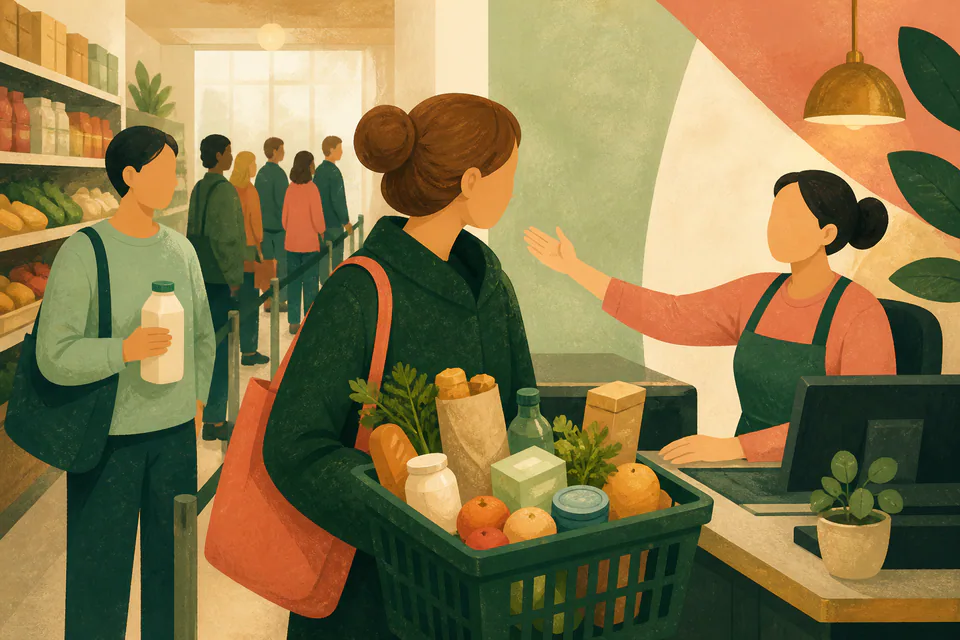
The sign says twelve items and you have fourteen. Is the express lane still yours?

The regular checkout lines are long and the express lane is empty. You count fourteen small items, two over the posted limit. A shopper approaches behind you carrying a single carton of milk as the cashier waves you forward.

Are small rules optional when enforcing them would seem fussier than breaking them?

Explore this quandary