English-language podcasts

TED-Ed

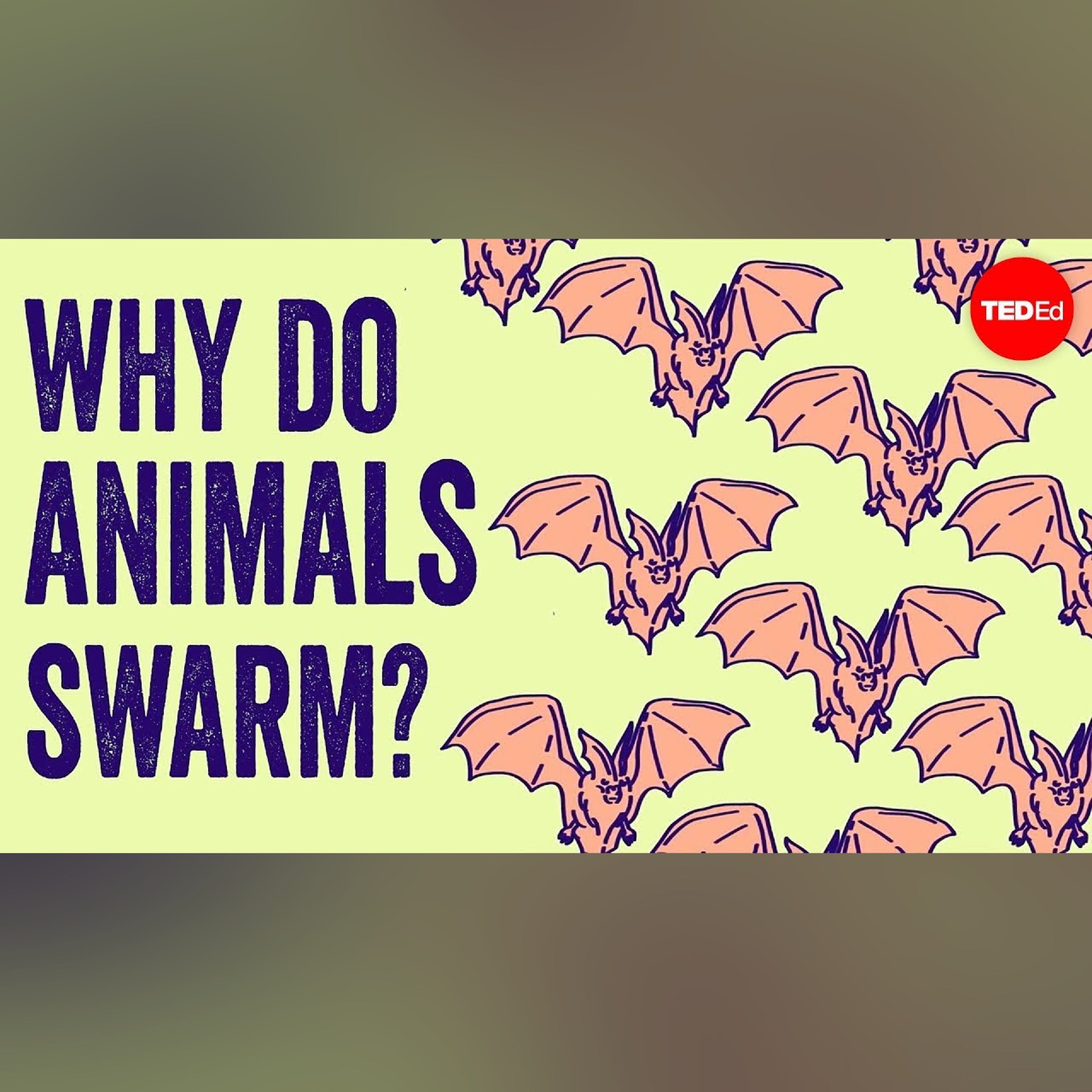
Why do animals form swarms? - Maria R. D'Orsogna
6 min

Listen through the publisher, then discuss the episode here or arrange an in-person Roundtable. Your city determines where to meet.

Roundtables are designed for groups of four, with a shared subject and room for everyone to speak. Come for discussion, with no dating expectation.

Uploaded 18-12-17 View full lesson: https://ed.ted.com/lessons/why-do-animals-form-swarms-maria-r-d-orsogna When many individual organisms come together and move as one entity, that’s a swarm. From a handful of birds to billions of insects, swarms can be almost any size. They have no leader, and members interact only with their neighbors or through indirect cues. Members follow simple rules: travel in the same direction as those around you, stay close and avoid collisions. Maria R. D’Orsogna shares why. Lesson by Maria R. D’Orsogna, animation by Matt Reynolds. Thank you so much to our patrons for your support! Without you this video would not be possible! Joren Schiks, Аркадий Скайуокер, Milad Mostafavi, Rob Johnson, Singh Devesh Sourabh, Ashley Maldonado, Clarence E. Harper Jr., Bojana Golubovic, Mihail Radu Pantilimon, Sarah Yaghi, Benedict Chuah, Karthik Cherala, haventfiguredout , Violeta Cervantes, Elaine Fitzpatrick, Lyn-z Schulte, Sharon Chou, Henrique 'Sorín' Cassús, Tim Robinson, Kiarash Asar, Jun Cai, Paul Schneider, Amber Wood, Nathalia Ortega Bravo, Ophelia Gibson Best, Cas Jamieson, Michelle Stevens-Stanford, Phyllis Dubrow, Andreas Voltios, Aliyya Rachmadi, Eunsun Kim, Philippe Spoden, Samantha Chow, Armando Ello, Minh Tran, Ayala Ron, Manognya Chakrapani, Simon Holst Ravn, Doreen Reynolds-Consolati, Rakshit Kothari, Melissa Sorrells, Antony Lee, Husain Mohammad, Dino Hrnjić, Max Shuai Tang, Côme Vincent, Astia Rizki Safitri, Alan Froese, Zhufeng Wang, alessandra tasso, Daniel Mardale, Jamerson Chingapanini, Gerald Onyango, Dalton Valette, Katrina Harding, Ezgi Yersu, Al the Scottish Wildcat, Katie Dean, Kin Lon Ma, Carsten Tobehn, Boris Langvand, Jeremy Fryd, Ran Ben Dov, Charlene You, Jarrel Cacdac, Carolyn Corwin and rakesh Katragadda.

Episode information is provided by the publisher. Listening takes place on the publisher’s service.

Listen at the source ↗

Featured places to meet in Palo Alto, CA

Explore these places and arrange a conversation through ThinkMatch.

City guide for Palo Alto, CA

More from TED-Ed

TED-Ed

Withstanding a nuclear attack - Irwin Redlener

33 min

View full lesson: http://ed.ted.com/lessons/surviving-a-nuclear-attack-irwin-redlener The face of nuclear terror has changed since the Cold War, but disaster-medicine expert Irwin Redlener reminds us the threat is still real. He looks at some of history's farcical countermeasures and offers practical advice on how to survive an attack. Talk by Irwin Redlener.

Discuss this episode

TED-Ed

The true reason polio poses such a threat

10 min

Explore what makes polio so dangerous, what is causing the 21st century resurgence of cases, and how we can eradicate the disease. -- In 1952, polio was everywhere: killing or paralyzing roughly half a million people annually. Yet just 10 years later, paralytic polio cases in the US dropped by 96% and we were on track to get rid of polio for good. But in recent years, the virus started striking back. So, what’s behind these recent spikes? Explore the dangers of poliovirus and the possibility of eradicating this deadly disease. Directed by Anton Bogaty. This video made possible in collaboration with Gates Ventures Learn more about how TED-Ed partnerships work: https://bit.ly/TEDEdPartner A special thanks to Ananda Bandyopadhyay, Amber Zeddies, and Kathleen O'Reilly who provided information and insights for the development of this video. Support Our Non-Profit Mission ---------------------------------------------- Support us on Patreon: http://bit.ly/TEDEdPatreon Check out our merch: htt

Discuss this episode

TED-Ed

How to fool a GPS - Todd Humphreys

21 min

Todd Humphreys forecasts the near-future of geolocation when millimeter-accurate GPS "dots" will enable you to find pin-point locations, index-search your physical possessions ... or to track people without their knowledge. And the response to the sinister side of this technology may have unintended consequences of its own. (Filmed at TEDxAustin.) Uploaded 26-06-13 Talk by Todd Humphreys.

Discuss this episode

Community Poll

Organizations should help affected people recover after a personal-data breach.

Share your view, then see how readers voted. No sign-in required. This poll is shared across stories.

Do you agree or disagree?

Choose one answer

Common Quandary

A Common Quandary to discuss

Another conversation to explore, separate from this news story.

You cannot stand your friend's partner. Do they still get a wedding invitation?

You are planning a small wedding and strongly dislike the person your longtime friend has been dating. Inviting them would make you uncomfortable, but excluding only that partner would embarrass your friend.

Whose comfort should govern a celebration centered on you?

Explore this quandary