English-language podcasts

Between The Covers : Conversations with Writers in Fiction, Nonfiction & Poetry

Youssef Rakha : Postmuslim : A Testimony
148 min

Listen through the publisher, then discuss the episode here or arrange an in-person Roundtable. Your city determines where to meet.

Roundtables are designed for groups of four, with a shared subject and room for everyone to speak. Come for discussion, with no dating expectation.

Todays’ guest is Egyptian novelist, poet, essayist, translator and photographer Youssef Rakha. We discuss his essay collection Postmuslim: A Testimony, a book that explores what it means (and what it could mean) to be Arab and Muslim in the contemporary world. As Postmuslim unpacks the hypocrisies of Western liberal humanism’s promise and self-regard, and questions Islam’s own relation and positioning to the modern world, it ultimately chronicles a personal journey towards claiming a more capacious Muslim identity within modernity. Whether speaking about the promise and disappointments of the Arab Spring, the reconfiguration of East and West since October 7th, or looking back to paths not taken in history, from Al-Andalus to the Ottoman empire, Rakha takes us along with him on a journey that is equal parts philosophical, historical, political, and metaphysical, and which suggests and dreams into multiple possible futures. For the bonus audio archive Youssef contributes a reading of four poems in translation by the Egyptian poet Mohab Nasr, prefacing his reading with a discussion of Nasr’s life and the importance of his work. To learn how to subscribe to the the bonus audio, and about the other potential rewards and benefits of joining the Between the Covers community as a listener-supporter, head over to the show’s Patreon page (http://patreon.com/betweenthecovers). Here is the episode-specific BookShop (https://bookshop.org/lists/books-from-youssef-rakha-conversation) for today’s conversation. And for your general book buying needs don’t miss Milkweed’s Bookshop bookstore (https://bookshop.org/shop/milkweed_books).

Episode information is provided by the publisher. Listening takes place on the publisher’s service.

Listen at the source ↗

Featured places to meet in Palo Alto, CA

Explore these places and arrange a conversation through ThinkMatch.

City guide for Palo Alto, CA

More from Between The Covers : Conversations with Writers in Fiction, Nonfiction & Poetry

Between The Covers : Conversations with Writers in Fiction, Nonfiction & Poetry

From the Archives: Abdellah Taïa : A Country for Dying

141 min

Today’s conversation is an archival recording from 2021 with the Moroccan writer and filmmaker Abdellah Taïa discussing his novel A Country For Dying, translated by Emma Ramadan and winner of the 2021 PEN Translation Award. We talk about voice in relation to self, story in relation to truth, writing in one’s second language, particularly a language imposed by colonization, about making that tongue bend to one’s reality, about being both Muslim and gay (as well as being the first openly homosexual Arab writer from Morocco), about why it is important not to write characters who are good, or only so, about Isabelle Adjani, the Zulawski film Possession, the role of possession and djinns in his work, and about creating a literature that does not itself come from literature, that does not come from books or speak to them. A great complement to today’s conversation with Abdellah is the hour-long conversation with his translator Emma Ramadan which joins the Between the Covers bonus audio archi

Discuss this episode

Between The Covers : Conversations with Writers in Fiction, Nonfiction & Poetry

Writing in the Hour of Genocide with Lena Khalaf Tuffaha & Omar El Akkad

93 min

Today’s episode, recorded live at the 2nd annual Portland Poetry Confluence, is a conversation between two National Book Award winners, Lena Khalaf Tuffaha in poetry and Omar El Akkad in prose. We use the essay “Notes on Craft: Writing in the Hour of Genocide,” by Palestinian poet and performance artist Fargo Tbakhi, as a frame under which to look at writing at a time of great political urgency within their respective genres. Questions of audience and address, silence and silencing, gestures on the page and gestures in the world, and how to continue to make art at a time when everything is moving decidedly the wrong way. Today’s conversation was conceived by Literary Portland for Palestine and raised money for two Palestinian families supported by Creators for Gaza. If you enjoyed today’s conversation consider supporting the Portland Poetry Confluence (https://portlandpoetryconfluence.org/) and Creators for Gaza (https://creatorsforgaza.github.io/the-list/) in your holiday giving. And

Discuss this episode

Community Poll

Documentaries should disclose editing choices that substantially affect how events are understood.

Share your view, then see how readers voted. No sign-in required. This poll is shared across stories.

Do you agree or disagree?

Choose one answer

Common Quandary

A Common Quandary to discuss

Another conversation to explore, separate from this news story.

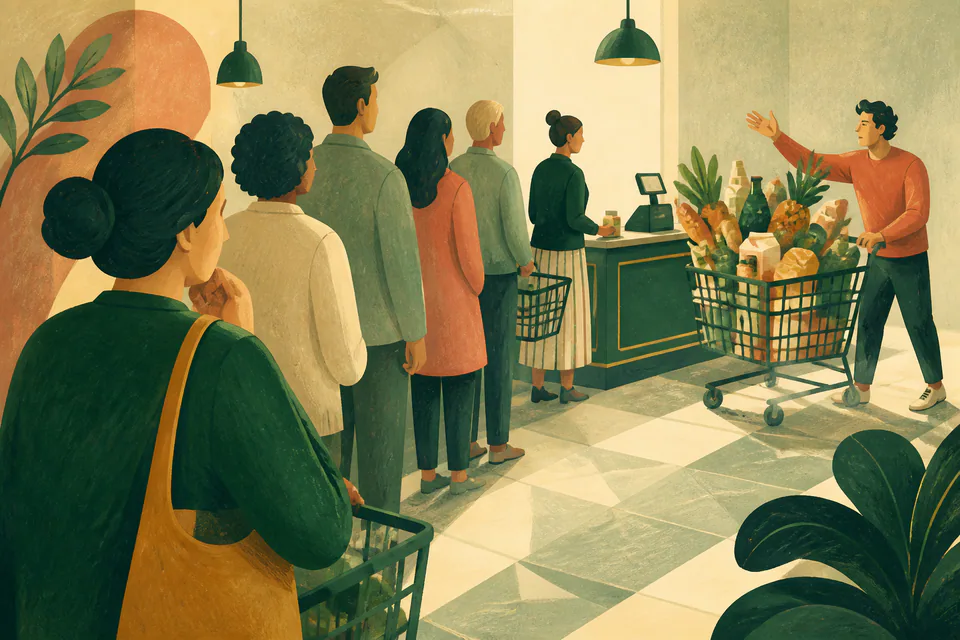
Someone holds a grocery line spot while their partner fills the cart. Is that cutting?

A shopper with one item stands ahead of you in a long checkout line. Just before reaching the register, their partner arrives with a cart packed to the top and joins them. They insist they were shopping together all along.

Can one person reserve a place in line for an unknown amount of work?

Explore this quandary