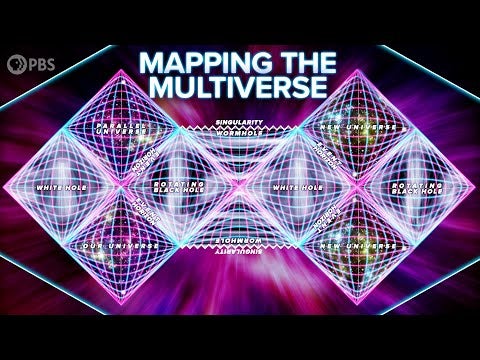
PBS Member Stations rely on viewers like you. To support your local station, go to: http://to.pbs.org/DonateSPACE ↓ More info below ↓ Uploaded 18-05-20 Sign Up on Patreon to get access to the Space Time Discord! Check out the Space Time Merch Store Sign up for the mailing list to get episode notifications and hear special announcements! This is a map of the multiverse. Or in physics-ese, it’s the maximally extended Penrose diagram of a Kerr spacetime. And in english: when you solve Einstein’s equations of general relativity for a rotating black hole, the universe does not come to an abrupt halt at the bottom of the gravitational pit. Instead, a path can be traced out again but you do not end up in the universe that you started in. Like I said, it’s a map of the multiverse. Hosted by Matt O'Dowd Written by Matt O'Dowd Graphics by Leonardo Scholzer, Yago Ballarini, and Pedro Osinski Directed by: Andrew Kornhaber Camera Operator: Bahaar Gholipour Executive Producers: Eric Brown and Andrew
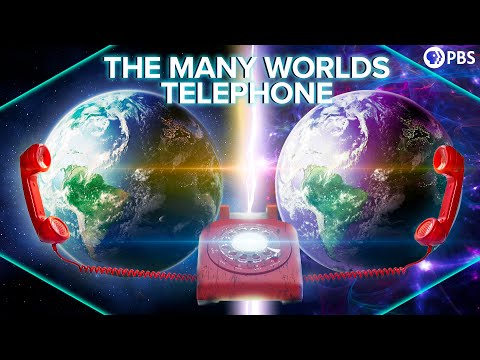
Check Out Megawow on PBS Kids: https://youtu.be/meU4f31gqYI Uploaded 10-08-21 In the Many Worlds interpretation of quantum mechanics, the universal wavefunction is the reality, encompassing all possible histories and futures and all exist. But we are only sensitive to a slice of the wavefunction corresponding to our “world”, and due to the superposition principle our world can happily do its thing unperturbed by other parts of the wavefunction - other “ripples,” or worlds. And while it may seem like it would be physically impossible to have any connection between worlds, it may turn out to be entirely possible to communicate between them. More About Steven Weinberg: Sign Up on Patreon to get access to the Space Time Discord! Check out the Space Time Merch Store Sign up for the mailing list to get episode notifications and hear special announcements! Hosted by Matt O'Dowd Written by Matt O'Dowd Graphics by Leonardo Scholzer, Yago Ballarini, Pedro Osinski, Adriano Leal and Stephanie Fari
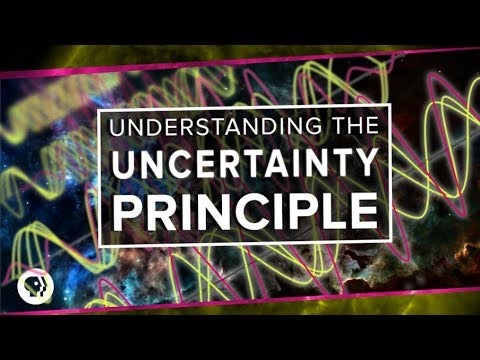
Viewers like you help make PBS (Thank you ) . Support your local PBS Member Station here: https://to.pbs.org/DonateSPACE Uploaded 06-12-17 Sometimes intuitive, large-scale phenomena can give us incredible insights into the extremely unintuitive world of quantum mechanics. Sign up for your free trial of The Great Courses Plus at http://ow.ly/HAvT30beNAj Today the humble sound wave is going to open the door to really understanding Heisenberg’s uncertainty principle, and, ultimately quantum fields and Hawking radiation. You can further support us on Patreon at https://www.patreon.com/pbsspacetime Get your own Space Time tshirt at http://bit.ly/1QlzoBi Tweet at us! @pbsspacetime Facebook: facebook.com/pbsspacetime Email us! pbsspacetime [at] gmail [dot] com Comment on Reddit: http://www.reddit.com/r/pbsspacetime Help translate our videos! https://www.youtube.com/timedtext_cs_panel?tab=2&c=UC7_gcs09iThXybpVgjHZ_7g (https://www.youtube.com/timedtext_cs_panel?c=UC7_gcs09iThXybpVgjHZ_7g&tab=2
Learn More about Brilliant: https://brilliant.org/SpaceTime/ Uploaded 23-03-22 Take the Space Time Fan Survey Here: https://forms.gle/wS4bj9o3rvyhfKzUA PBS Member Stations rely on viewers like you. To support your local station, go to:http://to.pbs.org/DonateSPACE Sign Up on Patreon to get access to the Space Time Discord! Today we’re going to ask a simple-seeming question that will lead to so pretty wacky places. The question is this: If the universe has a center, where is it? Check out the Space Time Merch Store Sign up for the mailing list to get episode notifications and hear special announcements! Hosted by Matt O'Dowd Written by Matt Caplan and Matt O'Dowd Post Production by Leonardo Scholzer, Yago Ballarini, Pedro Osinski, Adriano Leal and Stephanie Faria GFX Visualizations: Ajay Manuel Directed by Andrew Kornhaber Assistant Producer: Setare Gholipour Executive Producers: Eric Brown and Andrew Kornhaber Executives in Charge (PBS): Adam Dylewski, Maribel Lopez Director of Program
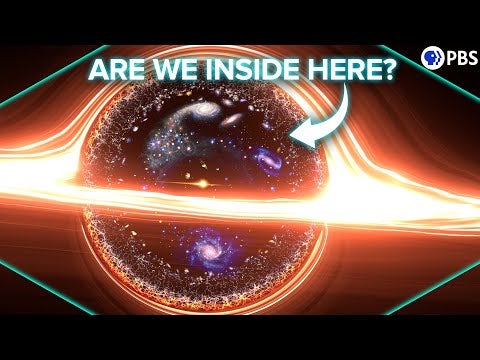
Take the Space Time Fan Survey Here: https://forms.gle/wS4bj9o3rvyhfKzUA Uploaded 30-03-22 PBS Member Stations rely on viewers like you. To support your local station, go to:http://to.pbs.org/DonateSPACE Sign Up on Patreon to get access to the Space Time Discord! What is inside a black hole? Inevitable crushing doom? Gateways to other universes? Weird, multidimensional libraries? If you’ve ever wanted to know then you might be in luck - Some physicists have argued that you’re inside one right now. Check out the Space Time Merch Store Sign up for the mailing list to get episode notifications and hear special announcements! Hosted by Matt O'Dowd Written by Matt O'Dowd Post Production by Leonardo Scholzer, Yago Ballarini, Pedro Osinski, Adriano Leal and Stephanie Faria GFX Visualizations: Ajay Manuel Directed by Andrew Kornhaber Assistant Producer: Setare Gholipour Executive Producers: Eric Brown and Andrew Kornhaber Executives in Charge (PBS): Adam Dylewski, Maribel Lopez Director of Pro
Viewers like you help make PBS (Thank you ) . Support your local PBS Member Station here: https://to.pbs.org/DonateSPACE Uploaded 04-10-17 So what happens when two Super Massive Black Holes collide? We may be about to find out, because astronomers have spotted a pair of them in a close binary orbit for the very first time. This episode of Space Time Journal Club discusses: "A candidate sub-parsec binary black hole in the Seyfert galaxy NGC 7674", Kharb, Lal and Merritt 2017 You can further support us on Patreon at https://www.patreon.com/pbsspacetime Get your own Space Time tshirt at http://bit.ly/1QlzoBi Tweet at us! @pbsspacetime Facebook: facebook.com/pbsspacetime Email us! pbsspacetime [at] gmail [dot] com Comment on Reddit: http://www.reddit.com/r/pbsspacetime Help translate our videos! https://www.youtube.com/timedtext_cs_panel?tab=2&c=UC7_gcs09iThXybpVgjHZ_7g (https://www.youtube.com/timedtext_cs_panel?c=UC7_gcs09iThXybpVgjHZ_7g&tab=2) Previous Episode: Are the Fundamental Cons
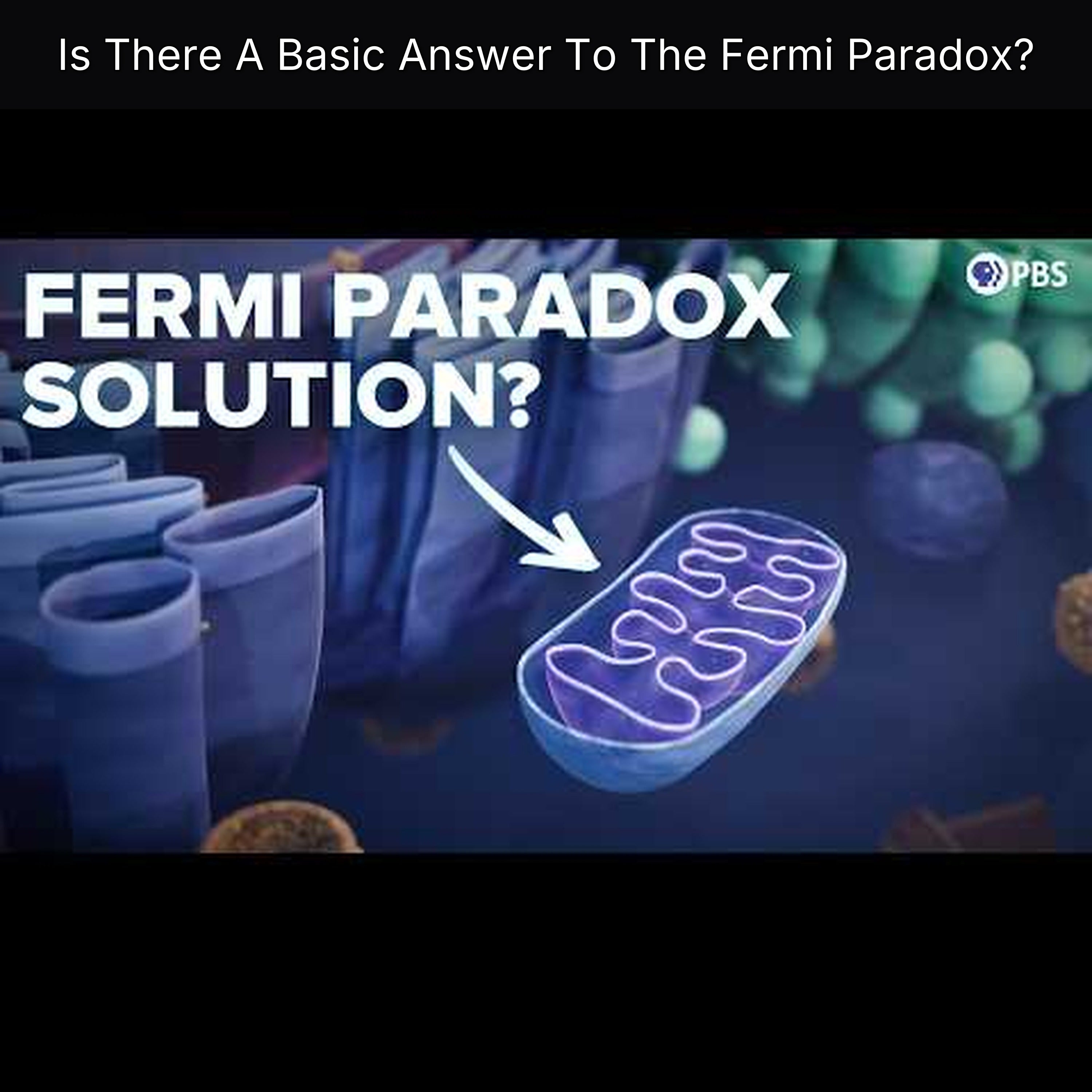
North America / UK / Australia / International: https://bit.ly/pbs_novium EU: https://bit.ly/pbs_noviumeu Around 2 billion years ago, life had plateaued in complexity, ruined the atmosphere, and was on the verge of self-annihilation. But then something strange and potentially extremely lucky happened that enabled endless new evolutionary paths. The first eukaryote cell was born. This may also explain why there are no aliens. Patreon Interview with Dr. Matt Caplan Cool World Episode: Sign Up on Patreon to get access to the Space Time Discord! Check out the Space Time Merch Store Sign up for the mailing list to get episode notifications and hear special announcements! Search the Entire Space Time Library Here: https://search.pbsspacetime.com/ Hosted by Matt O'Dowd Written by Matt O'Dowd Post Production by Leonardo Scholzer, Yago Ballarini & Stephanie Faria Directed by Andrew Kornhaber Associate Producer: Bahar Gholipour Executive Producer: Andrew Kornhaber Executive in Charge for PBS: Ma
PBS Member Stations rely on viewers like you. To support your local station, go to: http://to.pbs.org/DonateSPACE ↓ More info below ↓ Uploaded 05-10-20 Check Out Overview of PBS Terra: https://bit.ly/33otrUn If you rank the most habitable places in our solar system Venus lands pretty low, with surface temperatures hot enough to melt lead and sulphuric acid rain. And yet it may have just jumped to the front of the pack. In fact, we may have detected the signature of alien life - Venusian life -for the first time. Sign Up on Patreon to get access to the Space Time Discord! Check out the Space Time Merch Store Sign up for the mailing list to get episode notifications and hear special announcements! Hosted by Matt O'Dowd Written by Matt O'Dowd Graphics by Leonardo Scholzer, Yago Ballarini, and Pedro Osinski Directed by: Andrew Kornhaber Camera Operator: Setare Gholipour Executive Producers: Eric Brown and Andrew Kornhaber End Credits Music by J.R.S. Schattenberg: https://www.youtube.com/ch
Viewers like you help make PBS (Thank you ) . Support your local PBS Member Station here: https://to.pbs.org/DonateSPACE Uploaded 07-06-17 Could the mysterious Cold Spot found in the CMB be the result of a collision with a bubble universe? Try 23andMe at http://23andme.com/spacetime ____________________________________________________ [CORRECTION: The calculated ISW cooling from cold spot observed voids is 0.000032 Kelvin not 0.032 K as is listed on screen, the actual cold spot temperature differential is 0.000150 Kelvin not 0.15 K, and the actual ISW cooling from the control region is 0.000014 Kelvin not 0.014 K. The actual control region temperature differential is 0.000015 Kelvin not 0.015K. Thanks to Chris Morong for catching this discrepancy!] You can further support us on Patreon at https://www.patreon.com/pbsspacetime Get your own Space Time tshirt at http://bit.ly/1QlzoBi Tweet at us! @pbsspacetime Facebook: facebook.com/pbsspacetime Email us! pbsspacetime [at] gmail [dot] com
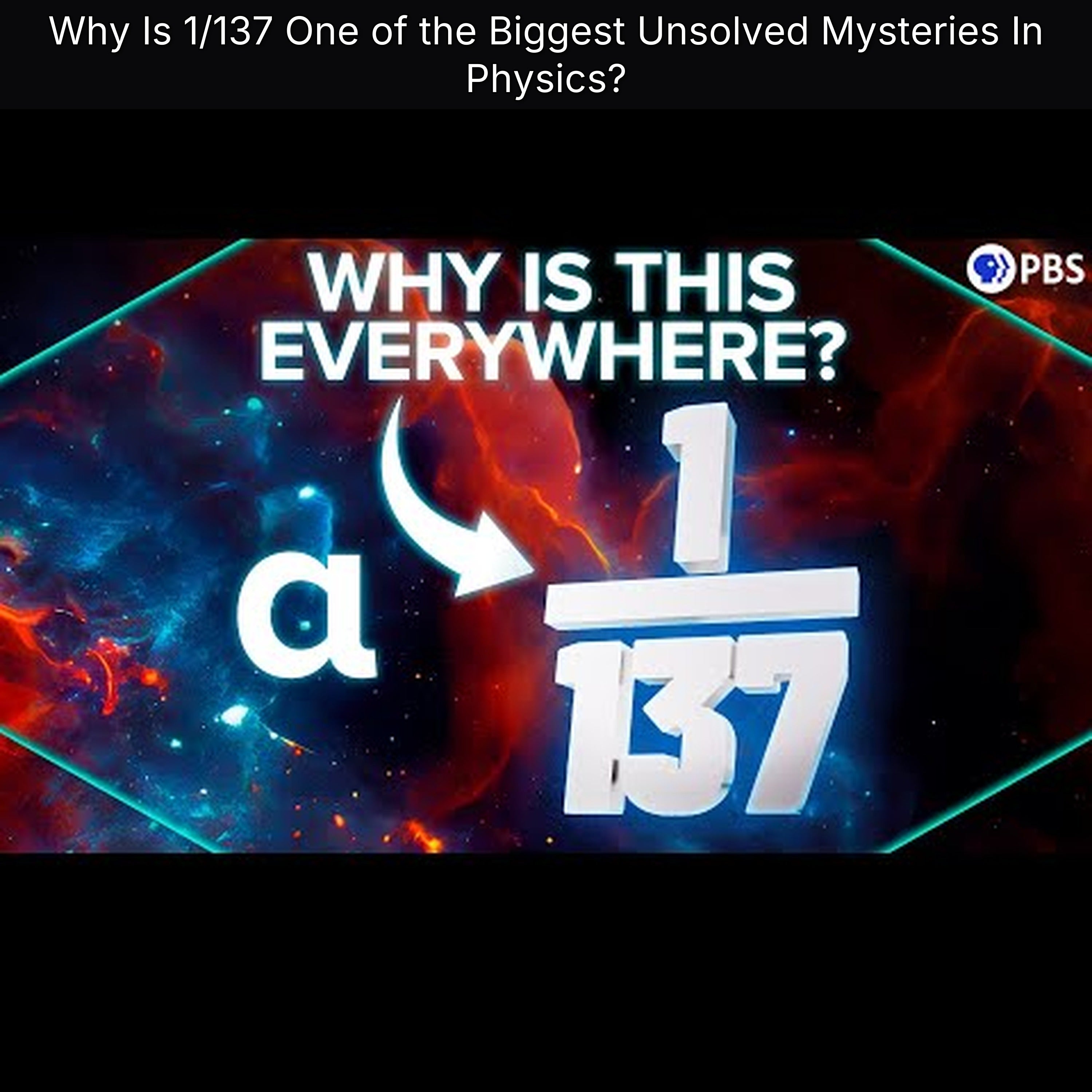
Thank you to Squarespace for supporting PBS. PBS Member Stations rely on viewers like you. To support your local station, go to:http://to.pbs.org/DonateSPACE Sign Up on Patreon to get access to the Space Time Discord! The Fine Structure Constant is one the strangest numbers in all of physics. It’s the job of physicists to worry about numbers, but there’s one number that physicists have stressed about more than any other. That number is 0.00729735256 - approximately 1/137. This is the fine structure constant, and it appears everywhere in our equations of quantum physics, and we’re still trying to figure out why. Check out the Space Time Merch Store Sign up for the mailing list to get episode notifications and hear special announcements! Search the Entire Space Time Library Here: https://search.pbsspacetime.com/ Hosted by Matt O'Dowd Written by Fernando Franco Félix & Matt O'Dowd Post Production by Leonardo Scholzer, Yago Ballarini, Pedro Osinski, Caique Oliveira, Adriano Leal & Stephani
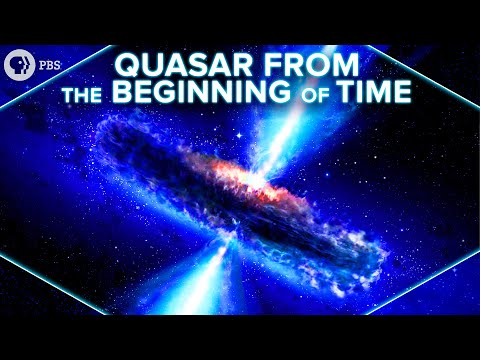
Viewers like you help make PBS (Thank you ) . Support your local PBS Member Station here: https://to.pbs.org/DonateSPACE Uploaded 25-01-17 Thanks to The Great Courses Plus for sponsoring this episode of Space Time. Try a 30 day trial of The Great Course Plus at http://ow.ly/m8ms306GoxP. Quasars ... the most metal thing in the universe. Support us on Patreon at https://www.patreon.com/pbsspacetime Get your own Space Time tshirt at http://bit.ly/1QlzoBi Tweet at us! @pbsspacetime Facebook: facebook.com/pbsspacetime Email us! pbsspacetime [at] gmail [dot] com Comment on Reddit: http://www.reddit.com/r/pbsspacetime Help translate our videos! https://www.youtube.com/timedtext_cs_panel?tab=2&c=UC7_gcs09iThXybpVgjHZ_7g (https://www.youtube.com/timedtext_cs_panel?c=UC7_gcs09iThXybpVgjHZ_7g&tab=2) When Quasars were first discovered the amount of light pouring out of such a tiny dot in space seemed impossible. A hysterical flurry of hypothesizing followed: swarms of neutron stars, alien civiliz
Viewers like you help make PBS (Thank you ) . Support your local PBS Member Station here: https://to.pbs.org/DonateSPACE Uploaded 15-08-18 Let’s talk about the best evidence we have that the theories of quantum physics truly represent the underlying workings of reality. You can signup for your trial to The Great Courses Plus at: http://ow.ly/bugR30hIvbu Quantum field theory is notoriously complicated, built from mind-bendingly abstract mathematics. But are the underlying rules of reality really so far from human intuition? Or are physicists just showing off? For better or worse, the physicists are definitely on the right track. We know this because the predictions of quantum field theory stand up to experimental test time and time again. The Great Courses Plus is currently available to watch through a web browser to almost anyone in the world and optimized for the US, UK, and Australian markets. The Great Courses Plus is currently working to both optimize the product globally and accep
To learn to think like a scientist check out http://Brilliant.org/SpaceTime (http://brilliant.org/SpaceTime) Uploaded 21-11-18 PBS Member Stations rely on viewers like you. To support your local station, go to: http://to.pbs.org/DonateSPACE To repeat the space time maxim: it’s never aliens … until it is. So let’s talk about ‘oumuamua. You can further support us on Patreon at https://www.patreon.com/pbsspacetime Get your own Space Time t-shirt at http://bit.ly/1QlzoBi Tweet at us! @pbsspacetime Facebook: facebook.com/pbsspacetime Email us! pbsspacetime [at] gmail [dot] com Comment on Reddit: http://www.reddit.com/r/pbsspacetime Help translate our videos! Previous Episode: Are Virtual Particles A New Layer of Reality? Hosted by Matt O'Dowd Written by Matt O'Dowd Graphics by Luke Maroldi Assistant Editing and Sound Design by Mike Petrow and Meah Denee Barrington Made by Kornhaber Brown (www.kornhaberbrown.com) Bialy and Loeb (2018) Micheli et al. (2018) Last year a visitor came to our in
Thank you to Morning Brew for supporting PBS. To learn more and sign up go to https://cen.yt/mbpbsspace Uploaded 08-03-22 Take the Space Time Fan Survey Here: https://forms.gle/wS4bj9o3rvyhfKzUA PBS Member Stations rely on viewers like you. To support your local station, go to:http://to.pbs.org/DonateSPACE At just four light years away, Proxima Centauri is our closest solar neighbor. The recent discovery of the new exoplanet Proxima D, has reopened the discussion of whether the proxima system is our best chance at reaching another Earth. How did we discover Proxima D? How do we know what the conditions are on planets so far away? Watch the episode to learn more. Sign Up on Patreon to get access to the Space Time Discord! Check out the Space Time Merch Store Sign up for the mailing list to get episode notifications and hear special announcements! Hosted by Matt O'Dowd Written by Matt O'Dowd Post Production by Leonardo Scholzer, Yago Ballarini, Pedro Osinski, Adriano Leal and Stephanie F
Learn More About Anydesk: https://anydesk.com/spacetime Sign Up on Patreon to get access to the Space Time Discord! Dark matter has eluded us for many decades. Even our most advanced particle colliders and sophisticated underground detectors have come up short. But it may be that we can finally solve this mystery with a much simpler experiment, involving a ray of light, a good clock, and the planet Mars. Check out the Space Time Merch Store Sign up for the mailing list to get episode notifications and hear special announcements! Search the Entire Space Time Library Here: https://search.pbsspacetime.com/ Hosted by Matt O'Dowd Written by Matt Caplan & Matt O'Dowd Post Production by Leonardo Scholzer, Yago Ballarini & Stephanie Faria Directed by Andrew Kornhaber Associate Producer: Bahar Gholipour Executive Producer: Andrew Kornhaber Executive in Charge for PBS: Maribel Lopez Director of Programming for PBS: Gabrielle Ewing Assistant Director of Programming for PBS: John Campbell Spacetim
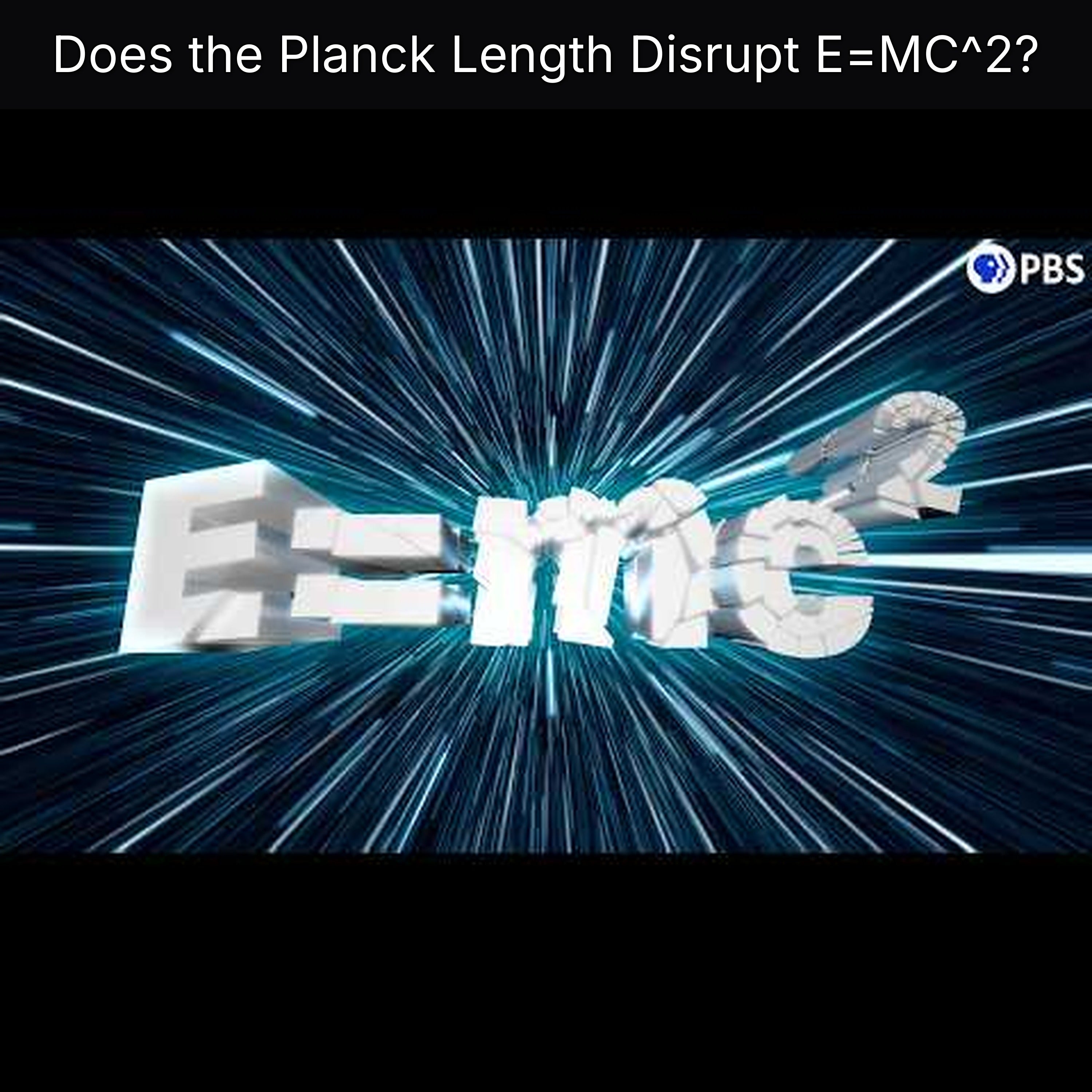
Every good nerd knows that E=mc^2. Every great nerd knows that, really, E^2=m^2c^4+p^2c^2 Want to know what that even means? Sure, I’ll tell you, but today I’d like to invite you to an even higher level of nerdom with extra bits to Einstein’s famous equation that will make even the greatest nerds quiver in their … space time merch if they turn out to be real. PBS Member Stations rely on viewers like you. To support your local station, go to:http://to.pbs.org/DonateSPACE Sign Up on Patreon to get access to the Space Time Discord! Sign up for the mailing list to get episode notifications and hear special announcements! Search the Entire Space Time Library Here: https://search.pbsspacetime.com/ Hosted by Matt O'Dowd Written by Christopher Pollack & Matt O'Dowd Post Production by Leonardo Scholzer, Yago Ballarini & Stephanie Faria Directed by Andrew Kornhaber Associate Producer: Bahar Gholipour Executive Producer: Andrew Kornhaber Executive in Charge for PBS: Maribel Lopez Director of Prog
Is our universe a definitive single reality or is it merely one within an infinitely branching multiverse? Be sure to check out Physics Girl’s Dianna Cowern for more awesome science https://www.youtube.com/c/physicsgirl Uploaded 26-10-16 Get your own Space Time tshirt at http://bit.ly/1QlzoBi Tweet at us! @pbsspacetime Facebook: facebook.com/pbsspacetime Email us! pbsspacetime [at] gmail [dot] com Comment on Reddit: http://www.reddit.com/r/pbsspacetime Support us on Patreon! http://www.patreon.com/pbsspacetime Help translate our videos! http://www.youtube.com/timedtext_cs_panel?tab=2&c=UC7_gcs09iThXybpVgjHZ_7g (http://www.youtube.com/timedtext_cs_panel?c=UC7_gcs09iThXybpVgjHZ_7g&tab=2) The Copenhagen interpretation of quantum mechanics tells us that observation collapses a probability wave into a single definitive outcome, but this isn’t the only interpretation of quantum mechanics. The many worlds theory proposes that the wavefunction never actually collapses. The observer simply fol
Sign Up on Patreon to get access to the Space Time Discord! Uploaded 07-07-21 Quantum mechanics has a lot of weird stuff - but there’s thing that everyone agrees that no one understands. I’m talking about quantum spin. Let’s find out how chasing this elusive little behavior of the electron led us to some of the deepest insights into the nature of the quantum world. Spin Renderings by the Incredible Jason Hise Check out the Space Time Merch Store Sign up for the mailing list to get episode notifications and hear special announcements! Hosted by Matt O'Dowd Written by Graeme Gossel and Matt O'Dowd Graphics by Leonardo Scholzer, Yago Ballarini, Pedro Osinski, Adriano Leal and Stephanie Faria GFX Visualizations: Katherine Kornei Directed by Andrew Kornhaber Assistant Producer: Setare Gholipour Executive Producers: Eric Brown and Andrew Kornhaber End Credits Music by J.R.S. Schattenberg: https://www.youtube.com/user/MultiDroideka Special Thanks to Our Patreon Supporters Big Bang Supporters
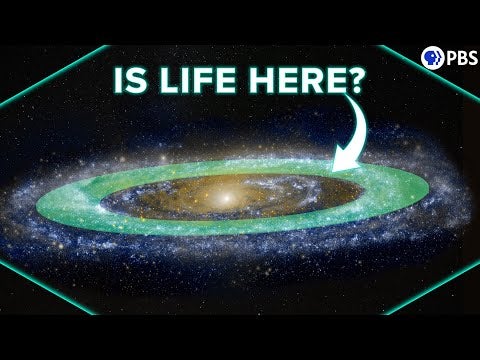
Check Out Matt on Fate and Fabled Here: https://youtu.be/utJZ8YmXOnc Uploaded 18-05-22 PBS Member Stations rely on viewers like you. To support your local station, go to:http://to.pbs.org/DonateSPACE Sign Up on Patreon to get access to the Space Time Discord! Our solar system is a tiny bubble of habitability suspended in a vast universe that mostly wants to kill us. In fact, a good fraction of our own galaxy turns out to be utterly uninhabitable, even for sun—like stellar systems. Is this why .. most of us .. haven’t seen aliens? Check out the Space Time Merch Store Sign up for the mailing list to get episode notifications and hear special announcements! Hosted by Matt O'Dowd Written by Matt O'Dowd Post Production by Leonardo Scholzer, Yago Ballarini, Pedro Osinski, Adriano Leal and Stephanie Faria GFX Visualizations: Ajay Manuel Directed by Andrew Kornhaber Associate Producer: Bahar Gholipour Executive Producers: Eric Brown and Andrew Kornhaber Executives in Charge (PBS): Adam Dylewsk
Thank you to Draper and its "We Hack the Moon" initiative for supporting PBS Digital Studios. Learn more at https://wehackthemoon.com. (https://wehackthemoon.com./) Uploaded 20-06-19 PBS Member Stations rely on viewers like you. To support your local station, go to: http://to.pbs.org/DonateSPACE Check out Physics Girl visit LIGO to see where they discovered Gravitational Waves Recently, the oldest quasar ever seen was discovered by the Gemini North telescope in Hawaii, the Magellan Telescopes at Las Campanas Observatory in Chile, as well as the Large Binocular Telescope in Arizona. In this first episode of the PBS DS mini-series, STELLAR, Matt travels to the top of Mauna Kea to visit the Gemini North telescope and see just how they found this ancient Quasar and it’s massive black hole. Stellar is a brand new miniseries done in collaboration with Dianna Cowern from @Physics Girl and Joe Hanson from @It's Okay To Be Smart Over six episodes we travel to some of the world's most important
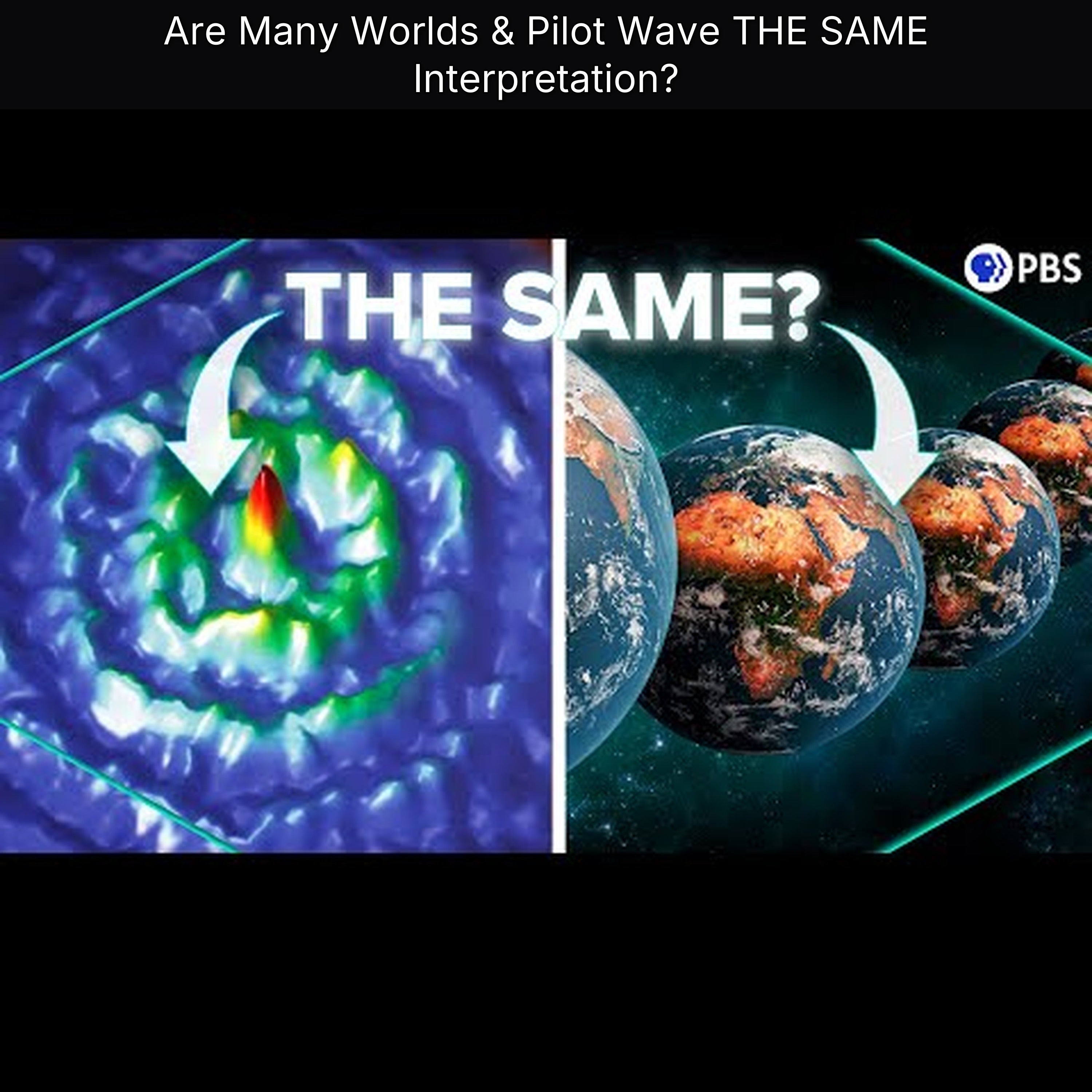
PBS Member Stations rely on viewers like you. To support your local station, go to: http://to.pbs.org/DonateSPACE Sign Up on Patreon to get access to the Space Time Discord! It’s hard to interpret the strange results of quantum mechanics, though many have tried. Interpretations range from the outlandish—like the multiple universes of Many Worlds, to the almost mundane, like the very mechanical Pilot Wave Theory. But perhaps we’re converging on an answer, because some are arguing that these two interpretations are really the same thing. Check out the Space Time Merch Store Sign up for the mailing list to get episode notifications and hear special announcements! Search the Entire Space Time Library Here: https://search.pbsspacetime.com/ Hosted by Matt O'Dowd Written by Taha Dawoodbhoy & Matt O'Dowd Post Production by Leonardo Scholzer, Yago Ballarini & Stephanie Faria Directed by Andrew Kornhaber Associate Producer: Bahar Gholipour Executive Producers: Eric Brown & Andrew Kornhaber Execu
PBS Member Stations rely on viewers like you. To support your local station, go to: http://to.pbs.org/DonateSPACE ↓ More info below ↓ Uploaded 15-10-19 Sign Up on Patreon to get access to the Space Time Discord! Check out the Space Time Merch Store It’s time we talked about loop quantum gravity. What exactly is it? What are the loops? And can it really defeat string theory in our quest for a Theory of Everything? Hosted by Matt O'Dowd Written by Graeme Gossel and Matt O'Dowd Graphics by Leonardo Scholzer Directed by: Andrew Kornhaber Executive Producers: Eric Brown and Andrew Kornhaber End Credits Music by J.R.S. Schattenberg: https://www.youtube.com/channel/UCRl6-nb4iOnsij-vnpAjp0Q The holy grail of physics is to connect our understanding of the tiny scales of atoms and subatomic particles with that of the vast scales of planets, galaxies, and the entire universe. To connect quantum physics with Einstein’s general theory of relativity. Our search for a theory of quantum gravity is a c
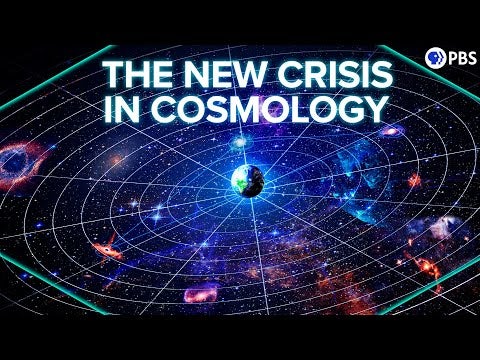
PBS Member Stations rely on viewers like you. To support your local station, go to: http://to.pbs.org/DonateSPACE ↓ More info below ↓ Uploaded 16-03-21 I have good news and bad news. Bad news first: two years ago we reported on the Crisis in Cosmology. Since then, it’s only gotten worse. And actually, the good news is also that the crisis in cosmology has actually gotten worse, which means we may be onto something! The most exciting thing for any scientist is when something they thought they knew turns out to be wrong. So it’s no wonder that many cosmologists are starting to get excited by what has become known as the Hubble tension, or the crisis in cosmology. The “crisis” is the fact that we have two extremely careful, increasingly precise measurements of how fast the universe is expanding which should agree with each other, and yet they don’t. Original Crisis in Cosmology Sabine Hossenfelder's episode "Do we travel through time at the speed of light?" Check out the Space Time Merch
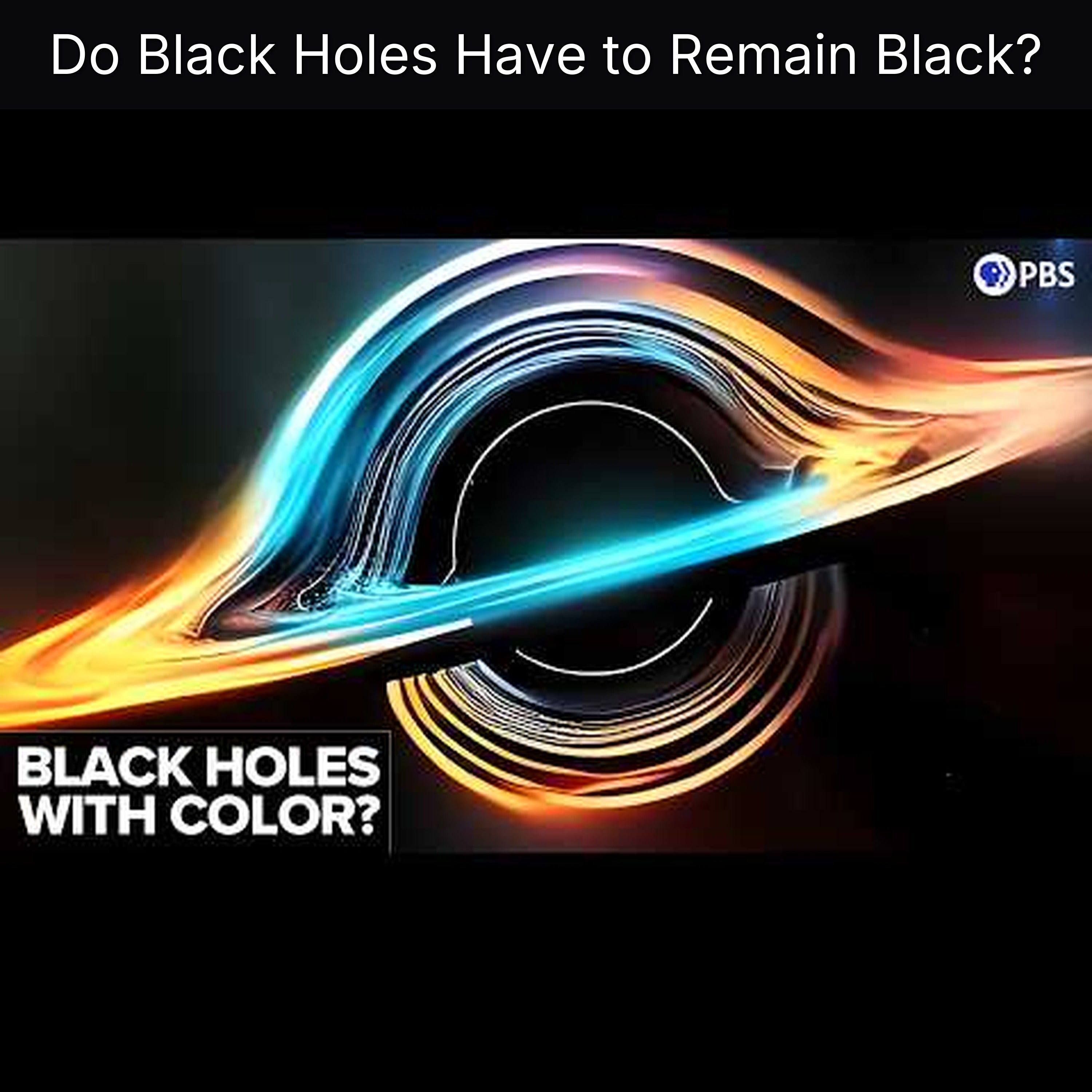
Check out the Space Time Merch Store Sign Up on Patreon to get access to the Space Time Discord! The primary characteristic that defines black holes is in the name. Black holes are black. The gravitational pull at the event horizon is so powerful that not even light can escape. In this case, black means absence of light. We also think of black as indicating absence of colour. But it turns out there is a way to make a coloured black hole—as long as by colour you mean quantum chromodynamic charge. PBS Member Stations rely on viewers like you. To support your local station, go to:http://to.pbs.org/DonateSPACE Sign up for the mailing list to get episode notifications and hear special announcements! Search the Entire Space Time Library Here: https://search.pbsspacetime.com/ Hosted by Matt O'Dowd Written by Andrea Quaranta & Matt O'Dowd Post Production by Leonardo Scholzer, Yago Ballarini & Stephanie Faria Directed by Andrew Kornhaber Associate Producer: Bahar Gholipour Executive Producers: