View full lesson: http://ed.ted.com/lessons/curiosity-discovery-and-gecko-feet-robert-full The scientific method is widely used to make many scientific discoveries, but Robert Full suggests the possibility of finding world-changing results with less formulaic approaches. In his TEDYouth Talk, Full describes the unlikely way he studied gecko's feet and how these beneficial discoveries could eventually save lives. Talk by Robert Full.
Dig into what makes head lice so difficult to get rid of, and the effectiveness of our most common treatments. -- For as long as humans have had lice, we’ve fought hard to get rid of them. Nit combs, the fine-tooth brushes used to remove lice and their sticky eggs, have been found among the ancient remains of cultures across the globe. Today it’s estimated we spend billions of dollars each year treating infestations. So why are lice so difficult to get rid of? Nazzy Pakpour digs into these stubborn insects. Lesson by Nazzy Pakpour, directed by Oksana Kurmaz. Support Our Non-Profit Mission ---------------------------------------------- Support us on Patreon: http://bit.ly/TEDEdPatreon Check out our merch: http://bit.ly/TEDEDShop ---------------------------------------------- Connect With Us ---------------------------------------------- Sign up for our newsletter: http://bit.ly/TEDEdNewsletter Find us on Twitter: http://bit.ly/TEDEdTwitter Peep us on Instagram: http://bit.ly/TEDEdInstag
View full lesson: http://ed.ted.com/lessons/how-to-fossilize-yourself-phoebe-a-cohen Uploaded 06-01-14 You can aspire to great things in life, but how about in death? Could you be one of the world's greatest fossils many years from now? To ensure being found by a future paleontologist, you'll need to die in a highly specific way (think within tree sap or on the bottom of the ocean floor), and nature takes care of the rest. Phoebe A. Cohen details the steps your body must take to find future fame as a fossil. Lesson by Phoebe A. Cohen, animation by Anton Bogaty.
Traditional lab tests for disease diagnosis can be too expensive and cumbersome for the regions most in need. George Whitesides' ingenious answer is a foolproof tool that can be manufactured at virtually zero cost. (Filmed at TEDxBoston.) Uploaded 08-08-13 Talk by George Whitesides.
View full lesson: http://ed.ted.com/lessons/how-big-is-the-ocean-scott-gass Uploaded 24-06-13 While the Earth's oceans are known as five separate entities, there is really only one ocean. So, how big is it? As of 2013, it takes up 71% of the Earth, houses 99% of the biosphere, and contains some of Earth's grandest geological features. Scott Gass reminds us of the influence humans have on the ocean and the influence it has on us. Lesson by Scott Gass, animation by Sandro Katamashvili.
What could our future look like if we harness our technology to create a sustainable world? Take a look at the possibilities. -- Faced with the realities of current crises, it’s easy to assume our world is headed in a bleak direction. But there’s good reason to be hopeful— with developments in science and technology, a positive future is more viable than ever before. So, what if the future was awesome? Iseult Gillespie explores what three cities could look like in 100 years if we harness the tools we have at our disposal. Lesson by Iseult Gillespie, directed by Devin Clark, Augenblick Studios. This video made possible in collaboration with Speed & Scale Learn more about how TED-Ed partnerships work: https://bit.ly/TEDEdPartner Support Our Non-Profit Mission ---------------------------------------------- Support us on Patreon: http://bit.ly/TEDEdPatreon Check out our merch: http://bit.ly/TEDEDShop ---------------------------------------------- Connect With Us ---------------------------
Explore the history of IQ tests; how they measure a person’s intelligence and the ways they have been used to justify scientifically baseless ideologies. Uploaded 27-04-20 -- In 1905, psychologists Alfred Binet and Théodore Simon designed a test for children who were struggling in school in France. Designed to determine which children required individualized attention, their method formed the basis of the modern IQ test. So how do IQ tests work, and are they a true reflection of intelligence? Stefan C. Dombrowski explores how the tests have been used throughout history. Lesson by Stefan C. Dombrowski, directed by Kozmonot Animation Studios. Animator's website: https://www.kozmonot.tv/ Sign up for our newsletter: http://bit.ly/TEDEdNewsletter Support us on Patreon: http://bit.ly/TEDEdPatreon Find us on Twitter: http://bit.ly/TEDEdTwitter Peep us on Instagram: http://bit.ly/TEDEdInstagram View full lesson: https://ed.ted.com/lessons/the-dark-history-of-iq-tests-stefan-c-dombrowski Thank
Dig into how the Sun and Moon are responsible for the tides on Earth, and what this force looks like on other celestial bodies. -- In the 17th century, Isaac Newton offered the first gravitational explanation of tides. As he correctly identified, tides are choreographed by the motions of celestial objects, and Earth’s tides in particular are mostly driven by the Moon. But the precise nature of this relationship is actually quite nuanced. Elise Cutts explains how the Sun and Moon are responsible for the tides. Lesson by Elise Cutts, directed by Rémi Cans, Atypicalist. Support Our Non-Profit Mission ---------------------------------------------- Support us on Patreon: http://bit.ly/TEDEdPatreon Check out our merch: http://bit.ly/TEDEDShop ---------------------------------------------- Connect With Us ---------------------------------------------- Sign up for our newsletter: http://bit.ly/TEDEdNewsletter Find us on Twitter: http://bit.ly/TEDEdTwitter Peep us on Instagram: http://bit.ly/TE
Uploaded 07-01-14 View full lesson: http://ed.ted.com/lessons/how-sugar-affects-the-brain-nicole-avena When you eat something loaded with sugar, your taste buds, your gut and your brain all take notice. This activation of your reward system is not unlike how bodies process addictive substances such as alcohol or nicotine -- an overload of sugar spikes dopamine levels and leaves you craving more. Nicole Avena explains why sweets and treats should be enjoyed in moderation. Lesson by Nicole Avena, animation by STK Films.
Practice more problem-solving at https://brilliant.org/TedEd Uploaded 20-01-22 -- Your friend’s birthday is tomorrow, and he’s turning… well… you’ve forgotten. A ginormous cake has been prepared and your job is to sculpt his age as the chocolate centerpiece. The birthday boy is a giant, and you’re afraid that if your forgetfulness becomes known, you’ll become part of the feast. Can you figure out your friend’s age before the party? Marie Brodsky shows how. Lesson by Marie Brodsky, directed by Igor Coric, Artrake Studio. Support Our Non-Profit Mission ---------------------------------------------- Support us on Patreon: http://bit.ly/TEDEdPatreon Check out our merch: http://bit.ly/TEDEDShop ---------------------------------------------- Connect With Us ---------------------------------------------- Sign up for our newsletter: http://bit.ly/TEDEdNewsletter Find us on Twitter: http://bit.ly/TEDEdTwitter Peep us on Instagram: http://bit.ly/TEDEdInstagram -----------------------------------
Dig into the challenges of modern pastoralism, a form of agriculture where farmers guide livestock to seasonal grazing areas. -- For millennia, livestock farmers strategically guided animals to seasonal grazing areas. This mobile way of life, known as pastoralism, provided them with wealth, social status, and political independence into the 20th century. But in the last century, political and economic policies have worked against these communities. Take a closer look at the challenges of modern pastoralism. Directed by Anton Bogaty. This video made possible in collaboration with Gates Ventures Learn more about how TED-Ed partnerships work: https://bit.ly/TEDEdPartner A special thanks to Graham Gerrity, Donald Nkrumah, and Obai Khalifa who provided information and insights for the development of this video. Support Our Non-Profit Mission ---------------------------------------------- Support us on Patreon: http://bit.ly/TEDEdPatreon Check out our merch: http://bit.ly/TEDEDShop ---------
Explore how bacteria become resistant to antibiotics and turn into superbugs, and what scientists are doing to stop it. Uploaded 07-08-14 -- Right now, you are inhabited by trillions of microorganisms. Many of these bacteria are harmless (or even helpful!), but there are a few strains of ‘super bacteria’ that are pretty nasty -- and they’re growing resistant to our antibiotics. Why is this happening? Kevin Wu details the evolution of this problem that presents a big challenge for the future of medicine. Lesson by Kevin Wu, animation by Brett Underhill. Sign up for our newsletter: http://bit.ly/TEDEdNewsletter Support us on Patreon: http://bit.ly/TEDEdPatreon Find us on Twitter: http://bit.ly/TEDEdTwitter Peep us on Instagram: http://bit.ly/TEDEdInstagram View full lesson: http://ed.ted.com/lessons/how-antibiotics-become-resistant-over-time-kevin-wu
An animated interpretation of Robert Frost's poem "The Road Not Taken" Uploaded 02-02-19 -- For an analysis of this poem, watch this video: http://bit.ly/TEDEdFrostAnalysis This animation is part of our series, "There's a Poem for That," which features animated interpretations of poems both old and new that give language to some of life's biggest feelings. Check out the full series here: http://bit.ly/TEDEdTheresAPoemForThat Poem by Robert Frost, directed by Ellen Su. Sign up for our newsletter: http://bit.ly/TEDEdNewsletter Support us on Patreon: http://bit.ly/TEDEdPatreon Find us on Twitter: http://bit.ly/TEDEdTwitter Peep us on Instagram: http://bit.ly/TEDEdInstagram #poetry
Dig into Moore’s Law and explore its 4 main limitations and how they could change how we are able to make progress in computing. -- Moore’s Law states that every 1 to 2 years the number of transistors that can fit on a given size computer chip will double. Thanks to this law, chips have gotten smaller, faster, more efficient, and cheaper. But today, there are four key problems that trip up this trend, potentially ending Moore’s Law and fundamentally changing how computing progresses. Sajan Saini and George Zaidan investigate. Lesson by Sajan Saini and George Zaidan, directed by Jeff Le Bars, JetPropulsion.space. A special thanks to Anuradha Murthy Agarwal who provided information and insights for the development of this video. Artists and artworks referenced in the animation: "The Persistence of Memory and The Disintegration of the Persistence of Memory" by Salvador Dalí "Composition VIII" by Wassily Kandinsky "Oh Jeff and Girl with Tear III" by Roy Lichtenstein "Black Square on a Whit
View full lesson: http://ed.ted.com/lessons/the-nurdles-quest-for-ocean-domination-kim-preshoff Uploaded 04-08-14 Nurdles are the tiny, factory-made pellets that form the raw material for every plastic product that we use, from toys to toothbrushes. And while they look pretty harmless on land, they can really wreak havoc on our oceans. Kim Preshoff details the nurdles' quest for ocean domination, shedding light on the particular features that allow these pervasive polluters to persist for entire generations. Lesson by Kim Preshoff, animation by Reflective Films.
Join the Celtic druid Camma in her village as she conducts religious rites, serves as a healer, and mediates conflict between tribes. Uploaded 17-09-19 -- As the sun rises in 55 BCE, Camma lays two pigeons on the altar at the center of her village. She wrings the birds’ necks and cuts them open to examine their entrails for divine messages. Camma is a druid. She conducts religious rites, serves as a judge, healer, and scholar, teaches children and mediates conflict between Celtic tribes. Philip Freeman outlines a day in the life of a druid. Lesson by Philip Freeman, directed by Keegan Thornhill. Sign up for our newsletter: http://bit.ly/TEDEdNewsletter Support us on Patreon: http://bit.ly/TEDEdPatreon Find us on Twitter: http://bit.ly/TEDEdTwitter Peep us on Instagram: http://bit.ly/TEDEdInstagram View full lesson: https://ed.ted.com/lessons/a-day-in-the-life-of-an-ancient-celtic-druid-philip-freeman Thank you so much to our patrons for your support! Without you this video would not be
Dive into the Japanese myth of the shape-shifting tanuki, as the raccoon-like creature rewards a traveling salesman for his kindness. Uploaded 25-01-21 -- On the dusty roads of a small village, a traveling salesman was having difficulty selling his wares. As he wandered the outskirts of town in the hopes of finding some new customers, he heard a high-pitched yelp coming from the edge of the forest. Following the screams to their source, he discovered a trapped tanuki. Iseult Gillespie details the Japanese myth of the shape-shifting creature. Lesson by Iseult Gillespie, directed by Anna Samo. Support Our Non-Profit Mission ---------------------------------------------- Support us on Patreon: http://bit.ly/TEDEdPatreon Check out our merch: http://bit.ly/TEDEDShop ---------------------------------------------- Connect With Us ---------------------------------------------- Sign up for our newsletter: http://bit.ly/TEDEdNewsletter Find us on Twitter: http://bit.ly/TEDEdTwitter Peep us on In
Uploaded 21-12-17 View full lesson: https://ed.ted.com/lessons/why-should-you-read-charles-dickens-iseult-gillespie The starving orphan seeking a second helping of gruel. The spinster wasting away in her tattered wedding dress. The stone-hearted miser plagued by the ghost of Christmas past. More than a century after his death, these remain recognizable figures from the work of Charles Dickens. But what are the features of Dickens’ writing that make it so special? Iseult Gillespie investigates. Lesson by Iseult Gillespie, directed by Compote Collective. Thank you so much to our patrons for your support! Without you this video would not be possible! Hoang Viet, Sarah Yaghi, Peter Liu, Joris Debonnet, Bruno Pinho, Tim Armstrong, Katie Dean, Javier Aldavaz, Sage Curie, Husain Mohammad, Ahmad Hyari, Quinn Shen, Dmitry Neverov, Mrinalini , Fabian Amels, Antony Lee, Faiza Imtiaz, Noa Shore, Dominik Kugelmann, Max Shuai Tang, Alexander Walls, Tyler Yoshizumi, Sharon Chou, Jarrel Cacdac, Chris
In this 360° animation, explore the vibrant world of neon signs and learn the science of what makes them glow. Uploaded 19-09-19 -- When the Hoover Dam was completed, it created a huge source of hydroelectric power and zapped a sleepy desert town to life: Las Vegas, Nevada. With the power supply from the dam, Las Vegas soon exploded with vibrant displays. The source of these dazzling lights was electrified neon gas. In this special 360° animation, explore the colorful world of neon signs as Lippy shares what makes them glow. -- How to view this TED-Ed animated 360° video: If you have access to a Google Cardboard viewer and a smart phone: 1. Open this video in the YouTube app on your phone. 2. Hit pause on the video. 3. Tap the 3 vertical dots on the top right corner of the view window. This will slide up a sub-menu where you will choose the quality setting of your video stream. Choose "2160s." Note that if you are not streaming over Wifi, YouTube will only allow "720s" quality. 4. Tap
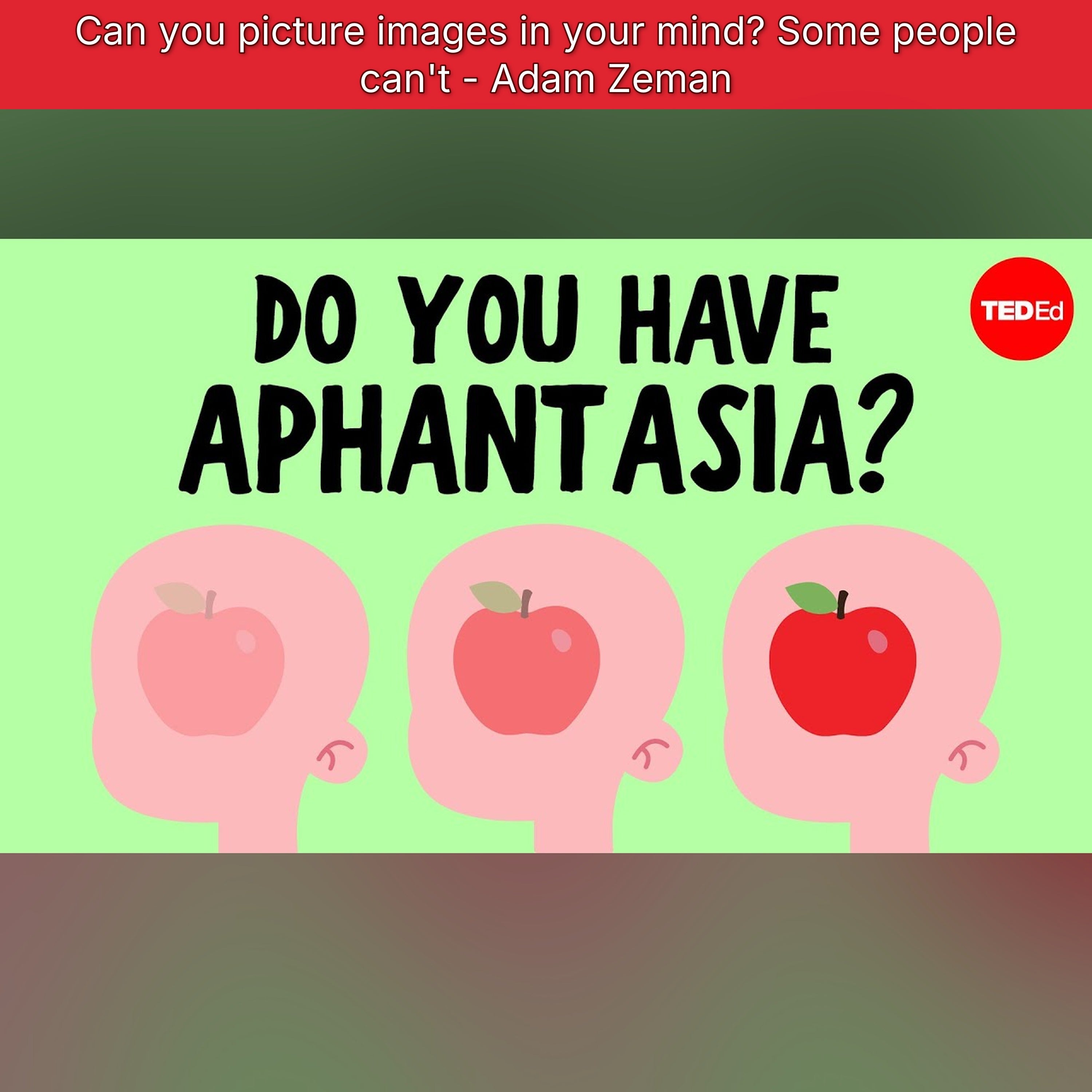
Learn more at https://brilliant.org/TedEd -- When reading "Alice's Adventures in Wonderland," most readers visualize the queen’s croquet game play out in their heads. A few might see the scene in vivid detail. However, a small fraction of readers have a drastically different experience: within their heads, they "see" absolutely nothing. Why do some people have an inability to visualize images? Adam Zeman explores the science of aphantasia. Lesson by Adam Zeman, directed by Biljana Labović. Animation by Manon David. Support Our Non-Profit Mission ---------------------------------------------- Support us on Patreon: http://bit.ly/TEDEdPatreon Check out our merch: http://bit.ly/TEDEDShop ---------------------------------------------- Connect With Us ---------------------------------------------- Sign up for our newsletter: http://bit.ly/TEDEdNewsletter Find us on Twitter: http://bit.ly/TEDEdTwitter Peep us on Instagram: http://bit.ly/TEDEdInstagram ----------------------------------------
View full lesson: http://ed.ted.com/lessons/susan-cain-the-power-of-introverts In a culture where being social and outgoing are prized above all else, it can be difficult, even shameful, to be an introvert. But, as Susan Cain argues in this passionate talk, introverts bring extraordinary talents and abilities to the world, and they should be encouraged and celebrated. Susan Cain makes a case for the quiet and contemplative. Talk by Susan Cain.
View full lesson: http://ed.ted.com/lessons/radioactivity-expect-the-unexpected-steve-weatherall Neutrons don't change into protons. Except, sometimes, they do. Radioactivity is the process under which the nucleus can change spontaneously from one element to another. Steve Weatherall suggests that we acknowledge both the usefulness and danger inherent in harvesting radioactivity. Talk by Steve Weatherall, animation by Eugene Uymatiao.
View full lesson: http://ed.ted.com/lessons/medicine-s-future-there-s-an-app-for-that-daniel-kraft Uploaded 23-06-13 Daniel Kraft offers a fast-paced look at the next few years of innovations in medicine, powered by new tools, tests and apps that bring diagnostic information right to the patient's bedside. (Filmed at TEDxMaastricht.) Talk by Daniel Kraft.
View full lesson: http://ed.ted.com/lessons/sylvia-earle-s-ted-prize-wish-to-protect-our-oceans Legendary ocean researcher Sylvia Earle shares astonishing images of the ocean -- and shocking stats about its rapid decline -- as she makes her TED Prize wish: that we will join her in protecting the vital blue heart of the planet. Sylvia Earle has been at the frontier of deep ocean exploration for four decades. She's led more than 50 undersea expeditions, and she's been an equally tireless advocate for our oceans and the creatures who live in them. Talk by Sylvia Earle.