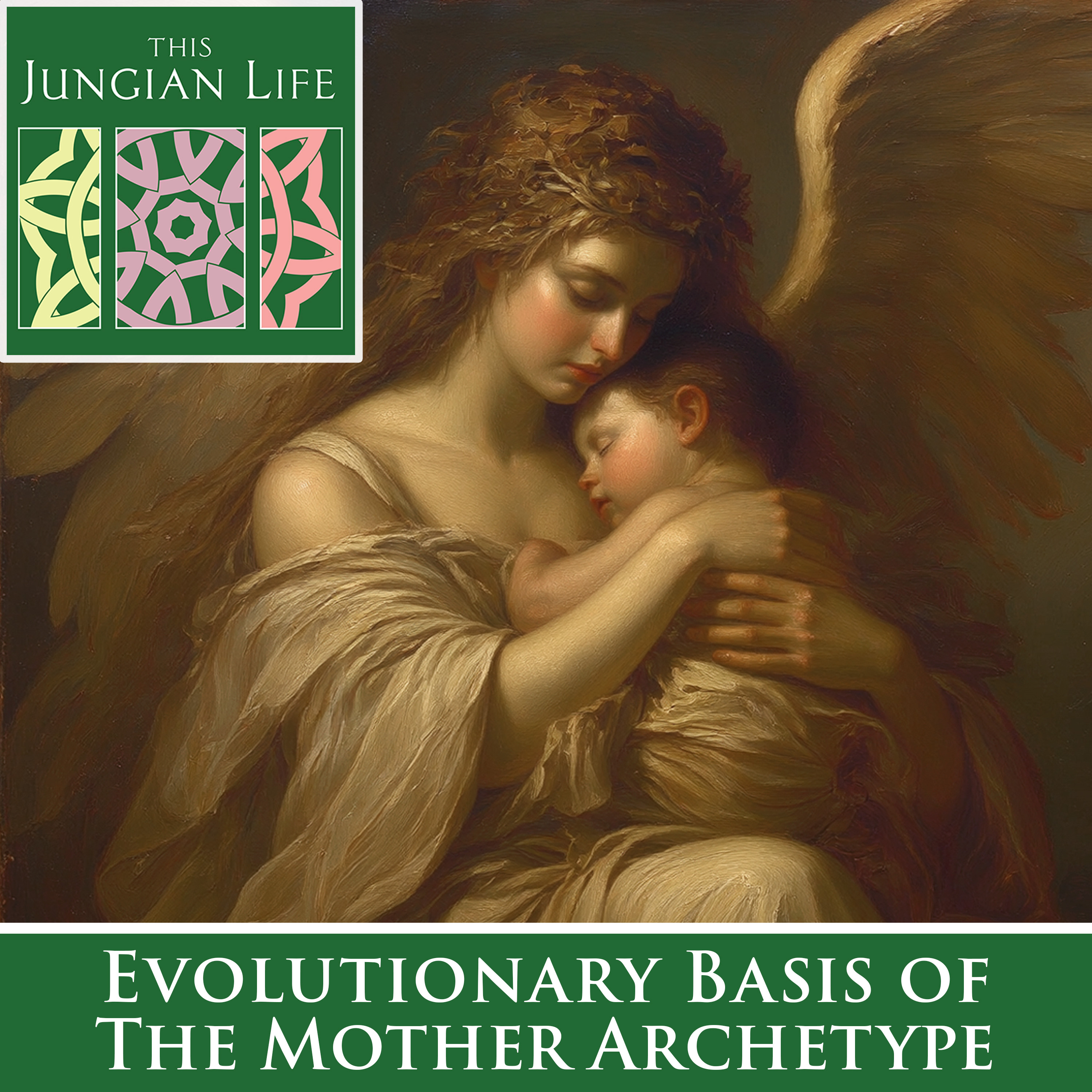
This week on the podcast, we attempt no small task: to bring together neurobiology and Jungian thought to explore the possible evolutionary roots of the mother archetype. Jungian analyst Lisa Marchiano welcomes back GARY CLARK, author of Carl Jung and the Evolutionary Sciences (https://bookshop.org/a/99234/9781032624518) and a visiting research fellow at the University of Adelaide. When a new mother cradles an infant, the mother archetype is constellated. Maternal instinct means previously unknown behaviors now feel completely natural: crooning to the baby in a singsong voice, cradling her on the left side, rocking her gently to sleep. This shows up in the culture in the endless representations of the mother archetype - such as the Madonna and child - in art, religion and literature. Jungians explain such maternal experiences as universal patterns of behavior that organize psychic energy related to mothering. Science, on the other hand, presents us with evidence pointing to ancient par
Whether it’s an intractable dispute at the United Nations or a teenager’s dirty clothes on the floor, some conflicts are impossible to solve with words. When we raise difficult issues in our relationships, such as whether to have a child, address a partner’s alcohol consumption, or negotiate spending, we may discover that the other person stonewalls. A refusal to engage can take us from one difficult question to another: what does obstruction say about the relationship? Are we strong enough to handle difficult conversations? When repeated attempts at communication fail, a different approach may be needed. Deb shares her mentor’s rule: if you have clearly raised an issue three times without a meaningful response, it is time to step back and find support, perhaps from a friend, a therapist or a lawyer. This can lead to self-examination, a new perspective, or facing a painful reality and developing the strength to act. The famous conflict between Jung and Freud proved unresolvable, leadin
Two people stand at the rim of the Grand Canyon. One is overcome with awe at nature’s grandeur, while the other sees an enormous rift in the landscape. What accounts for the difference? This week, Jungian analyst and scholar JOHN R. WHITE joins Lisa Marchiano and Deborah Stewart to explore Jung’s feeling function, our capacity to discern what matters. One of Jung’s best-known legacies is his categorization of ego functions: typology. Whether we are extraverted or introverted (terms Jung introduced), our four basic ego functions sort themselves into intuition, sensation, thinking, and feeling. We have all four functions but prefer some over others. Jung’s system led directly to the creation of the widely used Myers-Briggs Personality Type Indicator. The feeling and thinking functions are both ways of making judgments, but the feeling function is based on personal values: if you were a military commander, would you be like Napoleon, directing his troops from the hilltop -- or like Braveh