English-language podcasts

This Jungian Life Podcast

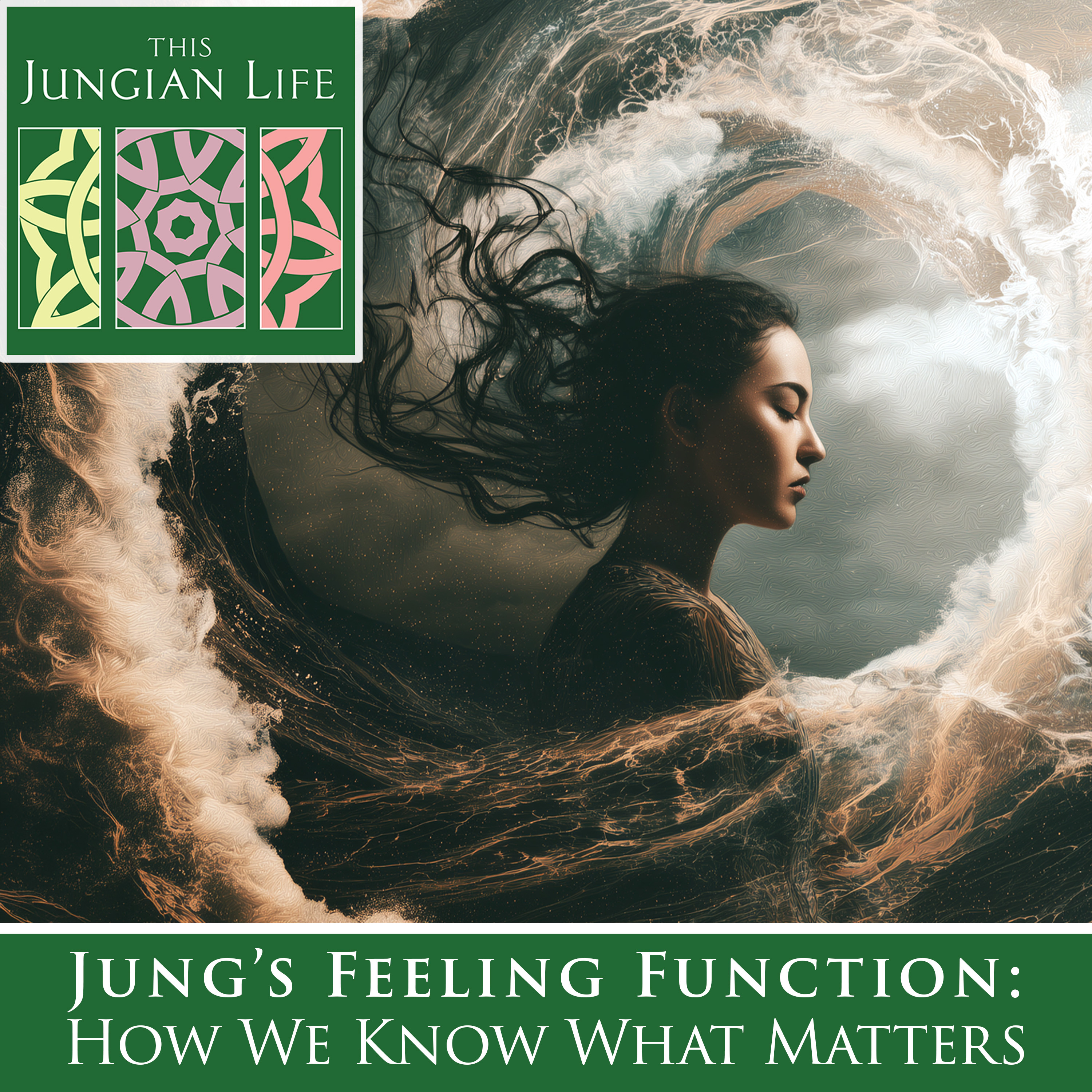
Jung’s Feeling Function: How We Know What Matters
86 min

Listen through the publisher, then discuss the episode here or arrange an in-person Roundtable. Your city determines where to meet.

Roundtables are designed for groups of four, with a shared subject and room for everyone to speak. Come for discussion, with no dating expectation.

Two people stand at the rim of the Grand Canyon. One is overcome with awe at nature’s grandeur, while the other sees an enormous rift in the landscape. What accounts for the difference? This week, Jungian analyst and scholar JOHN R. WHITE joins Lisa Marchiano and Deborah Stewart to explore Jung’s feeling function, our capacity to discern what matters. One of Jung’s best-known legacies is his categorization of ego functions: typology. Whether we are extraverted or introverted (terms Jung introduced), our four basic ego functions sort themselves into intuition, sensation, thinking, and feeling. We have all four functions but prefer some over others. Jung’s system led directly to the creation of the widely used Myers-Briggs Personality Type Indicator. The feeling and thinking functions are both ways of making judgments, but the feeling function is based on personal values: if you were a military commander, would you be like Napoleon, directing his troops from the hilltop -- or like Braveheart, leading his men on the field? When the feeling function is cultivated and differentiated, it illuminates much of how and why we do what we do. Do we tend to prefer a subjective stance based on personal values, or a more objective and strategic stance? Developing our feeling function may be challenging in the context of a culture that prioritizes thinking and sensate functions over feeling and intuition. It is a task worth taking on, however. Evaluating our experiences up close as well as from the greater distance the thinking function affords can be a profound step toward growth and individuation. Discerning whether the basis of a decision should be subjective or objective builds consciousness and expands choice. Since subjectivity is closely aligned with feelings, we can reflect on what a bruising encounter has made us feel—and choose our response rather than reacting. We discuss some of the strategies you might use to differentiate your feeling function, including embarking on analysis, writing in your journal, and Eugene Gendlin’s focusing technique, which asks us to tune into the body and carefully name what is felt. Connect With This Jungian Life Send a dream (https://tinyurl.com/senddream) for us to analyze on the show Follow This Jungian Life on Instagram (https://www.instagram.com/thisjungianlifepodcast/)

Episode information is provided by the publisher. Listening takes place on the publisher’s service.

Listen at the source ↗

Featured places to meet in Palo Alto, CA

Explore these places and arrange a conversation through ThinkMatch.

City guide for Palo Alto, CA

More from This Jungian Life Podcast

This Jungian Life Podcast

The Evolutionary Basis of the Mother Archetype

72 min

This week on the podcast, we attempt no small task: to bring together neurobiology and Jungian thought to explore the possible evolutionary roots of the mother archetype. Jungian analyst Lisa Marchiano welcomes back GARY CLARK, author of Carl Jung and the Evolutionary Sciences (https://bookshop.org/a/99234/9781032624518) and a visiting research fellow at the University of Adelaide. When a new mother cradles an infant, the mother archetype is constellated. Maternal instinct means previously unknown behaviors now feel completely natural: crooning to the baby in a singsong voice, cradling her on the left side, rocking her gently to sleep. This shows up in the culture in the endless representations of the mother archetype - such as the Madonna and child - in art, religion and literature. Jungians explain such maternal experiences as universal patterns of behavior that organize psychic energy related to mothering. Science, on the other hand, presents us with evidence pointing to ancient par

Discuss this episode

This Jungian Life Podcast

When Words Don't Work: Finding a Way Forward

90 min

Whether it’s an intractable dispute at the United Nations or a teenager’s dirty clothes on the floor, some conflicts are impossible to solve with words. When we raise difficult issues in our relationships, such as whether to have a child, address a partner’s alcohol consumption, or negotiate spending, we may discover that the other person stonewalls. A refusal to engage can take us from one difficult question to another: what does obstruction say about the relationship? Are we strong enough to handle difficult conversations? When repeated attempts at communication fail, a different approach may be needed. Deb shares her mentor’s rule: if you have clearly raised an issue three times without a meaningful response, it is time to step back and find support, perhaps from a friend, a therapist or a lawyer. This can lead to self-examination, a new perspective, or facing a painful reality and developing the strength to act. The famous conflict between Jung and Freud proved unresolvable, leadin

Discuss this episode

Community Poll

A tradition can remain authentic while changing with the community that practices it.

Share your view, then see how readers voted. No sign-in required. This poll is shared across stories.

Do you agree or disagree?

Choose one answer

Common Quandary

A Common Quandary to discuss

Another conversation to explore, separate from this news story.

A likable but unreliable former employee lists you as a reference. How honest are you?

A former employee who was unreliable but personally likable lists you as a reference without asking. Their prospective manager calls and asks only whether you would hire them again.

How much truth do you owe a stranger when it may cost someone a fresh start?

Explore this quandary