In which John Green explores F. Scott Fitzgerald's novel of the Jazz Age, The Great Gatsby. John introduces you to Nick Carraway, Jay Gatsby, Daisy and Tom Buchanan, and the other characters in the novel, and tries to look beyond the surface story to figure out what this thing is ABOUT. Set in the 1920s against a conflicted backdrop of prohibition and excess, The Great Gatsby takes a close look at the American Dream as it existed in Fitzgerald's time. It turns out, it had a lot to do with money and status, and it still does today. John will cover the rich symbolism of the novel, from the distant green light to the pale gold of wealth and decay. Also, Paris Hilton drops by. Turn on the captions. You'll like it. Consider supporting local bookstores by purchasing your books through our Bookshop affiliate link https://bookshop.org/shop/complexly or at your local bookseller. Crash Course is on Patreon! Want to find Crash Course elsewhere on the internet? Facebook - http://www.facebook.com/Y
The entire American retirement system was built for people with a steady employer, a predictable paycheck, and benefits that are easy to opt in to. But that’s just not how a huge number of people make money anymore. Freelancers, consultants, gig workers, seasonal workers, and side-hustlers are building their financial lives without a 401(k) match or a biweekly deposit, and “just save more” won’t cut it. Jean talks with AJ Ayers, CFP®, co-founder of Brooklyn Fi (https://www.ajayers.com/)and author of Creative Money (https://www.penguinrandomhouse.com/books/808718/creative-money-by-aj-ayers/). AJ shares practical, realistic advice for artists, freelancers, and solopreneurs, whether you chose self-employment or the job market chose it for you. In this episode: How to set up your finances when you go out on your own How self-employment differs in your 50s versus your 30s How much to keep in an emergency fund when your income is unpredictable Jean is hosting a free Forever Paycheck book clu
Religion and science have had some famously messy fights, but do they always have to be in conflict? In this episode of Crash Course Religions, we’ll look at some ways religion and science are more than just enemies. Introduction: The Three Sisters 00:00 Earth's Age 0:55 Creation vs. Evolution 1:51 Galileo 3:45 The Conflict Thesis 5:53 Traditional Ecological Knowledge 8:32 Review & Credits 10:56 *** Support us for $5/month on Patreon to keep Crash Course free for everyone forever! https://www.patreon.com/crashcourse Or support us directly: https://complexly.com/support Join our Crash Course email list to get the latest news and highlights: https://mailchi.mp/crashcourse/email Get our special Crash Course Educators newsletter: http://eepurl.com/iBgMhY Thanks to the following patrons for their generous monthly contributions that help keep Crash Course free for everyone forever: Shruti S, Ryan Lueckenotte, Spilmann Reed, Brandon Thomas, Emily Beazley, Forrest Langseth, Rie Ohta, oranjeez,
What happens when a child has the intelligence and potential to succeed, but the traditional education system isn't meeting their needs? In Episode 64 of The Influence Exchange, J.V. sits down with Russell Van Brocklen to explore dyslexia, learning differences, and why struggling with reading or writing should never define a child's future. Russell shares his remarkable personal journey, from having a first-grade reading and writing level while attending university to receiving 15 credits of F after an internship that originally recommended A-minus grades. Rather than allowing those experiences to define him, Russell dedicated himself to helping students with dyslexia develop their reading, writing, and critical-thinking skills. Throughout this conversation, we explore: Why dyslexia doesn't mean a lack of intelligence or potential. Early signs of reading and writing difficulties that parents should recognize. Why traditional teaching methods don't always work for every student. How Rus
Explore how fiber optics uses light to transmit data over long distances, and with integrated photonics, expands our virtual world beyond the internet. Uploaded 22-04-19 -- In 2012, a team of researchers set a world record, transmitting 1 petabit of data— that’s 10,000 hours of high-def video— over a fifty-kilometer cable, in a second. This wasn’t just any cable. It was a souped-up version of fiber optics, the hidden network that links our planet and makes the internet possible. What is fiber optics and how does it work? Sajan Saini explores the vital technology. Lesson by Sajan Saini, directed by Artrake Studio. Learn more about integrated photonics: https://aimphotonics.academy (https://aimphotonics.academy/) Learn how integrated photonic chips are made: https://www.aimphotonics.com (https://www.aimphotonics.com/) Sign up for our newsletter: http://bit.ly/TEDEdNewsletter Support us on Patreon: http://bit.ly/TEDEdPatreon Find us on Twitter: http://bit.ly/TEDEdTwitter Peep us on Instag
In this episode, Roger explains how to rebalance your portfolio before retirement and why it's important to align your investments with the changing purpose of your money. He discusses how guaranteed income, your retirement plan's fundedness, and your comfort with market volatility influence your approach. Roger also shares a practical framework for organizing your assets into three layers to provide financial flexibility, fund your retirement paycheck, and support long-term growth. Plus, he answers listener questions about finding a retirement planner and preparing for the nonfinancial aspects of retirement. OUTLINE OF THIS EPISODE OF THE RETIREMENT ANSWER MAN (00:00) Roger introduces the episode and discusses why rebalancing your portfolio before retirement is important, particularly as the purpose of your money changes. He previews the discussion on retirement portfolio allocation, listener questions, and a Rockin' Retirement in the Wild story. RETIREMENT TOOLKIT: HOW TO REBALANCE Y
Why are we still treating going to work sick like it's some kind of accomplishment? Today we're talking about sick day guilt, why so many of us feel responsible for keeping the office running when we're unwell, and the research on working while sick. Plus, why working from home doesn't mean you should be working through an illness, and why your company's staffing problems are not your personal responsibility. Got a career question you want answered on the show? Hosted by Simplecast, an AdsWizz company.
Two weeks ago, I got the scariest phone call of my life. I had cancer. It was melanoma. I love the sun so much, but did my sun exposure put my life at risk? This is what I was grappling with when I discovered Rowan Jacobsen's new book, In Defense of Sunlight, which basically flips everything that I have ever heard about sun exposure on its head. It says we’re all treating the sun, and sunscreen, completely wrong. Rowan Jacobsen was a Knight Science Journalism fellow at MIT, which put him in the rare position of getting to research the science of the sun on every aspect of our health. You’re going to learn the real science behind sun exposure, sunscreen use, preventing heart disease, autoimmune diseases, depression, anxiety, and more. What you’ll learn: • The 4 major ways the sun impacts your overall health • The 6 skin types and how to approach the sun with each • The truth about Vitamin D supplements • The shocking study showing smart light bulbs reduced depression • Why you actually
Dave McGillivray was 23 when he ran into Fenway Park on August 29, 1978 in front of 32,000 people. He had just run 3,452 miles from Medford, Oregon to Medford, Massachusetts, 45 to 50 miles a day for 80 straight days, raising money for the Jimmy Fund. His mother mailed chocolate chip cookies to post office boxes along the route. That was his PowerBar. I grew up next door in Somerville and remember it as a kid. He was the smallest kid on every team, the last pick, until he figured out that nobody can cut you from running. He has run every Boston Marathon since 1973, 54 in a row. For 36 of those years he worked the race all day, then went back to Hopkinton and ran it at night as the last finisher. He has directed or consulted on 1,400 events, run 175 marathons and logged 165,000 miles. Then one day he could not catch his breath on a run. He ignored it for months. The angiogram showed severe coronary artery disease, and he told the doctor to zip it up and not tell anyone. He changed every
What if you could work less, travel more, and enjoy financial freedom long before reaching your full early retirement number? Mel, nurse and creator of Traveling to Retirement, joins Mindy Jensen and Evan Lawler to explain how Coast FI changed her approach to money, work, and life. At 33, she has a 65–80% savings rate, is roughly 60% of the way to her $3 million FI goal, and could stop investing today and still reach financial independence by 41. Mel shares how she quadrupled her income, keeps expenses relatively low, and uses tax-advantaged accounts and a taxable brokerage to build wealth. But the real goal isn't just retiring early. It's having the freedom to work fewer days, travel when she wants, and pursue opportunities without worrying about maximizing every dollar. She also explains why enjoying the journey matters more than reaching a magic number. To go beyond the podcast: Interested in a Flat Fee Financial Planner? Go tohttps://biggerpocketsmoney.com/fipro/ Interested in Lear
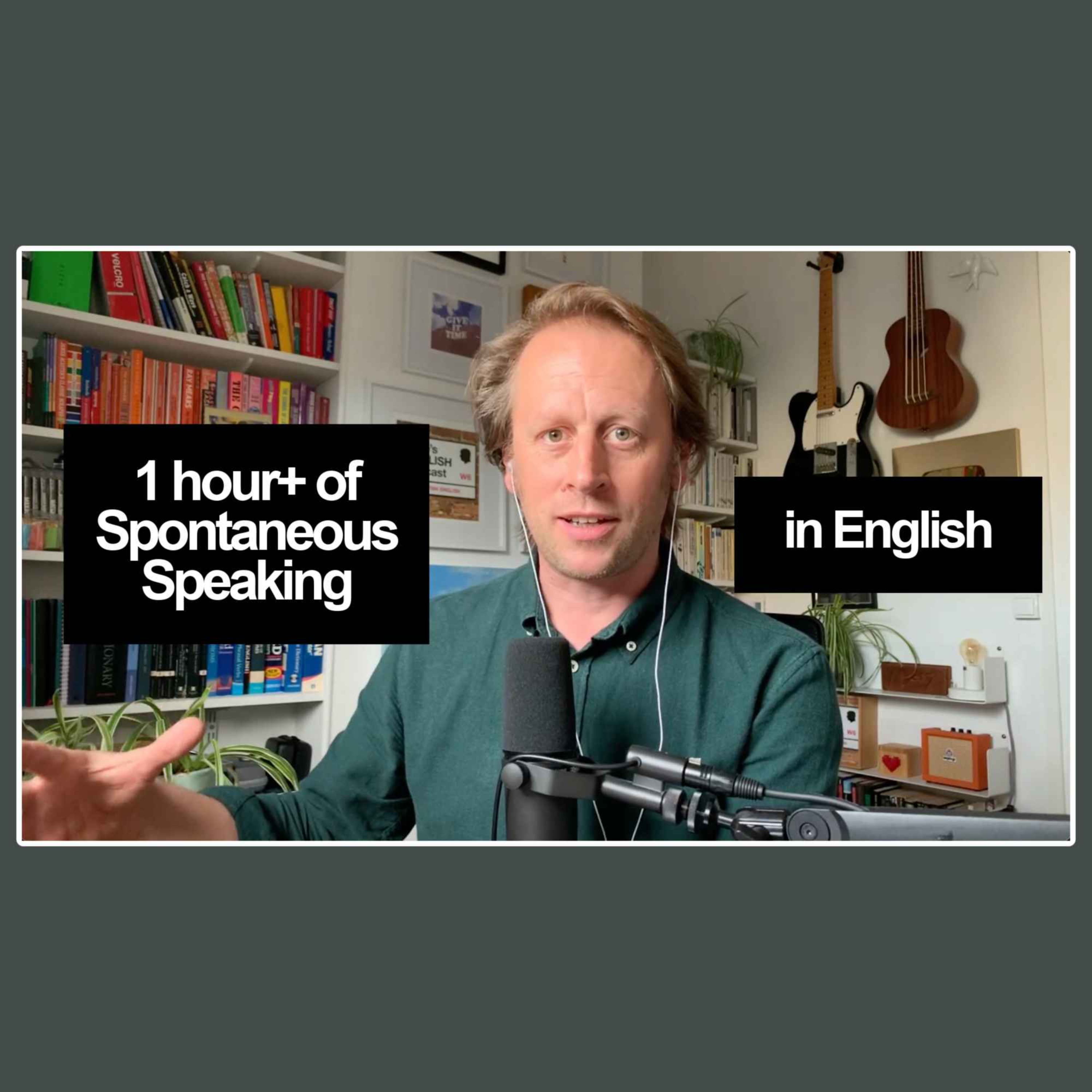
Join me for a completely spontaneous "rambling challenge" in which I attempt to talk without stopping for at least 45 minutes. I end up discussing the benefits of talking to yourself for English fluency, the ideas of "practice makes perfect" and "practice makes permanent", the best advice Tom Hiddleston ever got, what it means to "seize the day", how thinking about death is life affirming, Dr Kawashima's Brain Training, and a nostalgia trip about Super Mario Kart on the Nintendo. • Luke's event at the British Council • Get the PDF transcript • Episode page ️/ (https://teacherluke.co.uk/2026/11/04/life-death-mario-kart-1008-a-rambling-challenge-%F0%9F%97%A3%EF%B8%8F/) • LEP Premium Hosted on Acast. See acast.com/privacy (https://acast.com/privacy) for more information.
You’ve probably lied to someone today. You also probably think you lie less than everyone else. Welp, I have some bad news. We all manipulate, we all get played, and sometimes, the smarter you are, the easier you are to con. In this episode, Drew and I get into what manipulation is, why everyone does it, and how to keep from getting fooled. We tell the story of how Freud’s nephew turned bacon into a doctor-approved breakfast, and how the TSA spent nearly $1 billion training officers to spot liars, with nothing to show for it. We walk through the one test that shows when persuasion crosses into manipulation, and the tactics advertisers, propagandists, and con artists have been running on you for a century. Then we cover why skeptics make some of the easiest marks and the only defense with serious evidence behind it. We also spend a good chunk of time on the manipulator you know best (or least)... yourself. You can’t fully escape influence, and you might not want to. But once you know th
In the world of ecology, the only constant is change - but change can be good. Today Hank explains ecological succession and how ecological communities change over time to become beautiful, biodiverse mosaics. Table of Contents 1. Primary Succession 1:56:1 2. Secondary Succession 3:36 3. Climax Community Model 5:11 4. Intermediate Disturbance Hypothesis 7:25:1 Reference: Crash Course is on Patreon! Want to find Crash Course elsewhere on the internet? Facebook - http://www.facebook.com/YouTubeCrashCourse Twitter - http://www.twitter.com/TheCrashCourse Instagram - https://www.instagram.com/thecrashcourse/ CC Kids: http://www.youtube.com/crashcoursekids
Uploaded 24-05-18 View full lesson: https://ed.ted.com/lessons/what-is-dust-made-of-michael-marder Less than a tenth the size of an ant, a dust mite’s whole world is contained in the dusty film under a bed or in a forgotten corner. This realm is right under our noses, but from our perspective, the tiny specks of brilliant color blend together into a nondescript grey. What are these colorful microscopic particles? Michael Marder explores the science of dust. Lesson by Michael Marder, animation by Mette Ilene Holmriis. Thank you so much to our patrons for your support! Without you this video would not be possible! Irindany Sandoval, William Bravante, Elizabeth Parker, Sai Krishna Koyoda, Therapist Gus, Samuel Barbas, Betsy Feathers, Maxwell Ingram, Ajinkya Deshmukh, Victoria Soler-Roig, Abdulmateen Aderinto, Pavel Maksimov, Barbara Younker, Cyrus Garay, Yvette Mocete, Mike Azarkman, Valeria Sloan Vasquez, Patricia Alves Panagides, William Biersdorf, Michael Aquilina, Vinamr L. Sachdeva,
Hank gets to the more violent part of community ecology by describing predation and the many ways prey organisms have developed to avoid it. TABLE OF CONTENTS Herbivory and Parasitism 1:43 Predatory Adaptation 3:39 Cryptic Coloration 4:25 Mullerian Mimicry 5:43 Batesian Mimicry 6:38 Resources: http://www.youtube.com/watch?v=37hHBgaZymo&feature=fvwrel (http://www.youtube.com/watch?feature=fvwrel&v=37hHBgaZymo) Thanks to the Boone and Crockett Club for letting us film the introduction to this video in their headquarters here in Missoula: http://www.boone-crockett.org/about/about_headquarters.asp?area=about Crash Course is on Patreon! Want to find Crash Course elsewhere on the internet? Facebook - http://www.facebook.com/YouTubeCrashCourse Twitter - http://www.twitter.com/TheCrashCourse Instagram - https://www.instagram.com/thecrashcourse/ CC Kids: http://www.youtube.com/crashcoursekids
Healthy eating doesn't have to mean complicated recipes, expensive groceries, or spending your entire weekend preparing food. In this episode of Godly Nutrition, discover simple meal planning tips to help you prepare wholesome, real-food meals with less stress. If you've ever stood in front of the refrigerator wondering what to make for supper, this episode will help you create a realistic meal plan that works with your schedule, your grocery budget, and the foods you already have on hand. In this episode, you'll learn how to: Plan simple, healthy meals using pantry staples. Choose a few dependable meals without planning every bite. Combine protein foods, whole grains, vegetables, and other basic ingredients. Create a practical grocery list and reduce food waste. Prepare a few ingredients ahead of time without spending all day meal prepping. Use leftovers and keep easy backup meals available. Approach meal planning with biblical gratitude and good stewardship. Your simple challenge: Ch
What happens when prayer stops being something we try to accomplish and becomes something we simply receive from God? Sr. Katie Flanagan explains the transition from our own efforts in prayer to the mysterious work of God within the soul—and reminds us that we cannot force or manufacture His grace. Today, we read The Fourth Dwelling Places: Chapter 2.
Bioluminescence is the natural emission of light produced through a chemical reaction between the compound luciferin and the catalytic enzyme luciferase. First isolated in the late nineteenth century by French scientist Raphaël Dubois, this biological phenomenon is most prominent in marine environments, where sunlight is absorbed within the first 650 feet (200 meters) of the water column. In the ocean, roughly three-quarters of pelagic organisms, including jellyfish, squid, worms, and deep-sea fish, generate their own light. Marine species rely on bioluminescent adaptations across diverse ecological niches, using specialized light organs on their bellies for counterillumination camouflage, dangling glowing lures such as the anglerfish's esca to draw in prey, or discharging clouds of luminous mucus to confuse and disorient predators. Beyond open waters, bioluminescence serves essential evolutionary and ecological roles on land and across microbial colonies. Terrestrial fireflies regulat
Most investing advice starts with what to buy. Dr. Daniel Crosby, behavioral finance expert and author of The Behavioral Investor, starts with you. He tells Joe Saul-Sehy and OG why a brain built for survival on the savanna makes a poor money manager, and how four predictable troublemakers (ego, conservatism, attention, and emotion) show up in real portfolios. Then they play a round of “Who Broke the Portfolio?” In the headline segment, Joe Saul-Sehy, OG, and Doug look at why companies that lean on AI are running into an insurance problem, and what that means for protecting your own finances. Last Call: Veterans Day Giveaway Enter by Friday, Nov 6 at stackingbenjamins.com/veterans (https://stackingbenjamins.com/veterans) for a chance to win a Solo Stove, given away next Wednesday on Veterans Day. Veterans and active duty service members get three entries, and everyone else gets one. If you already get the 201, you can still enter. What You’ll Walk Away With Why the first investing ques
Are you the only one in your house who notices the mess, and the only one who asks for help cleaning it up? In this episode, I'm sharing how I stopped feeling like the nag in my own home. My family is great and happy to help. The hard part was carrying the remembering and the asking every single night. After our unexpected move into a much bigger house this summer, I knew something had to change. In this episode: Why the person who notices the mess ends up doing the work Wanting someone to parent me, and why handing off the reminder helps so much Why 10 minutes works better than 5 (hello, underpromise and overdeliver) How a nightly tidy turned us into a team against the house The night we finished in 4 minutes and 38 seconds 3 steps to hand off the nightly reset, starting tonight Tonight's homework: pick your reset spots, set a 10-minute timer and ask your family to join you for just 10 minutes. Want the reminder and timer done for you? Try Tindy free at tindy.app. You'll also get ever
Whether you're shopping for furniture or buying low-quality knick-knacks at the fake market, it always helps to know what your product is made of to help determine a fair price. There's nothing worse than realizing your shiny dragon statue is made of cheap plastic! Learn how to talk about materials in today's elementary lesson. Episode link: https://www.chinesepod.com/1920
Zig Ziglar (https://www.ziglar.com/) shares a classic lesson on the power of expectation. In this eye-opening talk, he reveals what happened when students were told their lab rats were geniuses or dummies, how the same experiment played out in a classroom, and why the way you see people shapes how they perform. This episode will challenge you to raise your expectations of the people around you and of yourself. Source: Success and The Self Image (https://www.audible.com/pd/Success-and-the-Self-Image-Audiobook/B076MJ2J4Y?srsltid=AYCX9vILU-nmA9OzR4TSPvaXr8c2lItRLiaGmAgfoQlBqzIADavCfRzO) Hosted by Sean Croxton (https://seancroxton.com/) Follow me on Instagram (https://www.instagram.com/seancroxton/)
You can tell your therapist exactly why you people please... and you still find yourself apologizing for things that aren't yours before your brain even catches up. If that sounds familiar, this conversation is for you. This week I'm talking with Zipa Leah Scheinberg, LCSW, an EMDR Certified Therapist and EMDRIA Approved Consultant who has spent more than fifteen years working with trauma and dissociation. Zipa grew up as the youngest of ten, the daughter of a Holocaust survivor, and she knew from a young age that she was looking at a kind of pain nobody had words for. Some of the deepest wounds come from what never happened at all: the comfort, the mirroring, the permission to want something. We talk about: What developmental trauma actually is, and why "it wasn't that bad" keeps so many people stuck Why understanding your patterns doesn't always change them Zipa's BITES framework: Belonging, Identity, Trust, Existential meaning, and Shame Her STAY practice for coming back to yourself
Get the 200+ Page Optimal Living Daily Workbook (PDF) - Free. Want to turn today's episode into an actionable plan? Episode 3758: Mr. Money Mustache uses his trusty nail gun to show why human productivity and knowledge keep compounding, and why constant predictions of financial collapse miss the bigger picture. He makes the case for basing your decisions on long-term optimism: investing in index funds and real estate instead of trying to time the next crash, investing your time in education, health, and relationships, and producing far more value than you consume. Read along with the original article(s) here: https://www.mrmoneymustache.com/2014/03/03/why-we-are-not-really-all-doomed/ Quotes to ponder: "Humankind's ability to live well and prosper depends at its core only on productive land, sunshine and our collective knowledge." "Produce value for the world much more than you consume things from the world." "All of this will continue as long as most of us choose to remain happy, prod