What if the very thing that makes you different is actually your greatest strength? For years, Emilia Smith faced challenges with memory loss, identity, and understanding why she experienced the world differently. But instead of allowing those experiences to define her future, she developed a mindset centered on resilience, growth, and discovering her own strengths. In Episode 66 of The Influence Exchange, I sit down with Emilia Smith, entrepreneur, founder, CEO, podcast host, and leadership coach, for an honest conversation about neurodivergence, emotional intelligence, personal growth, and what it really takes to become a better leader. Emilia shares how her personal experiences shaped her perspective, why she views thinking differently as an advantage, and how leaders can create healthier workplaces by developing greater self-awareness and humility. In this episode, we explore: Emilia's experiences with memory loss and discovering her neurodivergence. Why thinking differently can be
Explore the science of why mixing drugs and drug interactions with other substances can lead to dangerous health complications. -- Which of the following is risky behavior: a person taking cholesterol medicine with grapefruit juice? Or a person taking Acetaminophen before going out for drinks? Or a person on blood thinners who takes an aspirin? Turns out, all of them are risky. Each has inadvertently created a drug interaction that could lead to serious complications. Céline Valéry describes the dangers of mixing substances. Lesson by Céline Valéry, directed by Cabong Studios. Animator's website: https://www.cabongstudios.com.br/ Sign up for our newsletter: http://bit.ly/TEDEdNewsletter Support us on Patreon: http://bit.ly/TEDEdPatreon Find us on Twitter: http://bit.ly/TEDEdTwitter Peep us on Instagram: http://bit.ly/TEDEdInstagram View full lesson: https://ed.ted.com/lessons/the-dangers-of-mixing-drugs-celine-valery Thank you so much to our patrons for your support! Without you this v
Ian and Randy help Patrick address listener feedback and answer their questions. Kerry describes living in a small house. Architect Chris Briley motivates a discussion about line versus low-voltage lighting. The crew talks about favorite house features and problematic construction details. Tune in to Episode 763 (https://www.finehomebuilding.com/2026/11/13/podcast-episode-763-living-in-a-small-space-led-lighting-favorite-house-features) of the Fine Homebuilding Podcast to learn more about: The advantages of small-house living Should we rethink how we wire houses Favorite house features and amenities Email us at [email protected]. ️ Check Out the Full Show Notes: FHB Podcast 763 (https://www.finehomebuilding.com/2026/11/13/podcast-episode-763-living-in-a-small-space-led-lighting-favorite-house-features) ️ Sign up for Myron Ferguson's eLearning course, Drywall: Start to Finish (https://courses.finehomebuilding.com/drywall-start-to-finish-with-myron-ferguson) ️ Follow Fine Homebuildi
In this week’s episode, we explore how perfectionism turns food into a high-stakes series of “right” and “wrong” choices, often triggering all-or-nothing thinking, overeating, and renewed promises to start again. The conversation examines how fear of mistakes, criticism, rejection, and uncertainty can reinforce strict food rules, and why learning to tolerate imperfect decisions helps reduce food noise and create a more relaxed relationship with eating. FREE WORKSHOP SERIES: https://www.rewireyourweightmethod.com/quiet/
Are you constantly worrying about everything that could go wrong, or do you spend more time worrying about what other people think of you? Both experiences involve anxiety, but understanding what's driving that anxiety can make a difference in how you approach it. In this episode of Off the Couch Psychology Podcast, Dr. Jerry Cunningham explores the differences between Social Anxiety Disorder (SAD) and Generalized Anxiety Disorder (GAD), using everyday examples, relatable humor, and two personal stories that reveal how anxiety can affect careers, relationships, and daily life. You'll meet Michael, whose fear of judgment has followed him since childhood, and Jennifer, whose mind seems determined to prepare for every possible disaster. You'll also discover what the Ugly Duckling and Chicken Little can teach us about the different ways anxiety influences our thoughts and behavior. Could understanding what you're actually afraid of be the first step toward taking back control? Listen now a
Eric Haze started writing graffiti on New York City subways at 11. By his early 20s he was writing more than ever at night and going to the School of Visual Arts by day, teaching himself to be a logo designer. Then a conversation with the Beastie Boys after the club at four in the morning put him in the Def Jam office the next day. He designed the single covers for She’s Crafty and No Sleep till Brooklyn, art directed Public Enemy’s first LP, built the logo and packaging for LL Cool J’s Bigger and Deffer, and did Check Your Head a few years later in LA. But he got tired of packaging other people’s identities and waving goodbye to the baby. In the early 90s he started his own clothing brand in California, right as streetwear was being born, got to Japan early and has been all over Tokyo ever since. Then came Nike Dunks and Air Force 1s, G-Shock, a Mountain Dew bottle, the US ski team uniforms and the Brooklyn Nets jersey that ran on court for two years. This week I sat down with Eric, a
What does the average American's financial situation really look like, and is the wealth gap getting worse? Mindy Jensen and Scott Trench break down the Federal Reserve's latest Survey of Consumer Finances to see how household income, net worth, debt, and financial security have changed. While median income and wealth have improved, the gains aren't evenly distributed. They explore the surprising differences between generations, why older Americans are accumulating wealth while younger households are falling behind, and whether the K-shaped economy narrative tells the whole story. Plus, they share practical ways to protect your finances, build a bigger emergency fund, stay invested, and prepare for an increasingly uncertain economy. To go beyond the podcast: Interested in working with Nectarine? Go to https://biggerpocketsmoney.com/ (https://biggerpocketsmoney.com/fipro/)nectarine Interested in Learning More About Buying a Franchise? Want to better protect your personal identity? Go to
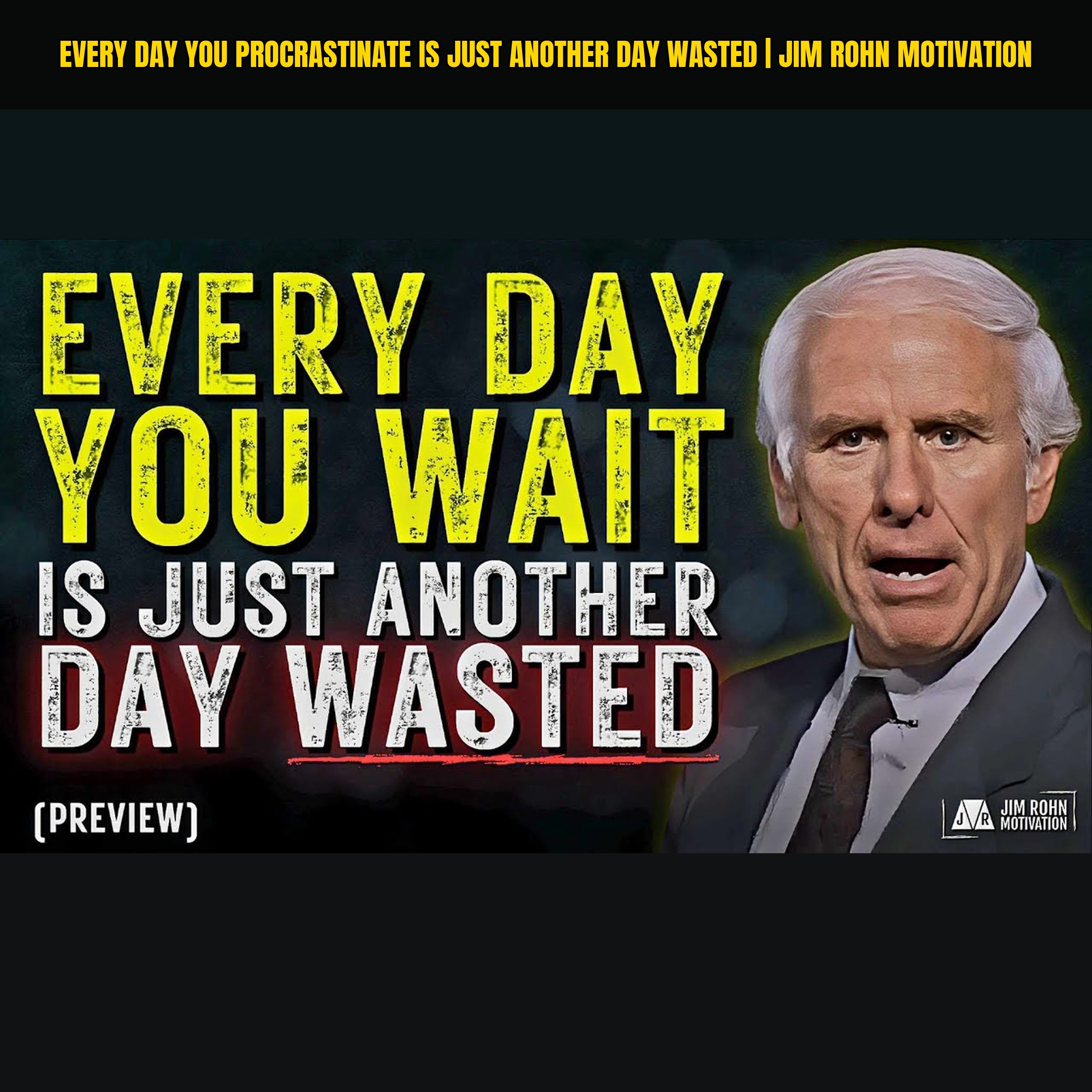
#JimRohnMotivation #JimRohn #JimRohnSpeech In this Jim Rohn Motivation video, we uncover a powerful truth—waiting is not a neutral decision. Every day you hesitate, you’re losing momentum, training your mind to accept inaction. Time moves forward whether you’re ready or not, and the biggest enemy of success isn’t failure—it’s waiting. The people who win in life are those who take action before they feel ready.Key Topics From This Motivational Video: - Why waiting is the most dangerous habit - How hesitation kills progress and self-belief - The myth of the "perfect time" and how to break free - Why taking action builds confidence, not the other way around - How to stop delaying and start creating success now The reality is, most people live as if they have unlimited time. They convince themselves that they’ll start when things are perfect, but perfection never arrives. If you look back six months ago and regret not starting, what makes you think waiting another six months will change an
Can writing instruction actually strengthen how students read and think, not just how they write? Judith Hochman and Natalie Wexler say yes, and their book The Writing Revolution shows teachers exactly how. In this episode, Judith and Natalie make the case that writing does not need its own separate block on the schedule. Instead, it belongs inside the content areas teachers are already teaching, and it starts small: at the sentence level, not the five paragraph essay. We dig into the six principles behind their approach, including why explicit writing instruction should begin in the early grades, how grammar sticks best when it is taught through students' own writing, and why planning and revising deserve more attention than most writing instruction gives them. Whether you teach reading, writing, or a content area like science or social studies, this episode will give you a fresh way to think about the role writing plays in building knowledge and critical thinking. We explore: Why sen
We continue our tour of the nervous system by looking at synapses and the crazy stuff cocaine does to your brain. Pssst... we made flashcards to help you review the content in this episode! Find them on the free Crash Course App! Download it here for Apple Devices: https://apple.co/3d4eyZo Download it here for Android Devices: https://bit.ly/2SrDulJ Chapters: Introduction: What are Synapses? 00:00 Electrical vs Chemical Synapses 1:58 How Electrical Synapses Work: Gap Junctions 2:56 How Chemical Synapses Work: Neurotransmitters 4:01 How Neurotransmitters Work 5:33 How Cocaine Works 7:44 Review 9:52 Credits 10:37 Crash Course is on Patreon! Want to find Crash Course elsewhere on the internet? Facebook - http://www.facebook.com/YouTubeCrashCourse Twitter - http://www.twitter.com/TheCrashCourse Instagram - https://www.instagram.com/thecrashcourse/ CC Kids: http://www.youtube.com/crashcoursekids
View full lesson: http://ed.ted.com/lessons/debunking-the-myths-of-ocd-natascha-m-santos Uploaded 19-05-15 There’s a common misconception that if you like to meticulously organize your things, keep your hands clean, or plan out your weekend to the last detail, you might be OCD. In fact, OCD (Obsessive Compulsive Disorder) is a serious psychiatric condition that is frequently misunderstood by society and mental health professionals alike. Natascha M. Santos debunks the myths surrounding OCD. Lesson by Natascha M. Santos, animation by Zedem Media.
In which John Green, Hank Green, and Emily Graslie teach you about, well, everything. Big History is the history of everything. We're going to start with the Big Bang, take you right through all of history (recorded and otherwise), and even talk a little bit about the future. It is going to be awesome. In the awe-inspiring sense of the word awesome. In this episode, we walk you through the start of everything: The Big Bang. We'll look at how the universe unfolded at its very beginning, and how everything in the universe that we know today came into being. So that's kind of a big deal, right? For more information, visit www.bighistoryproject.com Crash Course is on Patreon! Want to find Crash Course elsewhere on the internet? Facebook - http://www.facebook.com/YouTubeCrashCourse Twitter - http://www.twitter.com/TheCrashCourse Instagram - https://www.instagram.com/thecrashcourse/ CC Kids: http://www.youtube.com/crashcoursekids
Why would growing closer to God require courage? Sr. Katie Flanagan reflects on St. Teresa of Ávila's teaching about extraordinary experiences of prayer and the courage needed to remain faithful through suffering, criticism, and misunderstanding. Today we read The Sixth Dwelling Places: Chapter 4.
Batteries are portable devices that store chemical energy and convert it into electricity through three main internal components: a negative anode, a positive cathode, and an electrolyte. While everyday devices rely on single electrochemical cells like AA and AAA batteries, true batteries, a term coined by Benjamin Franklin in 1749, consist of multiple cells wired together, such as the six 1.5-volt cells inside a standard 9-volt rectangular battery. The path to modern battery technology began in 1800 when Alessandro Volta invented the voltaic pile, creating the first continuous flow of electrical current and resolving a famous scientific debate with Luigi Galvani over "animal electricity". Centuries earlier, ancient artisans in Mesopotamia even constructed the Baghdad Battery, a terracotta jar containing a copper cylinder and iron rod capable of generating a small electric charge when filled with an acidic liquid. Modern battery sizing standards were established in the early 20th centu
More of us feel good about retirement than we did a year ago, yet fewer of us are doing the things that get us there. Two new surveys, one on confidence and one on how each generation is tracking, put that gap in plain view. Joe Saul-Sehy and Doug sit down with contributors Paula Pant, Chris Luger, and Evan Raidt to ask what to do about it. The answer is less about willpower and more about swapping a feeling for a plan, then starting before it feels perfect. If you suspect you’re behind, this is a friendly place to begin. What You’ll Walk Away With Why confidence is a feeling and “on track” is a number, and how the two can pull in opposite directions Why popular rules of thumb can leave you falsely comforted or needlessly discouraged A better starting point than a rule of thumb: define the life you want, then work backward Why people with a written plan tend to feel more on track, and the honest caveat about cause and effect What “step zero” looks like before you do any math How to pla
Do you feel like you won’t be fully happy until you find your soulmate? In part 1 of the Love Your Life series, Sabrina Zohar explains why waiting for a partner, a ring, or getting over a breakup before you let yourself be happy puts your whole life on hold. Whether you’re single, dating, in a relationship, or married, this episode covers loneliness, comparing yourself to other people’s highlight reels on social media, toxic positivity, and why a relationship should add to your life instead of being your whole life. Sabrina breaks down 3 studies. The first followed 24,000 people for 15 years to see whether getting married actually makes you happier. The second found that chasing happiness can make you lonelier. The third shows what the happiest people do differently. You’ll also get a simple 10-minute Sunday tool you can start tonight to build a life you love right now, with or without a partner. Want to work with Sabrina 1:1? Email [email protected] and we will send you info
While you can, before it’s too late...catch yourself. Make this interaction a kind one, a patient one, a friendly one. With the holidays coming up, we wanted to make it a little easier to join. For a limited time, we’re taking $60 off a yearly Daily Dad Society (http://dailydad.com/society) membership. Join here: https://dailydad.com/society Hosted on Acast.
Get the 200+ Page Optimal Living Daily Workbook (PDF) - Free. Want to turn today's episode into an actionable plan? Episode 3768: Steve Pavlina explains that the essence of earning income is creating value for other people, a simple idea that many people still miss. He walks through two common mental blocks, relying on inner work like meditation and visualization alone, and chasing money without caring about the people you serve, and shows why the solution to both is focusing on what only you can provide. Read along with the original article(s) here: https://stevepavlina.com/blog/2007/11/2-mental-blocks-to-making-money/ Quotes to ponder: "The essence of successful income generation is value creation." "A clean aura is certainly helpful, but unfortunately it won't pay your bills." "By focusing on trying to get money, you're missing the point."
View full lesson: http://ed.ted.com/lessons/madeleine-albright-on-being-a-woman-and-a-diplomat Uploaded 17-08-13 In a frank and funny Q and A with Pat Mitchell from the Paley Center, former U.S. Secretary of State Madeleine Albright talks bluntly about politics and diplomacy, making the case that women's issues deserve a place at the center of foreign policy. Far from being a "soft" issue, she says, women's issues are often the very hardest ones, dealing directly with life and death. Since leaving office as U.S. Secretary of State in 2001, Madeleine Albright has continued her distinguished career in foreign affairs as a businesswoman, political adviser and professor. Talk by Madeleine Albright.
Overthinking starts the moment one bad thought gets stuck on a loop and refuses to leave. Dr. Ethan Kross, a University of Michigan psychologist who has studied chatter for over 20 years, sat down with Lewis to explain why your inner voice spirals and how to pull it back. His book, Chatter: The Voice in Our Head, Why It Matters, and How to Harness It, lays out 26 tools, and he walks through a handful of them here. The simplest one sounds strange at first. You coach yourself silently, using your own name, the way LeBron James and Jennifer Lawrence both did in interviews. Ethan's team texted people five times a day for two weeks to track this kind of self-talk and found no link to narcissism at all. He also explains why venting to a friend can turn into co-rumination and leave you just as upset as when you started. A moment of awe in nature can shrink your problems, and Rafael Nadal lines up his water bottles because the ritual gives him “the order I seek in my head.” Negative emotions s
Anxiety always gives you guarantees. Your intuition never will. So how do you know what to trust? Master intuitive Nikki Novo, host of Soul Led Living, joins Jessica to explore how to hear your soul’s guidance and manifest a life that’s truly yours, even in a world full of AI, algorithms, and noise. Nikki breaks down how to tell intuition from anxiety, why your soul won’t reveal the next step until you take the first one, and the surprising clues your soul leaves in your birth chart and even your name. She also explains how ancestral patterns can block your manifestations, and why you can’t get your path wrong—because the soul wastes nothing. Plus, you’ll learn why every desire is sacred (yes, even the Lamborghini) and how to trust divine timing when your manifestations are taking longer than expected. The episode closes with a live intuitive message from Nikki for the Expanded community. If you’ve been in limbo and waiting for a sign, this might be it. Full show notes →https://tobemag
What if becoming better at connecting with people could change your relationships, career, and entire life? In this episode, I share five practical ways to master the art of conversation, turn awkward small talk into meaningful connections, and make people genuinely enjoy talking to you. You'll learn how to ask better questions, follow the spark, embrace vulnerability, and leave people wanting more so you can build relationships that open doors to new opportunities. break through what’s keeping you from your next level. Get $100 off your ticket: direction, and focus in life. Rich Roll, and Dr. Steven Gundry. Hosted by Simplecast, an AdsWizz company. See https://pcm.adswizz.com advertising.
Episode art of the frugivore Infernogallus jamesi by Joel Lee joelleeart.com (http://joelleeart.com/) New dinosaur hot spots all around the world, including Diplodocus in Europe and a new amazing museum in the Gobi desert. For links to every news story, all of the details we shared about Parksosaurus, and our fun fact check out https://iknowdino.com/Parksosaurus-Episode-578/ Join us at www.patreon.com/iknowdino (https://www.patreon.com/iknowdino) for dinosaur requests, bonus content, ad-free episodes, and more. Dinosaur of the day Parksosaurus, (like the Infernogallus featured in the episode art) an herbivore with a beak.. In dinosaur news this week: There’s a new fruit-eating dinosaur, Infernogallus jamesi Dinosaurs have been found for the first time in a new part of China—the Bayan Gobi Formation in western Inner Mongolia There’s a new museum in the Gobi Desert featuring sand pumps and huge light funnels Diplodocus lived on two continents: what’s now North America and Europe After a
As the colder months arrive, birds that remain in northern climates face the harsh realities of staying warm and finding food. Some birds approach the food problem by storing it in advance — a behavior called caching. Chickadees, nuthatches, jays, and some woodpeckers are known to cache large supplies of seeds in many places. But what enables birds such as this Black-capped Chickadee to find the seeds they’ve stored? They amplify spatial memory. More info and transcript at BirdNote.org (https://www.birdnote.org/podcasts/birdnote-daily/chickadee-brains-are-bigger-cold). Want more BirdNote? BirdNote is a nonprofit. Hosted by Simplecast, an AdsWizz company.