Chuck Todd and J.A. Adande continue their deep dive into the history of Ohio State football, exploring the bitter rivalries, coaching scandals, and relentless pursuit of greatness that shaped one of college football's most successful dynasties. From Woody Hayes' infamous downfall to the controversies surrounding Jim Tressel and Urban Meyer, they examine how the Buckeyes survived decades of turmoil and built a powerhouse that continues under Ryan Day.
Donald Trump and his Republicans were crushed last night. Everything changed last night but what will it mean? Our regular guide to the ups and downs of U.S. politics, Keith Boag is with us again on the morning after the night before. Hosted by Simplecast, an AdsWizz company.
The ways that rural communities improve the flow of capital was one of the topics covered at the 2026 Investing in Rural America Conference, hosted by the Federal Reserve Bank of Richmond in partnership with the Federal Reserve System and Rural LISC. In this episode, Jason Smith, the Richmond Fed's senior community development advisor, discusses what the Bank has done to improve capital investment in rural areas. We also hear from three conference speakers: Robin Hacke, co-founder and senior fellow at the Center for Community Investment; Alex Flachsbart, founder and CEO of OPAL Community Capital; and Diane Standaert, senior vice president of policy and advocacy at HOPE Credit Union. Full transcript and related links: https://www.richmondfed.org/podcasts/speaking_of_the_economy/2026/speaking_2026_11_04_IRA_credit_formation
All year on Complexified, we’ve been asking who gets to claim Christianity in American politics. Tonight, that question has some new answers. Did these candidates win because of how they talked about faith? What brought voters to the polls? And how much of what happened tonight will last beyond this election? Jack Jenkins (https://religionnews.com/author/jackjenkins/), national reporter for RNS and author of American Prophets: The Religious Roots of Progressive Politics and the Ongoing Fight for the Soul of the Country (https://www.jackjenkins.me/american-prophets.html), is joining us to unpack the results and what they mean for religion and political power.
The Eleventh Circuit hears Solomon versus Isaac Btesh. The brothers are disputing their interests in a family bank in Panama and the proceeds of its sale. A family agreement referred disputes to procedures used by a Jewish congregation there. Solomon began arbitration in Panama, then pursued proceedings in Miami. A Miami rabbinical panel issued an award against Isaac, who did not participate in that arbitration. Solomon asked a Florida federal court to confirm the award, meaning turn it into an enforceable court judgment. The judge dismissed the petition for lack of personal jurisdiction: the court's power over Isaac. That differs from the arbitrators' authority under the family agreement. One route discussed here is Rule 4(k)(2), a federal rule for federal claims when no state's courts can exercise jurisdiction over the defendant. It looks beyond a single state, but exercising jurisdiction must still be constitutional. Another route, quasi in rem jurisdiction, concerns specified prope
What does it take to move from military service into entrepreneurship when the path is uncertain, expensive, and rarely linear? John and Victor sit down with Mike Quilty, a Naval Academy graduate and former Navy submarine officer, to discuss his route from healthcare consulting and a long-running startup to Wild Bill’s Craft Beverage Co. Quilty explains that his first healthcare venture lost money for seven years before it was sold in 2011. He shares why mentorship, persistence, supportive relationships, and learning from people already doing the work mattered throughout that experience. He also describes how time at Boulder Crest helped sharpen his interest in creating meaningful employment and ownership opportunities for veterans. The conversation explores Wild Bill’s veteran-focused franchise model, including its mobile-event craft soda business, collectible stainless-steel mugs, canned-soda expansion, and approach to selecting franchisees. Quilty discusses the practical skills vete
Welcome to Ark News Daily with Deborah Pardes. In this episode: - Democrats win big as progressive candidates challenge the party's traditional positions on Israel - Trump says Israel no longer needs American military aid as he announces plans to end funding this year ____ This episode is sponsored by the podcast, The Five Books: Jewish Authors on the Books That Shaped Them, making room for Jewish voices to tell our own stories, and playing literary matchmaker between readers and the rich, centuries-old tradition of Jewish books. Listen and subscribe onApple Podcasts (https://us.list-manage.com/45fwjWCsA9e?c2id=109260ea87b77a332a0cdcefc53ae471&e=0d5b8253ce),Spotify (https://us.list-manage.com/jRPFXLacmb4?c2id=109260ea87b77a332a0cdcefc53ae471&e=0d5b8253ce),YouTube (https://us.list-manage.com/1BFSLqmLqpa?c2id=109260ea87b77a332a0cdcefc53ae471&e=0d5b8253ce), or wherever you get your podcasts. ____ ____ More Ark Media: Listen to: For Heaven Sake (https://arkmedia.org/podcasts/ark-news-daily
Mayor Mike Hurley talks with Chad Turpin, a longtime Deputy City Manager and more recently his own advisor in the Mayor’s Office. With his work for the City coming to a close after more than 50 years, we’ll reflect on a journey that stretches back to 1972. Their conversation explores the origins of Burnaby’s four town centres and the successful approach to building financial reserves. Chad discusses his work with the #Burnaby Hospital Foundation, the urgent need to complete the hospital’s redevelopment and deliver its new cancer centre, and his own experience with prostate #cancer and the importance of raising awareness. He also reflects on how the Canada Games, BC Games and World Police and Fire Games helped build Burnaby’s sporting legacy and the vision of becoming Canada’s competition capital.
In the latest round-up, Mala is back with Jasmine to discuss everything that happened in October. Jasmine looks at the latest trafficking statistics, which show a record number of referrals to the National Referral Mechanism. The success rate for reconsideration requests is still very high, too. We also talk through the proposed 'credibility test' for potential victims of trafficking in the Immigration and Asylum Bill. Mala had a number of cases, including JCK, which gives guidance on the higher standard of proof in asylum claims, along with a challenge to a British citizenship refusal under the good character requirement . Plus, another AI horror story. This one involves AI-generated forged documents, which the tribunal admits are increasingly difficult to distinguish from genuine ones. And more! Asylum & protection (00:18) Trafficking referrals increase while government targets ‘misuse’ (https://freemovement.org.uk/trafficking-referrals-increase-targets-misuse/) Proposed trafficking
The First Circuit hears United States versus Jorge Mercado. After serving time for an armed robbery, Mercado was on supervised release, a period of court-ordered supervision after prison. During that supervision, he possessed a machine gun and ammunition. That conduct led to a new criminal sentence and a separate prison term for violating his release conditions. In an earlier appeal, the First Circuit left the machine-gun sentence in place but vacated the revocation sentence because the judge had not adequately explained why it exceeded the advisory sentencing range. This appeal returns to those limits on revocation sentencing. An upward variance means a sentence above that advisory range, not necessarily above the statutory maximum. Another distinction runs through the argument: retribution means punishment because past wrongdoing deserves it; deterrence aims to prevent future crime. The Supreme Court has held that judges may not rely on retribution for the original offense when revok
The midterms delivered a stunning political blow to Republicans—but was it a rejection of Trump, a warning about the economy, or a sign that American politics is shifting in a more populist direction? Dan Senor speaks with Mark Halperin to unpack the forces behind the Democratic wave and what it could mean for the next two years. Halperin, a veteran political analyst, is editor-in-chief of the 2Way, an engine for participation-based live content and authentic communities, and a premium newsletter called Wide World of News. They explore what the Democrats’ victories could mean for the special relationship with Israel, and how the rise of its progressive wing could impact policy, both foreign and domestic. Dan and Mark discuss what comes next for President Trump, and they also look forward to 2028 to see who’s emerging as the frontrunner on both sides. Plus: could a pro-Israel Democrat win the presidential nomination? Read Mark’s Substack, Wide World of News (https://markhalperin.substac
Aisling Claffey, Teagasc ruminant nutrition specialist, joins Stuart Childs to discuss the importance of dry cow minerals to the success of your calving season. Aisling explains that magnesium is key. Pre-calving minerals need to supply enough magnesium to support the cow’s ability to mobilise calcium around calving. She also highlights the importance of vitamins—particularly vitamin D and the role it has for milk fever prevention also. Consistency is vital with minerals. Missing minerals for a day or two can matter, especially when many cows are close to calving. As people are getting better at their soil fertility, Aisling believes people should test silage for minerals annually as silage potassium can vary from year to year and as this may interfere with magnesium absorption, farmers need to be aware of the feed that they are feeding. Milk fever can have wider consequences. Low calcium can affect muscle function, calving and rumen contractions, and intake. It is known as a gateway d
In this week's episode, I explore the newly updated Department for Education's statutory guidance on effective advocacy for looked-after children, children in need and care leavers. In this episode I discuss: What has changed in the statutory guidance. When advocacy should be offered. Supporting children who may struggle to express their wishes. Why independence matters. What reviewers should be looking for. Are you ready to find out more about independent review work? Whether you've been thinking about independent review work for a while or you're only just coming across it, why not download the replay of the one session that brings all of this together the The Pivot. My on demand one hour workshop provides all you need to understand what independent review work involves, whether your skills are transferable, and what the journey from blue light professional to independent reviewer really looks like. No experience needed. No prior training required. Just bring your curiosity. Download
Could Artificial Intelligence be used by judges in our courts - and even help make legal decisions? It's a technology that's already being adopted by legal systems in other parts of the world, including a court in the Chinese city of Shenzhen where it is has helped judges navigate over 600,000 small claims cases. Other countries are more cautious, and maintain that AI should never replace human judicial decisions. What are acceptable uses of AI in the judicial system, and what areas should be off limits? So far, in England, Wales Scotland and Northern Ireland, there have been AI pilots for legal administrative work and transcription services. In England and Wales, there are also plans for AI legal assistants to help with routine casework and help judges decide which cases are ready to be heard in court. It's an issue which has been considered by Sir Geoffrey Vos - the recently retired Master of the Rolls, Head of Civil Justice in England and Wales. He speaks to Joelle about his finding
The Eleventh Circuit hears Joy Laskar versus Phillip Hurd and Patrick Jenkins. Laskar was a Georgia Tech professor who also ran a wireless-technology startup. University auditors investigated whether the company had improperly used university money, microchips, facilities and staff. Their report was referred to state law enforcement, and a criminal investigation and arrest followed. Laskar denies wrongdoing, saying the company was permitted to use university resources through its research-center relationship. The criminal case was dismissed as time-barred: it was brought too late, not resolved by a jury verdict. Laskar then sued university officials for damages, alleging malicious prosecution in violation of the Fourth Amendment. That civil claim concerns an allegedly unlawful deprivation of liberty through criminal legal process. An earlier appeal allowed his claims against Hurd and Jenkins to proceed at the pleading stage, accepting his allegations as true rather than deciding whethe
As the United States midterm elections hand control of Congress to the Democrats, we check in with business commentator Paul Martin on what the stunning shift in the political landscape means for the prairie economy, the 50 per cent import tariffs, and the future of the border standoff.
Episode 678 features Scott Sells, who sat down with me to share his son Masons' story, what the Mason Sells AED Coordination Act is, and how it will help 911 professionals locate nearby AED's and help those in need. This episode is sponsored by RapidSOS - Facebook (https://www.facebook.com/rapidsos) | LinkedIn (https://www.linkedin.com/company/rapidsos/posts/?feedView=all) | X (https://x.com/rapidsos) | Web (https://rapidsos.com/) Learn more about Mason's story - Web (https://masononamission.org/) Episode topics – The events surrounding the sudden cardiac arrest of Mason Sells and the challenges faced during the emergency The gaps in AED accessibility and how a locked device and lack of information impacted the outcome The process of turning personal tragedy into action: advocating for and creating the Mason Sells AED Coordination Act (Senate Bill 399) How the bill connects 911 telecommunicators to AED locations and incorporates technology to speed up emergency responses The vision for
On this WPN Call #600, Dr. Jim Garlow is joined by Dr. Lisa Dunne, an industry disruptor in the field of education. In addition to founding Chula Vista Christian University, she has launched 32 national K to 12 homeschool academies that are dedicated to rescuing the next generation from the toxic traits of traditional education. She discusses the state of Christian higher education in America, and we can do to reclaim the next generation. Websites: https://www.cvcu.us/ Dr. Jim Garlow has partnered with Pastor Mario Bramnick and Terry Barnes to bring you World Prayer Network (WPN), which seeks out Holy Spirit given strategies for how to be an effective and contagious Christ-follower in our present national situations. facebook.com/wellversedworld Twitter: @wellversedworld Instagram: @wellversedworld www.wellversedworld.org (http://www.wellversedworld.org/)
The Federal Circuit hears Robocast versus Netflix. Robocast sued Netflix over patents for automatically presenting online content. Instead of a user repeatedly opening separate pages, the patents describe software that arranges content and presents it in sequence. A Delaware federal judge granted Netflix summary judgment, ruling before trial that the asserted patent claims were ineligible for protection. The court treated them as abstract content organization and display carried out on conventional computers. Robocast challenges that characterization. It says its software structure improves how the computer operates, not merely the user's experience. This appeal concerns patent eligibility, rather than whether Netflix infringed. Patent claims define what an invention's legal protection covers. Under the Supreme Court's Alice framework, the court first asks whether the claims are directed to an abstract idea. If so, it asks whether their features, individually and together, add an inven
The First Circuit hears Hospital Menonita Ponce versus the National Labor Relations Board. After a hospital-asset purchase in Puerto Rico in 2022, Menonita Ponce faced a dispute over its employees' union representation. The union had represented seven groups under the previous operator. Menonita Ponce recognized the union for two groups, then withdrew recognition, saying the union lacked employee support. The union filed charges alleging unlawful refusals to recognize or bargain and retaliation in hiring; the hospital denies violating labor law. It also filed a separate constitutional lawsuit. It challenges rules limiting the President's power to remove Board members and administrative law judges, the agency's hearing officers. The hospital sought a preliminary injunction, a temporary order stopping the agency proceeding. The district court refused, invoking the Norris-LaGuardia Act's restriction on labor-related injunctions and, alternatively, the hospital's failure to meet the ordina
After the historic rebuke of Trump and his authoritarian movement in the recent US Midterms, the tide is clearly turning. Canadian politicians who align with MAGA ideologies need to realize that we will not stand idly by while they push their authoritarian Maple MAGA policies. This is a moment for all of us to unite against the forces of division and hatred! In this pivotal era, we also witness the downfalls of global power players like Putin and Netanyahu, who represent everything that threatens democracy. Join Charlie Angus, Leader of the Canadian Resistance and Host of Meidas Canada, as he partners with Laura Babcock for a special #POWERCAST. They will explore this monumental victory for democracy, its implications for Canada, and how we can collectively confront the tech oligarchs and fascists around the world. Let’s revel in this moment of decency and reaffirm our commitment to the values of humanity and democracy. We each have a role to play in this fight—our voices matter now mo
Automated license plate readers (ALPRs) have been part of American policing for two decades, but they have rarely sparked as much controversy as right now. Social media campaigns, new questions about data sharing and a wave of local officials pausing or canceling programs have put agencies under pressure to defend a tool many leaders see as essential. In this episode of Policing Matters, host Jim Dudley talks with Jim Burch, president and CEO of the National Policing Institute (NPI), about what the public actually thinks and what police leaders can do about it. NPI surveyed 1,435 people (https://www.policinginstitute.org/announcements/new-national-survey-alpr/), and more than half said they oppose law enforcement use of ALPRs in their community. But Burch says the number that matters isn’t the headline figure. It’s how quickly public opinion shifts depending on what the technology is used for and what safeguards come with it. He and Dudley dig into where the public draws the line, why
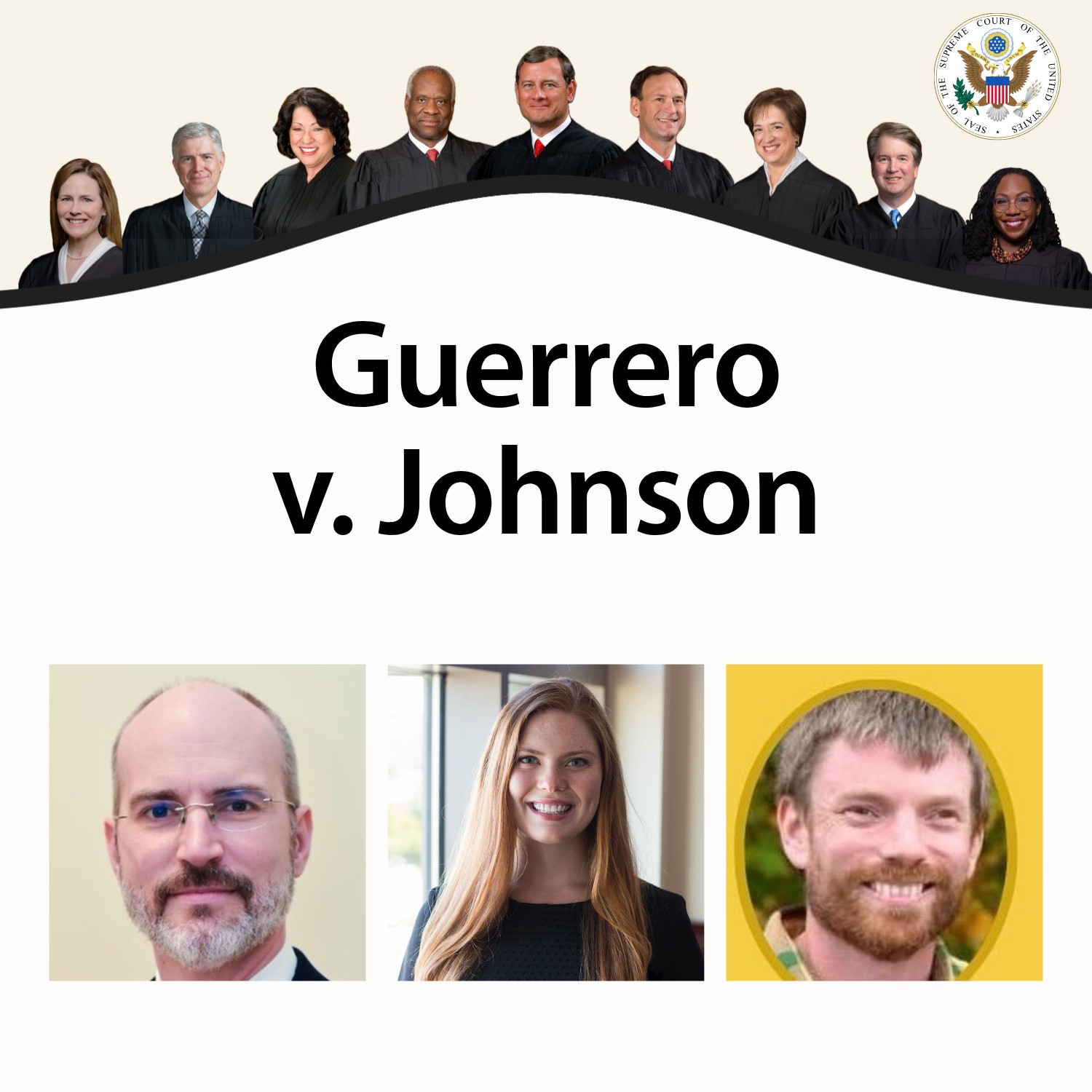
Guerrero v. Johnson Justia · Docket (https://www.supremecourt.gov/docket/docketfiles/html/public/25-1003.html) · oyez.org (https://www.oyez.org/cases/2026/25-1003) · YouTube (https://www.youtube.com/watch?v=QzOSlEEjjvQ) Argued on Nov 4, 2026. Petitioner: Eric Guerrero. Respondent: Dexter Johnson. Advocates: William R. Peterson (for the Petitioner) Emily M. Ferguson (for the United States, as amicus curiae, supporting the Petitioner) Jeremy Schepers (for the Respondent) Facts of the case (from oyez.org) Dexter Johnson kidnapped, raped, and murdered Maria Aparece in June 2006, years after the Supreme Court decided Atkins v. Virginia, 536 U.S. 304 (2002), which held the Eighth Amendment prohibits executing intellectually disabled people. At trial, Johnson’s own defense expert tested his IQ between 74 and 88, concluded he showed no obvious adaptive deficits, and opined that he was not intellectually disabled. Johnson was convicted of capital murder and sentenced to death in June 2007. John
A case in which the Court will decide whether a prisoner’s claim based on a new constitutional rule counts as “previously unavailable”—which would allow the prisoner to file a second habeas petition—when the prisoner could have raised that claim in an earlier petition even if it would not have succeeded at that time.