Today we're going to take a look at mineral extraction -- or the removal of rocks and minerals from the Earths' crust -- and examine how this human activity impacts all aspects of Geography. We'll focus on the Democratic Republic of the Congo and take a look at how the mining of minerals such as cobalt, has significantly impacted life in this region. Sources Watch our videos and review your learning with the Crash Course App! Download here for Apple Devices: https://apple.co/3d4eyZo Download here for Android Devices: https://bit.ly/2SrDulJ Crash Course is on Patreon! Thanks to the following patrons for their generous monthly contributions that help keep Crash Course free for everyone forever: Dave Freeman, Hasan Jamal, DL Singfield, Lisa Owen, Jeremy Mysliwiec, Shannon McCone, Amelia Ryczek, Ken Davidian, Stephen Akuffo, Toni Miles, Erin Switzer, Steve Segreto, Michael M. Varughese, Kyle & Katherine Callahan, Laurel Stevens, Vincent, Michael Wang, Stacey Gillespie (Stacey J), Jaime Wil
AI Translation = Global Peace! 5 ways we can use AI to bring about global peace Episode release date: 1 Jan 2024 Core Ideas: Metamodernism: Narratives and emergence view of reality - Reduce suffering - Increase prosperity - Increase understanding mantra: Seek knowledge. DISCLAIMER: This is a community-driven show. -------- Keywords: openai, ai development, david shapiro
The author of a new history of Wikipedia on the unicorn of the tech world, the wisdom of crowds and the destruction of the digital commons. Regular panelists Digital Rights Watch chair Lizzie O’Shea, Health Engine CEO Dan Stinton and Per Capita’s Peter Lewis also discuss: Microsoft’s single point of failure the impact of Nvidia’s implosion and the campaign to Fartist For show notes go to https://burningplatforms.substack.com/
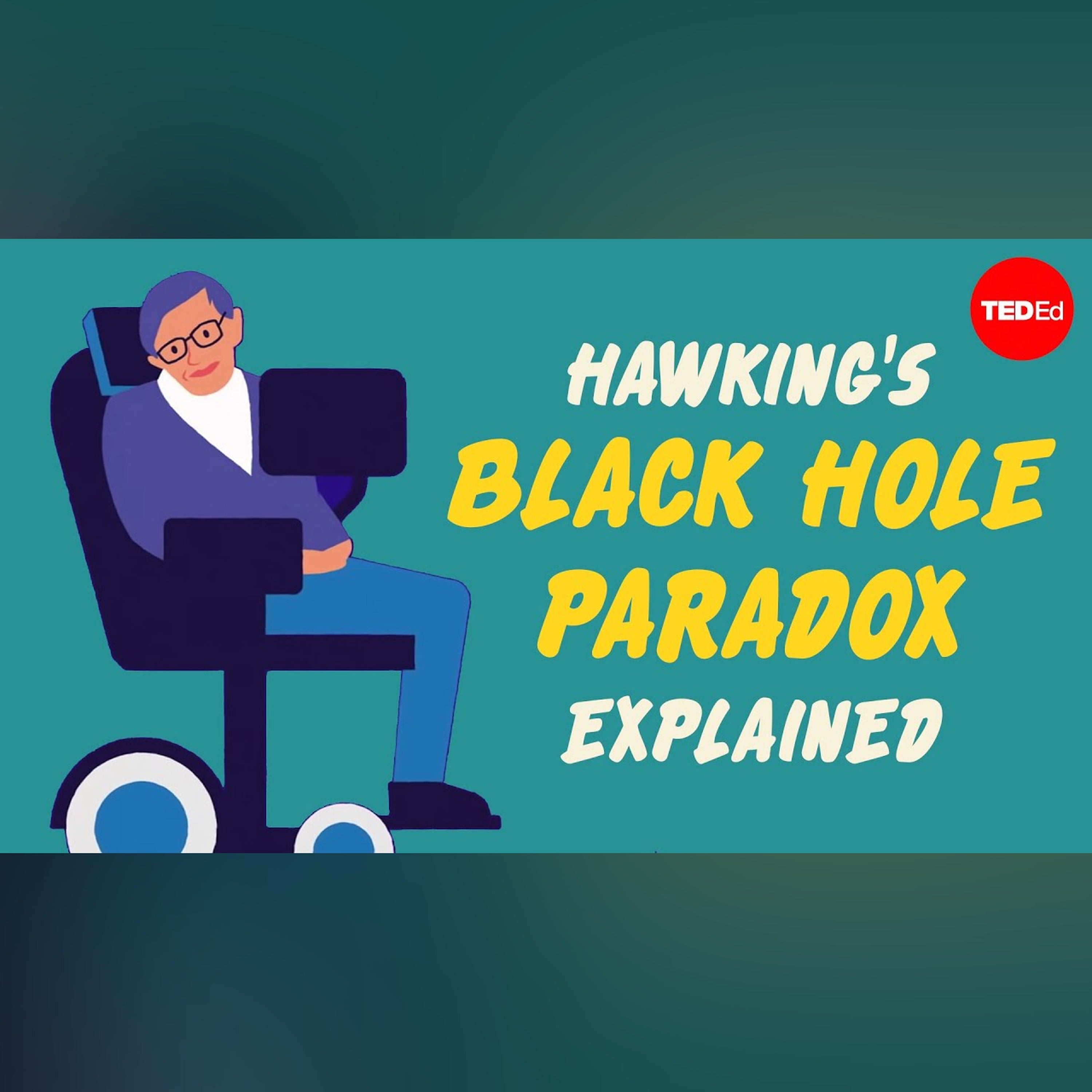
Where does quantum information go when it enters a black hole? Investigate the theories of the black hole information paradox. Uploaded 22-10-19 -- Today, one of the biggest paradoxes in the universe threatens to unravel modern science: the black hole information paradox. Every object in the universe is composed of particles with unique quantum properties and even if an object is destroyed, its quantum information is never permanently deleted. But what happens to that information when an object enters a black hole? Fabio Pacucci investigates. Lesson by Fabio Pacucci, directed by Artrake Studio. Animator's website: https://www.artrake.com (https://www.artrake.com/) Sign up for our newsletter: http://bit.ly/TEDEdNewsletter Support us on Patreon: http://bit.ly/TEDEdPatreon Find us on Twitter: http://bit.ly/TEDEdTwitter Peep us on Instagram: http://bit.ly/TEDEdInstagram View full lesson: https://ed.ted.com/lessons/hawking-s-black-hole-paradox-explained-information-paradox Thank you so much
Hank continues our exploration of animal phyla with the more complexly organized annelida and arthropoda, and a biolography on insects. References: http://www.bukisa.com/articles/41743_amazing-facts-about-arthropods#ixzz1sXW1Jigp (http://www.bukisa.com/articles/41743_amazing-facts-about-arthropods) Crash Course is on Patreon! Want to find Crash Course elsewhere on the internet? Facebook - http://www.facebook.com/YouTubeCrashCourse Twitter - http://www.twitter.com/TheCrashCourse Instagram - https://www.instagram.com/thecrashcourse/ CC Kids: http://www.youtube.com/crashcoursekids
How close are we to building a real Westworld? A look at the hardware, software, and social impact Episode release date: 23 Apr 2023 Core Ideas: Metamodernism: Narratives and emergence view of reality - Reduce suffering - Increase prosperity - Increase understanding mantra: Seek knowledge. DISCLAIMER: This is a community-driven show. ----------- Keywords: superintelligence, ai research, deep learning
Opera singer Denyce Graves-Montgomery shares how to find your voice, range, breath, and, ultimately, your truth. -- "Think Like A Musician" connects you with working musicians who want to help the music-curious and music-passionate hone and share the gift of music with the world. Part interview, part animated course, our first season "Think Like A Performer" features artists sharing their insight on the ins and outs of fine-tuning your instrument and crafting a great performance. Each episode features free supplemental learning materials developed by Education Through Music (https://etmonline.org) (https://etmonline.org)/) — a nonprofit with over 30 years of experience developing classroom-adaptable curriculum for music educators. Directed by Kozmonot Animation Studio. A special thanks to Denyce Graves-Montgomery who provided her insights and expertise for this video. You can check out her page here: https://www.youtube.com/channel/UC4IGqi6jnpDTct8_ij6LBag Support Our Non-Profit Missio
Welcome to Crash Course Latin American Literature! In 13 episodes, Curly Velasquez will introduce you to the themes, trends, and movements that have breathed life into Latin American literature for centuries. From Indigenous texts to contemporary novels, we’ll explore how Latin American authors have been shaped by the dynamic cultures, history, and politics around them. Course Description In 13 episodes, host Curly Velasquez will introduce you to Latin American Literature! This course is based on sources and topics explored in AP and college-level surveys. By the end of this series, you will be able to: Trace major trends and tropes in Latin American literature across genres Engage with diverse case studies through a transnational and historical lens Identify major periods of Latin American literary history and the debates they raise Think critically about the interconnectedness of history, politics, culture, and literature Become familiar with prominent, canonical works and marginaliz
AGI-Proof Jobs: Navigating the Impending Obsolescence of Human Labor in the Age of AGI Episode release date: 25 Jun 2023 Core Ideas: Metamodernism: Narratives and emergence view of reality - Reduce suffering - Increase prosperity - Increase understanding mantra: Seek knowledge. DISCLAIMER: This is a community-driven show. ------- Keywords: chatbots, gpt, ai development, machine autonomy, artificial general intelligence, future technology, david shapiro, singularity
0:00 – Introduction 0:43 – Background: ApoB and LDL cholesterol 2:38 – Metabolic Vulnerability and All Cause Mortality 4:38 – Two things can be true at the same time… 6:06 – Predictors of Fatal and Non-fatal events are different 6:47 – Metabolic Signatures tell us about Metabolism: MVX and LMHR 7:55 – Interventions come with side effects 9:02 – Thanks to Simon and Bill Otvos 2023: https://www.thelancet.com/journals/lanhl/article/PIIS2666-7568(23)00001-6/fulltext LI 2022: https://www.ncbi.nlm.nih.gov/pmc/articles/PMC8821163/ Simon Hill @theProof podcast: COMING SOON!
Black holes reveal something astonishing about our universe. Take your personal data back with Incogni. This extended cut is a deep dive into cutting edge research about black holes. It’s an interview with famous physicist Dr. Brian Cox. We start with “what if you fell into a black hole?” and end on the cutting edge research that had me questioning my whole reality. I interviewed Dr. Cox originally for a shorter Huge If True episode all about what would happen if you fell into a black hole. Watch our Huge If True episode about “What If You Fell Into A Black Hole?” here: https://youtu.be/BKIkTKqWMfg?si=bTde4QxUeN6bN1Io But there was SO much weird and mind bending stuff about the cutting edge of black holes that didn't fit into that shorter episode, and we knew you'd want to hear it. So we decided we had to release the full conversation. It's just too cool and I think you'll love it. Now, strap in, because the cutting edge of black holes is absolutely WILD. As always, if you want more op
Dig into the truffle’s unique and mysterious biology to find out what makes them so rare and the limitations of farming them. -- Truffles are one of the world’s most expensive foods— in part because global demand often outstrips supply. And truffles are becoming even more rare and more expensive as deforestation and climate change shrink their suitable terrain. But why are these fungi so rare? And why don’t we just farm more of them? Carolyn Beans digs into the truffle’s unique and somewhat mysterious biology. Lesson by Carolyn Beans, directed by Denys Spolitak. Support Our Non-Profit Mission ---------------------------------------------- Support us on Patreon: http://bit.ly/TEDEdPatreon Check out our merch: http://bit.ly/TEDEDShop ---------------------------------------------- Connect With Us ---------------------------------------------- Sign up for our newsletter: http://bit.ly/TEDEdNewsletter Find us on Twitter: http://bit.ly/TEDEdTwitter Peep us on Instagram: http://bit.ly/TEDEdIn
Aging is an essential topic for the MCAT, and in this episode, we’ll explore it from multiple angles. We start with the biological aspects of aging, including key processes like telomere shortening, cell senescence, and mitochondrial dysfunction—each providing insight into how and why cells age. From there, we dive into how aging impacts the brain, including the types of memory and cognitive functions that either decline or improve with age. Lastly, we’ll cover the sociology of aging, focusing on the life course theory, the social significance of aging, and demographic changes. Expect a comprehensive breakdown of these concepts, with real-world applications and examples to reinforce your understanding. Jump Into the Conversation: (00:00) Intro (02:30) Cellular markers of aging: Protein aggregation and telomere shortening (04:55) Exploring cell senescence and autophagy dysregulation (07:20) Mitochondrial dysfunction and its role in cellular aging (09:10) Deep dive into telomeres and the
Last week we introduced Thomas Aquinas’s four cosmological arguments for the existence of god; today we introduce his fifth argument: the teleological argument, and the ensuing dialogue it initiated. -- Bokeh Spiral by Eric Wüstenhagen: https://www.flickr.com/photos/eriwst/2987739376 Gusano alambre (wireworms) by jacinta lluch valero: https://www.flickr.com/photos/70626035@N00/8817671329 Experimental by Peter Klashorst: https://commons.wikimedia.org/wiki/File:Baby_playing_with_yellow_paint._Work_by_Dutch_artist_Peter_Klashorst_entitled_%22Experimental%22.jpg Flightless Cormorant by Mike Weston: https://www.flickr.com/photos/mikeweston/331214460 All other images via Wikimedia Commons, licensed under Creative Commons by 4.0: https://creativecommons.org/licenses/by/4.0/ -- Produced in collaboration with PBS Digital Studios: http://youtube.com/pbsdigitalstudios Crash Course Philosophy is sponsored by Squarespace. -- Want to find Crash Course elsewhere on the internet? Facebook - http://www
View full lesson: http://ed.ted.com/lessons/do-you-speak-monkey-the-language-of-cotton-top-tamarins-anne-savage Uploaded 26-06-14 The cotton-top tamarin is a very vocal monkey -- the species communicates using a sophisticated language of 38 distinct and grammatically structured calls! Anne Savage teaches a few of these chirps and whistles, taking us through a day in the life of Shakira the tamarin (using sounds pulled from the wild) as Shakira signals to her family, talks to her food and warns against potential predators. Lesson by Anne Savage, animation by Avi Ofer.
In which John Green teaches you about the changes wrought by contact between the Old World and the New. John does this by exploring the totally awesome history book "The Columbian Exchange" by Alfred Crosby, Jr. After Columbus "discovered" the Americas, European conquerors, traders, and settlers brought all manner of changes to the formerly isolated continents. Disease and invasive plant and animal species remade the New World, usually in negative ways. While native people, plants, and animals were being displaced in the Americas, the rest of the world was benefitting from American imports, especially foods like maize, tomatoes, potatoes, pineapple, blueberries, sweet potatoes, and manioc. Was the Columbian Exchange a net positive? It's debatable. So debate. The Columbian Exchange, by Alfred Crosby, Jr: https://bit.ly/3M3ZtbG Chapters: Introduction: The Columbian Exchange 00:00 Diseases of the Columbian Exchange 1:14 John Green Does the Cinnamon Challenge (Ew) 4:21 An Open Letter to To
AI progress SLOWING DOWN! Bad news for E/ACC, good news for SAFETY! Let's unpack all this! Episode release date: 17 Jun 2024 Core Ideas: Metamodernism: Narratives and emergence view of reality - Reduce suffering - Increase prosperity - Increase understanding mantra: Seek knowledge. DISCLAIMER: This is a community-driven show. ----- Keywords: gpt, ai future, ai innovation, ai philosophy, deep learning, ai agents
An AI agent can make many model calls to finish a single job. Some need frontier reasoning. Others can run on an open-weight model, and some involve data that has to stay in-house. How do you decide which inference to buy and which to run yourself? Sadeepa Wijesekara, who leads engineering for HPE Private Cloud AI, joins Sam Charrington to discuss how enterprises make those decisions. They get into what it takes to see the cost of individual calls, how teams route work between hosted and local models, and when running your own GPUs makes economic sense. Sadeepa shares how HPE routes coding requests through a single internal endpoint that can send work to a frontier provider or serve it locally. ️ Full show notes: https://twimlai.com/go/785.
View full lesson on ed.ted.com http://ed.ted.com/lessons/what-s-invisible-more-than-you-think-john-lloyd Gravity. The stars in day. Thoughts. The human genome. Time. Atoms. So much of what really matters in the world is impossible to see. A stunning animation of John Lloyd's classic TEDTalk from 2009, which will make you question what you actually know. Lesson by John Lloyd, animation by Cognitive Media.
On this, our 352nd Evolutionary Lens livestream, we discuss Jensen Huang and Nvidia in the context of sex and corporate culture. The Russell Brand and Jensen Huang cases are circuses that we can’t stop watching. Commentary on social media is disgusting, and everyone is enraged. Expectations of women who dare to age are unrealistic, and loyalty is undervalued. And: why these men, and why now? Is it useful for something to have these two removed from positions where they have voice? ***** Our sponsors: Ridge: Upgrade your wallet today! Caraway: Non-toxic, highly functional & beautiful cookware and bakeware. It’s way better. ***** Join us on Locals! Music: "Marble Machine" by Wintergatan Thumbnail: Getty Images News/Getty Images Europe ***** Mentioned in this episode: Sum Ting Wong (=Huang): https://nationalpost.com/news/sum-ting-wong-intern-blamed-for-leaking-fake-names-of-pilots-aboard-plane-that-crashed-in-san-francisco/ Meghan Murphy: https://x.com/meghanemurphy/status/212137584598182
Most people think the UFO story starts at Roswell in 1947. Ali Siadatan says it starts in Genesis. In this sweeping teaching, the returning fan favorite makes his case to Luke and Nate that the craft people have seen for generations are not intergalactic visitors but part of a far older story: the gods of the ancient world, the sons of God, the Nephilim, and the chariots that Scripture attaches to both heaven’s armies and the fallen powers behind the nations. His key that unlocks it is the word Elohim, which applies to God and to the lesser divine beings alike, which is why both sides of the war have what the Bible calls chariots of fire. From his own close encounter in the Iranian desert to the throne of Satan at Pergamum, from Kenneth Arnold to Ezekiel’s wheels, Ali connects the dots into a single narrative that runs straight to the end of the age. His warning is the sharp edge of it: the phenomenon keeps growing, the messaging keeps repeating that the saviors have arrived, and the f
Trials underway in northern New South Wales reveal the most promising treatments involve deep ripping and gypsum with strategically placed nitrogen and phosphorus to improve root growth, wateraccess and soil stability. Associate Professor Richard Flavel from University of New England and Nils Jacobson from Lawson Grains discuss outcomes of the research so far. This research forms part of GRDC’s Economics of Amelioration of Soil Sodicity investment, led by the University of New England (UNE) with research partners the Queensland Department of Primary Industries (DPI) and University of Queensland (UQ). Contact: Associate Professor Richard Flavel School of Environmental and Rural Science Dept. Agronomy Soil Science, University of New England [email protected] More Information: Digging deeper into the economics of subsoil amelioration (https://groundcover.grdc.com.au/agronomy/soil-and-nutrition/digging-deeper-into-the-economics-of-subsoil-amelioration) Digging deeper: Unlocking the upsid
Latin America is a vastly diverse region shaped by a blend of influences. In this episode of Crash Course Latin American Literature, we’ll explore how Latin American authors navigate one big question: Who are we? Introduction: Where is Latin America? 00:00 The History of "Latin America" 0:53 Latino vs. Hispanic 2:41 Varying Identities & Languages 3:28 Paz & Identity 5:05 "Terra Nostra" 7:30 Borges & Andrade 9:17 Review & Credits 11:09 Sources: https://docs.google.com/document/d/1eE7g4-k6PD7C6wNBzeJIO8GCDHpoJl8ldDjKyq_2yYg/edit?tab=t.0 To learn more, check out these videos: Geopolitical history of Latin America: Latin American Revolutions: Crash Course World History #31 https://youtu.be/ZBw35Ze3bg8?si=8z_ra4m4cXUMnLdT , War and Nation Building in Latin America: Crash Course World History 225 https://youtu.be/v6xi8_7Fy6Y?si=uDevoPt88Q6wBBXB Imperialism: Columbus, Vasco da Gama, and Zheng He - 15th Century Mariners: Crash Course World History #21 https://youtu.be/NjEGncridoQ?si=hzKIJz7J5y
Welcome to the Fourth Industrial Revolution Episode release date: 2 Oct 2023 Core Ideas: Metamodernism: Narratives and emergence view of reality - Reduce suffering - Increase prosperity - Increase understanding mantra: Seek knowledge. DISCLAIMER: This is a community-driven show. ------------ Keywords: openai, ai masterclass, tech singularity, ai safety, david shapiro, ai education