Today, we are going to begin our discussion on the determinants of health which are all of the conditions we are born, live, and work in that have an influence on our overall wellbeing. Now these determinants can span everything from your education level to income level to genetic code, so today we're just going to focus on the biological factors like our age, genes, and sex, and take a closer look at their impacts. Check out our shared playlist with APHA: https://www.youtube.com/playlist?list=PLDjqc55aK3kywF2dd97_Jh5iP0d2ARhdo Vanessa’s channel: https://www.youtube.com/braincraft Sources: https://docs.google.com/document/d/1OHJiQ1njj5jWJC1YLDBzQgKC1QfnVgqJbbpK6qs7ekA/edit?usp=sharing Chapters: Introduction: Biological Determinants 00:00 Behavioral & Biomedical Approach 01:27 Social Approach 02:44 Determinants of Health 04:11 Biological Determinants 05:42 Epigenetics 09:16 Review & Credits 11:33 *** Crash Course is on Patreon! Thanks to the following patrons for their generous monthly
Dig into the body's biological process that heals a broken bone, and find out how different kinds of fractures are mended. -- The human body’s 206 bones come in many shapes and sizes: short bones, long bones, flat bones, irregular bones. Roughly 50% of people will break a bone at some point in their lives. But whether the cause is as mundane as a slip on the ice or as dramatic as a tightrope-walking accident, how do our broken bones heal? Gurpreet Baht and Natalie Pang dig into the incredible biological process. Lesson by Gurpreet Baht and Natalie Pang, directed by Eliška Oz, Lee Oz, Oz Animation. Support Our Non-Profit Mission ---------------------------------------------- Support us on Patreon: http://bit.ly/TEDEdPatreon Check out our merch: http://bit.ly/TEDEDShop ---------------------------------------------- Connect With Us ---------------------------------------------- Sign up for our newsletter: http://bit.ly/TEDEdNewsletter Find us on Twitter: http://bit.ly/TEDEdTwitter Peep us
Megan Baer is a lifelong Christian with no occult past, no dabbling, nothing weird in her history. Then she gets married at nineteen, comes home from the honeymoon, and on the first morning alone in the apartment, the lights will not turn on, and an ancient, hateful voice begins speaking over her in a language she doesn't know. For the next seventeen years, she is pulled out of her body, levitated, thrown against walls, and choked by something she can feel but rarely sees, an entity that behaves as though she belongs to it. The attacks come only when her husband leaves for work, and no one at her church will even return the call. The answer, when it finally comes, runs back four generations to a 33rd-degree Freemason great-grandfather, the lodge's oaths and dedications, and a ceremony that hands a child over to an entity as a spirit spouse. Megan walks Luke and Nate through the whole seventeen-year ordeal, the ancestral prayers that began to break it, the night it came for her daughter
You're already learning on YouTube — why not get college credit for it? https://link.gostudyhall.com/my1 So, you did it! You're done and now you need to look beyond college. What's next? How do you know what's next? Do you want to go to grad school? To work? In this episode, Erica talks about how to think about what comes after college. *** Now you can take top-tier college courses with Study Hall! Study Hall videos are available to watch at no cost, and first-year courses are $25 to sign-up and begin coursework. Sign up at https://link.gostudyhall.com/my1 Follow Study Hall on socials! Twitter: https://twitter.com/gostudyhall Instagram: https://Instagram.com/GoStudyHall (https://instagram.com/GoStudyHall) Facebook: https://www.facebook.com/GoStudyHall Learn more about Federal Student Aid: https://studentaid.gov/h/understand-aid _______________________________________________ Chapters: 0:00 - Introduction 0:36 - Planning Your Transition 5:50 - Managing Priorities 8:59 - Conclusion _____
LAHAINA: THREE YEARS LATER — WHAT REALLY HAPPENED IN MAUI? Three years after the devastating Lahaina fires, the questions surrounding the destruction, the future of Maui, and the people who lost everything remain at the center of a growing controversy. Michael Jaco welcomes Michelle Melendez and Elle Cochran for a powerful conversation examining the Lahaina disaster, allegations of directed-energy weapons (DEWs), weather warfare theories, disputed political outcomes in Hawaii, and the battle over Maui's land and future. Elle Cochran, a lifelong Lahaina resident, former Maui County Council member, and retired Hawaii State House representative, brings a firsthand perspective on the community, its history, and the ongoing struggle to preserve what remains. As founder of the Save Honolulu Coalition and caretaker of Hawaiian monarchy graves in Lahaina, Elle is committed to protecting Hawaii's heritage and perpetuating the Spirit of Aloha for future generations. Michelle Melendez, freedom ac
This week Jacob and Adriene teach you about marginal analysis, which you're using RIGHT NOW! The video is coming from inside the house! Or something. You'll learn how marginal analysis guides the decision making if cities, nations, companies, and amusement park enthusiasts. We'll also look at the idea of elasticity, and what people are willing to pay for certain stuff based on the supply. Why is a Van Gogh worth more than an OBEY poster? (hint: it's because they're still cranking out the OBEY posters, and Vincent is dead) All this and more on Crash Course Economics! *** Crash Course is on Patreon! Thanks to the following Patrons for their generous monthly contributions that help keep Crash Course free for everyone forever: Mark, Eric Kitchen, Jessica Wode, Jeffrey Thompson, Steve Marshall, Moritz Schmidt, Robert Kunz, Tim Curwick, Jason A Saslow, SR Foxley, Elliot Beter, Jacob Ash, Christian, Jan Schmid, Jirat, Christy Huddleston, Daniel Baulig, Chris Peters, Anna-Ester Volozh, Ian Dun
In this episode of Crash Course Psychology, Hank takes a look at how the treatment for psychological disorders has changed over the last hundred years and who is responsible for getting us on the path to getting us here. Want more videos about psychology? Check out our sister channel SciShow Psych at https://www.youtube.com/scishowpsych -- Chapters: Asylums 00:00 David Rosenhan's Pseudopatient Experiments 0:43 How do we classify psychological disorders? 2:29 Psychological Disorders 3:26 Deviant Thoughts & Behaviors 4:06 Distress & Dysfunction 4:53 Medical Model of Psychological Disorder 5:20 Biopsychological Approach to Psychological Disorders 6:12 The DSM-5 7:09 Review & Credits 9:25 -- Crash Course is on Patreon! Want to find Crash Course elsewhere on the internet? Facebook - http://www.facebook.com/YouTubeCrashCourse Twitter - http://www.twitter.com/TheCrashCourse Instagram - https://www.instagram.com/thecrashcourse/ CC Kids: http://www.youtube.com/crashcoursekids
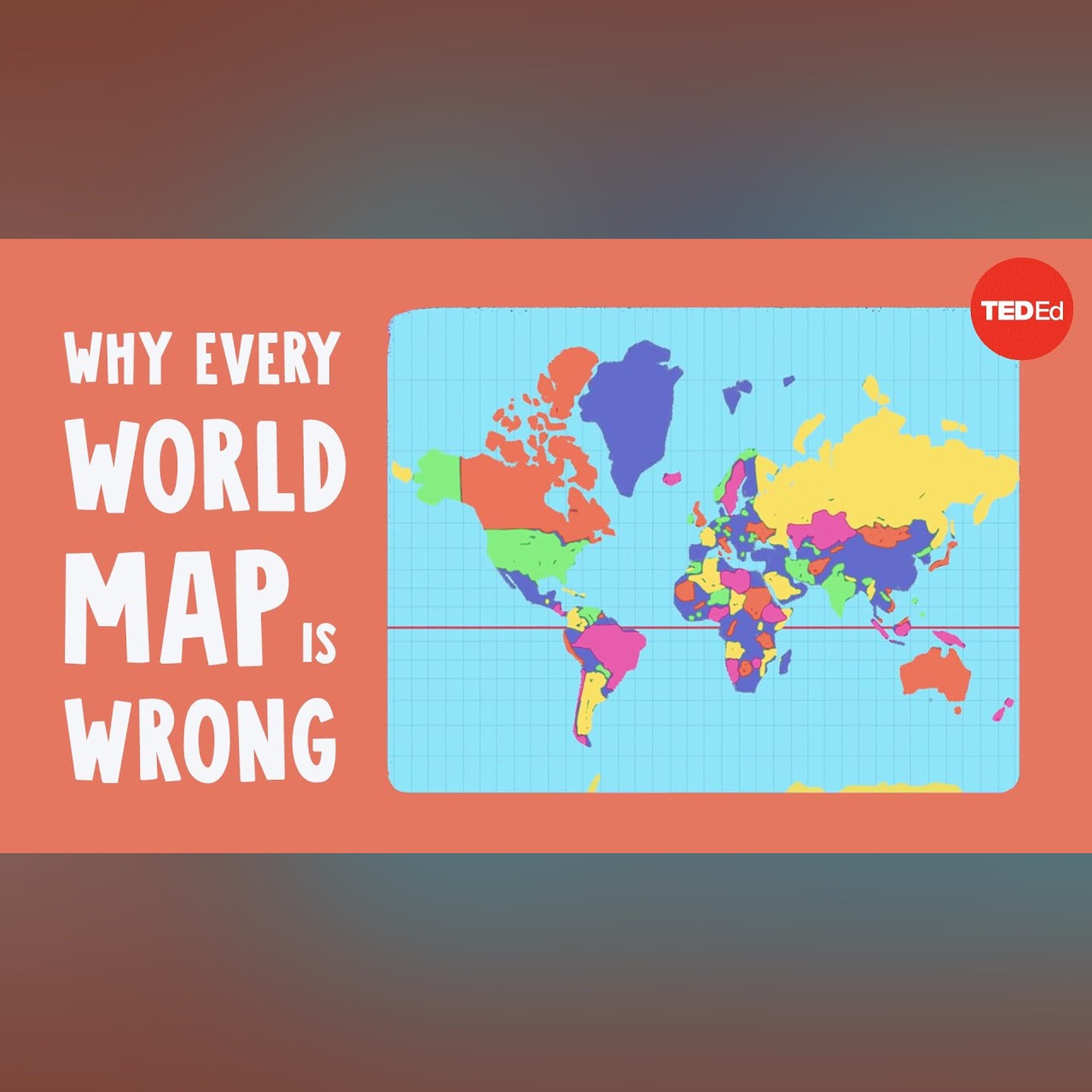
Dig into the inaccuracies of flat maps and how different map designs can shift our point of view. Uploaded 29-03-21 -- Fourteen Greenlands could fit in Africa— but you wouldn’t guess it from most maps of the world. The fact is, every world map humans have ever made is wrong. Actually, it’s impossible to make a flat map of the whole spherical world 100% right. So why do we bother with these inaccurate maps at all? Kayla Wolf explores how even the simplest changes in map design can shift our point of view. Lesson by Kayla Wolf, directed by Hernando Bahamon, Globizco Studios. Support Our Non-Profit Mission ---------------------------------------------- Support us on Patreon: http://bit.ly/TEDEdPatreon Check out our merch: http://bit.ly/TEDEDShop ---------------------------------------------- Connect With Us ---------------------------------------------- Sign up for our newsletter: http://bit.ly/TEDEdNewsletter Find us on Twitter: http://bit.ly/TEDEdTwitter Peep us on Instagram: http://bit
In which John Green teaches you about disease and the effects that disease has had in human history. Disease has been with man since the beginning, and it has shaped the way humans operate in a lot of ways. John will teach you about the Black Death, the Great Dying, and the modern medical revolution that has changed the world. Crash Course is on Patreon! Want to find Crash Course elsewhere on the internet? Facebook - http://www.facebook.com/YouTubeCrashCourse Twitter - http://www.twitter.com/TheCrashCourse Instagram - https://www.instagram.com/thecrashcourse/ CC Kids: http://www.youtube.com/crashcoursekids
Practice more problem-solving at https://brilliant.org/TEDEd/ Uploaded 22-03-18 View full lesson: https://ed.ted.com/lessons/can-you-solve-the-buried-treasure-riddle-daniel-griller After a massive storm tears through the Hex Archipelago, you find five grizzled survivors in the water. As an act of gratitude for saving them, they reveal a secret – the island they were just on holds some buried treasure. But when the sailors try to describe the island, something seems off. Can you find the booty despite their strange instructions? Daniel Griller shows how. Lesson by Daniel Griller, animation by Patrick Smith. Thank you so much to our patrons for your support! Without you this video would not be possible! Cailin Ramsey, Seung Hoon Shin, John Saveland, Nicolle Fieldsend-Roxborough, Venkat Venkatakrishnan, Sandy Nasser, CG Nobles, Yoga Trapeze Wanderlust, Jaron Blackburn, Alejandro Cachoua, Thomas Mungavan, Elena Crescia, Edla Paniguel, Anna-Pitschna Kunz, Tim Armstrong, Alessandro , Erika B
Apple Devices: https://apps.apple.com/us/app/crash-course-watch-and-study/id1505594172 Android Devices: https://play.google.com/store/apps/details?id=com.complexly.thecrashcourse&hl=en_US (https://play.google.com/store/apps/details?hl=en_US&id=com.complexly.thecrashcourse) Today we're so excited to announce the free Crash Course App! (Available now for Apple and Android phones and tablets.) The app is a portal to find all of our thousands of videos and a platform to help you review what you've learned in those videos. At the heart of the app are decks which are essentially really beautiful flashcards that transform into multiple choice questions in quiz mode. The app currently supports decks for all episodes of Anatomy & Physiology, Chemistry, and Organic Chemistry, and we'll be continually adding more content. So please download the app and let us know what you think! Crash Course is on Patreon! Thanks to the following patrons for their generous monthly contributions that help keep Cr
You're already learning on YouTube — why not get college credit for it? https://link.gostudyhall.com/my1 If you've taken out student loans, graduation can start a ticking clock in terms of when your first payments will come due. So it's important to know how to navigate those loan payments and your own finances so you can make sure you're on the path to get your loans paid off and you don't have any negative effects on your finances and credit. *** Now you can take top-tier college courses with Study Hall! Study Hall videos are available to watch at no cost, and first-year courses are $25 to sign-up and begin coursework. Sign up at https://link.gostudyhall.com/my1 Follow Study Hall on socials! Twitter: https://twitter.com/gostudyhall Instagram: https://Instagram.com/GoStudyHall (https://instagram.com/GoStudyHall) Facebook: https://www.facebook.com/GoStudyHall Learn more about Federal Student Aid: https://studentaid.gov/h/understand-aid _______________________________________________ Ch
In today's brief: Asteroid or Soviet probe: Avi Loeb's team says odd-moving asteroid 1998 KY26 could be Phobos 1, a Soviet Mars probe lost in 1988, while NASA says it is just an asteroid. A disclosure Hail Mary: UFO researcher Jon Stewart predicts President Trump could reach for an alien announcement after the midterms, with no evidence offered. UAP observatory at Carl Sagan's old house: the Galileo Project plans passive radar and a metre-class telescope in Ithaca, New York. Haunted open house: a Chicago woman says doors shut and a sink ran by itself at a new build on an old church site. Gloucester Prison possession: a ghost hunter tells the BBC he still has nerve damage from a 2019 investigation. It's a stick: a Specsavers survey says most Brits have mistaken everyday things for monsters, ghosts or UFOs. Quick hits: alien technology fragments in Moon dust, an airline captain films repeated lights over Europe, and a UK ruling on paranormal council records. Every story and source: https
In this calm and sleepy facts episode, we set out on a slow and peaceful grand tour of our solar system, visiting each planet one by one as we drift outward from the Sun into the quiet dark. We begin with tiny Mercury, where a single day lasts longer than its entire year, and then glide past Venus, a world wrapped in thick golden clouds that spins so slowly backward the Sun rises in the west. From there we return to our own pale blue Earth before traveling on to Mars, home to a volcano nearly three times taller than Mount Everest and a canyon that could stretch across a continent. Along the way, we visit mighty Jupiter with its giant swirling storm and moons hiding oceans beneath their ice, pass gently by the glowing rings of Saturn, and meet Uranus, which rolls through space on its side, and deep blue Neptune, a world discovered through mathematics before anyone ever saw it. We end beyond Neptune with Pluto and the distant icy worlds of the Kuiper Belt, following the Voyager spacecraf
"You're a fishmonger!" By taking a closer look at Shakespeare's words--specifically his insults--we see why he is known as a master playwright whose works transcend time and appeal to audiences all over the world. Lesson by April Gudenrath, narration by Juliet Blake, animation by TED-Ed. View the full lesson: http://ed.ted.com/lessons/insults-by-shakespeare
After spending the night caring for a seriously ill man, a caregiver lay down to rest in a guest bed beside him. As she began drifting off, she felt someone climb into bed next to her. She saw a pale blonde woman who disappeared almost immediately, but left behind two very specific memories involving painting and birthday dinners. When she described the encounter to her patient, he became emotional. His wife had been dead for twenty years, and the details matched things only someone familiar with her life would have known. His daughter was equally stunned when the caregiver described the woman's appearance. But with the man facing another hospital stay, the family had a troubling question. Was his late wife appearing because he was nearing death—or had she come with an entirely different message? #RealGhostStoriesOnline #AfterDeathCommunication #SpiritVisitation #SignsFromLovedOnes #Mediumship #ParanormalEncounters #LifeAfterDeath #MessagesFromBeyond #GhostlyVisitations #TrueGhostStori
Everyone in town knew the legend of the railroad tunnel. After dark, people said a tall man dressed in dark clothing sometimes appeared near the far end, standing with his back turned. And according to the story, if he ever turned around, you were supposed to leave. One summer night, three thirteen-year-old friends decided to walk through the tunnel for themselves. Partway through, one of them noticed a man standing beneath one of the yellow lights. Then he slowly turned toward them and smiled. The girls turned back. Seconds later, footsteps began following them through the tunnel, matching their pace until all three were running. For years, they assumed the man had chased them. Then one of them finally admitted that she had looked back. #GhostStories #UrbanLegend #HauntedTunnel #Paranormal #LocalLegend #GhostEncounter #HauntedPlaces #Unexplained #ParanormalStory #ShadowPerson # Folklore #Hauntings Love real ghost stories? Want even more? Want even more? Stay connected with us on socia
One of the biggest mistakes we make in life is assuming that everything we think is true. Our thoughts are powerful. They influence how we feel, how we behave, the decisions we make and ultimately the direction our lives take. However, just because a thought enters your head does not mean it is accurate, helpful or worth acting on. We can convince ourselves that we are not good enough, that people are judging us, that we are going to fail or that our circumstances will never improve. We create stories based on past experiences, fear, insecurity and assumptions. Over time, those stories can become so familiar that we stop questioning them and start treating them as facts. The problem is that when you believe every thought you have, you give your mind control over your behaviour. Developing emotional intelligence requires learning to recognise your thoughts without automatically accepting them. It means creating enough space between what you think and what you do to make a conscious deci
There is no denying the effect that our environment has on us. Things like water and air pollution are detrimental to our health. In this episode of Crash Course Public Health, we’ll take a look at some of the ways our environment impacts us, why marginalized and low-income populations are disproportionately exposed to environmental pollution, and what we can do about it. Check out our shared playlist with APHA: https://www.youtube.com/playlist?list=PLDjqc55aK3kywF2dd97_Jh5iP0d2ARhdo Vanessa’s channel: https://www.youtube.com/braincraft Sources: https://docs.google.com/document/d/1OHJiQ1njj5jWJC1YLDBzQgKC1QfnVgqJbbpK6qs7ekA/edit?usp=sharing Chapters: Introduction: The Environment and Your Health 00:00 Defining our Environment 2:09 Air Pollution 3:43 Water Pollution 6:27 The Neighborhood Factor 8:11 Environmental Justice 11:59 Climate Change 12:11 Review & Credits 13:28 *** Crash Course is on Patreon! Thanks to the following patrons for their generous monthly contributions that help kee
Michael Jaco welcomes Sheila Holm back to Unleashing Intuition for a wide-ranging conversation about the 2026 midterm elections, disputed election claims, and the direction of the country. Sheila shares her perspective on what she believes is happening behind the scenes, raising questions about voting systems, election oversight, alleged irregularities, and the possibility of further investigations. Michael and Sheila examine claims surrounding ballot handling, reported arrests, government accountability, and the potential role of federal authorities. Sheila also discusses President Trump, constitutional questions, military involvement, and her belief that significant developments may still lie ahead. ⚡ THE ELECTION IS OVER. THE QUESTIONS AREN'T. What happens next? Where does America go from here? And what does Sheila believe the coming weeks could reveal? Join Michael Jaco and Sheila Holm for a conversation exploring the allegations, predictions, and competing narratives surrounding t
Hank calls in a friend to do his push-ups for him today to explain how skeletal muscles work together to create and reverse movements. Hank and Claire also demonstrate the role size plays in motor units, the three-phase cycle of muscle twitches, and how the strength and frequency of an impulse affect the strength and duration of a contraction. This episode also explains twitch summation, tetanus, and isotonic vs. isometric movements. Pssst... we made flashcards to help you review the content in this episode! Find them on the free Crash Course App! Download it here for Apple Devices: https://apple.co/3d4eyZo Download it here for Android Devices: https://bit.ly/2SrDulJ Chapters: Introduction: Heavy Lifting 00:00 How Muscles Push & Pull 1:13 Functional Muscle Groups: Prime Movers, Antagonists, and Synergists 2:27 Motor Units 3:49 3 Phases of Muscle Twitches: Latent, Contraction, Relaxation 4:41 Graded Muscle Responses 5:22 Temporal Summation vs Tetanus 6:19 Multiple Motor Unit Summation (
Today, Craig is going to dive into the history of American political parties. So throughout most of United States history our political system has been dominated by a two-party system, but the policies and the groups that support these parties have changed drastically throughout history. There have been five, arguably six, party systems since the election of John Adams in 1796 (George Washington’s presidency was an unusual case, and we’ll get to that), so we’ll look at the supporters and policies of each of the parties during these eras and look at how historical contingencies cause these policy shifts. We’ll also talk a bit about the benefit of a third party, which although rarely ever wins, helps to influence political debate. Produced in collaboration with PBS Digital Studios: http://youtube.com/pbsdigitalstudios Support is provided by Voqal: http://www.voqal.org (http://www.voqal.org/) All attributed images are licensed under Creative Commons by Attribution 4.0 Want to find Crash C
Where do squid, jellyfish and other sea creatures begin life? The story of a sea urchin reveals a stunningly beautiful saga of fertilization, development and growth in the ocean depths. Lesson by Tierney Thys, visualization by Christian Sardet (CNRS/Tara Oceans), Noé Sardet, and Sharif Mirshak (Plankton Chronicles Project, Parafilms). View the full lesson: http://ed.ted.com/lessons/how-life-begins-in-the-deep-ocean
First up on the podcast, producer Kevin McLean talks with staff writer Jennie Erin Smith about a new old idea for Alzheimer’s disease. They discuss how the cholinergic hypothesis originally came about, how it fell out of fashion, and why it’s making a comeback now (https://www.science.org/doi/10.1126/science.z91c7ic). Next on the show, the United States can make more power as demand goes up, but moving that increased amount of electricity around the country is proving problematic. Madeline Yozwiak (https://www.madyoz.com/), a postdoctoral scholar in the Engineering and Public Policy Department at Carnegie Mellon University, joins host Sarah Crespi to discuss her Policy Forum article on the barriers to scaling up the country’s electric grid (https://www.science.org/doi/10.1126/science.aeh4460) and some potential solutions. Finally, boosting precision medicine by looking at All of Us (https://www.science.org/doi/10.1126/scitranslmed.adt8040). The National Institutes of Health’s All of Us