In this conversation, I sit down with Professor Dom D’Agostino, one of the world’s leading experts on metabolic therapies, ketosis, and exogenous ketones. We dive deep into the science of ketone esters, MCT oils, and 1,3-butanediol, breaking down how these compounds affect the brain, liver, and mitochondria. If you’ve ever wondered what ketone supplements actually do, this interview cuts through hype with hard data, clinical context, and self-experimentation. Mitochondrial Migration (Adapt) Video: https://youtu.be/R9x5Y57HuoA 0:00 – Ketones Can Rescue the Brain from Hypoglycemia 2:00 – The Self-Experiment That Changed Dom’s Career 5:00 – Ketones as a Lifeline in Severe Hypoglycemia 8:15 – Ketone Esters Explained: Forms, Effects, and Risks 16:10 – What Are MCTs and How They Boost Ketones 18:00 – The Story of MCT Oil and Alzheimer’s Disease 27:40 – Polyunsaturated Fats (PUFAs) and Ketone Production 33:00 – Ketone Salts: Benefits, Risks, and Misconceptions 36:00 – The Hidden Dangers of 1,
Remove your personal information from the web at https://joindeleteme.com/SPACETIME One of the most important reasons we go to space is to know our own planet better. Today I'm going to tell you about an orbiting facility that literally watches Earth's biosphere breath and grow and die with incredible resolution. I'll talk about its profound existential and economic importance, and about why it's in danger of being lost. PBS Member Stations rely on viewers like you. To support your local station, go to:http://to.pbs.org/DonateSPACE Sign Up on Patreon to get access to the Space Time Discord! Check out the Space Time Merch Store Pale Blue Dot By Carl Sagan Search the Entire Space Time Library Here: https://search.pbsspacetime.com/ Hosted by Matt O'Dowd Written by Fernando Franco Félix & Matt O'Dowd Post Production by Leonardo Scholzer, Yago Ballarini & Stephanie Faria Directed by Andrew Kornhaber Associate Producer: Bahar Gholipour Executive Producer: Andrew Kornhaber Executive in Charge
In this week's Podcast: I’ve just pumped out a 300kg barrel of honey and at the bottom was a thick, granulated layer of sugary goodness. It got me thinking about why honey granulates, the science behind it all, why that’s a good thing and how, we beekeepers, can use it to our advantage. Hi, I’m Stewart Spinks, welcome to Episode 418 of my podcast, Beekeeping Short and Sweet. References: Manikis, I., & Thrasivoulou, A. (2001). The relation of physicochemical characteristics of honey and the crystallization rate. Apiacta, 36(2), 106–112. Escuredo, O., Míguez, M., Fernández-González, M., & Seijo, M. C. (2014). Nutritional value and antioxidant activity of honeys produced in a European Atlantic area. Food Chemistry, 154, 44–51. Venir, E., Spaziani, M., & Maltini, E. (2010). Crystallization in “Tarassaco” (Dandelion) Italian honey studied by DSC. Food Chemistry, 122(2), 410–415. Krishnan, R., Mohammed, T., Kumar, G. S., & Arunima, S. H. (2021). Honey crystallization: Mechanism, evaluation a
🇺🇸 TWO NAVY SEALS. TWO INCREDIBLE JOURNEYS. ONE POWERFUL MISSION TO TRANSFORM YOUR FINANCIAL FUTURE! Michael Jaco welcomes fellow former Navy SEAL Larry Yatch, founder of TruPath Mastery, for an eye-opening conversation about success, leadership, financial trauma, and the hidden subconscious patterns that can keep even the most accomplished people from reaching their full potential. With 24 years as a Navy SEAL and 11 years as a CIA security operative, Michael shares the powerful lessons of mental discipline, intuition, and personal transformation that shaped his extraordinary journey. Larry brings 10 years of Navy SEAL service and an impressive career advising Fortune 50 executives. But despite achieving tremendous professional success, he discovered that the survival patterns that once made him successful were also keeping him trapped in his own business. THE BIG REVELATION: YOUR MONEY HABITS MAY HAVE VERY LITTLE TO DO WITH MONEY! From childhood programming and fear of scarcity to
When is sports gear so good it’s actually cheating? There is a ton of cool sports gear that’s banned from sports for making athletes too good. Swimsuits that make a swimmer too streamlined, gloves that make a receiver’s hands too grippy, bats that let a player hit the ball too hard, and shoes that help a runner go too freaking fast… They call it “TECH DOPING,” using physical gear to gain an unfair advantage. In this video, I’ll show you the banned gear you won’t see at the Paris Olympics, and the cutting edge tech you will see that’s on the very limit of what’s allowed. You might be thinking, hold on, no gear should give athletes an advantage! But… we don’t run barefoot anymore. We don’t swim naked. We use tech to play sports. And that tech is always improving, pushing forward what humans can do. So… where’s the line? This is about way more than sports. In every part of our lives, technology pushes forward what we can do! And it’s up to us to decide what we want from it. This video is
In Florida, three counties have declared states of emergency due to rising cases of dengue (https://www.sciencefriday.com/segments/floridas-dengue-outbreak/)—a viral infection spread by mosquitos carrying the dengue virus. There have been around 1,000 cases (https://www.cdc.gov/dengue/data-research/facts-stats/current-data.html) in the state this year, making it the largest outbreak (https://apnews.com/article/dengue-virus-outbreak-florida-7f0bda2b0a1e7895e834010f38cedb1e) in the continental U.S. in decades. But this is part of a larger story. Over the last couple of decades, the number of dengue cases has surged globally, and dengue is becoming more common in places it hasn’t historically been. So what’s behind these shifts? And what public health measures should we be thinking about? Flora chats about this with epidemiologist Gabriela Paz-Bailey, chief of CDC’s dengue branch in San Juan, Puerto Rico. Guest: Dr. Gabriela Paz-Bailey is an epidemiologist and chief of the dengue branch i
The history of science is always fascinating, and the history of medicine surely has some of the best stories. In this episode we talk to writer Lindsey Fitzharris about two of them. First, the story of Scottish surgeon Joseph Bell, who was both a pioneer of forensic pathology and the inspiration for Sherlock Holmes (whose author, Arthur Conan Doyle, took classes with Bell as a medical student). Second, the story of Harold Gillies, the World War II doctor who pioneered reconstructive surgery. Bell is the subject of Fitzharris's new book Sleuth-Hound (https://drlindseyfitzharris.com/sleuth-hound/), while Gillies is the subject of her previous book The Facemaker (https://drlindseyfitzharris.com/facemaker/). Blog post with transcript: https://preposterousuniverse.com/podcast/2026/11/16/374-lindsey-fitzharris-on-forensic-pathology-reconstructive-surgery-and-sherlock-holmes/ Stop piecing your software together. Go to https://odoo.com/mindscape to learn more. #ad Upgrade your everyday with Q
Welcome to the November 2026 Ask Me Anything episode of Mindscape! These monthly excursions are funded by Patreon supporters (https://www.patreon.com/seanmcarroll) (who are also the ones asking the questions). We take questions asked by Patreons, whittle them down to a more manageable number -- based primarily on whether I have anything interesting to say about them, not whether the questions themselves are good -- and sometimes group them together if they are about a similar topic. Enjoy! Blog post with AMA questions and transcript: https://preposterousuniverse.com/podcast/2026/11/09/ama-november-2026/ Got to https://scribe.how/mindscape and mention Mindscape for you first month of Scribe Capture free on select plans. #ad Use code MINDSCAPE at https://monarch.com/ to get your first year of Monarch Core half off at just $50. #ad Look your best and support men's health at https://www.amazon.com/b?node=223476965011&ref_=MOV26_pod #ad
Environmental transitions should include financial help for people least able to afford change.
Share your view, then see how readers voted. No sign-in required. This poll is shared across stories.
Do you agree or disagree?
Common Quandary
A Common Quandary to discuss
Another conversation to explore, separate from this news story.
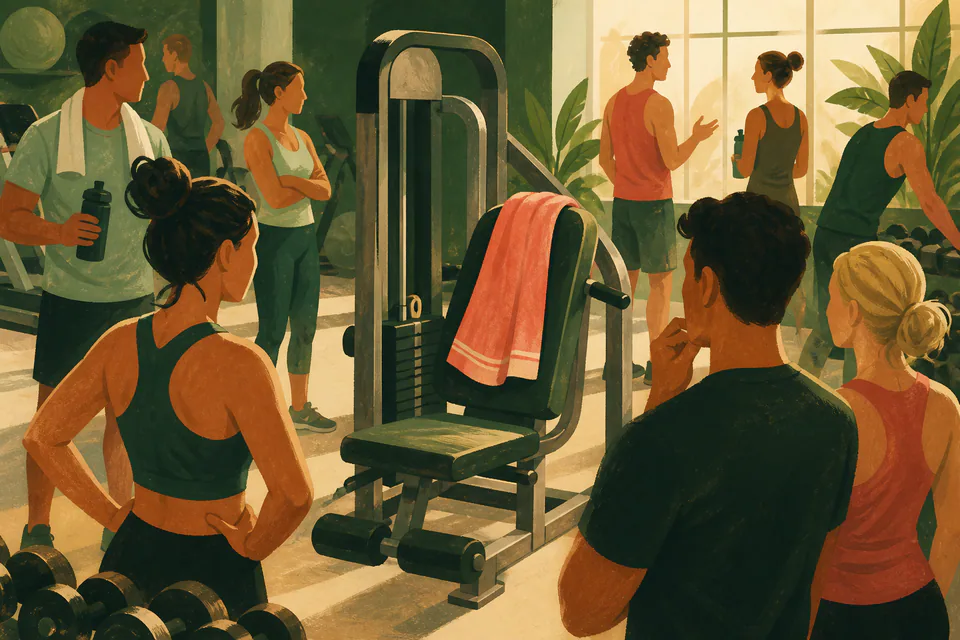
Someone reserves the best gym machine with a towel. When may you move it?
At a crowded gym, a towel has occupied the most popular machine for fifteen minutes while its owner chats across the room. Gym rules prohibit reserving equipment, but everyone occasionally steps away between sets.
How long may convenience masquerade as continued use?