English-language podcasts

Sleepy Facts

8 Hours of the Most Relaxing Facts About Space and the Universe to Fall Asleep To

523 min

Listen through the publisher, then discuss the episode here or arrange an in-person Roundtable. Your city determines where to meet.

Roundtables are designed for groups of four, with a shared subject and room for everyone to speak. Come for discussion, with no dating expectation.

Eight hours of calm, slow facts about space to help you fall asleep and stay asleep. Tonight we drift through the greatest mysteries of the universe, the planets of our solar system, black holes and the Big Bang. There is nothing to remember and nothing to follow. Just a quiet voice and the night sky. Settle in, get comfortable and let the universe carry you to sleep.

Episode information is provided by the publisher. Listening takes place on the publisher’s service.

Listen at the source ↗

Featured places to meet in Palo Alto, CA

Explore these places and arrange a conversation through ThinkMatch.

City guide for Palo Alto, CA

More from Sleepy Facts

Sleepy Facts

The Most Relaxing Facts About the Night Sky to Fall Asleep To

132 min

In this calm and sleepy facts episode, we look up into the darkness above and explore everything the night sky has to offer, from the first faint star that appears at dusk to the most distant object the naked eye can see. We begin with why the sky gets dark at all, tracing the stages of twilight as the Sun slips below the horizon and the atmosphere slowly stops scattering its light. We learn why stars twinkle but planets do not, how brightness is measured in a scale of apparent magnitude that stretches from the blazing glow of Sirius all the way down to the faintest smudges visible only on the darkest nights. We wander through the 88 officially recognized constellations, discovering that they are not shapes drawn in the stars but entire regions of sky, and that different cultures across history connected the same stars into entirely different pictures. We spend time with the Moon, following its 29.5 day cycle from thin crescent to full and back again, learning how earthshine softly ill

Discuss this episode

Sleepy Facts

The Most Relaxing Facts About Dreams to Fall Asleep To

134 min

In this calm and sleepy facts episode, we slip quietly into the world of dreams, the extraordinary theater the mind builds every single night from nothing but fragments of memory, emotion, and imagination. We begin with the basics of what a dream actually is, a vivid mental experience that occurs during sleep, most intensely during rapid eye movement sleep, and we trace the architecture of a full night, learning how the brain cycles through stages roughly every 90 minutes, with each REM period growing longer and more dream rich as the night goes on. We visit the moment in 1953 when Eugene Aserinsky and Nathaniel Kleitman first discovered REM sleep in a Chicago laboratory, and we explore the curious state of muscle atonia, the temporary paralysis that keeps the body still while the dreaming mind races. From there we wade into the deep question of why we dream at all, from Freud's wish fulfillment theory to the activation synthesis model to the idea that dreams help consolidate memories

Discuss this episode

Sleepy Facts

The Most Relaxing Facts About the Milky Way to Fall Asleep To

144 min

In this calm and sleepy facts episode, we look up and explore the enormous, slowly turning galaxy that contains everything humanity has ever known. We begin with what the Milky Way actually is, a barred spiral galaxy roughly 100,000 light years across, home to somewhere between 100 and 400 billion stars, one of which is our own Sun, quietly orbiting about two thirds of the way out from the center. We trace the galaxy's structure from the dense central bulge and its bar of stars outward through the great spiral arms, past stellar nurseries where new stars are still being born in vast clouds of gas and dust, and into the faint stellar halo where ancient globular clusters orbit high above and below the galactic plane. At the very heart of it all sits Sagittarius A star, a supermassive black hole roughly four million times the mass of the Sun, hidden behind thick lanes of dust that block visible light but reveal themselves in infrared and radio waves. We explore the stellar population of t

Discuss this episode

Community Poll

Universities should protect controversial speech unless it directly threatens or harasses others.

Share your view, then see how readers voted. No sign-in required. This poll is shared across stories.

Do you agree or disagree?

Choose one answer

Common Quandary

A Common Quandary to discuss

Another conversation to explore, separate from this news story.

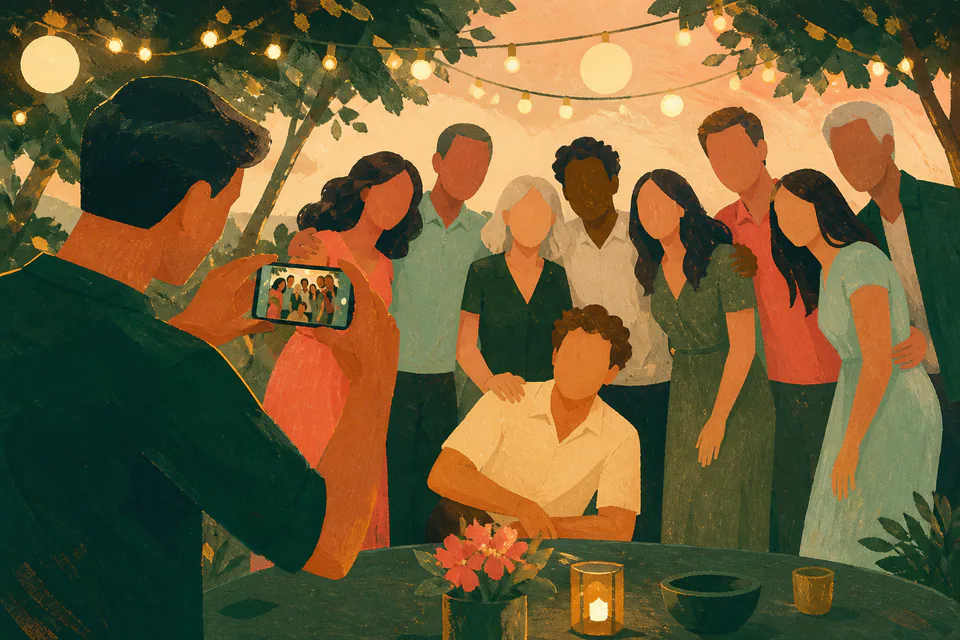
Everyone loves the group photo except you. Can you forbid them from posting it?

At a reunion, someone takes a joyful group photo that captures the night perfectly. Everyone looks wonderful except you, caught at an awful angle. The group wants to post it publicly and promises nobody else will care.

How much control should one person have over a memory shared by many?

Explore this quandary