A Hidden Effect in Optical Fibers Could Transform Future Technology
21 min
Listen through the publisher, then discuss the episode here or arrange an in-person Roundtable. Your city determines where to meet.
Roundtables are designed for groups of four, with a shared subject and room for everyone to speak. Come for discussion, with no dating expectation.
Scientists have uncovered an overlooked magnetic phenomenon that challenges conventional assumptions about how light behaves inside optical fibers. The discovery reveals unexpected interactions between magnetic fields and light, potentially opening new possibilities for advanced sensors, electrical monitoring, and optical computing. Could this subtle effect help reshape the future of photonic technology? This episode includes AI-generated content.
Episode information is provided by the publisher. Listening takes place on the publisher’s service.
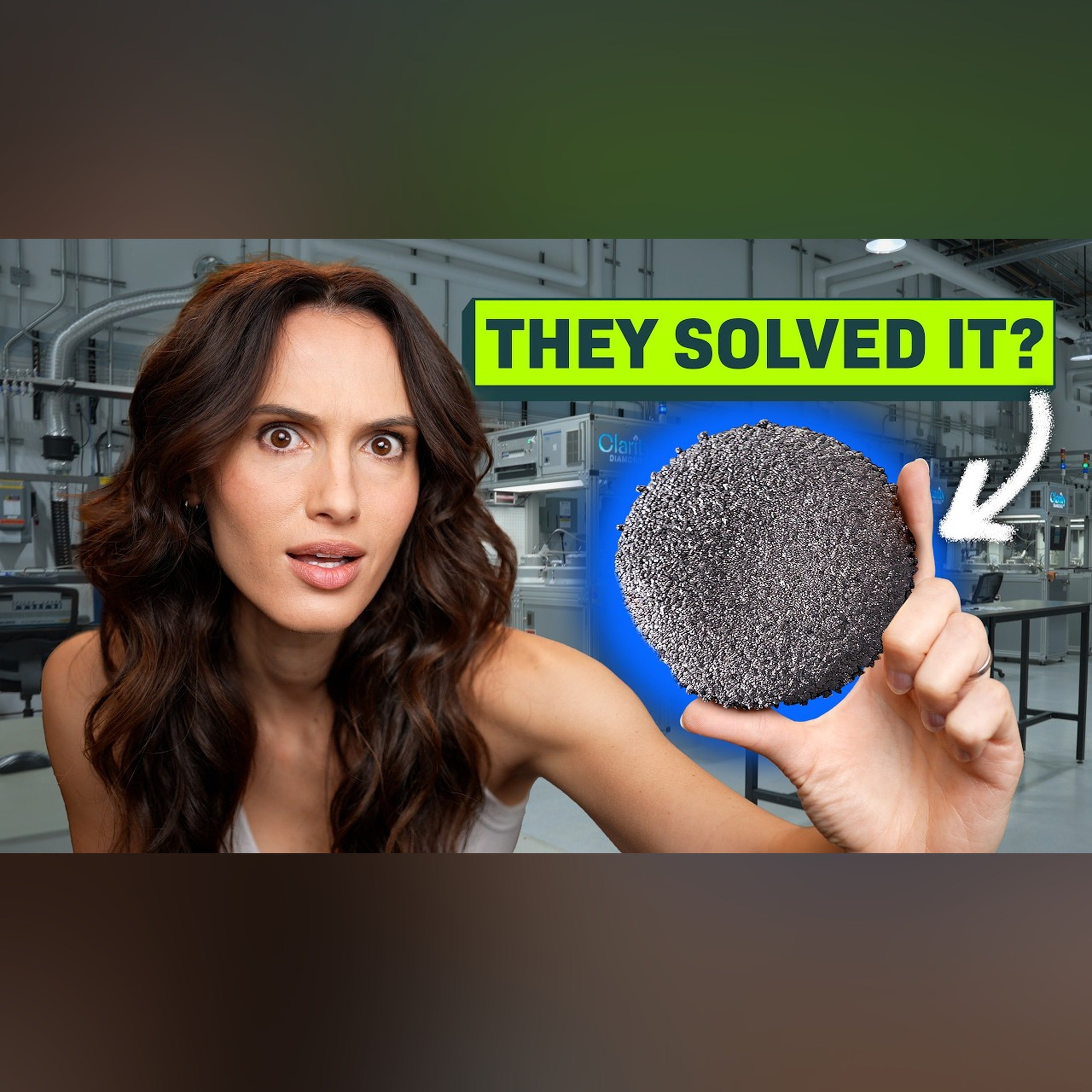
Most people think of diamonds as expensive jewelry, or maybe as super-hard drills. But everyone’s missing the coolest story here… We’ve built giant machines that can recreate the conditions inside our planet. And found new ways to make diamonds way cheaper, now unlocking the hidden potential of this super material. People are sending diamonds into space, adding them to massive computers, and using them to help solve one of the biggest technological problems we’re about to face. This is about pushing the limits of material science to benefit all of us. So in this video, we’re getting rare access inside a lab where they make diamonds to see how they actually do it… And we’re gonna shrink down inside your computer to show you why diamonds are not what you think. Chapters: 00:00 Diamonds are not what you think 01:38 Where do natural diamonds come from? 02:17 Why are diamonds so hard? 03:48 What's a diamond's secret superpower? 05:09 Why does my computer get so hot? 05:50 How small is a tra
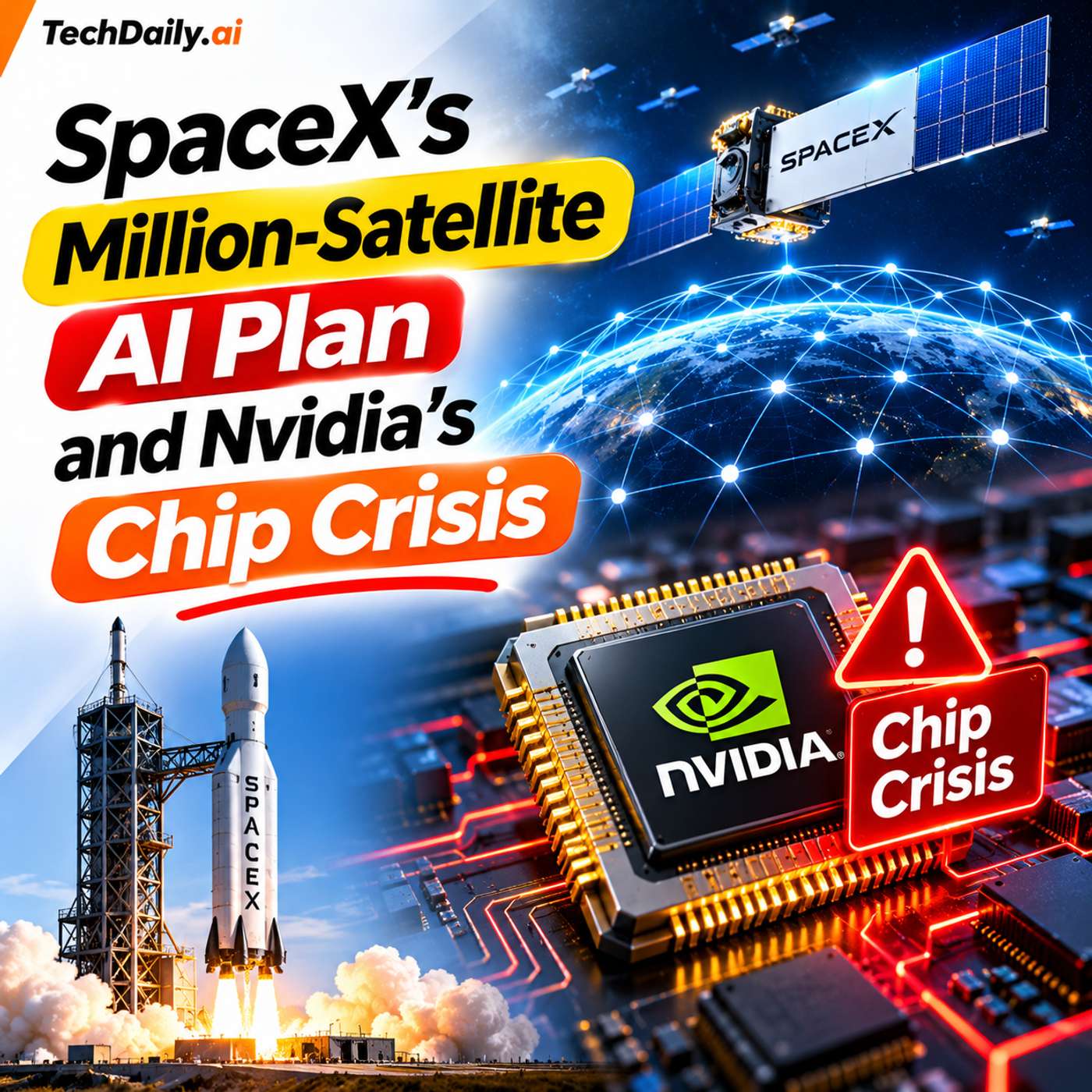
What if the future of artificial intelligence isn't being built in Silicon Valley but in low Earth orbit? And what happens when the semiconductor supply chain powering that future becomes vulnerable to international chip smuggling? In this episode of TechDaily.ai, David and Sophia explore SpaceX’s ambitious vision for a million-satellite orbital AI data center network, the engineering challenges of computing in space, and the growing concerns surrounding Nvidia, semiconductor export controls, and global AI competition. From laser-powered satellite communications to advanced AI chip restrictions, this episode examines the technological, economic, regulatory, and ethical challenges shaping the future of artificial intelligence. In this episode, we discuss: SpaceX’s Star Mind project and its proposed million-satellite constellation. Orbital AI data centers and the future of computing infrastructure. Laser-based satellite communications and Starlink connectivity. Thermal management and coo
Sponsor Link: This episode of Space Nuts is brought to you with the support of Uncommon Goods — a one-stop gift shop for everyone on your list. We’re all out of the ordinary. Space Nuts: BepiColombo Reaches Mercury, Planet X2 and a New Idea About Dark Energy In this episode of Space Nuts, Andrew Dunkley and Professor Fred Watson explore three big stories from across the Solar System and beyond. After an eight-year journey, the BepiColombo mission has reached Mercury, where its two spacecraft will investigate the planet’s oversized metal core, magnetic field and battered surface. Then they consider new modelling that suggests a distant planet — dubbed Planet X2 — could explain the unusual orbits of icy objects beyond Neptune, and how the Vera C. Rubin Observatory might help find it. Finally, Andrew and Fred Watson discuss a possible explanation for dark energy rooted in the known physics of the strong nuclear force. Join them for a close-up look at Mercury, a search for a hidden world a
PBS Member Stations rely on viewers like you. To support your local station, go to: http://to.pbs.org/DonateSPACE ↓ More info below ↓ Uploaded 10-04-19 We live in a universe with 3 dimensions of space and one of time. Up, down, left, right, forward, back, past, future. 3+1 dimensions. Or so our primitive Pleistocene-evolved brains find it useful to believe. And we cling to this intuition, even as physics shows us that this view of reality may be only a very narrow perception. One of the most startling possibilities is that our 3+1 dimensional universe may better described as resulting from a spacetime one dimension lower – like a hologram projected from a surface infinitely far away. Check out the new Space Time Merch Store! Support Space Time on Patreon Need a Refresher to Fully Understand the Holographic Principle? #holographicuniverse #holographicprinciple #spacetime Hosted by Matt O'Dowd Written by Matt O'Dowd Graphics by Aaron Halevy Directing by Andrew Kornhaber The holographic p
Canva Head of Ecosystem Anwar Haneef joins MTS to discuss the general availability launch of Canva’s upgraded MCP server, REST API, and CLI, allowing AI agents and frontier assistants like Claude and ChatGPT to generate designs directly. He explains why specialized models like Canva’s Craft and Brush beat general-purpose LLMs on visual taste, typography, and avoiding “AI slop,” and shares how Canva is positioning itself as the design infrastructure for the internet. -- -- MTS chronicles the singularity, live. Monitoring the situation of tech and AI. Follow MTS: Spotify |https://open.spotify.com/show/4HUNNmV1pjV7CW6Lphm1rM Apple |https://podcasts.apple.com/us/podcast/mts/id1891088763 – Brought to you by: Mongo DB - Anyone can prototype an agent. Lovable - Turn ideas into software people love with Lovable. Start today at https://lovable.dev/ Visithttps://factory.com/ Neon (by Databricks) - Scale your startup on Neon. The Postgres backend for apps and agents. Head over to http://getvcx.co
My most dangerous ideaSpreading awareness about the works of some of the leading educators in the AI revolution."Helping humanity shepherd through this transition as we embrace the final invention of mankind: advanced artificial intelligence." David Shapiro aims to provide a pragmatic and optimistic view of the future.Core Ideas:Metamodernism: Narratives and emergence view of realityPostnihilism: The demand for meaning is false, there is only the Great MysteryHeuristic Imperatives: An ethical, moral, and decision framework.- Reduce suffering- Increase prosperity- Increase understandingPost-Labor Economics: Replace humans with machines (better, faster, cheaper, safer)mantra:EXPLORE: Delve into the unknown, driven by curiosity and a quest for discovery. Seek knowledge.ELUCIDATE: Make complex ideas clear, communicating them in an accessible and comprehensible manner.ENUMERATE: Ground insights in concrete data, providing measurable and quantitative evidence.ELABORATE: Add depth and detail
What if dark energy doesn't require mysterious new particles after all? Researchers have proposed a theory linking the universe's accelerating expansion to the quantum physics already governing matter inside atomic nuclei. Their approach offers a fresh explanation that could reshape how scientists investigate one of cosmology's biggest mysteries. Upcoming observations may help determine whether this idea holds up. This episode includes AI-generated content.
A decades-old mystery surrounding energy confinement in nuclear fusion reactors may finally have an answer. Researchers have developed a new theoretical framework explaining how plasma turbulence influences heat retention inside tokamaks. The findings could help scientists predict the operating requirements of next-generation facilities, including ITER and SPARC, bringing greater clarity to the challenges facing practical fusion energy. This episode includes AI-generated content.
Strange metals have long challenged conventional explanations of electrical resistance. Now, new theoretical research suggests their unusual behavior may arise from a deeper quantum mechanism rather than ordinary electron collisions. Using advanced models of strongly interacting electrons, scientists are uncovering a different perspective on one of condensed matter physics' most persistent mysteries, with potential implications for understanding exotic quantum materials. This episode includes AI-generated content.
Publicly rescued businesses should share future gains with taxpayers.
Share your view, then see how readers voted. No sign-in required. This poll is shared across stories.
Do you agree or disagree?
Common Quandary
A Common Quandary to discuss
Another conversation to explore, separate from this news story.
You can clone the best dog you ever had. Would you?
After a beloved dog dies, its owner can afford to have it cloned. The procedure is legal and improving, but it uses animals as surrogates and will not recreate the original dog's memories or personality.
What do our obligations to animals permit us to create for our own comfort?