English-language podcasts

Space Nuts: Astronomy Insights & Cosmic Discoveries

Mercury at Last, The Search for Planet X2 & Dark Energy’s Mystery: Cosmic Discoveries
39 min

Listen through the publisher, then discuss the episode here or arrange an in-person Roundtable. Your city determines where to meet.

Roundtables are designed for groups of four, with a shared subject and room for everyone to speak. Come for discussion, with no dating expectation.

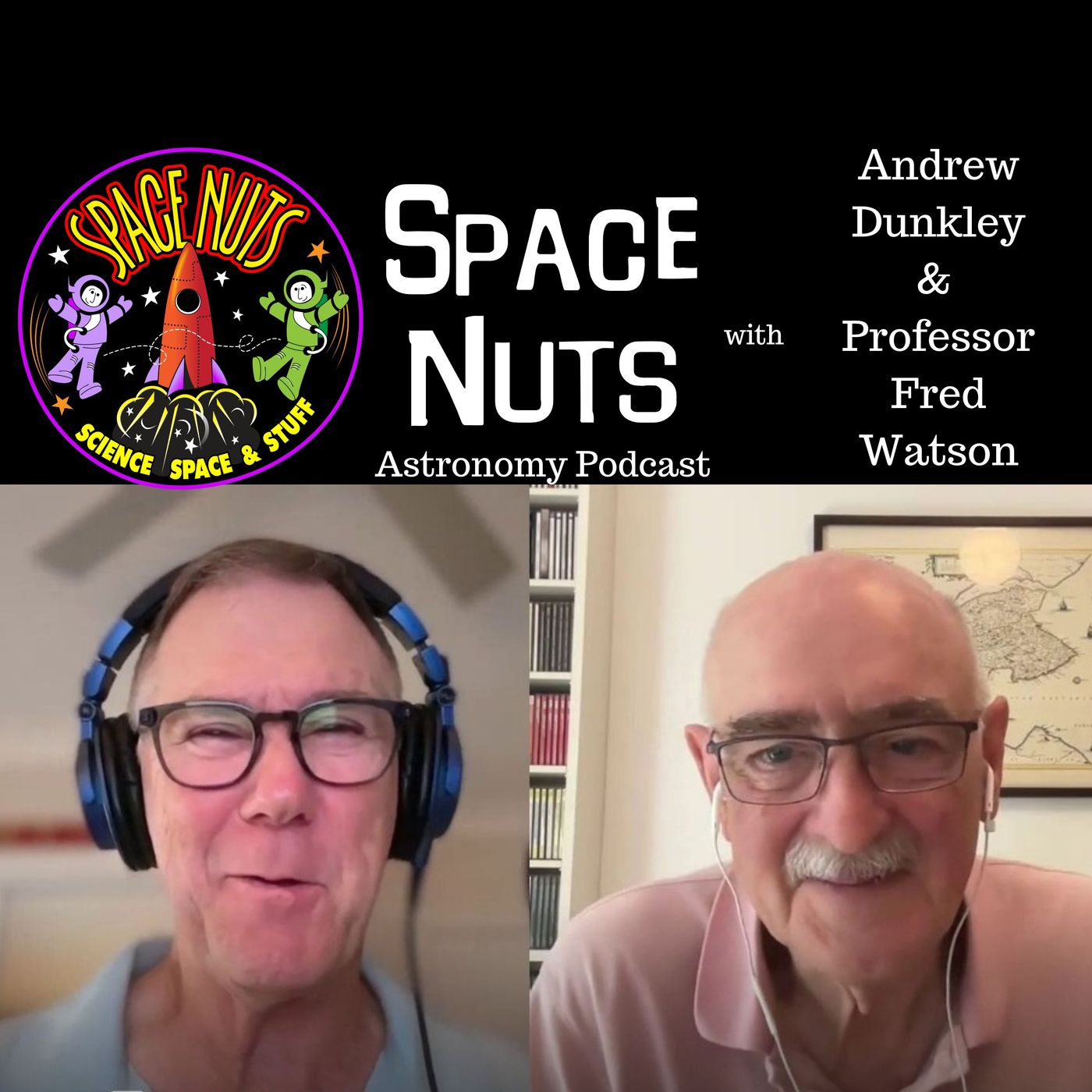
Sponsor Link: This episode of Space Nuts is brought to you with the support of Uncommon Goods — a one-stop gift shop for everyone on your list. We’re all out of the ordinary. Space Nuts: BepiColombo Reaches Mercury, Planet X2 and a New Idea About Dark Energy In this episode of Space Nuts, Andrew Dunkley and Professor Fred Watson explore three big stories from across the Solar System and beyond. After an eight-year journey, the BepiColombo mission has reached Mercury, where its two spacecraft will investigate the planet’s oversized metal core, magnetic field and battered surface. Then they consider new modelling that suggests a distant planet — dubbed Planet X2 — could explain the unusual orbits of icy objects beyond Neptune, and how the Vera C. Rubin Observatory might help find it. Finally, Andrew and Fred Watson discuss a possible explanation for dark energy rooted in the known physics of the strong nuclear force. Join them for a close-up look at Mercury, a search for a hidden world and a fresh approach to one of cosmology’s greatest puzzles. Key topics - BepiColombo’s eight-year journey to Mercury and the gravity-assist manoeuvres that brought it there. - How the ESA and JAXA spacecraft will study Mercury’s interior, magnetic field, surface and ultra-thin exosphere. - Why Mercury has such a large metal core, and the theory that a massive impact stripped away much of its mantle. - The evidence behind Planet X2 and how a hypothetical planet could shape the orbits of distant icy objects. - Why Planet X2 would be extremely faint, and how the Vera C. Rubin Observatory could help astronomers search for it. - How a newly proposed model links dark energy to the quantum chromodynamics vacuum and the strong nuclear force. - Whether dark energy changes over time, and how future observations could test the idea. Timestamps 00:00 - Introduction: Mercury, Planet X2 and dark energy 02:00 - BepiColombo reaches Mercury after an eight-year journey 05:00 - The mission’s spacecraft and gravity-assist manoeuvres 09:00 - Mercury’s surface, magnetic field and enormous core 13:00 - Could an ancient impact have stripped away Mercury’s mantle? 17:00 - Planet X2 and the search for a distant ninth planet 21:00 - The unusual orbits of icy objects beyond Neptune 25:00 - Why Planet X2 is difficult to observe and the role of the Rubin Observatory 29:00 - Could known particle physics explain dark energy? 33:00 - The strong nuclear force, quantum chromodynamics and the energy of empty space 38:00 - Is dark energy changing over time? 42:00 - Closing remarks and Space Nuts details

Episode information is provided by the publisher. Listening takes place on the publisher’s service.

Listen at the source ↗

Featured places to meet in Palo Alto, CA

Explore these places and arrange a conversation through ThinkMatch.

City guide for Palo Alto, CA

More from Space Nuts: Astronomy Insights & Cosmic Discoveries

Space Nuts: Astronomy Insights & Cosmic Discoveries

Exoplanet Tilts, Black Hole Event Horizons & Helium Stars: Cosmic Questions Answered

32 min

Sponsor Link: This episode of Space Nuts is brought to you with the support of Uncommon Goods - your one stop gift shop for everyone on your list - We’re all out of the ordinary. To get your special Space Nuts listener deal, visit www.uncommongoods.com/spacenuts (https://www.uncommongoods.com/spacenuts) Space Nuts: Exoplanet Tilts, Black Hole Horizons, Helium Stars and Foundation’s Jump Drive In this listener Q&A episode of Space Nuts, Andrew Dunkley and Professor Fred Watson tackle questions about planets, black holes and the possibilities of science fiction. They explain how astronomers investigate exoplanets’ rotation and axial tilt, why many worlds never transit their stars from our viewpoint, and why long-period planets can take years to confirm. Then they consider what an object crossing a black hole’s event horizon would look like to an outside observer, and whether the cosmic microwave background offers a distant parallel. The episode also explores helium-rich stars and the fic

Discuss this episode

Space Nuts: Astronomy Insights & Cosmic Discoveries

Voyager 1’s One-Light-Day Milestone & SpaceX’s Starship Catch: Cosmic News

36 min

Sponsor Link: This episode of Space Nuts is brought to you with the support of NordVPN - your first stop when it comes to online security. Visitwww.nordvpn.com/spacenuts t (https://www.nordvpn.com/spacenuts)o check out the deals and your special Space Nuts. Space Nuts: Starship’s Successful Failure, Voyager 1’s Light-Day Milestone and Cosmic Dust In this episode of Space Nuts, Andrew Dunkley and Professor Fred Watson examine a SpaceX Starship flight that ended in a remarkable landing — and an unplanned splashdown for its booster. They discuss what the achievement means for the future of the Starship lunar lander and NASA’s Artemis programme. Then they mark Voyager 1 travelling one light-day from Earth, reflecting on its extraordinary longevity, the science it is still returning and its eventual journey through interstellar space. Finally, Andrew and Fred Watson explore research into 12 tiny grains of cosmic dust gathered high in Earth’s atmosphere, which may hold clues to ancient water

Discuss this episode

Space Nuts: Astronomy Insights & Cosmic Discoveries

The Big Bang’s Energy & Can Black Holes Eat Galaxies? Cosmic Questions Answered

32 min

Sponsor Link: This episode of Space Nuts is brought to you with the support of NordVPN - your first stop when it comes to online security. To check out our special Space Nuts offer, visit www.nordvpn.com/spacenuts or use the code SPACENUTS at checkout. Space Nuts: Cosmic Horizons, the Big Bang’s Energy, Earth’s Habitable Zone and Black Holes In this listener Q&A episode of Space Nuts, Andrew Dunkley and Professor Fred Watson tackle questions from around the world. They explain how travelling across the universe would shift the boundary of what we can observe, then consider whether anyone can calculate the Big Bang’s total energy. Next, they explore Earth’s place in the Sun’s habitable zone and how changes in the Sun’s brightness may have influenced ancient climate shifts. Finally, they ask whether a black hole could consume an entire galaxy — and why even the biggest black holes have a limited reach. Join Andrew and Fred Watson Watson for cosmic horizons, planetary habitability and som

Discuss this episode

Community Poll

Environmental commitments should be judged by measured outcomes rather than announced targets.

Share your view, then see how readers voted. No sign-in required. This poll is shared across stories.

Do you agree or disagree?

Choose one answer

Common Quandary

A Common Quandary to discuss

Another conversation to explore, separate from this news story.

The buffet is unlimited while you are inside. Can one sandwich leave in your pocket?

An expensive hotel brunch advertises unlimited food but forbids takeout. You are full, yet quietly assembling a sandwich for later would cost the hotel almost nothing. Several trays will likely be discarded after service.

Does preventing waste justify ignoring the boundary of a bargain?

Explore this quandary