Listen through the publisher, then discuss the episode here or arrange an in-person Roundtable. Your city determines where to meet.
Roundtables are designed for groups of four, with a shared subject and room for everyone to speak. Come for discussion, with no dating expectation.
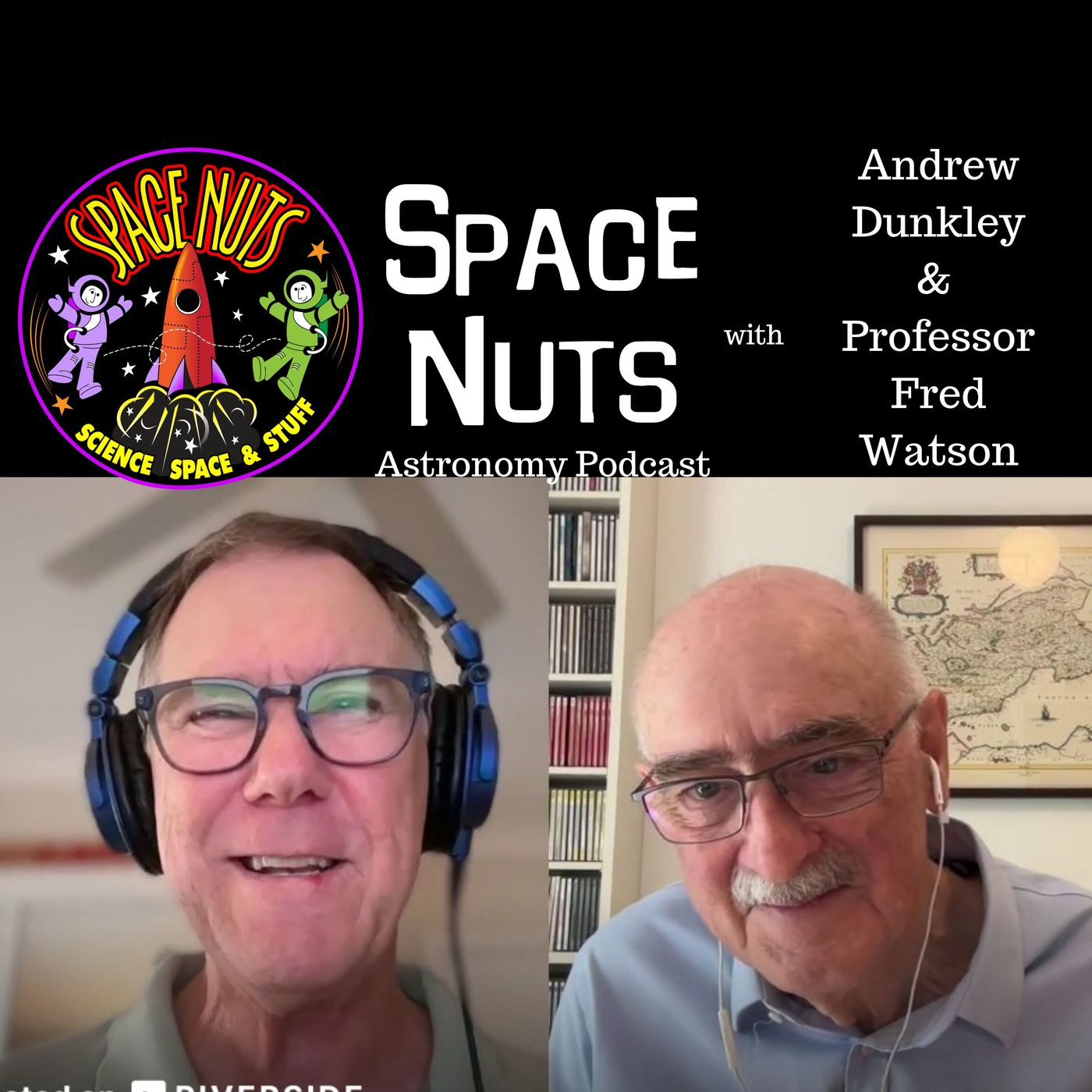
Sponsor Link: This episode of Space Nuts is brought to you with the support of NordVPN - your first stop when it comes to online security. Visit www.nordvpn.com/spacenuts (https://www.nordvpn.com/spacenuts) to check out the deals and your special Space Nuts. Space Nuts: Starship’s Successful Failure, Voyager 1’s Light-Day Milestone and Cosmic Dust In this episode of Space Nuts, Andrew Dunkley and Professor Fred Watson examine a SpaceX Starship flight that ended in a remarkable landing — and an unplanned splashdown for its booster. They discuss what the achievement means for the future of the Starship lunar lander and NASA’s Artemis programme. Then they mark Voyager 1 travelling one light-day from Earth, reflecting on its extraordinary longevity, the science it is still returning and its eventual journey through interstellar space. Finally, Andrew and Fred Watson explore research into 12 tiny grains of cosmic dust gathered high in Earth’s atmosphere, which may hold clues to ancient water in the distant outer Solar System. Join Andrew and Fred Watson Watson for giant rockets, far-flung spacecraft and a surprising story written in stardust. Key topics - SpaceX’s Starship completing an orbital flight and being caught by the launch tower’s chopsticks. - Why the Super Heavy booster was diverted into the ocean, and what still needs to be proven before Starship is ready for lunar missions. - How Starship and Blue Origin’s Blue Moon lander differ, and their roles in NASA’s Artemis programme. - Voyager 1 reaching one light-day — about 26 billion kilometres — from Earth. - How Voyager’s power supply is declining, which instruments are still operating and where the spacecraft is headed. - The Golden Records aboard Voyager and the people who continue to help maintain the mission. - How 12 grains of dust collected in the stratosphere may reveal evidence of ancient water beyond Neptune. - What unusual oxygen isotopes and radiation tracks can tell scientists about the origins of cosmic dust. Timestamps 00:00 - Introduction: SpaceX, Voyager 1 and cosmic dust 02:00 - NASA’s virtual guest programme and listener follow-up 05:00 - Starship’s latest flight and its successful catch 09:00 - Why the Super Heavy booster was sent into the ocean 12:00 - Starship, Blue Moon and the Artemis lunar landings 18:00 - Voyager 1 reaches one light-day from Earth 22:00 - Voyager’s remaining instruments and dwindling power supply 26:00 - Voyager’s future journey and the Golden Records 30:00 - Twelve cosmic dust grains and evidence of water beyond Neptune 35:00 - Isotopes, radiation tracks and how dust travels through the Solar System 39:00 - Closing remarks and Space Nuts details
Episode information is provided by the publisher. Listening takes place on the publisher’s service.
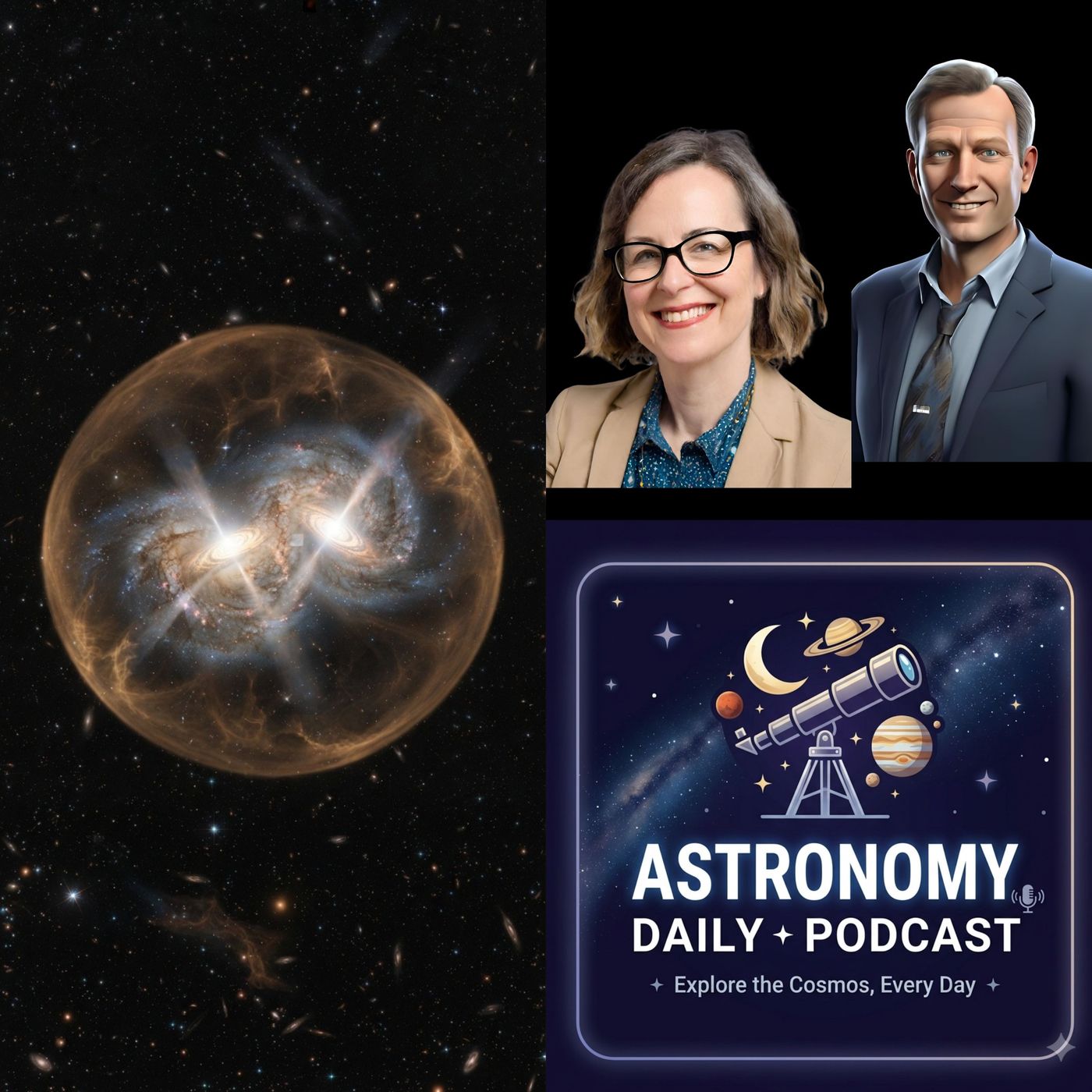
Eleven billion years ago two quasars blazed side by side, and this week astronomers weighed the invisible gas around them by the shadow it casts on the cosmic microwave background. There is 3.6 times more heat in it than gravity can explain. Plus a triple star 28 light-years away that 'should not exist', a pulsar found in ten hours with an algorithm borrowed from cryptography, The Week That Was, and the weekend sky from both hemispheres. In this episode Lead: Hot bubble around the dual quasar J1549+1245 at z = 2.37, measured with ALMA via the thermal Sunyaev–Zel'dovich effect (Hall, Zakamska et al., Nature Astronomy, 18 Nov 2026). Fresh item: Welopōʻai, the closest known triple with two white dwarfs, 28 light-years away (Artigau et al., A&A, 19 Nov 2026). Week That Was: Starship Flight 15 ship catch, CSIRO GenDIReCT and M87, SN 2026ahvu, failed supernovae in gravitational waves (E230); Voyager 1 one light-day, Beta Pictoris ices, heavy-oxygen water, Roman alignment (E231); Terra ends,
THE SEARCH FOR THE ULTIMATE RED LIGHT THERAPY IS OVER! After decades of exploring wellness technologies, Michael Jaco sits down with Rob Rene, founder of Exodus Strong, to explore the Red Light+ Total Body Reset system, the science behind red and near-infrared light, and why this technology has become such an important part of their wellness conversation. Rob's remarkable personal journey—including surviving five near-death experiences—inspired his mission to develop practical wellness tools that people can incorporate into their everyday lives. Discover the full-body Red Light+ Mat, designed for convenient 20-minute sessions, and the portable Red Light+ Wand, created for targeted use on areas such as the knees, shoulders, hands, and lower back. Michael and Rob discuss the technology, personal experiences, and how red light therapy may support a daily wellness routine. BLACK FRIDAY–CYBER MONDAY LISTENER EXCLUSIVE! This is your opportunity to explore Exodus Strong's special holiday offe
Thanks to Brilliant for supporting PBS. Learn more at: https://www.brilliant.org/spacetime Uploaded 02-12-19 PBS Member Stations rely on viewers like you. To support your local station, go to: http://to.pbs.org/DonateSPACE The universe is big, really, really big. Although according to a new paper, it may literally be infinitely smaller than we previously thought. Sign Up on Patreon to get access to the Space Time Discord! Check out the Space Time Merch Store Hosted by Matt O'Dowd Written by Matt O'Dowd Graphics by Leonardo Scholzer and Adriano Leal Directed by: Andrew Kornhaber Executive Producers: Eric Brown and Andrew Kornhaber End Credits Music by J.R.S. Schattenberg: https://www.youtube.com/channel/UCRl6-nb4iOnsij-vnpAjp0Q Every time you walk out the door, light from the Big Bang strikes your face, enters your eyes. This is the cosmic microwave background radiation - the left-over heat-glow from the very early universe. We can’t see this microwave light with our eyes, but we can ca
Robot dogs are here. But why? You might think you already know Spot, the robot dog from Boston Dynamics. Maybe you saw a viral video of it opening a door, or dragging a truck, or dancing. But now, this robot has hit a HUGE milestone... Spot got a job! These robots are now out in the real world doing real work, for fire departments, factories, defunct nuclear power plants like Fukushima, ancient ruins like Pompeii, deep mines, and, more controversially, police departments. You might already be starting to see robot dogs walking around, and even if you’re not, they’re starting to affect your life. That’s why we went to visit Boston Dynamics. In this video, we put Spot to the test, to show you what it’s really capable of, and how our future could be even better with robot dogs. Chapters: 00:00 What is Boston Dynamics robot dog? 1:33 What does Boston Dynamics robot dog do? 2:50 Why robot dogs? 3:32 Taking Spot on an obstacle course 4:33 When Spot falls down 5:34 How Spot protects itself an
For extra nuances and all the references, please see the newsletter: https://staycuriousmetabolism.substack.com/p/how-i-hacked-my-girlfriends-brainwith?r=40ekz2&utm_campaign=post&utm_medium=web&triedRedirect=true (https://staycuriousmetabolism.substack.com/p/how-i-hacked-my-girlfriends-brainwith?r=40ekz2&triedRedirect=true) Can light influence attraction, hormones, and even reproductive biology? In this video, we explore surprising research on light exposure, testosterone, estrogen, fertility signals, and behavioral changes observed in both animal models and human studies. From hormone cascades triggered through the skin to seasonal changes in reproductive biology, this is a fascinating look at how deeply light may shape human physiology. Along the way, I also test whether increasing my own sunlight exposure changes my testosterone levels and reveal how my girlfriend hacked my brain! For more nuance, mechanisms, protocols, and limitations behind these findings, check out the full deep
Dr. Al Grauer hosts. Dr. Albert D. Grauer ( @Nmcanopus (https://twitter.com/Nmcanopus) ) is an observational asteroid hunting astronomer. Dr. Grauer retired from the University of Arkansas at Little Rock in 2006. travelersinthenight.org (http://travelersinthenight.org/) From June & July, 2026. Today's 2 topics: - My Catalina Sky Survey teammate Josh Hogan has discovered a 2 football field diameter asteroid that was placed on NASA's Sentry list because it has a tiny minuscule but non-zero chance of impacting our home planet. With this motivation my team the Catalina Sky Survey, the Pan STARRS group in Hawaii, the ATLAS group with telescopes Hawaii, Chile, and South Africa , the Vera C. Rubin telescope in Chile, will be soon joined NASA's NEO Surveyor and groups world wide in a planet wide defense network. - The visually stunning Lunar Crater Pierazzo, named for the late Planetary Scientist Elizabeth "Betty" Pierazzo was observed by the Artemis II Crew as they passed over the Moon's far
Sponsor Link: This episode of Space Nuts is brought to you with the support of NordVPN - your first stop when it comes to online security. To check out our special Space Nuts offer, visit www.nordvpn.com/spacenuts (https://www.nordvpn.com/spacenuts) or use the code SPACENUTS at checkout. Space Nuts: Cosmic Horizons, the Big Bang’s Energy, Earth’s Habitable Zone and Black Holes In this listener Q&A episode of Space Nuts, Andrew Dunkley and Professor Fred Watson tackle questions from around the world. They explain how travelling across the universe would shift the boundary of what we can observe, then consider whether anyone can calculate the Big Bang’s total energy. Next, they explore Earth’s place in the Sun’s habitable zone and how changes in the Sun’s brightness may have influenced ancient climate shifts. Finally, they ask whether a black hole could consume an entire galaxy — and why even the biggest black holes have a limited reach. Join Andrew and Fred Watson Watson for cosmic hori
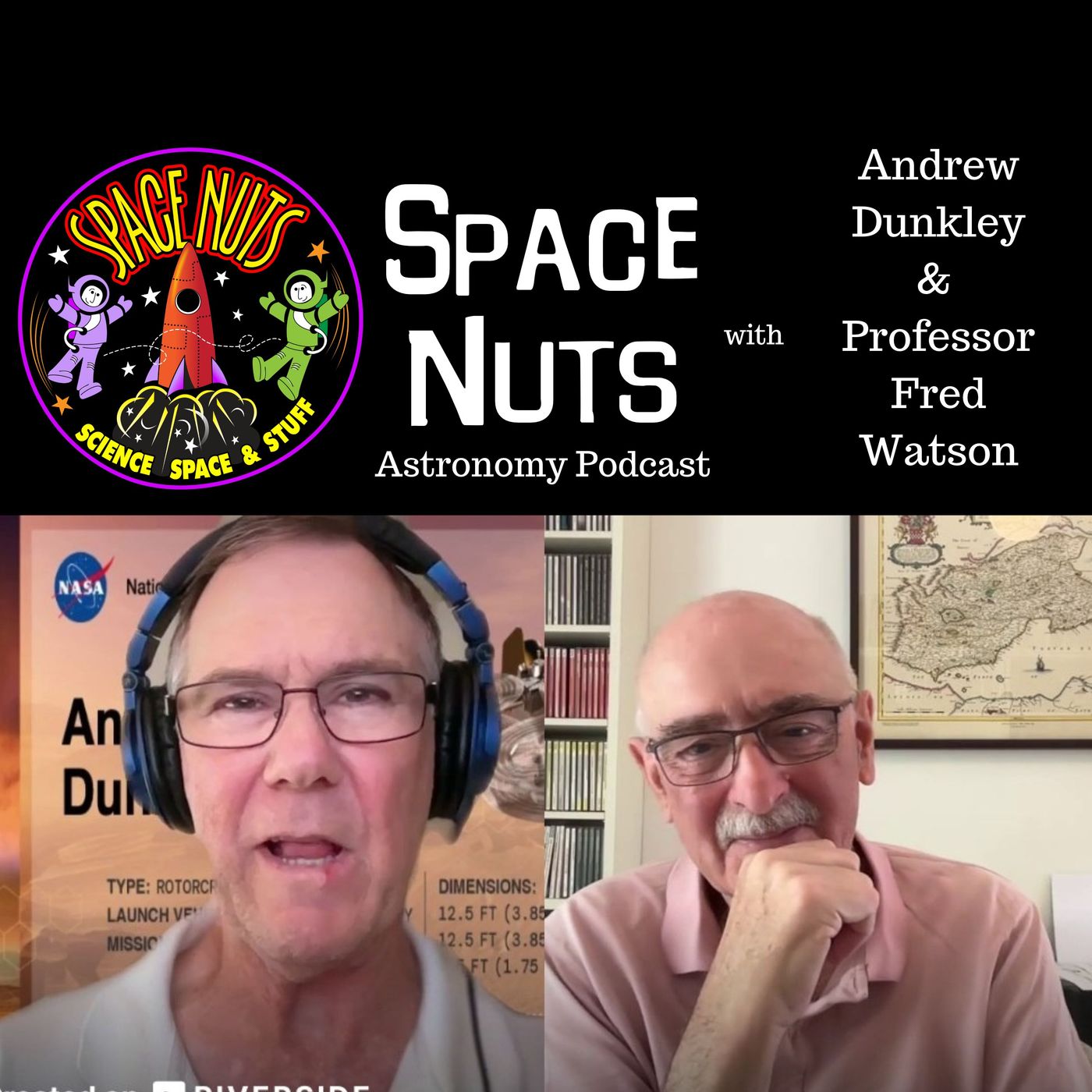
Sponsor Link: This episode of Space Nuts is brought to you with the help and support of NordVPN....the first name you should think of for your online security. To check out special Space Nuts listener deal and save big, visit this URL: www.nordvpn.com.spacenuts (https://www.nordvpn.com/spacenuts) Space Nuts: The M87 Black Hole, a Vanishing Exoplanet and Dragonfly’s Journey to Titan In this episode of Space Nuts, Andrew Dunkley and Professor Fred Watson revisit the Event Horizon Telescope’s landmark image of the black hole in galaxy M87 — and explain how a CSIRO team has now independently confirmed it using artificial intelligence. They then investigate an exoplanet that stopped transiting its star, apparently because the gravity of another planet has tilted its orbit out of view. Finally, Andrew and Fred Watson look ahead to NASA’s Dragonfly mission to Titan, where a flying rotorcraft will explore a moon with methane and ethane lakes. You can even send your name along for the ride. Joi
Sponsor Link: This episode of Space Nuts is brought to you with the help and support of NordVPN....the first name you should think of for your online security. To check out special Space Nuts listener deal and save big, visit this URL: www.nordvpn.com.spacenuts (https://www.nordvpn.com/spacenuts) Space Nuts: Vanishing Stars, White Holes, Earth’s Mass and Neutrinos In this listener Q&A episode of Space Nuts, Andrew Dunkley and Professor Fred Watson tackle four cosmic questions that stretch from distant stars to the nature of space-time. They explain why a star billions of light-years away would still appear in our sky long after it had gone out, and why looking across the universe means looking back through time. Next, they consider whether white holes are the opposite of black holes, then investigate whether dark matter could affect our measurements of Earth’s mass and gravity. Finally, they explore how neutrinos interact with gravity, whether black holes can capture them, and why spac
Courts should explain important rulings in terms ordinary people can understand.
Share your view, then see how readers voted. No sign-in required. This poll is shared across stories.
Do you agree or disagree?
Common Quandary
A Common Quandary to discuss
Another conversation to explore, separate from this news story.
A private joke from years ago goes public. How long should it follow the person who wrote it?
Someone shares a screenshot of a tasteless joke made years ago in a private friends' chat. The person who wrote it says they were performing for a small audience, have changed, and never agreed to have the message made public.
How private should speech remain when it reveals something troubling?