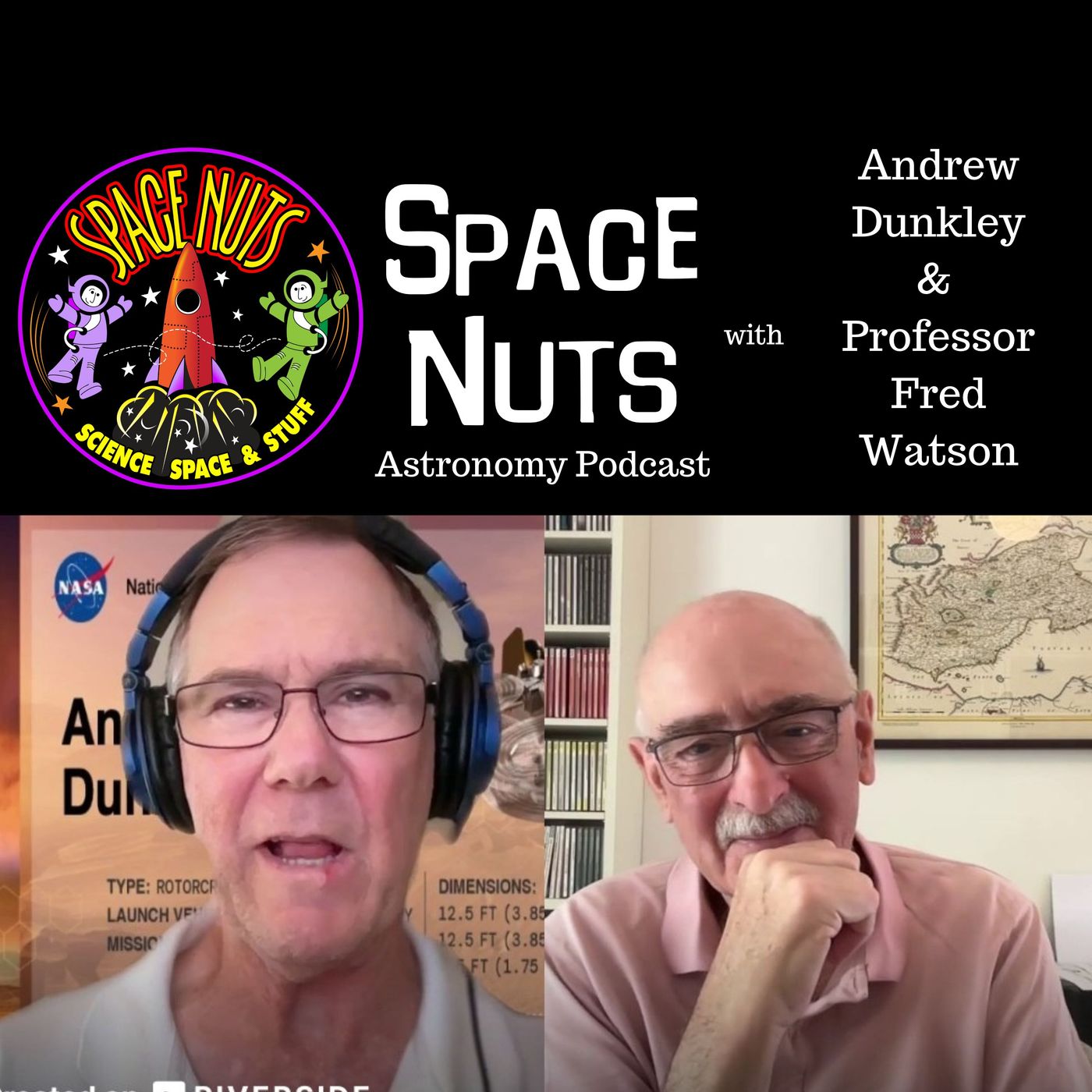
The Big Bang’s Energy & Can Black Holes Eat Galaxies? Cosmic Questions Answered
32 min
Listen through the publisher, then discuss the episode here or arrange an in-person Roundtable. Your city determines where to meet.
Roundtables are designed for groups of four, with a shared subject and room for everyone to speak. Come for discussion, with no dating expectation.
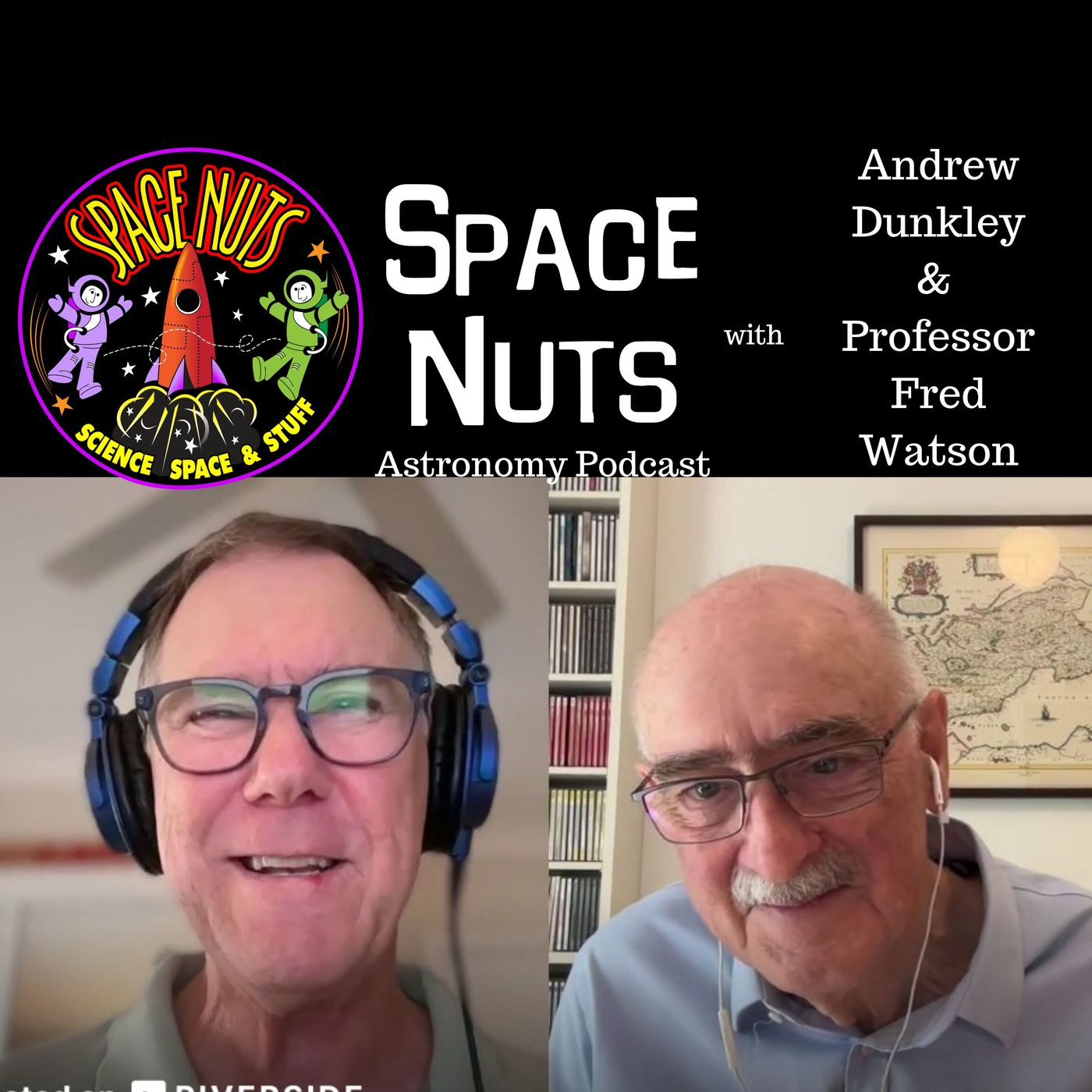
Sponsor Link: This episode of Space Nuts is brought to you with the support of NordVPN - your first stop when it comes to online security. To check out our special Space Nuts offer, visit www.nordvpn.com/spacenuts (https://www.nordvpn.com/spacenuts) or use the code SPACENUTS at checkout. Space Nuts: Cosmic Horizons, the Big Bang’s Energy, Earth’s Habitable Zone and Black Holes In this listener Q&A episode of Space Nuts, Andrew Dunkley and Professor Fred Watson tackle questions from around the world. They explain how travelling across the universe would shift the boundary of what we can observe, then consider whether anyone can calculate the Big Bang’s total energy. Next, they explore Earth’s place in the Sun’s habitable zone and how changes in the Sun’s brightness may have influenced ancient climate shifts. Finally, they ask whether a black hole could consume an entire galaxy — and why even the biggest black holes have a limited reach. Join Andrew and Fred Watson Watson for cosmic horizons, planetary habitability and some wonderfully big questions. Key topics - How travelling billions of light-years would change the part of the universe visible to us. - The cosmic microwave background and the limits of the observable universe. - Why the total energy released by the Big Bang is difficult to define, and estimates for the energy in the observable universe. - Earth’s position in the Sun’s habitable zone and how the zone changes as the Sun brightens. - Whether shifts in the habitable zone could help explain past climate events such as Snowball Earth. - How black holes grow by accreting nearby matter, and whether one could consume an entire galaxy. Timestamps 00:00 - Introduction and listener messages 02:30 - Would travelling across the universe change what we can see? 08:30 - The cosmic microwave background and our observable horizon 10:00 - How much energy was released in the Big Bang? 14:00 - Observable-universe energy estimates and the possibility of a zero-energy universe 18:00 - Earth’s place in the Sun’s habitable zone 22:00 - The Sun’s changing brightness, climate history and Snowball Earth 27:00 - Could a black hole eat an entire galaxy? 31:00 - Phoenix A and the scale of supermassive black holes 34:00 - How to send questions to Space Nuts and closing remarks
Episode information is provided by the publisher. Listening takes place on the publisher’s service.
Thanks to Brilliant for supporting PBS. Learn more at: https://brilliant.org/spacetime Uploaded 17-12-19 PBS Member Stations rely on viewers like you. To support your local station, go to: http://to.pbs.org/DonateSPACE What if every single black hole that formed in our universe sparked the big bang of a new universe? Cosmological natural selection proposes exactly this - but even better, it claims to be able to test the hypothesis. Sign Up on Patreon to get access to the Space Time Discord! Check out the Space Time Merch Store Physicists have been struggling for some time to figure out why our universe is so comfy. Why, for example, are the fundamental constants - like the mass of the electron or the strength of the forces - just right for the emergence of life? Tweak them too much and life, stars, galaxies, the universe as we know it wouldn’t exist. In recent episodes we explored one possible explanation for this - the anthropic principle and the idea of the multiverse. If there are c
Black holes reveal something astonishing about our universe. Take your personal data back with Incogni. This extended cut is a deep dive into cutting edge research about black holes. It’s an interview with famous physicist Dr. Brian Cox. We start with “what if you fell into a black hole?” and end on the cutting edge research that had me questioning my whole reality. I interviewed Dr. Cox originally for a shorter Huge If True episode all about what would happen if you fell into a black hole. Watch our Huge If True episode about “What If You Fell Into A Black Hole?” here: https://youtu.be/BKIkTKqWMfg?si=bTde4QxUeN6bN1Io But there was SO much weird and mind bending stuff about the cutting edge of black holes that didn't fit into that shorter episode, and we knew you'd want to hear it. So we decided we had to release the full conversation. It's just too cool and I think you'll love it. Now, strap in, because the cutting edge of black holes is absolutely WILD. As always, if you want more op
THE SEARCH FOR THE ULTIMATE RED LIGHT THERAPY IS OVER! After decades of exploring wellness technologies, Michael Jaco sits down with Rob Rene, founder of Exodus Strong, to explore the Red Light+ Total Body Reset system, the science behind red and near-infrared light, and why this technology has become such an important part of their wellness conversation. Rob's remarkable personal journey—including surviving five near-death experiences—inspired his mission to develop practical wellness tools that people can incorporate into their everyday lives. Discover the full-body Red Light+ Mat, designed for convenient 20-minute sessions, and the portable Red Light+ Wand, created for targeted use on areas such as the knees, shoulders, hands, and lower back. Michael and Rob discuss the technology, personal experiences, and how red light therapy may support a daily wellness routine. BLACK FRIDAY–CYBER MONDAY LISTENER EXCLUSIVE! This is your opportunity to explore Exodus Strong's special holiday offe
Eleven billion years ago two quasars blazed side by side, and this week astronomers weighed the invisible gas around them by the shadow it casts on the cosmic microwave background. There is 3.6 times more heat in it than gravity can explain. Plus a triple star 28 light-years away that 'should not exist', a pulsar found in ten hours with an algorithm borrowed from cryptography, The Week That Was, and the weekend sky from both hemispheres. In this episode Lead: Hot bubble around the dual quasar J1549+1245 at z = 2.37, measured with ALMA via the thermal Sunyaev–Zel'dovich effect (Hall, Zakamska et al., Nature Astronomy, 18 Nov 2026). Fresh item: Welopōʻai, the closest known triple with two white dwarfs, 28 light-years away (Artigau et al., A&A, 19 Nov 2026). Week That Was: Starship Flight 15 ship catch, CSIRO GenDIReCT and M87, SN 2026ahvu, failed supernovae in gravitational waves (E230); Voyager 1 one light-day, Beta Pictoris ices, heavy-oxygen water, Roman alignment (E231); Terra ends,
What you’re about to hear is a conversation between myself and Dr. Aseem Malhotra, a renowned consultant cardiologist, and close friend of RFK Jr.. I mention that upfront to address the elephant in the room. Our conversation centers around the latest research that colleagues and I have published on LDL cholesterol, ApoB, and their implications for heart disease, particularly in the context of metabolic health. Why are these new findings so important for understanding cardiovascular risk? Is High LDL and ApoB dangerous in the context of Metabolic Health? How can meditation impact heart disease prevention and overall heart health? Why does the scientific community move slowly when it comes to adopting new research? I encourage you to keep an open mind. Scientific narratives, health models, and medical practices evolve as new data emerges. This is the essence of the scientific method. Please Watch THIS Video: https://youtu.be/a_ROZPW9WrY NEW Paper: https://www.jacc.org/doi/10.1016/j.jacad
This holiday season, inspire the next generation of thinkers with KiwiCo! In this week's episode, David is joined by Jacob Haqq-Misra (https://www.haqqmisra.net), Senior Research Investigator and Co-Founder of Blue Marble Space (https://www.bluemarblespace.org). Check out Jacob's UAP software at https://mcdonald.bluemarblespace.org (https://mcdonald.bluemarblespace.org/) To support this podcast and our research lab, head to https://coolworldslab.com/support REFERENCES - Haqq-Misra et al. (2022): “Detectability of Chlorofluorocarbons in the Atmospheres of Habitable M-dwarf Planets” - Kopparapu et al. (2021): “Nitrogen Dioxide Pollution as a Signature of Extraterrestrial Technology” - Haqq-Misra et al. (2022): “Disruption of a Planetary Nitrogen Cycle as Evidence of Extraterrestrial Agriculture” - Loeb & Turner (2012): “Detection Technique for Artificially-Illuminated Objects in the Outer Solar System and Beyond” - Crawford & Schulze-Makuch (2024): “Is the apparent absence of extraterres
Sponsor Link: This episode of Space Nuts is brought to you with the support of NordVPN - your first stop when it comes to online security. Visit www.nordvpn.com/spacenuts (https://www.nordvpn.com/spacenuts) to check out the deals and your special Space Nuts. Space Nuts: Starship’s Successful Failure, Voyager 1’s Light-Day Milestone and Cosmic Dust In this episode of Space Nuts, Andrew Dunkley and Professor Fred Watson examine a SpaceX Starship flight that ended in a remarkable landing — and an unplanned splashdown for its booster. They discuss what the achievement means for the future of the Starship lunar lander and NASA’s Artemis programme. Then they mark Voyager 1 travelling one light-day from Earth, reflecting on its extraordinary longevity, the science it is still returning and its eventual journey through interstellar space. Finally, Andrew and Fred Watson explore research into 12 tiny grains of cosmic dust gathered high in Earth’s atmosphere, which may hold clues to ancient wate
Sponsor Link: This episode of Space Nuts is brought to you with the help and support of NordVPN....the first name you should think of for your online security. To check out special Space Nuts listener deal and save big, visit this URL: www.nordvpn.com.spacenuts (https://www.nordvpn.com/spacenuts) Space Nuts: The M87 Black Hole, a Vanishing Exoplanet and Dragonfly’s Journey to Titan In this episode of Space Nuts, Andrew Dunkley and Professor Fred Watson revisit the Event Horizon Telescope’s landmark image of the black hole in galaxy M87 — and explain how a CSIRO team has now independently confirmed it using artificial intelligence. They then investigate an exoplanet that stopped transiting its star, apparently because the gravity of another planet has tilted its orbit out of view. Finally, Andrew and Fred Watson look ahead to NASA’s Dragonfly mission to Titan, where a flying rotorcraft will explore a moon with methane and ethane lakes. You can even send your name along for the ride. Joi
Sponsor Link: This episode of Space Nuts is brought to you with the help and support of NordVPN....the first name you should think of for your online security. To check out special Space Nuts listener deal and save big, visit this URL: www.nordvpn.com.spacenuts (https://www.nordvpn.com/spacenuts) Space Nuts: Vanishing Stars, White Holes, Earth’s Mass and Neutrinos In this listener Q&A episode of Space Nuts, Andrew Dunkley and Professor Fred Watson tackle four cosmic questions that stretch from distant stars to the nature of space-time. They explain why a star billions of light-years away would still appear in our sky long after it had gone out, and why looking across the universe means looking back through time. Next, they consider whether white holes are the opposite of black holes, then investigate whether dark matter could affect our measurements of Earth’s mass and gravity. Finally, they explore how neutrinos interact with gravity, whether black holes can capture them, and why spac
Public cultural institutions should present contested works with context instead of simply removing them.
Share your view, then see how readers voted. No sign-in required. This poll is shared across stories.
Do you agree or disagree?
Common Quandary
A Common Quandary to discuss
Another conversation to explore, separate from this news story.
The prettiest trees on your street are ecological troublemakers. Do they come down?
A row of mature flowering trees defines a neighborhood and provides valuable shade. Ecologists identify them as invasive and recommend replacing them with native saplings that will take decades to grow.
How should visible community value be weighed against gradual ecological harm?