Listen through the publisher, then discuss the episode here or arrange an in-person Roundtable. Your city determines where to meet.
Roundtables are designed for groups of four, with a shared subject and room for everyone to speak. Come for discussion, with no dating expectation.
What would you build if an app only needed to work for you? Aytekin Tank and Demetri Panici share how they use AI to build personal mobile apps and rethink the software they use every day. The conversation includes native iOS development with Codex, a podcast app built with Jotform, and a personal teleprompter demonstration. They also discuss where custom apps fit into content workflows and internal tools. Chapters 00:00 Opening idea 00:22 AI Agents Podcast intro 00:46 Welcome: building mobile apps with AI 01:12 Software for one person 04:04 Native apps, iOS and Codex 09:32 Demonstrating personal apps 15:59 Building a podcast app with Jotform 24:50 CueStream teleprompter demonstration 29:00 AI content workflows 32:37 Replacing internal tools
Episode information is provided by the publisher. Listening takes place on the publisher’s service.
What NVIDIA is trying to build next… You're probably hearing a lot about AI, DeepSeek, NVIDIA and more right now. If you want the big picture (and to start from the beginning), watch this Huge Conversation with NVIDIA CEO Jensen Huang. In the last few years, NVIDIA has skyrocketed to become one of the world's most valuable companies. That's because, beginning in the 90s, they led a fundamental shift in how computers work, now unleashing the current explosion of what’s possible with technology. A huge amount of the most futuristic tech you’re hearing about - in AI, robotics, gaming, self-driving cars, breakthrough medical research - relies on new chips and software designed by him and his company. During the dozens of background interviews I did to prepare for this, what struck me most was how much Jensen Huang has already influenced all our lives over the last 30 years, and how many are saying it’s just the beginning of something even bigger… We all need to know what he’s building and
Peter Wildeford, Head of Policy at the AI Policy Network and a top forecaster, joins MTS to discuss accelerating AI R&D automation, timelines for replacing human AI researchers, and the growing bipartisan push in Congress and California to ban runaway recursive self-improvement. He also breaks down recent critical infrastructure outages caused by rushed patching of AI-discovered cyber vulnerabilities. MTS chronicles the singularity, live. Monitoring the situation of tech and AI. Follow MTS: Spotify |https://open.spotify.com/show/4HUNNmV1pjV7CW6Lphm1rM Apple |https://podcasts.apple.com/us/podcast/mts/id1891088763 – Brought to you by: Mongo DB - Anyone can prototype an agent. Lovable - Turn ideas into software people love with Lovable. Start today at https://lovable.dev/ Factory - A 24/7 system turning signals into production software. Visithttps://factory.com/ Neon (by Databricks) - Scale your startup on Neon. The Postgres backend for apps and agents. Built by Databricks.https://neon.co
Let's build an ACOG (artificial cognitive entity) - Part 3 Episode release date: 31 May 2022 Core Ideas: Metamodernism: Narratives and emergence view of reality - Reduce suffering - Increase prosperity - Increase understanding mantra: Seek knowledge. DISCLAIMER: This is a community-driven show. ----- Keywords: cognitive ai, ai agents, ai philosophy, post labor economics, ai masterclass, ai development, ai future
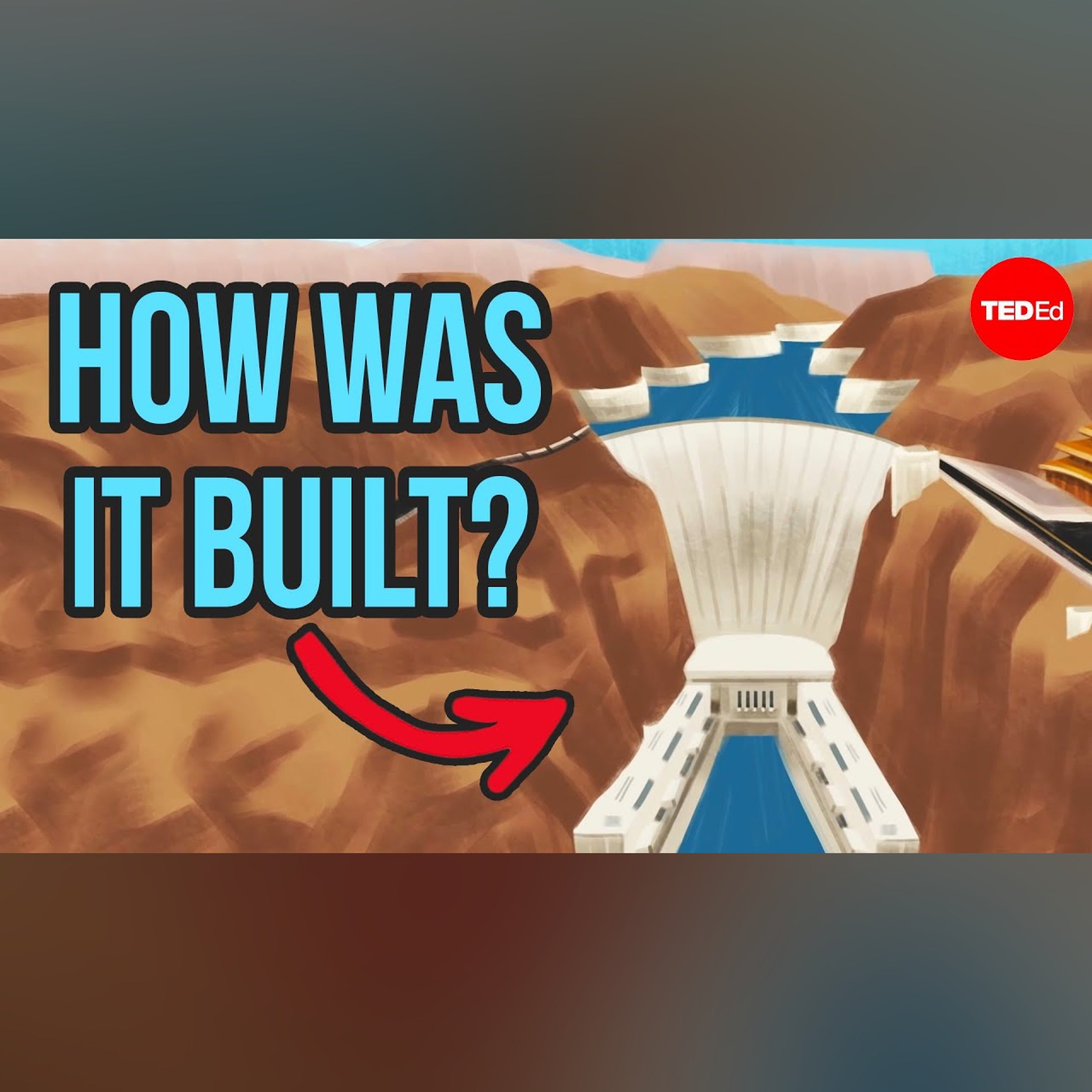
Dig into the engineering of the Hoover Dam, a concrete arch-gravity dam on the Colorado River that supplies water to the US southwest. Uploaded 23-12-21 -- In the early 20th century, the US had expanded from coast to coast, but many cities in the southwest still lacked reliable water sources. The Colorado River's erratic flow and frequent floods made it unreliable for agriculture, and the region’s growing cities needed more energy. So the government decided to build a massive hydroelectric dam. Alex Gendler details the creation of the Hoover Dam. Lesson by Alex Gendler, directed by Jovan Rakic, Artrake Studio. Support Our Non-Profit Mission ---------------------------------------------- Support us on Patreon: http://bit.ly/TEDEdPatreon Check out our merch: http://bit.ly/TEDEDShop ---------------------------------------------- Connect With Us ---------------------------------------------- Sign up for our newsletter: http://bit.ly/TEDEdNewsletter Find us on Twitter: http://bit.ly/TEDEdTw
Travelling made me rich, I’ll teach you how. Episodes created by entrepreneur and masculinity ace Jack Hopkins for his youtube channel, this podcast is dedicated to helping men rediscover their inner strength and confidence in a society that often promotes feminine values over masculine ones.Follow the podcast for valuable insights, inspiring stories, and practical advice on how to embrace your masculinity, build your confidence, and achieve your goals. Whether you're looking to improve your relationships, advance your entrepreneurial career, or simply feel more confident and capable, Jack has valuable insights that can help you achieve your goals.So, if you're ready to reclaim your masculinity and awaken the beast that lives inside you, follow the podcast & turn on notis Follow Jack Hopkins:Insta: @jackhopfitnessYT: @JackhopkinsCEODisclaimer: All content rights belong to @JackhopkinsCEO on YouTube. This is a fan page. ------------------------- ----- Keywords: self discipline men, figh
Project Synapse: Markets in Freefall, Fragile Infrastructure, and AI's Perfect Storm The hosts banter through the show's intro before focusing on a sense that "things are out of control," citing a WallStreetBets suicide-hotline post amid a market crash and discussing cascading system failures involving Microsoft, the FAA, and a reported NSA internal communications outage. They argue politicians and leadership lack technical competence and clear messaging, increasing panic, while emphasizing that many problems stem from aging, underfunded infrastructure and complex, brittle software (PHP, NGINX, Java), not proven AI attacks—more a "perfect storm" of crises. They debate whether AI should help fix complexity, stressing critical thinking, accountability, and using multiple AIs to verify each other. In a lightning round they cover Anthropic's IPO performance, mixed reactions and token limits with ChatGPT 6.2 (favoring "Sol" over "Astra"), Google's cheaper Neon model and confusing UX, Loblaw
What changes when you stop automating individual tasks and start building systems that handle an entire workflow? Aytekin Tank and Demetri Panici discuss AI factories: connected agents, human review, measurement, and the work of improving the system itself. Aytekin walks through the automation flywheel and software-factory examples from Jotform and other companies. Demetri shares his own tutorial-training workflow, agent stress-test requests, and personal autonomous setups. The conversation also covers how to start small and keep people involved as these systems develop. AI Agents Podcast | Episode 146 Hosts: Aytekin Tank and Demetri Panici 00:00 Design a factory that fixes the bug 00:14 AI Agents Podcast intro 00:38 Welcome: AI factories 01:47 What is an AI factory? 03:40 Full automation, human review and measurement 13:29 What changes for human work? 21:55 The automation flywheel 27:17 Jotform’s translation and widget factories 31:43 Software factory examples 33:37 Uber’s software fa
Can a personal AI assistant actually take work off your plate? Aytekin Tank and Demetri Panici try Dots and Muse in their everyday workflows. Aytekin demonstrates Dots, his assistant Miso, and computer use for reviewing a website. Demetri shows Muse handling email triage, messages, planning and subscription cleanup with live artifacts. They discuss proactive suggestions, connectors, personality and the tradeoffs of adding another assistant alongside the AI tools they already use. Which personal AI assistant would you use, and what would you ask it to handle first? CHAPTERS 00:00 Why Aytekin wanted another AI agent 00:14 AI Agents Podcast intro 00:38 Personal AI assistants 04:34 How Dots works proactively 12:53 Aytekin demonstrates Dots and Miso 23:01 Demetri demonstrates Muse 25:54 Email triage and live artifacts 27:32 Managing messages with Muse 32:59 Finding unused subscriptions 37:56 Which personal assistant would we keep?
Can AI make it practical to create a video for every product feature? Aytekin Tank and Demetri Panici explore motion graphics and training videos made with Claude, with examples from their own workflows.Watch a Jotform workflow video demonstration and calendar and training examples, then follow the discussion of reusable skills, brand consistency, product launches and help videos. The episode closes with a conversation about human creativity and where AI video tools could go next.Chapters00:00 Opening idea00:25 AI Agents Podcast intro00:49 Welcome: Claude Motion01:39 Jotform workflow video demonstration05:05 Calendar and training video examples07:16 Motion graphics for training11:16 Branding and reusable skills13:18 Design tools and brand consistency16:33 App launches and help videos19:45 Motion graphics across social media25:11 Human conversations and AI creativity29:10 Where video tools go next
People should always be told when they are communicating with a machine.
Share your view, then see how readers voted. No sign-in required. This poll is shared across stories.
Do you agree or disagree?
Common Quandary
A Common Quandary to discuss
Another conversation to explore, separate from this news story.
Software says a student cheated with AI. Is that enough to fail the paper?
A teacher suspects several essays were written with AI. Detection software marks one student's work as highly likely to be generated, but the software is known to make mistakes and the student denies using it.
How should responsibility be assigned when evidence is powerful but unreliable?