Muse and Dots: Putting Personal AI Assistants to Work | EP 145
44 min
Listen through the publisher, then discuss the episode here or arrange an in-person Roundtable. Your city determines where to meet.
Roundtables are designed for groups of four, with a shared subject and room for everyone to speak. Come for discussion, with no dating expectation.
Can a personal AI assistant actually take work off your plate? Aytekin Tank and Demetri Panici try Dots and Muse in their everyday workflows. Aytekin demonstrates Dots, his assistant Miso, and computer use for reviewing a website. Demetri shows Muse handling email triage, messages, planning and subscription cleanup with live artifacts. They discuss proactive suggestions, connectors, personality and the tradeoffs of adding another assistant alongside the AI tools they already use. Which personal AI assistant would you use, and what would you ask it to handle first? CHAPTERS 00:00 Why Aytekin wanted another AI agent 00:14 AI Agents Podcast intro 00:38 Personal AI assistants 04:34 How Dots works proactively 12:53 Aytekin demonstrates Dots and Miso 23:01 Demetri demonstrates Muse 25:54 Email triage and live artifacts 27:32 Managing messages with Muse 32:59 Finding unused subscriptions 37:56 Which personal assistant would we keep?
Episode information is provided by the publisher. Listening takes place on the publisher’s service.
A.I. for Finding a New Job: Navigating the Search Without It Taking Over Your Life, a practical, beginner-friendly look at how artificial intelligence can help you navigate the search without it taking over your life. Finding a New Job? Press play on Episode 428 of A.I. for Beginners and learn exactly how artificial intelligence, especially ChatGPT, alongside LinkedIn and Teal, can help you navigate the search without it taking over your life. WHAT YOU WILL LEARN IN THIS EPISODE - Why finding a new job is so hard to handle alone, and what is actually going on underneath it - A specific way to use LinkedIn to work through it, step by step - An example prompt you can copy word for word: "Here is a job description, help me tailor my CV to match what they're actually asking for" - A second practical technique, with another ready-to-use prompt: "Help me prepare clear, confident answers for the questions I'm most nervous about in an interview" WHO THIS EPISODE IS FOR - Anyone currently worki
At a concert, most listeners hear the melody. A trained singer hears the breath control that carries a difficult phrase. At a football match, the crowd follows the ball while a coach notices the defender who quietly closes off an attack. Knowing more changes who seems extraordinary. Audiences have traditionally borrowed that knowledge from commentators, critics, and friends, whose explanations help determine which achievements receive applause and which pass unnoticed. AI could make that guidance a routine part of watching almost anything. Tools already track players’ movements, analyze musical pitch and timing, and explain technical processes. As those abilities become integrated into broadcasts and personal assistants, viewers could ask what made a particular passage difficult or why a player chose one route over another. Instead of receiving occasional commentary, someone could explore an entire performance with detailed explanations tailored to their questions. The consequential sh
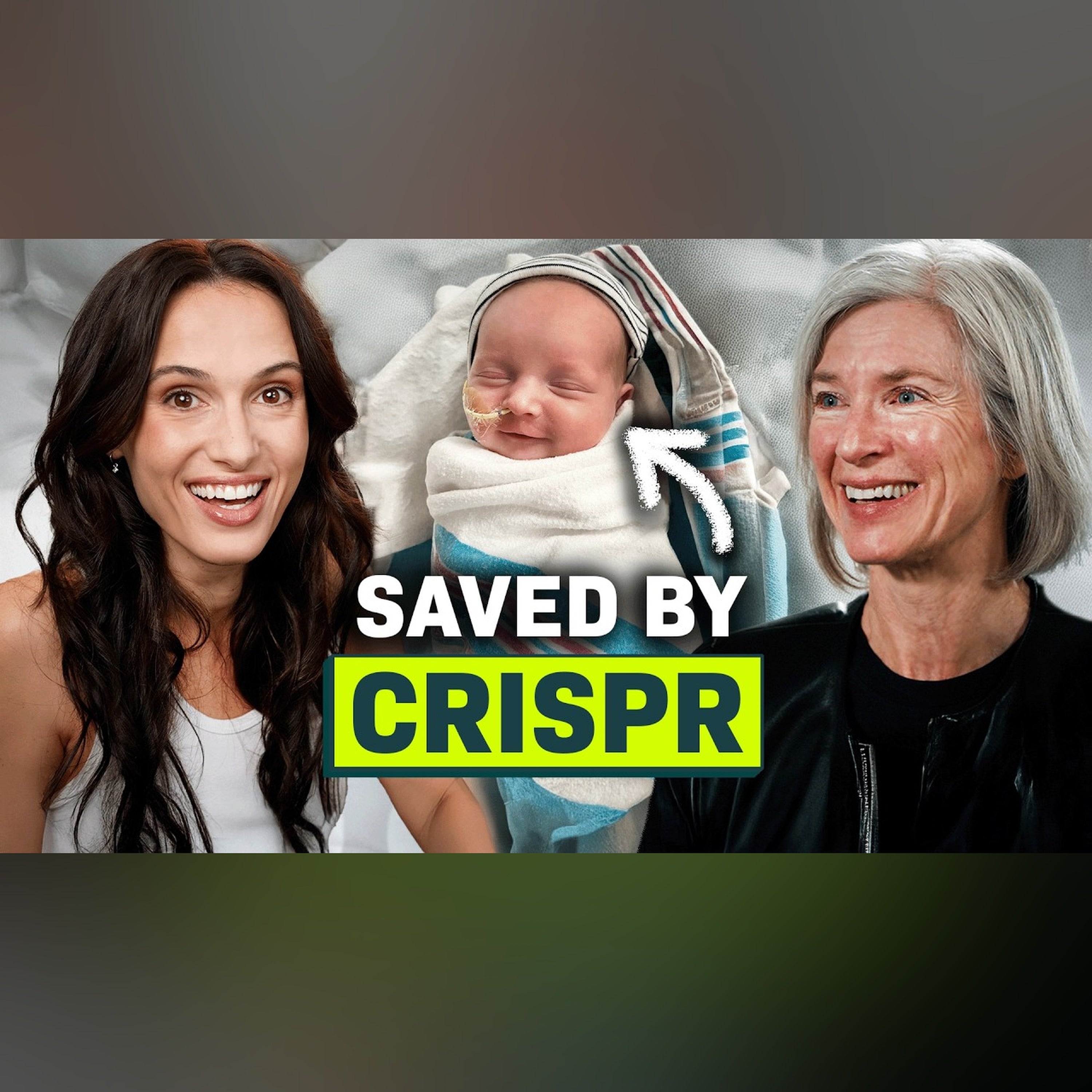
Human DNA editing is finally here. Check out the new WHOOP here! https://join.whoop.com/cleo There is a microscopic technology that now gives us the power to edit our own genes while we’re alive. To cure certain diseases, possibly prevent others, or boost what our bodies can do… or maybe, one day give our kids abilities no one has ever had before… effectively putting evolution into our hands. This is not some sci-fi future! We’re already using this technology in real medical treatments in plants to grow new crops and in animals to create new species! Just yesterday, news broke that a baby’s life was saved using personalized gene editing that fixed one tiny error in its DNA. This is truly “huge if true.” Deciding how we use this new superpower may be the biggest challenge we have ever faced - and the biggest opportunity to reduce human suffering. This tool is called CRISPR. Dr. Jennifer Doudna won the Nobel Prize for discovering it. So, in this third episode of Huge Conversations, Dr. D
Project Synapse: Markets in Freefall, Fragile Infrastructure, and AI's Perfect Storm The hosts banter through the show's intro before focusing on a sense that "things are out of control," citing a WallStreetBets suicide-hotline post amid a market crash and discussing cascading system failures involving Microsoft, the FAA, and a reported NSA internal communications outage. They argue politicians and leadership lack technical competence and clear messaging, increasing panic, while emphasizing that many problems stem from aging, underfunded infrastructure and complex, brittle software (PHP, NGINX, Java), not proven AI attacks—more a "perfect storm" of crises. They debate whether AI should help fix complexity, stressing critical thinking, accountability, and using multiple AIs to verify each other. In a lightning round they cover Anthropic's IPO performance, mixed reactions and token limits with ChatGPT 6.2 (favoring "Sol" over "Astra"), Google's cheaper Neon model and confusing UX, Loblaw
What if your AI agent could find the people you should know before you even start looking? Cosign is building a professional network around reputation and trusted recommendations, and now agents can use that network too. MTS host Sophia Dew sits down with a16z’s David Booth and Cosign’s Bella Nazzari to discuss what they’ve learned since launching Cosign, why traditional profiles often miss the operators doing the most important work, and how the Cosign Awards are surfacing talent through the people willing to vouch for them. They also explore an emerging behavior: people connecting their agents to Cosign to continuously find relevant people, lists, and opportunities, and what professional networking could look like when both humans and their agents participate. Resources: Follow David Booth: https://x.com/davidbooth Follow Bella Nazzari: https://x.com/nazzari Follow Sophia Dew: https://x.com/sophiadew Learn more about Cosign:https://cosign.co/ Connect your agent to Cosign:https://cosi
Uploaded 14-12-17 View full lesson: https://ed.ted.com/lessons/how-your-digestive-system-works-emma-bryce Across the planet, humans eat on average between 1 and 2.7 kilograms of food a day, and every last scrap makes its way through the digestive system. Comprised of ten organs covering nine meters, this is one of the most complicated systems in the body. Emma Bryce explains how the different parts of the digestive system work to transform your food into the nutrients and energy that keep you alive. Lesson by Emma Bryce, animation by Augenblick Studios. Thank you so much to our patrons for your support! Without you this video would not be possible! Narat Suchartsunthorn, Joy Love Om, Gi Nam Lee, Shawn Quichocho, Simone Kidner, Anika Westburg, Dale Dualan, Barun Padhy, John Ess, Brandy Jones, Devin Harris, Tony Trapuzzano, Stephen Michael Alvarez, Tom Lee, Juliana , Jason Weinstein, Hoang Ton, Kris Siverhus, Alexander Walls, Annamaria Szilagyi, Morgan Williams, Abhijit Kiran Valluri, Ma
What changes when you stop automating individual tasks and start building systems that handle an entire workflow? Aytekin Tank and Demetri Panici discuss AI factories: connected agents, human review, measurement, and the work of improving the system itself. Aytekin walks through the automation flywheel and software-factory examples from Jotform and other companies. Demetri shares his own tutorial-training workflow, agent stress-test requests, and personal autonomous setups. The conversation also covers how to start small and keep people involved as these systems develop. AI Agents Podcast | Episode 146 Hosts: Aytekin Tank and Demetri Panici 00:00 Design a factory that fixes the bug 00:14 AI Agents Podcast intro 00:38 Welcome: AI factories 01:47 What is an AI factory? 03:40 Full automation, human review and measurement 13:29 What changes for human work? 21:55 The automation flywheel 27:17 Jotform’s translation and widget factories 31:43 Software factory examples 33:37 Uber’s software fa
Can AI make it practical to create a video for every product feature? Aytekin Tank and Demetri Panici explore motion graphics and training videos made with Claude, with examples from their own workflows.Watch a Jotform workflow video demonstration and calendar and training examples, then follow the discussion of reusable skills, brand consistency, product launches and help videos. The episode closes with a conversation about human creativity and where AI video tools could go next.Chapters00:00 Opening idea00:25 AI Agents Podcast intro00:49 Welcome: Claude Motion01:39 Jotform workflow video demonstration05:05 Calendar and training video examples07:16 Motion graphics for training11:16 Branding and reusable skills13:18 Design tools and brand consistency16:33 App launches and help videos19:45 Motion graphics across social media25:11 Human conversations and AI creativity29:10 Where video tools go next
What would you build if an app only needed to work for you? Aytekin Tank and Demetri Panici share how they use AI to build personal mobile apps and rethink the software they use every day. The conversation includes native iOS development with Codex, a podcast app built with Jotform, and a personal teleprompter demonstration. They also discuss where custom apps fit into content workflows and internal tools. Chapters 00:00 Opening idea 00:22 AI Agents Podcast intro 00:46 Welcome: building mobile apps with AI 01:12 Software for one person 04:04 Native apps, iOS and Codex 09:32 Demonstrating personal apps 15:59 Building a podcast app with Jotform 24:50 CueStream teleprompter demonstration 29:00 AI content workflows 32:37 Replacing internal tools
Security claims about important digital products should face independent testing.
Share your view, then see how readers voted. No sign-in required. This poll is shared across stories.
Do you agree or disagree?
Common Quandary
A Common Quandary to discuss
Another conversation to explore, separate from this news story.
A patient records every doctor visit for their followers. Can the doctor refuse to be filmed?
A patient with a large social-media following livestreams their health journey and wants to record every appointment. They say the videos help others and keep doctors accountable. Their physician finds the camera distracting and worries that casual remarks will be edited out of context.
Whose comfort should control a conversation about one person's body and another person's work?