Ep. 408 Do Virtual Collars ACTUALLY Make Sense for Livestock??
104 min
Listen through the publisher, then discuss the episode here or arrange an in-person Roundtable. Your city determines where to meet.
Roundtables are designed for groups of four, with a shared subject and room for everyone to speak. Come for discussion, with no dating expectation.
Matt Vermeersch of Root and Raise Land and Livestock joins us to talk virtual fencing, Highland cattle, and grazing sheep under solar panels. We dig into whether Nofence collars pay off, why Matt’s beef tested at a 1.14 to 1 omega ratio, and what Iowa’s culture really looks like today. Be sure to stay tuned for our new outro at the end of the episode- HUGE thanks to musical talents of Kenny Leiser, Augie Dougherty and the always generous Doug Duren. Follow Kenny: @madisonviolin Follow Augie: @augiedougherty Follow Doug: @dougduren iowacovercrop.com (http://iowacovercrop.com/) (for all your cover crop mixes, waterway mixes, forage mixes, small grains, and more)
Episode information is provided by the publisher. Listening takes place on the publisher’s service.
I Ate 1000 Sardines in a Month, Video: https://youtu.be/_Th54GWd8WY How Sardines Supercharged my Metabolism, Letter: https://staycuriousmetabolism.substack.com/p/the-weird-anti-insulin-hormone-that?r=40ekz2 Omega-6/3 Ratio Can Be Misleading, Letter: https://staycuriousmetabolism.substack.com/p/how-we-got-omega-fat-wrong-this-will?r=40ekz2 Best Omega-3 for the Brain, Letter: https://staycuriousmetabolism.substack.com/p/why-omega-3-supplements-dont-work?r=40ekz2 If you want to get your Omega-3 via Omega Quant, click on this link: https://omegaquant.com/ref/864 Fatty Acid Research Institute: https://www.faresinst.org (https://www.faresinst.org/) Description: In this conversation, I sit down with Professor William Harris, one of the world’s leading experts on omega-3 and omega-6 fatty acids, to cut through confusion around fish oil, seed oils, cardiovascular health, and brain health. We break down what omega-3 and omega-6 fats actually are, why their chemistry matters, and how they’re conv
Viewers like you help make PBS (Thank you ) . Support your local PBS Member Station here: https://to.pbs.org/DonateSPACE Uploaded 25-04-18 It’s been conjectured that the center of the Milky Way is swarming with tens of thousands of black holes. And now we’ve actually seen them. You can further support us on Patreon at https://www.patreon.com/pbsspacetime Get your own Space Time t-shirt at http://bit.ly/1QlzoBi Tweet at us! @pbsspacetime Facebook: facebook.com/pbsspacetime Email us! pbsspacetime [at] gmail [dot] com Comment on Reddit: http://www.reddit.com/r/pbsspacetime Help translate our videos! Previous Episode: Using Stars to See Gravitational Waves This episode of Space Time Journal Club looks at the paper: A density cusp of quiescent X-ray binaries in the central parsec of the Galaxy by Hailey, Mori, Bauer, Berkowitz, Hong and Hord (2018) The core of our galaxy is a wild place. The stars are so densely packed that the night sky would be 500 times brighter. A supermassive black ho
AI is here. Now what? Everyone’s talking about artificial intelligence and machine learning. There are lots of names thrown around - OpenAI’s ChatGPT and DALLE-2, Google’s Bard, Meta’s LLaMa 2, Midjourney, AlphaFold… Right now, we’re in this weird moment where lots of smart people agree we’re on the cusp of a truly world-changing technology. But some seem to be saying it's going to lead to human extinction while others are saying it’s “more profound than fire.” But it all feels so VAGUE. I want to know: How specifically would AI kill me? Or totally transform my life for the better? In this video, that’s what I’m going to try to learn. We dive into what the most extreme bad and good AI futures actually look like, so that you and I can get ready. And more importantly, so we can make sure that we get our real future RIGHT. Chapters: 00:00 Why is AI so confusing? 1:13 What is AI? 2:37 Why is everyone talking about AI now? 5:12 Why is AI dangerous? 6:22 How would AI kill me? 8:08 Should we
Are we in an AI stock bubble, or are investors betting on a genuinely bigger economy? Justin Wolfers examines AI stock valuations with Stacey Vanek Smith, separating what the technology could do for the economy from what investors might actually earn. A deliberately hypothetical valuation exercise shows why a trillion-dollar company isn't automatically absurd—but a breakthrough for society doesn't guarantee profits for shareholders. Competition can give you powerful tools at low prices while squeezing the companies selling them. The Thanksgiving turkey problem illustrates why a long run of good news can hide rare, severe risks. Justin connects that analogy to fat tails and the peso problem, then explains why spotting a bubble and successfully betting against it are different challenges. He also unpacks what the CAPE ratio can—and can't—tell you about whether stocks are overpriced. The stakes are your savings, not just Wall Street's scoreboard: Justin discusses an S&P 500 decline of 7.5
What actually works when it comes to detecting lies, and why are so many popular ideas about reading people and nonverbal behavior at odds with the scientific research? I talk with Aldert Vrij, one of the world's leading deception-detection researchers, who has spent almost four decades studying these topics. We discuss why what people say is far more revealing than their body language; why the perceived “sexiness” of reading nonverbal behavior has contributed to widespread myths and misconceptions; whether vocal behaviors like pitch, volume, and hesitation contain meaningful clues; and whether there's value in analyzing minor word choices and turns of phrase, as is done in so-called “statement analysis.” We discuss Paul Ekman's legacy as a source of faulty ideas about deception, micro-expression-based deception detection training, and the strategies that popular “body language experts” use to appear scientifically credible while simultaneously promoting ideas that conflict with the sc
After her father died suddenly, she inherited more than the family farm. She inherited the responsibility of keeping it running without the man who had spent nearly his entire life there. Then the longtime farmhands began quietly sharing strange experiences. One heard her father whistling outside the machine shed. Another heard his familiar footsteps in an empty barn. Someone else saw a man wearing his old brown work jacket standing beside a gate—only to look again and find no one there. She told them grief and memory could make familiar sounds feel more meaningful than they were. Then one evening, while working alone after everyone else had gone home, she heard three notes outside the barn. It was a whistle she had known since childhood. And nobody else on the farm would have understood what it meant. #GhostStories #FamilyGhost #SpiritVisit #HauntedFarm #Afterlife #SignsFromBeyond #Paranormal #FatherAndDaughter #Unexplained #Signs Love real ghost stories? Want even more? Want even mor
Kent takes the host chair for Coffee Time Wednesday. Pierce tells the story of his big Iowa bow buck (and the headlamp blunder before it), we settle the KwikTrip breakfast pizza debate, and Kent digs into a five-state study that found rat poison in up to 100% of fishers tested. iowacovercrop.com (http://iowacovercrop.com/) (for all your cover crop mixes, waterway mixes, forage mixes, small grains, and more)
Kent and Nicolas head to Doug Duren’s Driftless farm after a burn school with the Wisconsin Prescribed Fire Council. Doug explains why fire needs people and how Sharing the Land became a nonprofit, then takes a lightning round on Leopold, the 765 kV power line, CWD, and the land ethic.
Dr. Jim Butler of the Kansas Geological Survey joins us to talk about the Ogallala Aquifer. How fast is it draining, why rain takes years to reach it, and how one group of Kansas irrigators cut water use 25% without losing money. Plus water rights, proposed pipelines, and data centers. iowacovercrop.com (http://iowacovercrop.com/) (for all your cover crop mixes, waterway mixes, forage mixes, small grains, and more) MckayInsAgency.com (for all your financial planning and insurance needs)
Creators should be compensated when their work is used commercially to train AI systems.
Share your view, then see how readers voted. No sign-in required. This poll is shared across stories.
Do you agree or disagree?
Common Quandary
A Common Quandary to discuss
Another conversation to explore, separate from this news story.
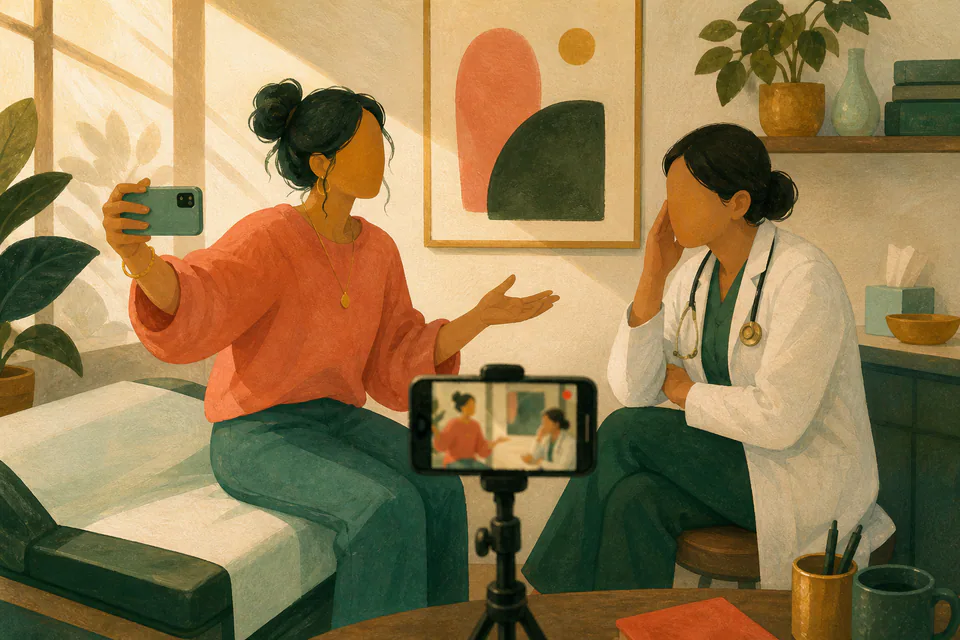
A patient records every doctor visit for their followers. Can the doctor refuse to be filmed?
A patient with a large social-media following livestreams their health journey and wants to record every appointment. They say the videos help others and keep doctors accountable. Their physician finds the camera distracting and worries that casual remarks will be edited out of context.
Whose comfort should control a conversation about one person's body and another person's work?