Ep. 410 Ground Water Scientist Explains the Draining of the Ogallala Aquifer and the Colorado River
79 min
Listen through the publisher, then discuss the episode here or arrange an in-person Roundtable. Your city determines where to meet.
Roundtables are designed for groups of four, with a shared subject and room for everyone to speak. Come for discussion, with no dating expectation.
Dr. Jim Butler of the Kansas Geological Survey joins us to talk about the Ogallala Aquifer. How fast is it draining, why rain takes years to reach it, and how one group of Kansas irrigators cut water use 25% without losing money. Plus water rights, proposed pipelines, and data centers. iowacovercrop.com (http://iowacovercrop.com/) (for all your cover crop mixes, waterway mixes, forage mixes, small grains, and more) MckayInsAgency.com (for all your financial planning and insurance needs)
Episode information is provided by the publisher. Listening takes place on the publisher’s service.
Dr. Al Grauer hosts. Dr. Albert D. Grauer ( @Nmcanopus (https://twitter.com/Nmcanopus) ) is an observational asteroid hunting astronomer. Dr. Grauer retired from the University of Arkansas at Little Rock in 2006. travelersinthenight.org (http://travelersinthenight.org/) From June & July, 2026. Today's 2 topics: - My Catalina Sky Survey teammate Josh Hogan has discovered a 2 football field diameter asteroid that was placed on NASA's Sentry list because it has a tiny minuscule but non-zero chance of impacting our home planet. With this motivation my team the Catalina Sky Survey, the Pan STARRS group in Hawaii, the ATLAS group with telescopes Hawaii, Chile, and South Africa , the Vera C. Rubin telescope in Chile, will be soon joined NASA's NEO Surveyor and groups world wide in a planet wide defense network. - The visually stunning Lunar Crater Pierazzo, named for the late Planetary Scientist Elizabeth "Betty" Pierazzo was observed by the Artemis II Crew as they passed over the Moon's far
Microplastics in my Heart Letter: https://staycuriousmetabolism.substack.com/p/microplastics-in-my-heart-its-worse?r=40ekz2 Stanford Fiber RCT, Letter https://staycuriousmetabolism.substack.com/p/fiber-is-good-for-you-is-lazy-science?r=40ekz2 Microbiome Reset, Letter https://staycuriousmetabolism.substack.com/p/how-im-rebuilding-my-microbiomeafter?r=40ekz2 Description: Microplastics are everywhere—in our food, water, and inside our bodies—and avoiding them completely is nearly impossible. In this conversation, I sit down with Dr. Matthew Dunn PhD, a molecular biologist working at the intersection of biotechnology and human health, to unpack what the science actually says about microplastics and how they may be linked to cardiovascular disease, reproductive health issues, and gut inflammation We break down the landmark human data, the animal and cellular studies that help explain possible mechanisms, and dissect the state of the data. We also explore a potential inside-out solution: usi
Eleven billion years ago two quasars blazed side by side, and this week astronomers weighed the invisible gas around them by the shadow it casts on the cosmic microwave background. There is 3.6 times more heat in it than gravity can explain. Plus a triple star 28 light-years away that 'should not exist', a pulsar found in ten hours with an algorithm borrowed from cryptography, The Week That Was, and the weekend sky from both hemispheres. In this episode Lead: Hot bubble around the dual quasar J1549+1245 at z = 2.37, measured with ALMA via the thermal Sunyaev–Zel'dovich effect (Hall, Zakamska et al., Nature Astronomy, 18 Nov 2026). Fresh item: Welopōʻai, the closest known triple with two white dwarfs, 28 light-years away (Artigau et al., A&A, 19 Nov 2026). Week That Was: Starship Flight 15 ship catch, CSIRO GenDIReCT and M87, SN 2026ahvu, failed supernovae in gravitational waves (E230); Voyager 1 one light-day, Beta Pictoris ices, heavy-oxygen water, Roman alignment (E231); Terra ends,
🇺🇸 TWO NAVY SEALS. TWO INCREDIBLE JOURNEYS. ONE POWERFUL MISSION TO TRANSFORM YOUR FINANCIAL FUTURE! Michael Jaco welcomes fellow former Navy SEAL Larry Yatch, founder of TruPath Mastery, for an eye-opening conversation about success, leadership, financial trauma, and the hidden subconscious patterns that can keep even the most accomplished people from reaching their full potential. With 24 years as a Navy SEAL and 11 years as a CIA security operative, Michael shares the powerful lessons of mental discipline, intuition, and personal transformation that shaped his extraordinary journey. Larry brings 10 years of Navy SEAL service and an impressive career advising Fortune 50 executives. But despite achieving tremendous professional success, he discovered that the survival patterns that once made him successful were also keeping him trapped in his own business. THE BIG REVELATION: YOUR MONEY HABITS MAY HAVE VERY LITTLE TO DO WITH MONEY! From childhood programming and fear of scarcity to
Brain chips don't read your mind. They do something weirder... This is Neuralink’s Next Gen R1 surgical robot. It’s one of several new ways scientists are now trying to combine the human brain with a computer, which sounds like science fiction because… it is! But not anymore. And you need to know about this right now, because human clinical trials are happening and this tech is moving fast. Some people want to use it to make you superhuman. But I think most people aren’t seeing what’s really huge if true here. This story isn’t about how to make us more like machines Instead, this might be one of the most cutting edge ways to keep us human. Visit http://mercury.com (http://mercury.com/) to join over 300 thousand entrepreneurs who love Mercury. Mercury is a financial technology company, not an FDIC-insured bank. Banking services provided through Choice Financial Group and Column N.A., Members FDIC. Chapters: 00:00 What if you put a chip in your brain? 01:02 What does a human brain feel l
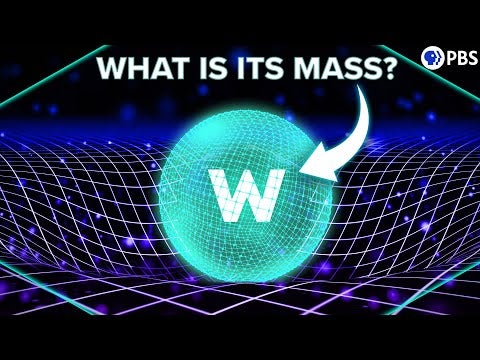
Take the Space Time Fan Survey Here: https://forms.gle/wS4bj9o3rvyhfKzUA Uploaded 27-04-22 PBS Member Stations rely on viewers like you. To support your local station, go to:http://to.pbs.org/DonateSPACE Sign Up on Patreon to get access to the Space Time Discord! Fermilab physicists really care about the mass of the W boson. They spent nearly a decade recording collisions in the Tevatron collider and another decade analysing the data. This culminated in the April 7 announcement that this obscure particle’s mass seems to be heavier than expected. So why do we care? Because understanding why this particle even has mass was one of the most important breakthroughs in our understanding of the subatomic world. And because measuring its precise mass either doubles down on our current understanding or reveals a path to an even deeper knowledge. The FermiLab discrepancy is a tantalizing hint of the latter. Need Catch Up On Your Fundamental Forces? Check out the Space Time Merch Store Hosted by
Kent takes the host chair for Coffee Time Wednesday. Pierce tells the story of his big Iowa bow buck (and the headlamp blunder before it), we settle the KwikTrip breakfast pizza debate, and Kent digs into a five-state study that found rat poison in up to 100% of fishers tested. iowacovercrop.com (http://iowacovercrop.com/) (for all your cover crop mixes, waterway mixes, forage mixes, small grains, and more)
Kent and Nicolas head to Doug Duren’s Driftless farm after a burn school with the Wisconsin Prescribed Fire Council. Doug explains why fire needs people and how Sharing the Land became a nonprofit, then takes a lightning round on Leopold, the 765 kV power line, CWD, and the land ethic.
Kent is in a tree for the rut, so we start with deer biology and why poaching is the one crime hunters never forgive. Then we dig into why new tractors cost up to $2,000 per horsepower, and how Iowa’s collapsed fur market left raccoons running unchecked across the landscape. BirdHunterSupply.com (for all your bird hunting supplies and dog hunting supplies)
Telling another person's difficult story carries responsibilities beyond getting the facts right.
Share your view, then see how readers voted. No sign-in required. This poll is shared across stories.
Do you agree or disagree?
Common Quandary
A Common Quandary to discuss
Another conversation to explore, separate from this news story.
Your friend asks for an honest review after every date. Do their dates deserve privacy?
A close friend sends detailed post-date reports and expects your advice about every message, kiss, and awkward silence. One recent date is someone you know professionally, who would be embarrassed to learn how much you have heard.
Where does friendship's need for advice become gossip about an unsuspecting person?