Listen through the publisher, then discuss the episode here or arrange an in-person Roundtable. Your city determines where to meet.
Roundtables are designed for groups of four, with a shared subject and room for everyone to speak. Come for discussion, with no dating expectation.
Electronic mail has evolved from a localized experimental file-transfer utility into the foundational communication backbone of the modern digital world, with billions of users exchanging hundreds of billions of messages every day. The technological framework for networked email was established in late 1971 by computer engineer Ray Tomlinson, who integrated messaging capabilities across the ARPANET system and popularized the iconic @ symbol to designate specific users on distinct computer hosts. Over the subsequent decades, digital communication expanded rapidly across academic, governmental, and commercial sectors, ultimately becoming a mandatory requirement for online authentication, digital receipts, and global commerce. Milestones in email history extend far beyond terrestrial computer networks, including the historic transmission of the first space-based electronic message by astronauts aboard the Space Shuttle Atlantis in August 1991 using AppleLink software. As digital correspondence grew, the phenomenon of unsolicited bulk messaging, commonly called "spam" after a famous Monty Python sketch involving canned pork, necessitated advanced cybersecurity measures, transitioning from early keyword filters to sophisticated Bayesian probability algorithms. Today, modern email infrastructure processes millions of messages per second while relying on automated spam detection systems to intercept the vast majority of unwanted traffic before it reaches user inboxes. Want to learn more? Fun Facts Daily is an Airwave Media Podcast.
Episode information is provided by the publisher. Listening takes place on the publisher’s service.
Master the skills that change lives — enroll in your free human behavior course today: https://nci.university/learn Uploaded 09-01-26 You were never reacting to chaos — you were responding to structure. Outcomes don’t appear suddenly; they’re assembled long before you notice them. Understanding how pressure is built changes how the world feels immediately. All influence follows patterns once you know where to look. Reality doesn’t break — it gets reshaped in layers. Every system depends on predictable human responses. Given the right conditions, behavior becomes almost automatic. Once you see the architecture, panic loses its leverage. Detection beats reaction — every time. Please note that the content provided in this broadcast is for informational and educational purposes only and should not be construed as legal, medical, financial, or professional advice. No material in this communication establishes any form of professional relationship that is privileged or confidential. The insi
Viewers like you help make PBS (Thank you ) . Support your local PBS Member Station here: https://to.pbs.org/DonateSPACE Uploaded 22-02-17 Fomalhaut is a massive young star surrounded by a ring of dust debris that can tell us a great deal about the formation of our own solar system. Get your first two months of CuriosityStream free by going to http://curiositystream.com/spacetime and using the promo code “spacetime”. You can further support us on Patreon at https://www.patreon.com/pbsspacetime Get your own Space Time tshirt at http://bit.ly/1QlzoBi Tweet at us! @pbsspacetime Facebook: facebook.com/pbsspacetime Email us! pbsspacetime [at] gmail [dot] com Comment on Reddit: http://www.reddit.com/r/pbsspacetime Help translate our videos! https://www.youtube.com/timedtext_cs_panel?tab=2&c=UC7_gcs09iThXybpVgjHZ_7g (https://www.youtube.com/timedtext_cs_panel?c=UC7_gcs09iThXybpVgjHZ_7g&tab=2) Fomalhaut is an awe-inspiring star that could unlock many mysteries concerning how our own solar sys
In today's brief: Lake Erie, 1957: a newly released Air Force report says two boys saw a humming, bell-shaped craft near the Enrico Fermi Atomic Plant. Skinwalker Ranch: owner Brandon Fugal calls the new files landmark and recalls a daylight saucer over the mesa. Warship footage: a 20-second 2020 infrared clip shows a light crossing a US Navy ship in the Middle East, with no Pentagon assessment. Martha's Vineyard, 1957: a spiked, nickel-coloured object that the Air Force put down to a radar-reflector balloon. Loch Ness: reported sightings jump to 15 this year, up from six in 2025. The Book of Miracles: a 16th-century manuscript of comets, blood rain and multiple suns heads to auction at Christie's. Quick hits: a 1952 file blames the saucer wave on temperature inversions; more Pentagon UFO files are on the way. Every story and source: https://believepod.com/ufo-paranormal-news-22-november-2026/ New episodes every morning. Keep your eyes on the sky. Sources: FOX 2 Detroit: https://www.fo
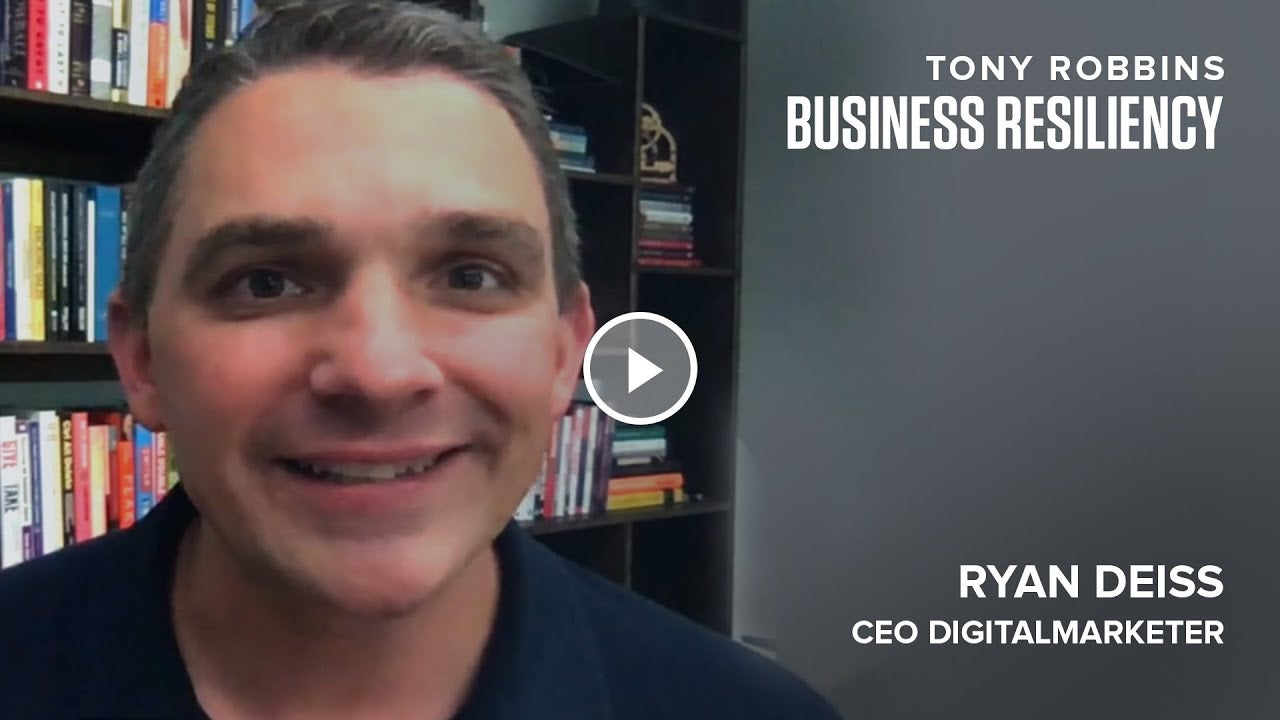
What will you do when the going gets tough? How will you react to economic winter, changes in the market and other events beyond your control? Will you shrink back in fear and adopt an attitude of scarcity – or will you power forward and learn how to take advantage of the moment? Uploaded 28-04-20 In this video, Ryan Deiss, CEO of Digital Marketer, best-selling author and expert investor, shares what you can do to not only continue to grow your business, but to grow as a human being as well. There are ways to make the most of hard times as a business leader, marketer, parent and friend. It’s all about turning your obstacles into opportunities. How can you do that? You must shift your focus. Instead of focusing on the negative, find the possibilities. You can head to https://www.tonyrobbins.com/career-business/where-focus-goes-energy-flows to learn how to get focused in this new environment. Tough economic times put most people in a mindset of scarcity and fear. They pull back. Business
In this motivational message, Jim Rohn breaks down the fundamental principles that separate those who merely wish for a better life from those who actively create one. Learn how to develop the habits, mindset, and character needed to turn your goals into reality. Uploaded 28-05-26 A timeless message from Jim Rohn® This timeless message will challenge your thinking, reshape your habits, and show you how real change begins from within. _____________ Speaker: Jim Rohn Jim Rohn (1930–2009) was a world-renowned motivational speaker, author, and personal development expert. He inspired millions with his lessons on discipline, mindset, and taking consistent action to achieve success. Known as the 'mentor to the mentors,' Rohn directly influenced some of today's most popular speakers such as Tony Robbins and Brian Tracy. _____________ SUCCESS® presents: Jim Rohn®. To discover more powerful messages and timeless teachings from Jim Rohn, visit: https://www.success.com/subscriptions/ Licensed for
Uploaded 11-12-17 View full lesson: https://ed.ted.com/lessons/why-is-herodotus-called-the-father-of-history-mark-robinson 2,500 years ago, the writing of history as we know it didn’t exist. The past was recorded as a list of events, with little explanation for their causes beyond accepting things as the will of the gods. Herodotus wanted a deeper understanding, so he took a new approach: looking at events from both sides to understand the reasons for them. Mark Robinson explains how “history” came into being. Lesson by Mark Robinson, directed by Remus and Kiki Thank you so much to our patrons for your support! Without you this video would not be possible! Daniel Day, Nick Johnson, Bruno Pinho, Javier Aldavaz, Rodrigo Carballo, Marc Veale, Boytsov Ilya, Bozhidar Karaargirov, Darren Toh, ilya bondarik, maxi kobi einy, Runarm , Misaki Sato, Peter Koebel, Levi Cook, Alex Kongkeo, Craig Sheldon, Andrew Bosco, Catherine Sverko, Nik Maier, Robert Sukosd, Mark Morris, Tamás Drávai, Adi V, Pet
From ancient sundials to modern atomic timekeepers, the history of clocks reveals how human societies have measured time with growing precision. Early mechanical clocks in the Northern Hemisphere adopted a clockwise motion to mirror the sweep of sundial shadows across the sky, while exceptions such as Prague's 16th-century Jewish Town Hall clock and La Paz's modified legislative clock demonstrate cultural and regional variations. Practical timekeeping milestones include Levi Hutchins's 1787 4:00 a.m. alarm clock, Antoine Redier's 1847 adjustable alarm patent, and the November 18, 1883 establishment of four North American standard time zones to replace chaotic local solar times across towns and railroads. Precision timekeeping spans from monumental pendulums to quantum-scale oscillators. London's Great Clock in Elizabeth Tower relies on a two-second pendulum regulated with pre-decimal pennies to adjust its daily rate by two-fifths of a second, whereas cesium-133 atomic clocks define the
The human nervous system is an intricate, high-speed biological network comprising the brain, spinal cord, and an extensive web of peripheral nerves that regulate nearly every bodily function, sensation, and movement. Nerve signals travel at varying speeds depending on myelination, with insulated alpha motor neurons transmitting electrical impulses at speeds up to 268 miles per hour via saltatory conduction, while unmyelinated pain fibers transmit sensations at much slower rates. Specialized neural pathways, such as reflex arcs, bypass the brain entirely during emergencies, routing signals through the spinal cord and interneurons to initiate rapid protective muscular reactions in fractions of a second before conscious processing occurs. Beyond the central nervous system, the human body features specialized decentralized networks like the enteric nervous system within the gastrointestinal tract, which contains roughly 100 million neurons and produces the vast majority of the body's sero
Zebras are iconic African equines recognized worldwide for their distinctive black-and-white striped coats, which conceal jet-black skin beneath unpigmented white and pigmented black hair. Far from functioning as camouflage against large savanna predators like lions, whose visual acuity fails to distinguish individual stripes at distances exceeding 164 feet, these high-contrast patterns act as an effective optical defense against biting horseflies. The overlapping visual lines scramble the insects' flight mechanics, causing them to miss their landing and bounce off the coat. Because every individual possesses a unique stripe arrangement akin to a human fingerprint, researchers use automated pattern-recognition tools and databases to track populations across the three recognized species: plains zebras, mountain zebras, and Grevy's zebras. Beyond their striking appearance, these animals exhibit remarkable ecological behaviors and physical adaptations across diverse African habitats. Plai
Courts should protect careful consideration even when this slows case processing.
Share your view, then see how readers voted. No sign-in required. This poll is shared across stories.
Do you agree or disagree?
Common Quandary
A Common Quandary to discuss
Another conversation to explore, separate from this news story.
You ignore a friend's message all day while posting online. Do you owe them an explanation?
A friend sends a message that deserves a thoughtful answer. You lack the energy to respond, but spend the day posting jokes and photos. They can see that you are active and eventually ask whether something is wrong.
Does being visibly online create an obligation to be available?