How often should you get a flu shot? - Melvin Sanicas
8 min
Listen through the publisher, then discuss the episode here or arrange an in-person Roundtable. Your city determines where to meet.
Roundtables are designed for groups of four, with a shared subject and room for everyone to speak. Come for discussion, with no dating expectation.
Why do we need flu shots every year? Dig into the science of flu viruses and what makes them different from other diseases. Uploaded 20-11-17 -- All year long, researchers at hospitals around the world collect samples from flu patients and send them to top virology experts with one goal: to design the vaccine for the next flu season. But why do we need a new one every year? Vaccines for diseases like mumps and rubella offer a lifetime of protection with two shots early in life; what’s so special about the flu? Melvin Sanicas explains. Lesson by Melvin Sanicas, directed by Andrew Foerster. Support Our Non-Profit Mission ---------------------------------------------- Support us on Patreon: http://bit.ly/TEDEdPatreon Check out our merch: http://bit.ly/TEDEDShop ---------------------------------------------- Connect With Us ---------------------------------------------- Sign up for our newsletter: http://bit.ly/TEDEdNewsletter Find us on Twitter: http://bit.ly/TEDEdTwitter Peep us on Instagram: http://bit.ly/TEDEdInstagram ---------------------------------------------- Keep Learning ---------------------------------------------- View full lesson: https://ed.ted.com/lessons/why-do-you-need-to-get-a-flu-shot-every-year-melvin-sanicas Dig deeper with additional resources: https://ed.ted.com/lessons/why-do-you-need-to-get-a-flu-shot-every-year-melvin-sanicas#digdeeper (https://ed.ted.com/lessons/why-do-you-need-to-get-a-flu-shot-every-year-melvin-sanicas) ---------------------------------------------- Thank you so much to our patrons for your support! Without you this video would not be possible! Rui Rizzi, Clair Chen, Joe Giamartino, Filip Dabrowski, Barbara Smalley, Megan Douglas, Justus Berberich, Duo Xu, Ghassan Alhazzaa, Yankai Liu, Pavel Zalevskiy, André Spencer, Claudia Mayfield, Kerstin M. Quinto, Ivan Tsenov, Ruby Solorzano, Narat Suchartsunthorn, Barun Padhy, Dale Dualan, Simone Kidner, Shawn Quichocho, Gi Nam Lee, Joy Love Om, Tony Trapuzzano, Devin Harris.
Episode information is provided by the publisher. Listening takes place on the publisher’s service.
Thank you to Brilliant for Supporting PBS. To learn more go to https://brilliant.org/SpaceTime/ PBS Member Stations rely on viewers like you. To support your local station, go to:http://to.pbs.org/DonateSPACE Sign Up on Patreon to get access to the Space Time Discord! There’s an absolute limit to our access to the universe beyond our own galaxy. There’s a limit to what we can ever hope to explore or send signals to, and a very different limit to what we can ever hope to witness. Today we’re going to explore the latter. We’re going to figure out the absolute limit of our future view of the universe, and of the universe’s ability to influence us. Next time we’ll turn it around and ask: how much of the external universe can WE potentially influence, and even explore? Check out the Space Time Merch Store Sign up for the mailing list to get episode notifications and hear special announcements! Search the Entire Space Time Library Here: https://search.pbsspacetime.com/ Hosted by Matt O'Dowd
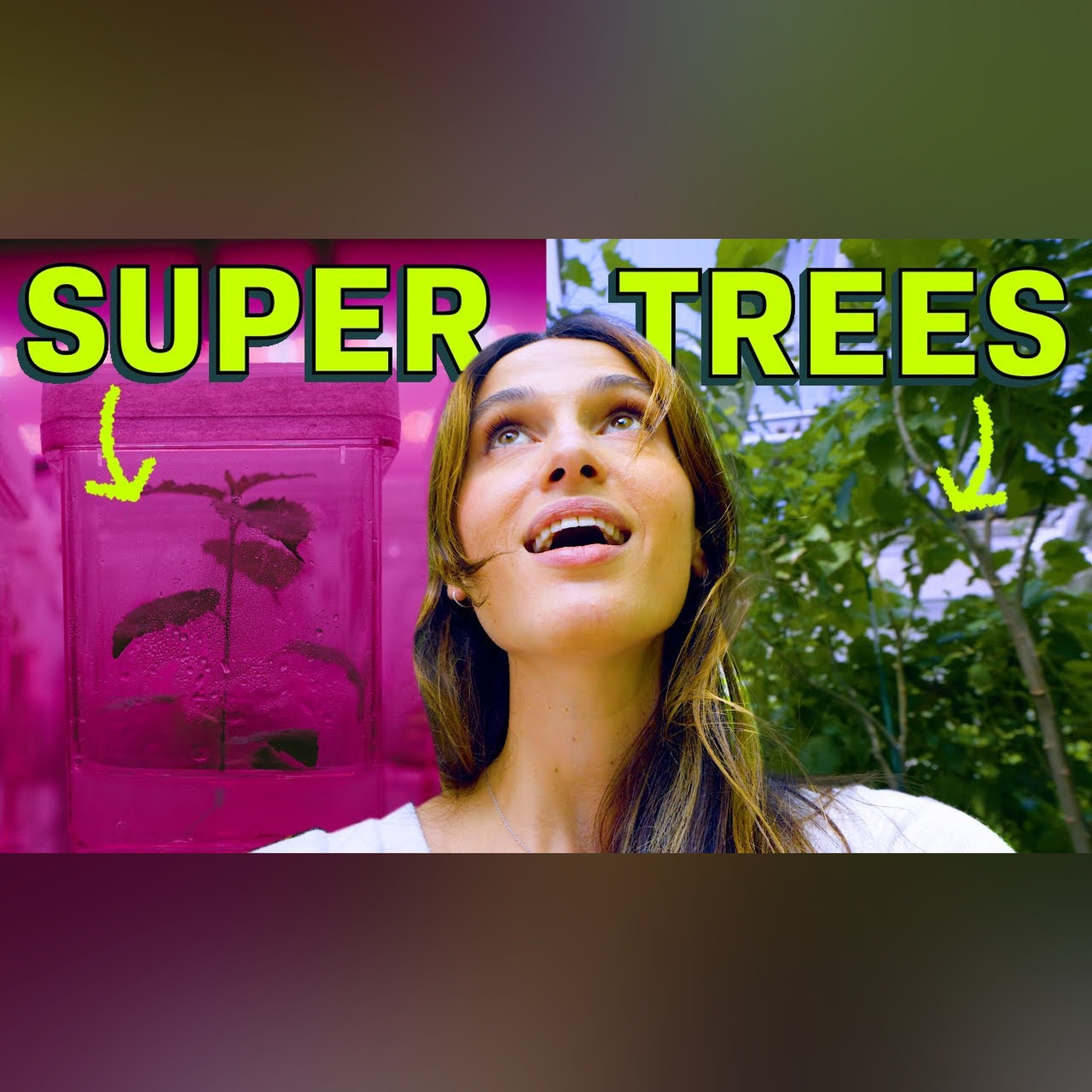
These trees have been genetically modified to capture more carbon. Should we use them? You may have heard that the United States Supreme Court recently weakened the power of the Environmental Protection Agency (EPA) to regulate emissions. That decision harms our ability to fight climate change. In this video, I look for hope in a new research effort - but it's important that new science be paired with regulation. As Mr Beast put it in this video, "we're going to need all the help we can get." Recently, I visited a greenhouse full of super trees. Over the past few decades, genetic engineering has given us the power to manipulate living things - crops, animals, even humans. At the same time, we’ve been unable to adequately slow climate change. The trees I saw are an effort to use one to help the other, led by a group of researchers at a company called Living Carbon. If it works, it could strengthen one of our best allies in this fight. Hold on though, easier said than done. In this video
Curious? Ready? Buy Our Simplified Budget System Black Friday Bundle Now! (https://budgetbesties.com/blackfriday) Budget besties, what's in your wallet? Because one little debit card could put your entire bills account at risk! In this episode, Shana and Vanessa are sharing a real-life client story that will have you checking your wallet ASAP. After a client's purse was stolen during a hometown celebration, thieves gained access to multiple bank accounts, credit cards, and even $1,200 in cash. And the worst part? Her bills account was compromised, leaving her scrambling while the bank investigated. But here's the thing, besties: This situation could have looked VERY different with just a few simple changes. We're breaking down why we always recommend keeping your bills account separate from your everyday spending accounts, why your bills debit card should stay safely at home, and how this system can protect your financial peace when life throws you a curveball. Plus, we're sharing anot
Are you on track with the Baby Steps? Get a Free Personalized Plan. (https://ter.li/zqzs8w) Have a money question? Ask Ramsey is here to help. (https://ter.li/vpd8ego2) George Kamel and Jade Warshaw answer your questions and discuss: “I am afraid that my creditors will garnish my inheritance check before I have a chance to negotiate” “My mortgage is 55% of my income, should I sell?” “I co-signed on a car loan with my sister and she is behind on her payments. Should I take over the loan and rent it to her?” “Should I switch careers if I keep getting fired from my jobs?” “Should I cash out my 401(k) to pay for a new window?” Next Steps: Have a question for the show? Call 888-825-5225 weekdays from 2–5 p.m. ET New to the show and want to learn more? Check out our 7 Baby Steps! (https://ter.li/1sn8b18j) Start your free budget today. Download the EveryDollar app! (https://ramsey.solutions/8tj2bn) Get your biggest Medicare questions answered. Watch the free webinar now! (https://ter.li/4o3g9
Professor Clare Collins speaks with Melbourne dietitian and gut-health researcher Sarah Melton about diet stacking, which is the phenomena of combining multiple dietary strategies at the same time, often without a clear plan. Diet stacking can severely limit food choice,, increase stress and reduce the number of foods a person feels confident to eat. They discuss how 'stacked diets' risk not being nutritional adequate, how restrictions can affect nutrition, health and wellbeing, and why diagnosis and professional guidance are important - before removing foods from your usual intake. Key Topics Diet stacking is an increasing phenomenon that clinicians are seeing Gut conditions can include identifiable diseases, like coeliac disease and inflammatory bowel disease, and disorders of gut-brain interaction, like irritable bowel syndrome. The more diets that are stacked, the more food groups excluded and the greater the risk for poor nutrition, health and wellbeing Some diet combinations may
"Its been 7 years since I turned 18, I got rich, ripped, and traveled the world just looking to pass on the wisdom." Jack Hopkins Let Pod Agency™️ turn your YouTube videos into revenuegenerating audio episodes just like this podcast. Click here or Visit podagency.carrd.co to double how much revenue each piece of your content generates before we reach full capacity. Follow the podcast & turn on notis Join the 10k Accelerator Course --------------------------------- ------- Keywords: high value men, men's psychology, men's mental health, inner strength, men's self improvement, men's confidence, reclaim masculinity, millionaire mindset
Your mobile phone, computer and game console have a bloody past — tied to tantalum mining, which funds the war in the Democratic Republic of the Congo. Drawing on his personal story, activist and refugee Bandi Mbubi gives a stirring call to action. (Filmed at TEDxExeter.) Uploaded 29-08-13 Talk by Bandi Mbubi.
Explore the depths of Lake Cadagno, a meromictic lake that is considered a model for Earth before the Great Oxidation Event. -- In the millions of years since oxygen began saturating Earth’s oceans and atmosphere, most organisms have evolved to rely on this gas. However, there are some places where oxygen-averse microorganisms like those from Earth’s earliest days have re-emerged. And one such place is hidden high in the Swiss Alp’s Piora Valley. Nicola Storelli and Daniele Zanzi dive into the depths of Lake Cadagno. Lesson by Nicola Storelli and Daniele Zanzi, directed by Ivana Volda, Thomas Johnson Volda. A special thanks to Francesco Di Nezio, Bruno Giussani, Raffaele Peduzzi, Sandro Peduzzi, Samuele Roman, and Mauro Tonolla who provided information and insights for the development of this video. Support Our Non-Profit Mission ---------------------------------------------- Support us on Patreon: http://bit.ly/TEDEdPatreon Check out our merch: http://bit.ly/TEDEDShop ----------------
View full lesson: http://ed.ted.com/lessons/particles-and-waves-the-central-mystery-of-quantum-mechanics-chad-orzel Uploaded 15-09-14 One of the most amazing facts in physics is that everything in the universe, from light to electrons to atoms, behaves like both a particle and a wave at the same time. But how did physicists arrive at this mind-boggling conclusion? Chad Orzel recounts the string of scientists who built on each other’s discoveries to arrive at this ‘central mystery’ of quantum mechanics. Lesson by Chad Orzel, animation by Joana Bartolomeu.
Public-health protections can justify some limits on individual choice.
Share your view, then see how readers voted. No sign-in required. This poll is shared across stories.
Do you agree or disagree?
Common Quandary
A Common Quandary to discuss
Another conversation to explore, separate from this news story.
Your father is becoming a dangerous driver. Would you report him behind his back?
Your father values the independence his car gives him. He has not caused an accident, but his reactions have noticeably slowed and several recent drives frightened you. He refuses an assessment.